Kingdom of Amarenicea
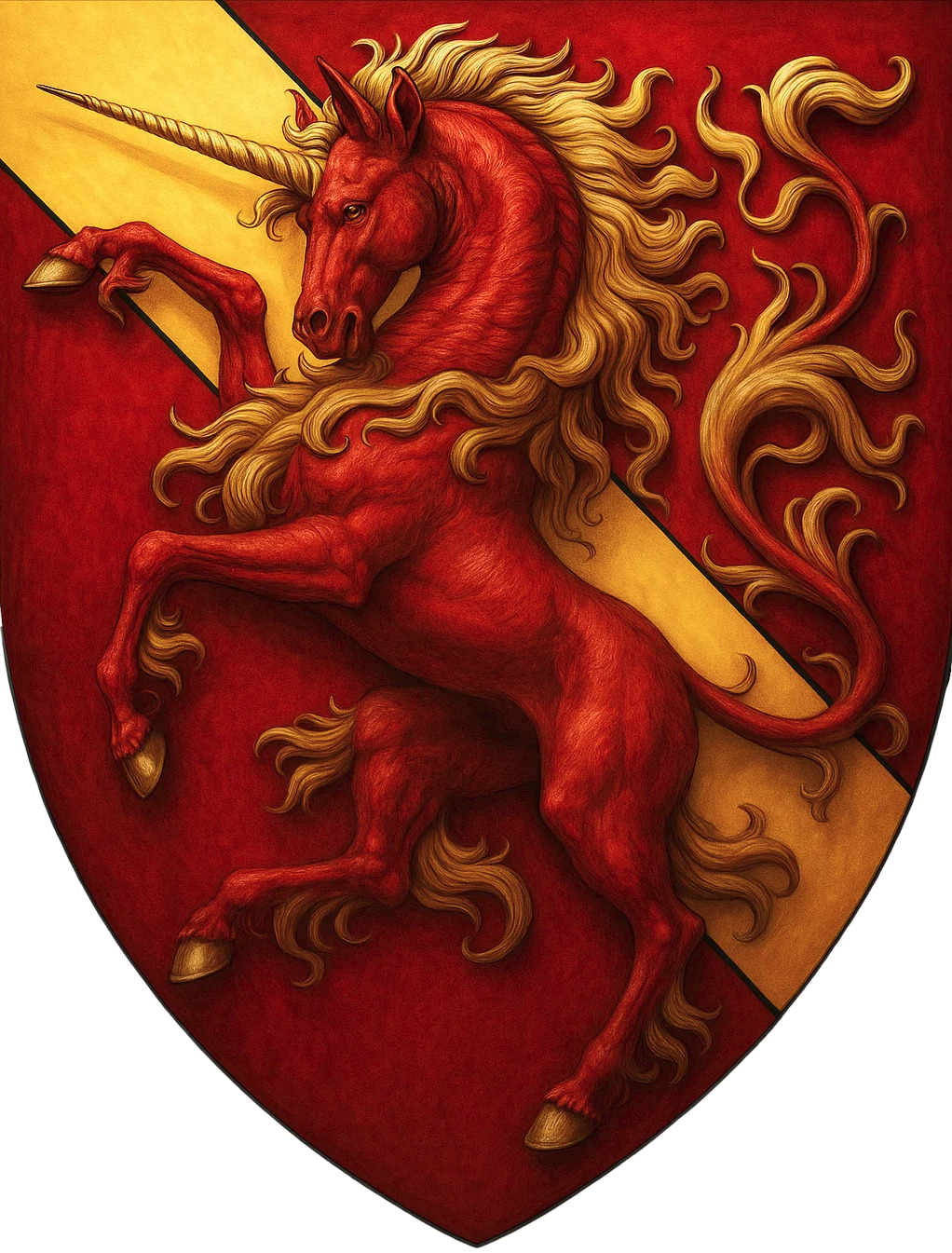
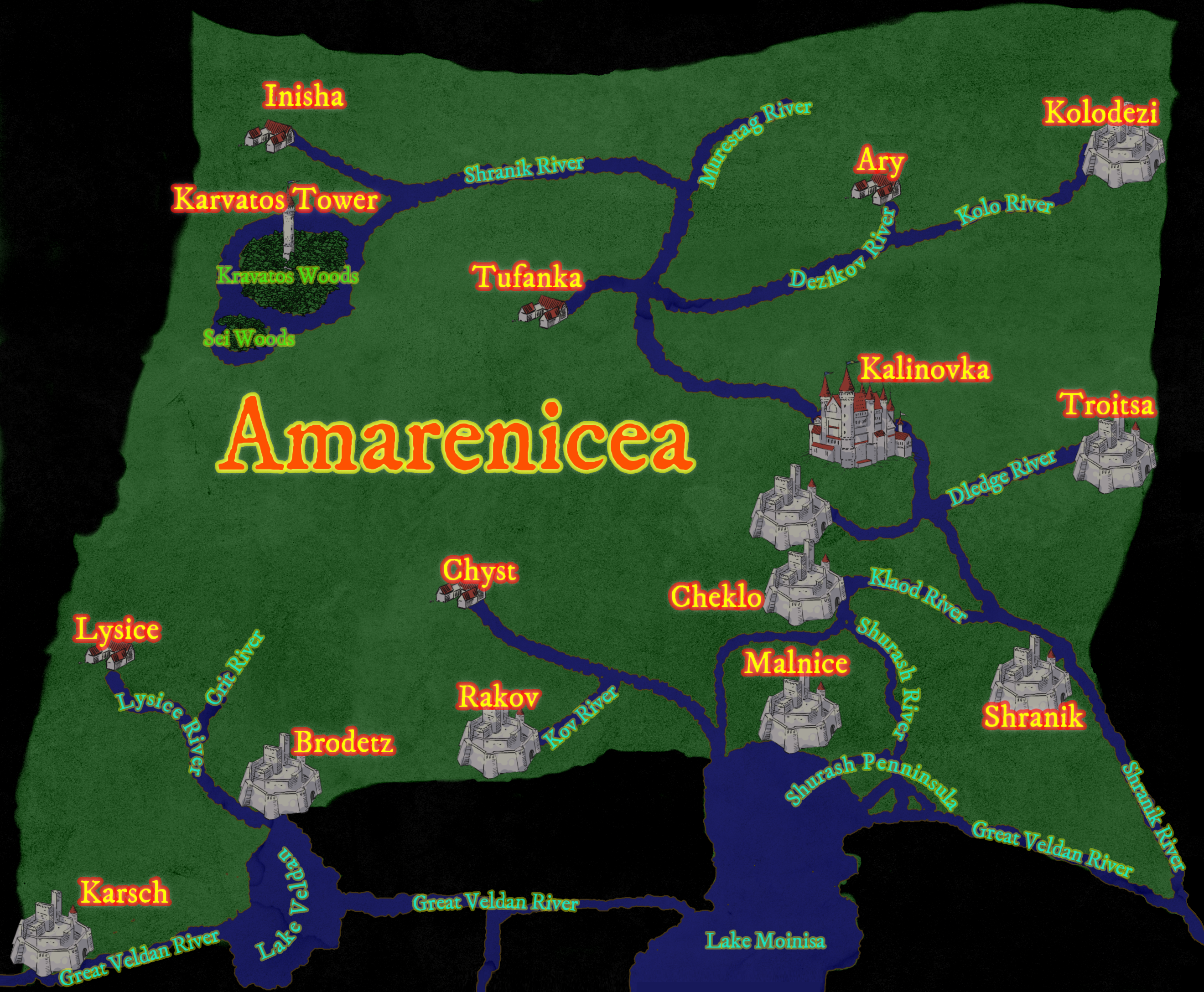
Amarenicea is a proud river kingdom carved among the low highlands and broad moorlands that stretch between Rhyanne to the east and Khelerha to the south, with Kolvydaer sharing its southern lakefront. It is not a realm of deep harbors nor sweeping coasts, but one of winding waterways, the mighty Veldan and its far-reaching tributaries, that carry lifeblood and lore alike. These waters thread through mist-draped fens, whispering reeds, and stony hill-barrows where cairns of forgotten kings still stand watch.
The land is open and undulating, marked by heathered moors, ancient ferry-stones, and weathered watchtowers once raised to keep both traders and raiders in check. Its heart is a vast inland confluence, a meeting place where the Veldan braids into a web of rivers that bind its cities like beads upon a necklace. Each current bears not just goods and travelers, but memories of centuries, of vassalage under foreign crowns, of rebellions fought upon frozen banks, and of slow, patient reclamation of sovereignty.
Here, wealth flows not from open seas but from the rhythm of the rivers: barges heavy with peat and grain, rafts of timber, ferries carrying pilgrims and magistrates, and candle-lit processions drifting downstream on holy nights. The moorwinds carry the scent of wet stone and wild mint, and the waterways reflect a thousand years of struggle, resilience, and the quiet pride of a people who measure their fortunes not by the tide, but by the depth of their rivers.
People of Amarenicea
The kingdom is peopled by the riverfolk, a proud and contemplative people whose lives are inseparable from the waterways that cradle their history. Known for their courtesy, keen memory, and measured strength, they are neither quick to wrath nor swift to trust, yet once their loyalty is earned, it is as enduring as the stones that line their riverbanks. Songs are sung not only of battles but of floods endured, bridges raised, and oaths sworn upon drifting barges beneath the moonlight.
Amarenicean nobility descends from the ancient river clans whose banners have flown since before the Harakan conquest, their lineages recorded in watermarked scrolls and etched upon the stone piers of long-forgotten ports. These houses are stewards of trade, law, and lore, and though they command respect, their influence flows less through tyranny than through ancient pact and precedent. Among the common folk, life gathers in reed-thatched villages and stilted towns, where every generation knows its place upon the river's tapestry and every crossing is marked by a tale.
Knights of the realm are held as much for their counsel as their swordplay, serving as judges, lorekeepers, and arbiters in disputes that ripple through the river valleys. Their vows bind them not only to protect their lords but to preserve the memory of their people, reciting genealogies, restoring broken shrines, and carrying relics of the flood-years when the river rose in wrath.
Faith runs deep, and so too does pilgrimage. The Amareniceans follow an elder branch of the Church of Light and Dark, tempered by the river's dual nature, at once giver of life and harbinger of loss. Pilgrims travel along the Veldan and Shranik, leaving offerings at waystones, casting wreaths into the current for safe passage, or setting afloat the lantern-barges that carry prayers for the dead. Ferries often bear both the living and the departed, for in Amarenicea, the boundary between voyage and vigil is as thin as mist upon the dawn water.
The Veldan and Shranik rivers are more than trade routes, they are the kingdom's veins and its memory. Shrines cling to their cliffs, their bells ringing with the tide; old stones whisper of ancient pacts; and every bend, sandbar, and reed-choked ford is known by name, story, and song. To be of Amarenicea is to know the river's moods: its quiet betrayals in drought, its fierce rejoicing in thaw, and its endless, patient shaping of the land.
Faith of the Rivers
Faith in Amarenicea flows as the rivers do, ever-moving, shaping the land and the lives of its people. At its heart lies the reverence of the Twin Currents: the Light of the Dawnbreak and the Dark of the Duskflow, believed to represent the eternal cycle of growth and ebb. The faithful teach that neither can exist without the other, for the rivers are both giver and taker, nourishing fields and homes while carving valleys and claiming what is lost.
The Sanctum of the Laurel in Kalinovka serves as the spiritual seat of the realm, housing the ancient scrolls of river law, chronicles of the High Crowns, and the legendary Crown of Nine Reeds, a relic said to have been woven by Queen Ilyava herself at the founding of the kingdom. Its high priests, known as the Reedwardens, oversee rites of passage: the birth blessing of flowing water, the River Oath of maturity, and the Last Crossing for the departed.
Festivals are vibrant and deeply tied to the waterways. The Festival of the First Melt marks the breaking of winter ice with candle-lit regattas that stretch for miles along the Kalin, while the Night of Thousand Reeds sees the people cast glowing reed-lanterns upon the waters to carry their wishes and prayers to the river spirits. Reed-blessing ceremonies, boat parades, and offerings cast into the current remain common across the realm, ensuring the rivers stay pure and plentiful.
Defenses and the Sky Lancers
Amarenicea maintains a modest standing army but excels through layered fortifications and a swift, disciplined levy system. The heart of its military pride lies with the Sky Lancers (Veyrnari), an elite corps of winged heavy cavalry mounted upon giant river kites and bred-for-war griffins. Their distinctive raptor-feathered arcs, long, curved lances tipped with barbed steel, are designed to deliver devastating plunging strikes during river crossings and marshland battles where ordinary cavalry falters.
Each Sky Lancer commands a personal retinue of squire-riders, falconers, and river scouts, forming a mobile strike unit capable of rapid redeployment along the kingdom's arterial waterways. In times of war, the High Crown calls the Banners of the Nine Reeds, regional musters that merge levies, city militias, and river bargemen into a single war host, converging at fortified border keeps and strategic fords.
The eastern marches are anchored by Kolodezi and Troitsa, towering bastions that guard the misted passes of Rhyanne. To the south, Rakov stands as both fortress and royal court, a stone sentinel braced between Khelerha's frontier and the restless plains of Kolvydaer. Along the Grand Serpent River, the cities of Tret'ya, Cheklo, and Malnice form a triad of defense and commerce, their river walls equipped with sluice-gates and chained harbors to choke invading fleets.
Amarenicea's defensive doctrine favors mobility and layered resistance over sheer numbers. Watchtowers strung along the great rivers carry mirrored beacons to relay alarms within moments, while reed-born palisades and hidden marsh causeways allow local militias to delay and harass invading forces until the Sky Lancers strike from above.
A History of Bonds and Breaking
Once a flourishing province of the ancient Elven realms of Kael, Amarenicea was renowned for its waterway sanctuaries, reed-woven cities, and the mystical stewardship of its river druids. When Kael fractured under the weight of civil strife and distant wars, the kingdom found itself swept into the rising tide of Rhyanne, its sovereignty traded for the promise of stability and trade. For centuries, it prospered in a gilded cage, its wealth flowing outward along the river roads.
Nine centuries of quiet occupation by Harak followed, marked by gradual erosion of local rites and the slow silencing of the Laurel Spire, once the council seat of the Riverlords. The native nobility endured as vassals, their power chained by tribute and treaty, until resentment and drought fanned the coals of rebellion into flame. In the Year of Fractures, High Crown Iselda of House Loryvain seized the moment: uniting river clans, reedfolk, and dispossessed nobles beneath her banner.
The River War was a campaign of cunning and tide-born maneuvering, fought upon the marshes and fords that only the Amarenese knew well. The Battle of Nasic Fork became its turning point, where Harak's ironclads were shattered upon hidden shoals and their marshward legions drowned in a midnight flood unleashed by the druids of the Green Current.
When the last Haraki standard sank beneath the reeds, the Crown of Nine Reeds was restored to the brow of the High Crown, and the Council of Riverlords gathered once more in Kalinovka beneath the newly consecrated Laurel Spire. With its rites reclaimed, its rivers unbound, and its trade flowing again by Amarenese hands, the kingdom rose as both rival and reed-kin, a proud neighbor to Khelerha, a wary sentinel beside Rhyanne, and a sovereign keeper of the waters that shaped its destiny.
Population Summary:
- Total Population: Approximately 2,000,000
- Humans: 85% (1,700,000): The dominant group, primarily riverfolk living along the Veldan and Shranik. Known for courtesy, measured strength, and loyalty to ancestral oaths. Human populations also include urban merchants, artisans, and nobility from ancient river clans.
- Half-Elves: 3% (60,000): Concentrated along the eastern frontier near Rhyanne, often serving as diplomats, scholars, and river navigators. They blend Elven traditions with human river culture, maintaining unique arts, rites, and language patterns.
- Gnomes: 2% (40,000): Primarily found in Kalinovka and major river cities, working as inventors, artisans, siege engineers, and rivercraft specialists. They are highly integrated into urban guilds and workshops.
- Halflings: 1% (20,000): Rural dwellers and fisherfolk in smaller villages and floodplain communities. Known for nimble hands, expertise in boatwork, and local storytelling traditions.
- Minorities and Other Groups: 9% (180,000): Itinerant fisher clans, marsh-dwellers, traveling merchants, and occasional foreign traders. These communities are mobile along rivers and lakes, preserving unique dialects, rituals, and crafts.
Geography and Settlements
Amarenicea is a kingdom of rivers, fens, lakes, and moorlands, its landscape a tapestry of misty fens, rolling hills, and fertile river valleys. The capital, Kalinovka, rises at a strategic bend in the Shranik, where massive stone keeps overlook bustling river harbors and winding cobbled streets. The city is both the political heart and spiritual center of the kingdom, hosting the High Crown, the Great Moot, and the Sanctum of the Laurel.
Along the rivers, cities like Tret'ya, Cheklo, Malnice, and Shranik serve as trading hubs and cultural centers, their noble houses bound by ancient oaths to the Crown. Malnice also overlooks one of the great freshwater lakes fed by Lake Veldren and Lake Moinisa, supporting fishing fleets and ritual regattas. Lake cities such as Zbrodetz are renowned for their ceremonial barge orders, river festivals, and the harmonious blend of civic pride and spiritual devotion.
Eastern bastions Kolodezi and Troitsa guard the passes into Rhyanne, their walls high and gates formidable, reflecting centuries of vigilance against both invasion and influence. To the south, Rakov stands where Amarenicea meets Khelerha and Kolvydaer, a fortress-city and court for border diplomacy. Smaller towns, Lysice, Inisha, Ary, Tufanka, and Chyst, preserve ancient tribal heritage, serving as centers of agriculture, folklore, and local governance, each ringed by palisades or stone walls that have stood for generations.
Together, the cities and towns of Amarenicea form a network bound by waterways, law, and lineage. Trade, culture, and defense flow along the rivers as naturally as the water itself, shaping a kingdom that is resilient, observant, and profoundly tied to the land and its currents.
Cities and Towns of Amarenicea
Amarenicea's settlements range from bustling river capitals to quiet agricultural towns. Each holds strategic, cultural, or spiritual significance along the kingdom's rivers and lakes.
- Capital City: Kalinovka: Fortress on a high bluff; council hall, High Crown Citadel, and gnome workshops for siege engines and rivercraft.
- Kolodezi: Eastern border city guarding the passes into Rhyanne; heavily fortified bastion.
- Troitsa: Twin bastion to Kolodezi; monitors trade and diplomacy with Rhyanne.
- Rakov: Southern fortress at the nexus of Khelerha, Kolvydaer, and Amarenicea; fortress, court, and diplomatic hub.
- Tretya: Northern fortified bridge and river port; key for trade and toll collection.
- Cheklo: Drill-ground city with barracks, archery ranges, and river flotilla docks.
- Malnice: Granary city amid floodplains; overlooks a freshwater lake; hosts seasonal harvest festivals.
- Shranik: Strategic river confluence; tolls collected, caravans regulated.
- Brodetz: Bastion on a river fork; famous for ritual regattas and barge orders.
- Karsch: Lighthouse city controlling river navigation and nearby lake access.
- Inisha: Agricultural heartland; preserves folk traditions and riverine festivals.
- Ary: Small trade and farming town; known for its historic palisades.
- Tufanka: Marshland town; specializes in river fowling, reeds, and crafts.
- Lysice: Ancient village; center for agricultural oversight and local lore.
- Chyst: Timber town with strong ties to the High Crown; retains older tribal customs.
- Karvatos Tower: A mysterious tower on an isolated river island. Visitors are mysteriously prevented from reaching the island. Its purpose, origin, and history remain unknown, and it is a source of local legend and superstition.