Kingdom of Beordmarr
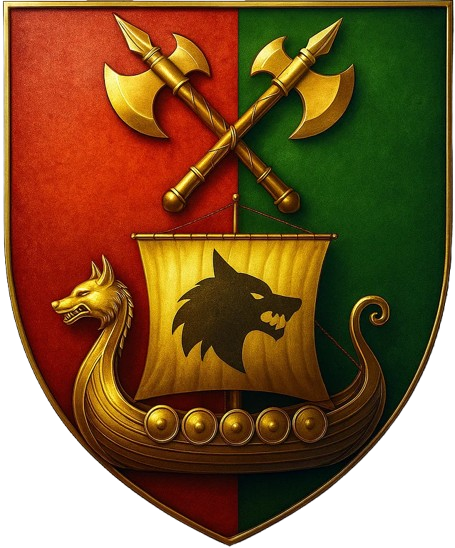
Beordmarr is a land carved from ice and myth, a kingdom of snowbound wilderness and ancient oaths where the wind itself seems to whisper the names of long-dead heroes. It is the homeland of the Wolfen, a race of towering, canine humanoids whose culture is steeped in honor, blood, and the sacred worship of Fenris, the Great Wolf. To understand Beordmarr is to understand the Wolfen, for the land and its people are bound as tightly as fang to bone.
The geography of Beordmarr is as unforgiving as its warriors. Jagged fjords bite into the sea like the teeth of Fenris himself, while vast forests stand silent beneath the shimmering aurora. Mountains rise like the bones of the world, black and cold, and the tundra stretches endlessly, a frozen canvas upon which the Wolfen carve their legacy. Winters are long and merciless, with the sun lingering only as a pale ember on the horizon. Summers arrive suddenly and fiercely, offering a brief reprieve, a season of life in which the land must yield enough to sustain its people through the next cycle of frost and shadow.
The Wolfen are not mere beasts, nor are they mindless monsters as many outsiders claim. They are a proud and civilized people, organized into twelve great tribes, each with its own customs, strengths, and sacred territories. Their society is built upon the pack, led by a chieftain known as a Bloodfang, chosen not by birthright but by strength, cunning, and the favor of Fenris. Beneath the Bloodfang, elders serve as keepers of memory and law, while warriors and hunters shape the daily rhythm of life. Every Wolfen bears the record of their deeds upon their flesh, scars from ritual duels and tattoos inked with runes that bind their lineage to their ancestors. These marks are read like scripture, recited by Skalds who weave them into sagas sung around winter fires.
Honor, loyalty, and vengeance are the sacred cornerstones of Wolfen culture. To betray one's oath is the gravest sin, punished by exile into the Ice Barrens, where even the strongest rarely survive. To keep an oath, no matter the cost, is to live in Fenris' gaze. Death is no less sacred than life. To fall in battle with one's oath unbroken is the greatest honor, for it is said that Fenris devours cowards but carries the brave into his eternal hunt across the skies. Warriors who dishonor their blood are denied funeral howls, their names struck from the sagas, condemned to silence. But those who die with honor are set upon pyres beneath the moon, their ashes scattered to the wind so their spirit may run with the Great Wolf forever.
At the heart of Wolfen belief lies Fenris, the Great Wolf, devourer of weakness and sanctifier of strength through trial. He is not a gentle god, but a protector and judge, teaching that strength comes only through bloodshed and survival. Other primal spirits, the White Stag, the Winter Raven, and the Ashen Bear, are honored as companions of Fenris, but all oaths are ultimately sworn upon his name. The prophecy of the Final Hunt looms over all Wolfen life. It is said that Fenris was bound beneath glacier and mountain long ago, held fast by sacred runes, yet destined to rise when the final great winter descends. In that ultimate battle, he will break his chains, swallow the sun, and bring the Final Hunt upon all creation. Every storm, every raid, every battle is interpreted as a rehearsal for Fenris' coming, a test of courage, loyalty, and strength.
Beordmarr's history is written in blood and frost. In the First Age, Fenris walked the world, his tread splitting the earth and his howl birthing the first oaths. From his blood and the endless snow arose the Wolfen, children of fang and frost. Later came the Winter of Broken Spears, when the southern empire of Harak sought to conquer the north. Its legions vanished into the snows, swallowed by ambushes and storms. The Wolfen remember this age as a time when Fenris stalked beside them, and from it came the oath that defines Beordmarr even now: to yield is to betray Fenris.
The deepest wound between Beordmarr and its southern neighbor, Celdaea, was carved in the Age of the Clans, when Celdaean settlers crossed the Frostpath in search of land and timber. Their axes bit into the Bone-Grove, a sacred forest where the Wolfen laid their dead to rest. The settlers burned the grove, scattering the ashes of ancestors into the wind and mocking Fenris. From that night was sworn the Oath of the Burning Grove, an eternal vow of blood-feud against Celdaea. Every raid upon their shores, every winter war launched across the Frostpath, is kindled by that oath. No child of Beordmarr grows to adulthood without hearing the tale, and no Wolfen has ever forgotten it.
Now, a new shadow creeps across the tundra. From the frozen wastes of the far north descend the Iceborn, undead orc warbands raised in necromancy and bound to the endless hunger of winter's heart. Their bodies are cold as stone, their eyes lit with frostfire, and where they march the land itself grows brittle and barren. They raid Wolfen halls and Celdaean villages alike, carrying off both prey and souls to feed their frozen gods. In this trial, ancient enemies find themselves cornered together. Some Wolfen packs have fought side by side with Celdaean warriors, their howls and war-cries clashing against the frozen drums of the Iceborn. Yet every alliance is a blade held by the edge; trust is brittle, and centuries of blood-feud cannot be washed away in a single winter.
The Wolfen are not alone in Beordmarr. They share it with other canine races, Coyles, Kankorians, Flinds, and Gnolls, each with their own strengths and flaws. Coyles are chaotic and cruel, often mistaken for Wolfen by outsiders due to their similar appearance. They raid and terrorize, and their actions have fueled the myths of Wolfen savagery. Kankorians, by contrast, are noble forest dwellers, revered by the Wolfen as seers and scouts. Flinds and Gnolls are brutal and selfish, favoring domination and carnage. The Wolfen have tried to unite these races, with limited success. Coyles remain a volatile ally, and the Flinds and Gnolls are too steeped in bloodlust to be trusted. Yet the dream of a unified canine host under Wolfen command remains, a force that could reshape the world.
Despite their martial prowess, the Wolfen are not mindless barbarians. They build cities, forge alliances, and govern with justice. Their empire grows not through destruction, but through reconstruction. Conquered peoples are protected, their cities rebuilt, their faiths respected, so long as they do not threaten Wolfen rule. This fair-play is unprecedented even in human society, and it has earned the Wolfen both admiration and fear. Yet prejudice remains. In many lands, Wolfen are hated and hunted, forced to disguise themselves or live as outcasts. Tales of baby-eating monsters persist, despite their falsehood. The Wolfen endure this hatred with stoic pride, knowing that their honor is written not in the words of others, but in the oaths they keep.
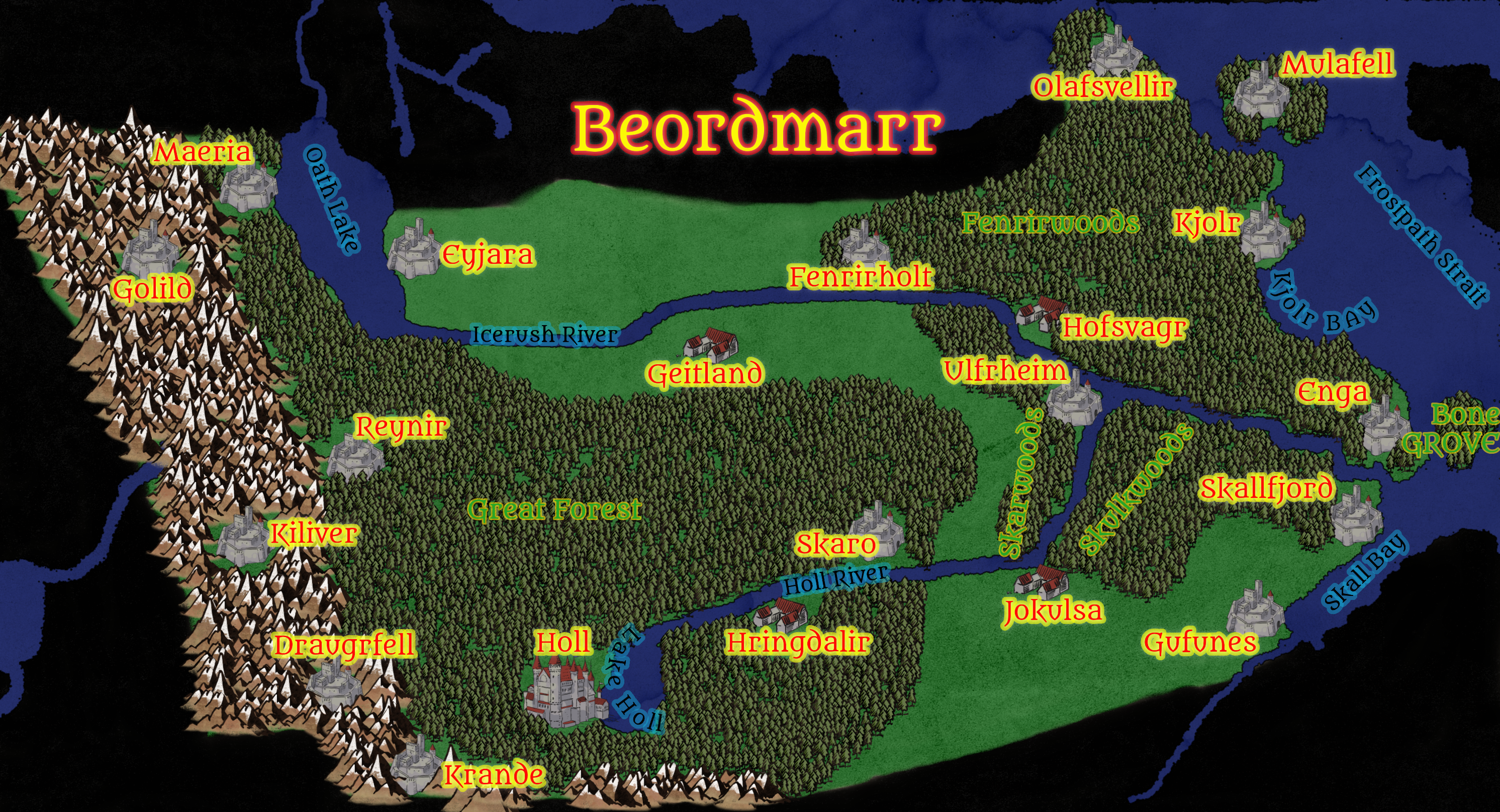
Beordmarr itself is a kingdom of cities and strongholds, each with its own role in the tapestry of Wolfen civilization. Holl, the capital, stands as the administrative heart. Fenrirholt guards the sacred resting place of Fenris. Ulfrheim serves as the central gathering-place for markets and seasonal assemblies. Olafsvellir is the birthplace of the longship tradition, while Draugrfell is famed for its legendary wolf packs and raiding traditions. From the shipwrights of Skallfjord to the seers of Mulafell, every settlement contributes to the strength and spirit of Beordmarr.
In the end, Beordmarr is more than a kingdom. It is a crucible of trial and triumph, a land where every storm is a hymn to Fenris, and every warrior a verse in the saga of survival. It is a place where honor is carved into stone, where oaths are stronger than steel, and where the howl of the Wolfen echoes across the tundra, calling all who hear it to stand, to fight, and to endure.
History of Beordmarr
The history of Beordmarr is a saga etched in frost and fire, a tale of survival, conquest, and unyielding honor that spans the ages. It begins in the First Age, when the world was young and the skies were still being named. According to Wolfen myth, it was during this primordial era that Fenris, the Great Wolf, walked the land. Vast as mountains and fierce as the storm, Fenris howled into the void and shattered its silence. From his blood mingled with snow, the first Wolfen were born, creatures of fang and frost, bound by sacred oaths and destined to endure.
This mythic beginning is not merely a story to the Wolfen; it is the foundation of their law and identity. The Law of the Fang, which governs all aspects of Wolfen life, was said to be carved into the bones of the world by Fenris himself. It teaches that strength sanctifies, weakness devours, and no oath may be broken without shame beyond death. The stars, they say, are Fenris' eyes, watching his children from the heavens, guiding them through the long winters and endless trials.
As the Wolfen multiplied and spread across the tundra, they formed thirteen tribes, each fiercely independent and often at war with one another. These early centuries were marked by bloodshed and rivalry, with alliances shifting like snowdrifts in the wind. The tribes fought over hunting grounds, sacred sites, and ancient grievances. It was a time of chaos, and though the Wolfen were strong, they were divided, unable to rise beyond the limitations of their tribal feuds.
Then came the Killer Winter, a season of famine, plague, and death that nearly extinguished the Wolfen race. During this time, the southern kingdom of Celdaea, long a rival to the Wolfen, offered aid. One of its noble houses opened its stores to feed the starving Wolfen, and for a brief moment, peace seemed possible. But generosity was twisted into suspicion, and rumors spread that Celdaea sought to use the famine to conquer Beordmarr from within. Eight Wolfen tribes, driven by fear and desperation, turned on those who had accepted Celdaean aid. In a massacre that defied even the brutal norms of Wolfen warfare, entire clans were slaughtered, warriors, elders, children, and allies alike.
The horror of this act led to a reckoning. The surviving tribes, ashamed and broken, came together to forge a new path. They created the Constitution of the Twelve Tribes, a sacred pact that united the Wolfen under a single banner. The thirteenth tribe was lost, but from its ashes rose a Kingdom. The Wolfen, once scattered and savage, became organized, disciplined, and just. They built cities, codified laws, and established a council to govern their people. This was the birth of the Wolfen Kingdom of Beordmarr.
The rise of Beordmarr did not go unnoticed. In the south, the Empire of Harak sought to expand its dominion. Its warlords marched into the tundra, confident that they could break the wolves and chain the fangs. But Beordmarr did not bend. The Wolfen fought with honor and fury, and the snows swallowed every army that dared to invade. This era became known as the Winter of Broken Spears, a time when Fenris was said to walk beside his children once more. The bones of Harak's legions were left to freeze beneath the aurora, and the Wolfen carved into stone the oath that no outsider would ever rule their land.
Yet the greatest wound in Beordmarr's history came not from Harak, but from Celdaea itself. During the Age of the Clans, Celdaean settlers crossed the Frostpath in search of land. Their axes bit into the Bone-Grove, a sacred forest where the Wolfen laid their dead to rest. The settlers burned the grove, scattering the ashes of ancestors and mocking Fenris. The howl that rose from Beordmarr that night shook the mountains. From that moment, the Oath of the Burning Grove was sworn, an eternal vow of vengeance against Celdaea. Every raid, every winter war, is kindled by that oath, and no Wolfen has ever forgotten it.
In more recent times, Beordmarr faces a new threat. From the frozen wastes of the far north descend the Iceborn, necromantic orc warbands raised and bound to the hunger of winter's heart. They raid Wolfen halls and Celdaean villages alike, carrying off prey and souls to feed their frozen gods. In this trial, ancient enemies have found themselves fighting side by side. Some Wolfen packs have allied with Celdaean warriors, their howls and war-cries clashing against the drums of the Iceborn. Yet trust is brittle, and centuries of blood-feud cannot be washed away in a single winter.
Among the Skalds of Beordmarr, whispers spread that the Iceborn are no mere foe, but a divine test. Fenris, they say, has loosed them upon the world to weigh the strength of his children. If the Wolfen endure and break the frostbound horde, they will prove themselves worthy of the Great Wolf's blood. But if they falter, the Iceborn will devour their oaths, their ancestors, and their name itself, until nothing of Beordmarr remains but silence beneath the snow.
Thus, the history of Beordmarr is a saga of transformation, from tribal chaos to imperial unity, from mythic origins to modern trials. It is a land where every storm is a hymn to Fenris, every battle a verse in the saga of survival. Beordmarr endures, not because it is easy, but because its people are forged in hardship, bound by honor, and driven by the eternal howl of the Great Wolf.
Religion
The religion of Beordmarr is not merely a system of belief, it is the marrow of the Wolfen soul, the fire in their blood, and the howl that echoes through every storm. It is a living, breathing force that shapes their laws, their wars, their rites, and their very understanding of existence. At its heart stands Fenris, the Great Wolf, a deity of primal power and sacred judgment, whose presence looms over every aspect of Wolfen life.
Fenris is not a god of mercy or comfort. He is the devourer of weakness, the sanctifier of strength, and the guardian of ancestral law. His worship is not conducted in soft whispers or gentle hymns, but in the clash of steel, the endurance of hardship, and the keeping of oaths. To the Wolfen, Fenris is both creator and judge, a divine force who forged their race from blood and snow and who watches them still from the stars above. His gaze is said to be felt in every storm, his breath in every winter wind, and his voice in the howl of the pack.
The central tenet of Fenris' faith is the Law of the Fang, a sacred code that teaches strength through trial, honor through loyalty, and damnation through betrayal. To break an oath is to fall from Fenris' favor, and such a fall is worse than death. Those who die with their oaths unbroken are said to be carried by Fenris into the Eternal Hunt, a celestial realm where the brave run forever beneath the aurora, hunting the spirits of the wicked and the weak. Those who die in shame are devoured, their names erased from memory, their souls lost to silence.
Though Fenris is supreme, he is not alone. The Wolfen also honor a pantheon of primal spirits, each seen as a companion or extension of Fenris' will. The White Stag represents purity and sacrifice, often invoked in rites of passage and healing. The Winter Raven is the messenger of omens and death, its appearance considered a sign of divine judgment or impending change. The Ashen Bear is the guardian of hearth and kin, worshipped in times of war and mourning. These spirits are revered, but all oaths, all sacrifices, and all rites are ultimately sworn in Fenris' name.
Religious practice in Beordmarr is deeply woven into daily life. Every hunt begins with a prayer to Fenris, every duel is sanctified by his name, and every child is marked with a rune of protection upon birth. Temples are rare and often simple, stone circles in the forest, shrines carved into mountain cliffs, or sacred groves where the bones of ancestors rest beneath totems of fang and claw. The most sacred site is Fenrirholt, a forested shrine said to guard the first resting place of Fenris himself. Pilgrims travel from across Beordmarr to leave offerings and seek visions beneath its ancient trees.
The spiritual leaders of the Wolfen are known as Skalds and Seers. Skalds are not only poets and historians but also priests, weaving the deeds of the living into the sagas of the dead, ensuring that the honored are remembered and the dishonored are forgotten. Seers, often found in remote places like Mulafell, are mystics who interpret omens, dream Fenris' visions, and guide the tribes in times of uncertainty. Their words carry great weight, and their prophecies are treated as divine truth.
Central to Wolfen eschatology is the Prophecy of the Final Hunt. It is foretold that Fenris, bound beneath glacier and mountain by ancient runes, will one day break his chains when the final great winter descends. He will rise, swallow the sun, and bring the Final Hunt upon all creation. In this ultimate battle, he will face the All-Father and be slain only by the vengeance of his foes, reshaping the world in fire, frost, and blood. The Wolfen believe that every storm, every war, and every hardship is a rehearsal for this cosmic reckoning. Only those who uphold their oaths and live with honor will stand beside Fenris when the bonds are broken.
Even in mundane life, the shadow of the Final Hunt guides every choice. The Wolfen read omens in the moonlight, the howl of the wind, and the patterns of snow. The cycles of the seasons are seen as Fenris' breath, testing his children and honing their resilience. To live in Beordmarr is to live in preparation, for battle, for judgment, and for the day when the Great Wolf returns to devour the world and remake it in the image of strength and truth.
In this way, the religion of Beordmarr is not a distant theology but a living force. It is the howl in the night, the oath carved into bone, and the fire that drives the Wolfen to endure. It is a faith of fang and frost, of blood and honor, and of the eternal promise that those who live true will never be forgotten.
Population Breakdown
The Wolfen of Beordmarr are not a single race but a diverse people descended from many canid lineages. Their society reflects the primal instincts and strengths of their varied forms.
Population Breakdown Total: 2,000,000
- Wolfen: 60%: Approximately 1,200,000 individuals. This includes all tribal variations of Wolfen, from the towering Dire Wolfen to the more agile Grey Wolfen. They form the core of the Empire's military, leadership, and cultural identity.
- Coyles: 15%: Roughly 300,000. Though once considered chaotic and ungovernable, many Coyles have begun integrating into Wolfen society, serving as scouts, mercenaries, and auxiliary forces.
- Kankorians: 10%: Around 200,000. These forest-dwelling mystics and rangers are few in number but highly respected for their wisdom, spiritual insight, and combat prowess in natural terrain.
- Gnolls: 10%: Approximately 200,000. Savage and opportunistic, Gnolls operate on the fringes of the Empire, often used as shock troops or raiders in times of war.
- Flinds: 5%: About 100,000. Dominant and cruel, Flinds are tolerated within the Empire for their martial strength but remain largely autonomous and feared.
The Twelve Clans of Beordmarr are the living pillars of the Kingdom, each one a lineage of warriors, mystics, and craftsmen who embody a distinct philosophy of war and survival. Though united under the banner of Fenris, each clan maintains its own traditions, fighting styles, and sacred rites, passed down through generations like heirlooms of blood and bone.
- The Redfang Clan are the berserkers and vanguard warriors of Beordmarr. Before battle, they engage in ritual bloodletting, dyeing their furs crimson to honor the pact of pain and strength. They fight with raw aggression and spiritual fervor, believing that suffering awakens the gaze of the wolf-god. Their war-cries are primal, their charge unstoppable.
- The Frostmaw Clan are the silent hunters of the north. Masters of ambush and camouflage, they move like ghosts across the snow, striking without sound and vanishing before the echo fades. Their presence is often seen as an omen, death in silence, judgment without warning.
- The Moonhowl Clan are mystics and priests, the spiritual heart of the Empire. They serve as seers, lorekeepers, and shrine guardians, maintaining the sacred sites of the Aisir and interpreting the signs of Fenris. Many High Warlords and Fangpriests hail from this revered bloodline, their wisdom shaping the course of the Empire.
- The Ironpelt Clan are the immovable wall, the heavy infantry of Beordmarr. Clad in thick armor and wielding tower shields, they are siege defenders and city wardens. Their discipline is unmatched, and their tactics are forged in the crucible of endurance. When they hold the line, it does not break.
- The Stormclaw Clan are cavalry masters and beast tamers. Riding dire wolves and thunderbeasts, they strike swiftly across open terrain, their bond with their mounts considered sacred. Their warbands are fast, ferocious, and thunderous, often arriving before the enemy even knows they've been challenged.
- The Ashhide Clan are fire-walkers and forge-priests. They train in volcanic caves and hot springs, crafting enchanted weapons and armor for the honored and the fallen. Their warriors are tempered by flame, their spirits hardened by heat. To them, fire is both a tool and a teacher.
- The Whitebone Clan are bone-shapers and rune-carvers, artisans of ancestral remains. They fashion armor, totems, and fetishes from the bones of the dead, believing that what dies teaches. Their necrolore is deep and feared, and their warriors often carry the wisdom, and wrath, of generations.
- The Hollowtooth Clan are assassins and infiltrators. Silent and swift, they serve as scouts, saboteurs, and interrogators. Their presence is rarely announced, but always felt. They speak little, act quickly, and leave no trace but the absence of their target.
- The Emberhide Clan are duelists and arena champions. Combat is a rite of passage, a spiritual offering to Fenris. They resolve feuds through public challenges, their ceremonial armor glowing with runes that burn with pride and purpose. Their blades are as sharp as their honor.
- The Shatterhowl Clan are siege engineers and shock troops. Experts in the destruction of fortifications, they wield siege claws, sonic horns, and hammers blessed by Bjarr, the god of ruin. Their name is spoken in fear by those who hide behind walls, for they bring the storm that breaks stone.
- The Grimfang Clan are the judges and oath-keepers of Beordmarr. Guardians of law and tradition, they oversee moonbound trials and deliver punishments with unwavering resolve. Their reputation for incorruptibility makes them feared more than loved, but their word is iron.
- The Skyfang Clan are highland warriors and aerial sentries. Though they cannot fly, they are climbers and leapers of incredible skill, taming falcons and sky-beasts to patrol the mountain passes. They serve as messengers, scouts, and guardians of the high places, where the wind speaks in riddles.
Cities & Settlements of Beordmarr
- Holl, Capital of Beordmarr: The administrative center located on the southern river, surrounded by forest and river trade routes.
- Golild: A mountain settlement in the west, known for timber, furs, and hardy miners.
- Kiliver: Western mountains stronghold with rich stone quarries and iron mines.
- Maerin: Forested lakeside town with skilled boatbuilders and abundant fishing.
- Krande: Mountain mining village extracting stone and metal from surrounding cliffs.
- Reynir: Northern edge fortress in forested highlands, preparing for seasonal hunts and border defense.
- Hringdalir: A forested settlement with circular stone halls used for gatherings and rituals.
- Skaro: Forested river town serving as a hub for riverine trade and coastal raiding fleets.
- Geitland: Rolling northern plains with hardy livestock herding and traditional crafts.
- Eyjara: Plains outpost on the Eastern coast of Lake Maein, known for watchtowers and coastal defense.
- Hofsvagr: Sacred forested site with priestly training halls and ceremonial grounds.
- Jokulsa: Plains settlement known for its skilled hunters, trackers and hardy villagers.
- Gufunes: Coastal city, Known for it's ship builders.
- Enga: Forest town known for its brutal raiders
- Kjolr: Forested fortress on the coast, renowned for watchtowers.
- Olafsvellir: Birthplace of the longship raiding tradition, famed for naval prowess.
- Mulafell: A sacred isle of visions, home to Wolf-Seers who chant Fenris' dreams.
- Fenrirholt: Northern forest shrine said to guard the first resting place of Fenris, spiritual heart of Beordmarr.
- Draugrfell: Western mountain fortress with legendary wolf packs and raiding traditions.
- Skallfjord: Eastern coastal port, famed for shipwrights and launching raiding longships.
- Ulfrheim: Central gathering-place of the Wolfen, with markets, oath-stones, and seasonal assemblies.
Relations with Celdaea
To this day, the kingdoms of Celdaea and Beordmarr remain ensnared in a bitter and enduring cycle of vengeance. The Celdaeans, steeped in their own divine traditions, regard the Wolfen as savage beasts, creatures cursed by the gods and driven by bloodlust. To the Wolfen, however, the Celdaeans are oath-breakers, defilers of sacred ground, and cowards who once bowed to the southern empire of Harak rather than stand and fight. The memory of the Bone-Grove's desecration, where Celdaean settlers burned the resting place of Wolfen ancestors, remains a wound that has never healed. The Oath of the Burning Grove, sworn in rage and sorrow, ensures that this feud will not fade with time but endure across generations.
Yet even ancient hatred can be tested by the weight of survival.
The rise of the Iceborn Orcs has cast a long and bitter shadow over Beordmarr, threatening not only the Wolfen Empire but the entire northern world. These are not mere raiders or wandering warbands, they are a force of unnatural winter, born of necromantic rites and bound to the hunger of frost itself. Their bodies are cold as stone, their eyes burn with frostfire, and wherever they march, the land withers. Crops fail, rivers freeze solid, and even the aurora dims in their presence. They do not conquer for territory or glory; they consume, corrupt, and erase.
The Iceborn descend from the far north, beyond the known tundra, from lands where even the Wolfen dare not tread. Their origin is cloaked in myth and dread. Some Skalds whisper that they are the remnants of an ancient orcish kingdom, cursed and buried beneath the ice until Fenris loosed them upon the world as a divine trial. Others claim they are the spawn of forgotten necromancers who traded their souls for eternal winter. Whatever their origin, their purpose is clear: to devour the living and extinguish the flame of civilization.
Beordmarr has borne the brunt of their assault. Strongholds have fallen, sacred groves have been defiled, and entire packs have vanished into the snow. The Iceborn do not speak, do not parley, and do not retreat. They fight with brutal precision, wielding weapons of ice and bone, and raise the dead to swell their ranks. Even the most seasoned Wolfen warriors find themselves tested beyond measure, for the Iceborn do not fear pain or death, they are already beyond both.
Faced with this existential threat, the Wolfen have been forced into a bitter and reluctant alliance with their ancient enemies: the Celdaeans. For centuries, the two peoples have clashed over land, honor, and faith. Now, they find themselves fighting side by side, not out of trust, but out of necessity. The Iceborn do not discriminate, they raid Celdaean villages as readily as Wolfen halls. Their advance threatens to swallow both kingdoms, and so, under the weight of survival, warriors from Beordmarr and Celdaea now march together.
Wolfen packs and Celdaean battalions clash against the frostbound horde, their war-cries mingling in the blizzard. Skalds and Celdaean priests share firelight, trading omens and prayers. Scouts from both lands chart the frozen passes, and healers tend wounds without regard for race or history. Yet the alliance is fragile. Every shared campfire is shadowed by old grudges. Wolfen warriors bristle at Celdaean commands, and Celdaean officers flinch at the sight of towering Wolfen soldiers. There are whispers of betrayal, of sabotage, of spies and broken oaths. The Oath of the Burning Grove has not been forgotten, and many Wolfen believe that once the Iceborn are defeated, the old war will resume. Likewise, Celdaean nobles speak of the alliance as a temporary necessity, not a path to peace.
Still, among the younger generations, there are signs of change. Wolfen and Celdaean warriors who have fought together in the snow speak of shared valor and mutual respect. Some Skalds have begun to weave new sagas, tales not of vengeance, but of unity against the dark. There are even rumors of mixed warbands forming, bound not by blood but by purpose. Whether these fragile bonds will endure beyond the Iceborn threat remains to be seen.
For now, Beordmarr stands on the edge of a blade. The Iceborn press ever southward, and the alliance with Celdaea is the only shield against annihilation. The Wolfen fight not only for their land and their people, but for their very identity. If they survive this trial, they may emerge stronger, wiser, and perhaps even changed. But if they fall, the howl of Fenris may be silenced forever, buried beneath the snow and ice of a world devoured by winter.