Delgwynthian Empire
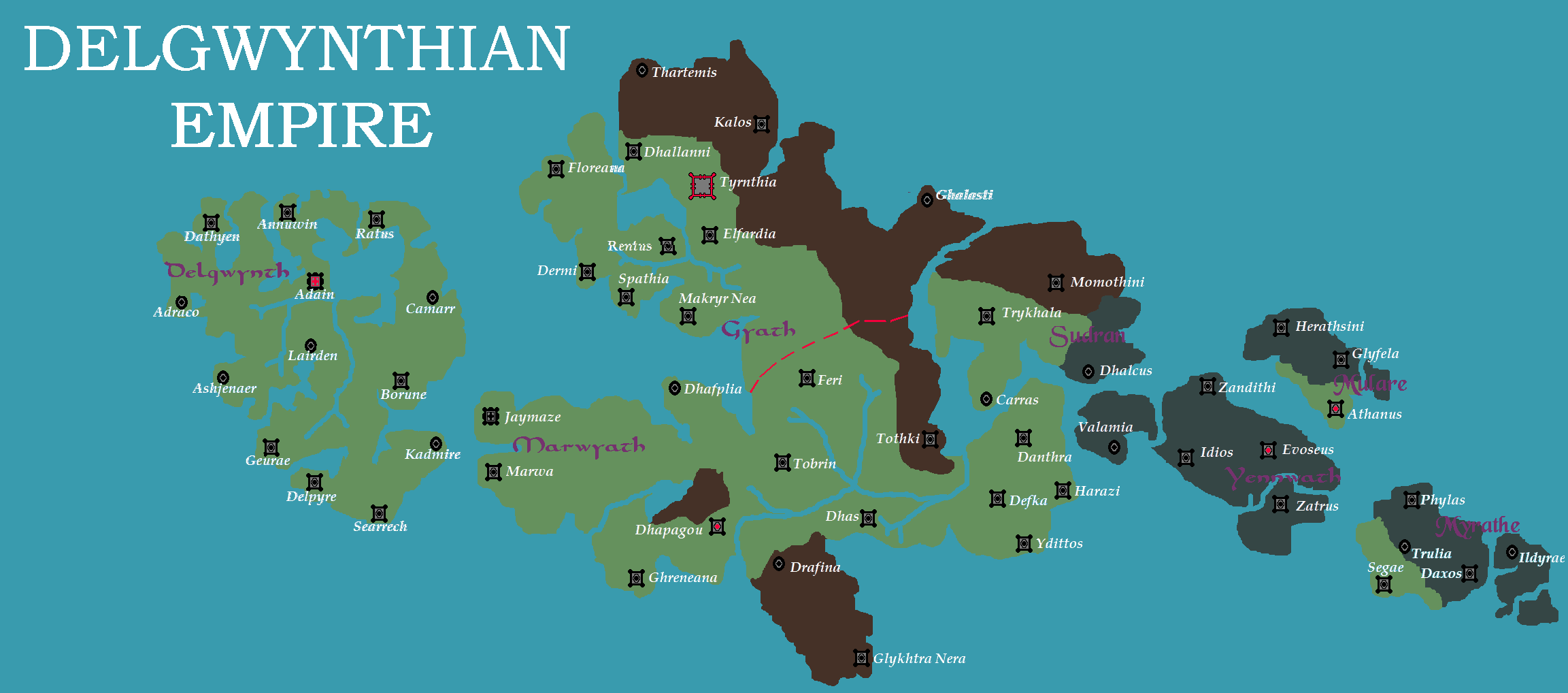
The History of the Delgwynthian Empire
Flight from Laridia
The Delgwynthian Empire was not born from the ruins of Valdossar, but from the desperation of refugees fleeing the Wars of Laridia, a distant continent torn apart by centuries of conflict, magical calamities, and collapsing kingdoms.
Thousands of humans, elves, dwarves, and other peoples escaped the bloodshed, sailing across the Ethereal Ocean in search of safety. What they found was a shattered land, Valdossar, broken by divine wrath, haunted by serpent ruins, and teeming with danger.
The survivors settled in the northwestern isles, where the terrain was fertile and the serpent presence weakest. These early settlements became the seeds of a new civilization.
The Age of Settlement
The first centuries were marked by hardship. The refugees built walled towns and fortified ports, constantly defending themselves from pirates, serpent cults, and the unpredictable tides of the shattered continent.
They called their new homeland Delgwynth, after a legendary captain who led the largest fleet to safety. Over time, Delgwynth became a beacon of order and resilience, attracting more settlers and growing into a confederation of city-states.
The settlers rejected the serpent legacy, viewing the ruins as cursed. They developed a new faith, Delgwynthian Orthodoxy, a specialized version of the worship of the Dragonwright.
The Founding of the Empire
Thalor Halkries the Just, a philosopher-warrior and devout follower of the Dragonwright, united the city-states under a single banner. He declared the formation of the Delgwynthian Empire, not as a kingdom of conquest, but as a sanctuary of civilization.
Thalor established the Imperial Code, a legal system rooted in divine principles and civic duty. He founded the High Council, composed of nobles, priests, and scholars, and crowned himself Emperor with the blessing of the High Flamebearer.
Under Thalor's rule, the empire expanded across the northwestern archipelago, building roads, temples, and academies. The serpent ruins were sealed or sanctified, and the empire began to see itself as the moral counterweight to the chaos of the continent.
The Wars of the Isles
As Delgwynth grew in power, so to did the Pirate Kingdom of Kydmarra and the two clashed. These conflicts, known as the Wars of the Isles, while barely more then a cold war, lasted for centuries and were marked with a few significant battles.
Delgwynthian legions fought to bring order to the shattered lands, while its navy battled pirates and dark cults. The empire suffered setbacks, most notably the Battle of the Burning Torches, where its fleet was devastated by Kydmarra's cunning tactics.
Despite the losses on both sides, both held their ground, fortified their borders and have remained in a state of guarded acceptance if each other.
The Age of Intrigue
In recent centuries, the empire has faced internal strife. Noble houses feud, the High Council is divided, and the clergy grows increasingly political. The rise of Prince Khellek Halkries the Red, a mindmage and diabolist with Elven blood, has shaken the empire's foundations.
Khellek's dark ascension, marked by scandal, transformation, and fratricide, has ushered in a new era of surveillance, sorcery, and reform. The empire now balances tradition with transformation, struggling to maintain unity as old powers stir beneath the waves. While the Emporer, Khellek's Father still lives, there are no other Halkries heirs and so Khellek will soon be emporer.
Modern Delgwynth
The empire is a crucible of ambition, faith, and fear. It claims to be the last hope of unity, but others see it as a gilded cage, haunted by the ghosts of Laridia and the ruins of Valdossar.
Political Structure
- Ruler: Emperor Attalos Halkries
- Heir: Khellek Halkries
- Capital: Adain
- Population: ?
- Human: 81% ()
- Dwarves: 8% ()
- Halflings: 5% ()
- Half Elves: 3% ()
- Elves: 1% ()
- Other: 2% ()
- The other races represent a mosaic of races from various corners of the world. The other races have found a welcoming home within the isles, contributing to the kingdom's diversity. This melting pot of cultures results in a vibrant exchange of traditions, culinary delights, and artistic expressions.
- Government Type:The Delgwyntian Empire is a centralized imperial monarchy, though its administration remains bound by strong feudal traditions. The Emperor rules from the radiant capital of Adain, a city of domes, marble palaces, and sprawling courts. His authority is near absolute, but in practice it must be negotiated with the High Council, a body of nobles, clergy, and scholars whose power has waxed and waned across the centuries.
- Key Institutions:
- The Imperial Throne: The throne is hereditary, passed down through the royal Halkries bloodline, though succession is rarely smooth. In the past,assassinations, civil wars, and rival claimants have made the throne both sacred and perilous. The coronation ritual involves anointing with flame from the Eternal Brazier, said to be lit from the fire of dragon gods.
- The High Council of Delgwynth: An advisory and legislative body with representatives from the great duchies, major religious orders, and scholarly colleges. Though officially subordinate to the Emperor, its decrees often shape imperial policy.
- Provincial Lords: Each region is governed by lords whose titles are largely hereditary. While they swear fealty to the Emperor, in practice they exercise broad autonomy, maintaining their own courts, militias, and tax systems.
- The Imperial Guard: An elite force of handpicked soldiers sworn to protect the Emperor and the imperial city. Their loyalty is absolute, their numbers small but formidable. They are both the shield of the throne and its executioners.
- Political Tensions:
- Gyath & Sudran: Mountainous and fiercely independent, these provinces frequently demand greater self-rule. Their warrior clans resist imperial oversight, and skirmishes along their borders are common.
- Marwyath's Merchant Guilds: Mulare's wealth comes from its vast trade fleets. Its merchant guilds regularly clash with the imperial treasury, resisting increased taxation and lobbying for special privileges.
- Mulare's Religious Leaders: The High Flamebearer and the clergy wield immense influence. Their blessing is essential to imperial legitimacy, and conflicts between throne and temple have shaped much of the empire's history.
- The Eternal Flame: All creation is the breath and fire of the Dragon. The flame symbolizes life, truth, and the will of the Dragon Gods. To extinguish it is blasphemy; to kindle it is holy.
- The Trinity of Moranthus: The Delgwyntian Church embraces the Dhelcrid Doctrine of the Trinity, teaching that the one God Moranthus exists in three hypostases:
- Bahamut, the Father He is the Ancient Flame, the austere and terrible Judge, embodiment of divine law and order. His wisdom is not tender but unyielding, a furnace where the dross of imperfection is burned away. To Bahamut is ascribed the forging of empires and the crushing of heresies. His gaze is the weight of eternity, and those who fall short of his commandments are consigned to the ash heap of history.
- Moranthis, the Son Moranthis is the Flame-Bearer, the Creator who descended into the clay of the world, clothed in flesh, and was broken upon it. Yet this breaking was his triumph: through death he rekindled creation with divine fire. To the Delgwyntians, Moranthis is not the gentle redeemer sung of in other lands but the Dragon Crucified, his wings torn, his scales blackened, who rose anew in flame to demand loyalty and sacrifice from his chosen. His incarnation is a warning as much as a promise, redemption can only be won through fire, agony, and obedience.
- Io, the Spirit The Living Flame, the Breath of Divinity, the spark that dwells within all souls. Yet this spark is no gentle warmth; it is a holy fire that consumes. To harbor Io is to feel both the blessing of illumination and the peril of immolation. The Spirit drives mortals to visions, raptures, and frenzies, often indistinguishable from madness. Priests of the Delgwyntian Church preach that to be touched by Io is to stand always upon the knife-edge of glory and ruin.
- Assimilation of Gods: Other gods are acknowledged but only as angels, saints, or fallen spirits within the greater truth of Dragonwright. Thus the pantheon remains wide, but all is subsumed beneath the supremacy of the Dragon Trinity.
- The Last Dragon: A prophecy that at the end of days, one Dragon God (Styphon) will return to breathe the fire that devours the world and ends all life.
- The Book of Dragonwright: A sprawling, contradictory scripture compiled from fragments, visions, and rituals across millennia. The Church treats it as a mystery text, with passages sung in liturgy but interpreted only by trained priests.
- The Holy Records: Ecclesiastical chronicles preserving the schisms, wars, and pilgrimages of Dragonwright. These read like both scripture and history, reinforcing the idea that holy war is inseparable from faith.
- Instructions to the Warrior: A canonical manual attributed to Zandragal, still used to train both priests and soldiers. It is seen as both a spiritual and military handbook.
- High Flamebearer (Archflame): The supreme patriarch of the Orthodox Dragonwright, seated in Marwyath, custodian of the Eternal Brazier. His blessing is essential for emperors, kings, and crusades.
- Metaflamebearers (Metropolitans): Regional patriarchs who govern whole provinces and oversee councils of priests.
- Flamebearers (Priests & Monks): Parish leaders, abbots, and monks, responsible for keeping sacred flames alight and teaching the faithful.
- Warrior-Priests & Paladins: The militant arm of the Church, blending martial training with priestly duties. They serve both as defenders of the faith and as zealots seeking to root out heresy.
- The Liturgy of the Flame: The centerpiece of worship, conducted in Old Delgwyntian, with incense, choral chants, and the lighting of sacred fires.
- The Sacrifice of Ashes: Offerings (animals, grain, or symbolic objects) burned in sacred braziers, recalling the ancient blood sacrifices of Zandragal without the human cost.
- Pilgrimage Routes: Every believer is expected to take at least one pilgrimage, often to Marwyath or the ruined temple of Kael. The Trail of the Flame is the most famous.
- Holy Icons: Images of dragon saints and gods rendered in mosaic and gilded art, believed to be windows into the divine.
- The Orthodox Dragonwright has survived countless schisms, often as bloody as any external war:
- The Zandragalian Heresy: Those who still demand human sacrifice in honor of Zandragal, condemned as blood-cults by the Church.
- The Kormathite Controversy: A centuries-old dispute over whether Kormath is a true name of the Dragon Father or a heretical corruption. Entire wars have been fought over the pronunciation of his name.
- The Twin Flames Movement: Heretics who claim there are two eternal flames (Light and Dark), echoing the Old Ones' corruption.
- Imperial Army: A core of professional, heavily armored soldiers stationed in and around Delgwynth. Known for their discipline, they form the backbone of imperial campaigns.
- Regional Militias: Raised by provincial lords, these troops vary in quality but provide the bulk of manpower in times of war.
- Imperial Navy: Headquartered in Mulare, the fleet is vital for protecting trade routes, securing the empire's islands, and projecting power overseas.
- Special Units:
- Gyathi Highlanders: Hardy mountain warriors famed for ambushes, skirmishes, and brutal axe-work.
- Sudran Cavalry: Fast-moving horsemen from the southern plains, excellent for charges and reconnaissance.
- Yenwathi Rangers: Masters of forest warfare, skilled in tracking, stealth, and archery. Their knowledge of woodland terrain is unmatched.
- Iron & Steel: The mountains of Gyath and Sudran yield rich ore deposits. Delgwynthian forges produce some of the most durable weapons and armor in the known world.
- Marble & Stonework: Quarries near Adain provide marble used in temples, palaces, and monuments across the empire.
- Grain & Olives: Fertile plains of Sudran supply the empire with grain, while coastal regions produce olives and wine for trade.
- Textiles & Tapestries: Wool from the highlands and silk from distant lands, woven into intricate tapestries, are prized exports.
- Religious Relics & Icons: Sanctified objects, mosaics, and relics blessed by the Church of Dragonwright are traded and revered beyond the empire's borders.
- Shipbuilding: With vast forests and advanced naval yards, the empire exports galleys and merchant vessels to foreign rulers and guilds.
- Spices & Exotic Herbs: Brought from eastern and southern lands, used in both cuisine and alchemy.
- Precious Gems: Imported for ornamentation of temples and regalia, as well as coinage backing.
- Horses: Sudran produces hardy stock, but finer breeds are imported from the steppes and deserts.
- Ivory & Rare Woods: Prized for carvings, furniture, and decorative inlays.
- Silks & Perfumes: Luxuries imported through Mulare's merchant fleets, reinforcing the empire's taste for refinement.
- Arcane Components: Rare minerals, crystals, and reagents sought by the empire's sorcerers and alchemists.
- Coinage Base: Silver
- Exchange Rates:
- 1 Gold Flame = 20 Silver Scales
- 1 Silver Scale = 12 Bronze Embers
- 1 Bronze Ember = 10 Copper Sparks
- Common
- Delgwyntian: The everyday tongue, with distinct regional dialects shaped by local traditions.
- Old Delgwyntian: Used in liturgy, law, and scholarly writing.
- Elven
- Mosaics & Frescoes: Palaces and temples gleam with vibrant mosaics telling stories of saints, emperors, and victories.
- Statues & Marble Work: Heroic figures and mythic beings adorn public squares.
- Domed Temples & Fortified Cities: Inspired by both faith and pragmatism, the empire's architecture combines grandeur with defense.
- Music & Performance: Lyres, flutes, and drums accompany choral chants in temples, while folk songs and traveling troupes bring entertainment to villages.
- Festival of the Flame: A grand celebration marking the founding of the empire. Processions carry sacred fire through the streets of Delgwynth.
- Harvest of Sudran: A thanksgiving for bountiful crops, marked by feasting, songs, and horse races.
- Gyath Trials: Brutal competitions where warriors prove their strength, agility, and honor before the clans and lords.
- Divine Justice: Crimes against faith, blasphemy, or heresy are judged by ecclesiastical courts, with punishments ranging from penance to burning.
- Civic Law: Theft, murder, and treason are overseen by magistrates, with trials conducted publicly to ensure imperial order is upheld.
- Morality: Faith is the axis of morality. Piety, obedience, and service to empire and flame are celebrated; hubris, sorcery outside the Church's sanction, and selfish ambition are condemned.
- Punishments: Branding, exile, forced service, or execution are common. The most severe cases, blasphemers and traitors, are cast into sacred flame.
- Allies:
- The Merchant Guilds of Mulare: Though often in tension with imperial taxation, their fleets and wealth bolster Delgwynth's economy and influence.
- Southern Tribes: Some Sudran clans ally with the empire for protection and trade, supplying cavalry and horses.
- Faithful Principalities: Minor kingdoms across the seas who embrace the Delgwynthian Orthodoxy, granting legitimacy and tribute.
- Adversaries:
- Kydmarra, the Pirate Kingdom: Eternal rival across the isles, their fleets remain a thorn in Delgwynth's naval supremacy.
- Serpent Cults: Hidden remnants of Valdossar's ancient ruin-worshippers, forever undermining the empire's faith and order.
- Independent Provinces: Gyath and Sudran often resist central authority, occasionally rebelling against imperial garrisons.
- Foreign Empires: Across the Ethereal Ocean, rival kingdoms watch the empire with envy and suspicion, sometimes funding pirates and rebels to weaken its grasp.
Population
The Delgwyntian Orthodox DragonwrightThe Delgwynthian Church proclaims that Moranthis, the Dragon God of Fire and Sovereignty, is eternal and indivisible, yet revealed in the mystery of the Trinity. This Trinity is salvation, a fire that cleanses the faithful and redeems the sinner. To deny or profane this truth is the highest blasphemy. The Dhelcrid Doctrine of the Trinity, marrow of the Delgwyntian faith, declares that Moranthis (and to misname Him as thus is an unforgivable blasphemy in the Delgwynth Faith) exists in three hypostases, not divided, not mingled, but bound in one consuming essence. This is the iron core of Delgwyntian belief, set not merely to guide, but to bind, protect, and to save the souls of sinners. This interpretation, and those espoused by the softer, gentler Dragonwright sects, is denounced as poisonous heresy, a soothing lie for weak souls by the true Orthodox Faith. The Delgwyntian understanding embraces the terrible majesty of flame in all its paradox: fire gives life, yet it destroys; light illumines, yet it blinds; order shields, yet it enslaves. To wrestle with its meaning, to kindle the flame of its mystery within the soul, is counted as sanctification itself. Thus the faithful are taught that Moranthus is no hearth-fire of comfort, but a wildfire to which one must surrender utterly, lest resistance leave only ash. Those who sin unrepentant, who scorn the Trinity and resist its consuming flame, are condemned to the torments of Styphon's Fires, the endless furnace where body, soul, and memory are burned without ceasing, and yet never consumed. There the blasphemer becomes kindling for eternity, a warning to the faithful and a hymn of judgment to the Flame Eternal. Core Doctrine Sacred Texts Hierarchy and Clergy Rituals and Worship Schisms and Heresies Role in the Empire: The Church of Orthodox Dragonwright is not merely spiritual, it is political, imperial, and martial. Emperors cannot ascend the throne without the Archflame's anointing. Councils of clergy and nobles dictate matters of law, war, and taxation. The Imperial Guard carries relics of Dragonwright into battle, making every campaign a holy war. Merchant guilds, warrior clans, and nobles alike seek legitimacy by sponsoring pilgrimages, temples, or crusades. Dragonwright is not just religion, it is empire itself, sanctified and eternal. MilitaryStructure: Exports, Industry and Resources:Imports:Standard Exchange RatesGold Flames are reserved for major trade, land, or military contracts; Silver Scales are the standard coin of commerce; Bronze Embers circulate in markets and villages, while Copper Sparks are used for daily necessities. CultureLanguage: Art & Architecture: Festivals: Legal System and Morality:The Delgwynthian Empire's laws are codified in the Imperial Code of Thalor, a fusion of civic duty and divine principle. The Code is administered by magistrates but sanctified by the clergy, ensuring that law is never divorced from faith. Allies and Adversaries:
|
||||||||||||||