The Dominion of Arangoth
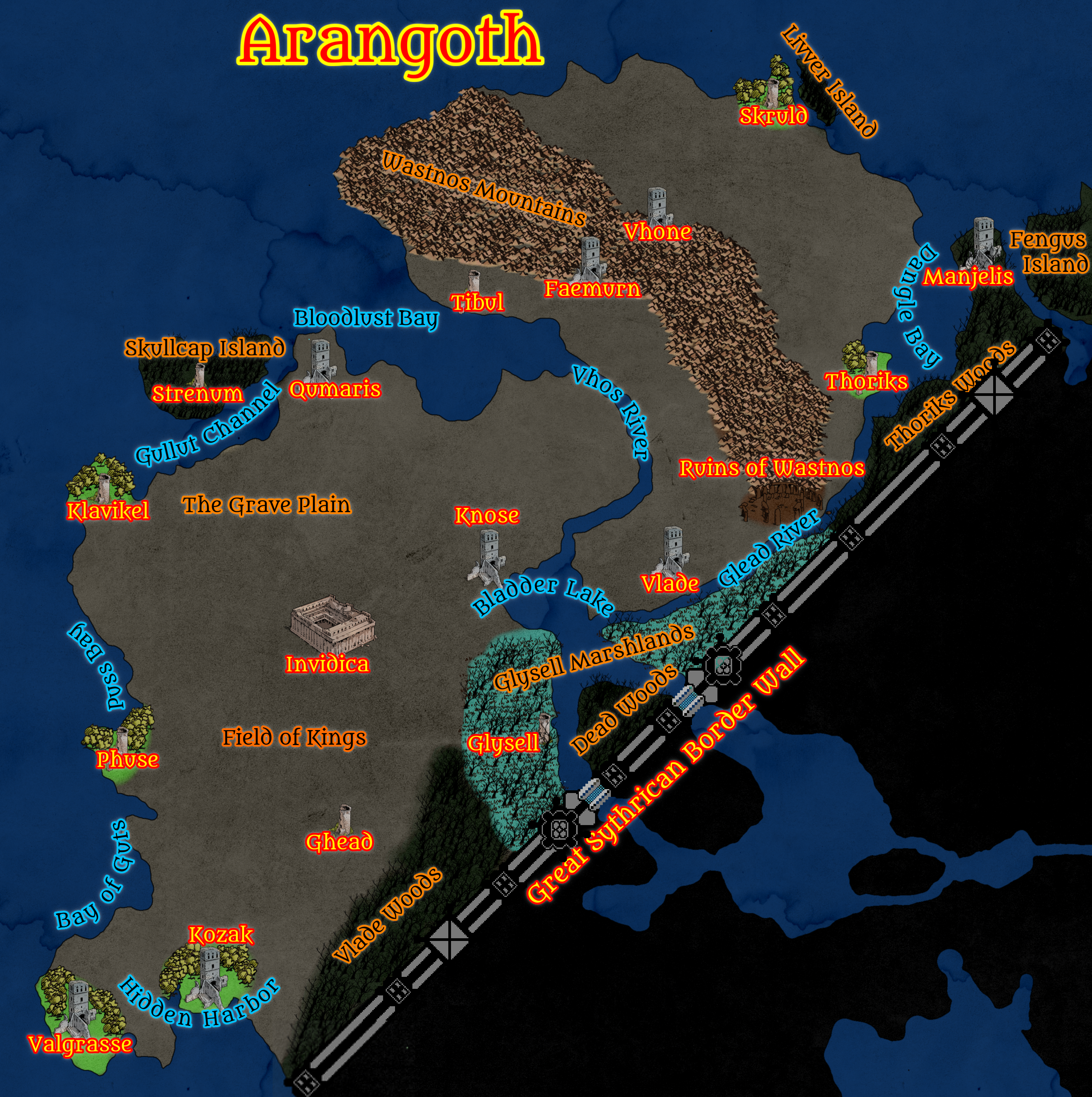
GeographyThe Dominion of Arangoth lies beyond the Great Sythrycan Barrier Wall, stretching across a bleak expanse of desolation and ruin. Once the northern jewel of Sythryca's frontier, this land has become a monument to entropy and the slow death of nature. Beneath its ashen skies, the very earth seems to mourn, cracked plains whispering with dry winds, rivers choked with soot and blood, and mountains that bleed faint green light from veins of corrupted crystal. The air is heavy and stagnant, thick with necrotic miasma that clings to the lungs of the living and sustains the endless legions of the dead. Once-verdant valleys now lie barren, their soil blackened by centuries of dark magic. The rivers Vhos and Glead, which once nourished Sythrycan settlements, now run black and viscous, carrying the residue of countless rituals performed along their haunted banks. Foul vapors rise from these waters, creating eternal fogs that blanket the countryside. The sun, when visible at all, burns dim and cold through a veil of necrotic clouds, its light distorted into shades of gray and pale violet. Even time feels warped here, as though the realm itself exists halfway between life and death. The terrain of Arangoth is divided into several distinct but equally cursed regions. In the far south lie the Marshlands of Glysell, a labyrinth of bogs and corpse-filled waters where the living dare not tread. The skeletal trees that grow there are black as iron, their roots feeding on the flesh of the drowned. Nearer to the Great Barrier Wall rise the Dead Forests of Vlade and Thoriks, vast, petrified woodlands where even the wind seems afraid to stir. The trees stand motionless and gray, their bark like stone, and their hollows filled with whispering shades. Further north, the land climbs toward the Highlands of Faemurn and the Ruins of Wastnos, a region steeped in the purest necromantic corruption. Here, the ground glows faintly in the night, radiating ghostly heat that never warms. The shattered ruins of Wastnos are said to mark the epicenter of the Arch-lich's ascension, where the living world was torn apart to give birth to Arangoth's undying dominion. The highlands themselves are cut through by rifts and fissures that descend into the underworld, and travelers report hearing voices rising from below, murmuring in forgotten tongues. To the west, near Klavikel and Qumaris, the terrain becomes a graveplain, rolling hills blanketed in ancient barrows and crumbling tombs. Monolithic stones jut from the ground like broken teeth, inscribed with runes of warding that have long since failed. This region is known as the Field of Kings, where the fallen nobles of Sythryca's lost legions still rest uneasily, their tombs disturbed by necromancers seeking to bolster their armies. It is said that on moonless nights, the ghosts of the slain gather here to wage eternal war against the rising dead. At the heart of it all stands Invidica, the capital of Arangoth and the locus of its corruption. Rising from a plain of volcanic glass, the city is a grotesque fusion of bone, obsidian, and enchanted metal. Its spires pierce the clouds, and rivers of spectral fire flow through streets paved with the remains of the fallen. From Invidica's black citadel, the Arch-lich Var'Morthul commands his dominion, the city's pulsing necrotic heart radiating power across the land. The necrotic storms that sweep outward from this blighted metropolis are said to feed the unlife of every creature in Arangoth, binding the realm itself into a single, undead organism. Few living beings have crossed the Great Barrier Wall and returned to tell of what lies beyond. Those who have speak of lands where the boundaries between the material and spiritual worlds have eroded entirely. Shadows move with purpose, echoes carry voices not their own, and the earth itself groans beneath the weight of ancient, restless souls. Arangoth is not merely a kingdom, it is a corpse that refuses to decay, its every heartbeat a defiance of the natural order. HistoryThe origins of Arangoth are deeply intertwined with the ancient kingdom of Sythryca. Nearly two thousand years ago, the lands that now form Arangoth were wild yet thriving frontiers, inhabited by hardy Valkir clans, frontier lords, and independent settlements that dotted the northern marches. These lands were known for their dense, dark forests, jagged mountains, and icy rivers, a harsh yet beautiful expanse where warriors honed their skills, and communities forged strong bonds of loyalty and honor. All of this changed with the emergence of the Arch-lich, a sorcerer of unparalleled power who transcended mortality through the darkest of necromantic arts. Legends tell that the Arch-lich was once a brilliant mage of Sythryca who, in seeking eternal knowledge and dominion, embraced forbidden rites and bound his soul to undeath. His transformation unleashed a cataclysm unlike any the realm had ever seen. The Battle of Frostpeak, fought on the frozen ridges of the northern mountains, became the turning point: Valkir armies and Sythrycan knights fought valiantly, but they were ultimately overwhelmed by the legions of the undead, who swept across the frontier like a tide of shadow. From that moment, the northern lands were lost, severed from the light of Sythrycan rule and plunged into an age of death and decay. In the centuries that followed, the realm of Arangoth festered under the Arch-lich's dominion. Necropolises rose from the ashes of once-prosperous towns, mausoleums and obsidian towers punctuating the bleak landscape. Lich-lords and their undead lieutenants extended their influence across the barren wastes, commanding vast armies of restless dead. Whispered rumors tell of vast underground cities, lit by eerie phosphorescence, where the Arch-lich and his council of necromancers plot the slow expansion of their dominion, and of cursed forests where no living creature dares tread. Meanwhile, Sythryca has struggled to contain the relentless threat. The Great Sythrycan Barrier Wall, a colossal fortification stretching across the northern border, was raised to stem the tide of the undead. Constructed of enchanted stone and reinforced with permanent wards against necromantic power, the wall remains a testament to Sythrycan ingenuity and resilience. Yet despite its strength, the shadow of Arangoth persists: rumors of undead scouts slipping through the dark, whispered cries from beyond the wall, and the constant threat of a renewed invasion keep the kingdom on perpetual alert. To this day, the lands of Arangoth remain a realm of death and corruption, a dark mirror of Sythryca's former northern frontiers, where the legacies of ancient heroes clash endlessly with the schemes of the immortal dead. CultureIn Arangoth, the concept of "culture" is a shadow of what it once was, a hollow echo of the life that once thrived in these northern lands. Here, the undead are not merely rulers, they are the very fabric of society. Liches, vampires, and deathknights govern with unyielding authority, while legions of mindless thralls, skeletons, and revenants enforce their will. Among the few living, survival often demands servitude or complicity: necromantic apprentices, zealots, and cultists cling to existence by mastering the forbidden arts or pledging loyalty to the immortal elite. Invidica, the heart of Arangoth, is the pinnacle of this grim order. The city is a vast labyrinth of obsidian towers, frost-covered spires, and blackened streets where silence is broken only by the tolling of death-bells, the scrape of bone on stone, and the low chanting of acolytes in the shadowed temples. Here, the ordinary notions of art, music, and beauty are inverted and corrupted: murals depict the triumph of entropy, orchestras play dirges that echo through tomb-lined avenues, and statues are carved to immortalize decay itself. In Arangoth, rot and stillness are sacred; the natural process of decay is celebrated as a divine truth. Gardens of skeletal flora, crypts adorned with the bones of ancient warriors, and fountains of blackened water serve as expressions of devotion. Festivals, if they can be called that, are solemn commemorations of death and dissolution, where lich-lords parade their power and the living and dead alike honor the eternal void. Humor, warmth, and compassion are all but forgotten, replaced by reverence for permanence, mastery over mortality, and the slow, inexorable spread of death's dominion. Even knowledge and scholarship are warped to fit this dark paradigm. Libraries are filled with forbidden tomes, grimoires of necromancy, and chronicles of lost civilizations, all maintained not for enlightenment, but for control, subjugation, and the accumulation of power beyond the mortal span. In Arangoth, culture is not a celebration of life; it is a testament to the triumph of undeath and the enduring influence of the eternal, unyielding night. EconomyArangoth possesses no true economy in the mortal sense. The realm's production revolves entirely around the needs of the undead and their necromantic overlords. Factories of bone and blood, vast crypts, necropolises, and shadowed workshops, produce reagents for spells of undeath, artifacts to control the dead, and constructs that serve the Arch-lich and his lieutenants. Corpses are meticulously harvested, preserved, and repurposed, while souls are collected and siphoned from the lands beyond the Great Sythrycan Barrier Wall. Though the living have no place in Arangoth's natural order, their few remaining enclaves serve as indispensable tools of industry, their labor extracted through coercion or dark enchantment. Trade with the outside world is nearly nonexistent, yet rumors persist of secret channels operated by necromancers and shadowy intermediaries. Through these hidden networks, forbidden materials, rare metals, enchanted crystals, and ancient relics, find their way into Arangoth, while the twisted creations of its necrotic forges sometimes leak into distant kingdoms, carried by spies, mercenaries, or cursed caravans. These exchanges are dangerous, highly clandestine, and heavily bound by the threat of death or undeath for any who dare to betray the Arch-lich's will. The few remaining human settlements, such as Glysell and Ghead, function as grim industrial hubs. Workshops churn endlessly, forging weapons, armor, siege engines, and arcane conduits designed to empower the undead legions. Prisoners captured in border raids, those foolish enough to defy necromantic patrols, and hapless slaves from frontier villages all serve as both labor and raw material, feeding the relentless cycle of death and reanimation. Entire districts of these cities are labyrinthine graveyards, where necromancers oversee production while undead enforcers patrol for insubordination. Wealth in Arangoth is measured not in coin, but in power: the number of obedient thralls, the potency of one's magical wards, and the accumulation of knowledge from forbidden tomes. The Arch-lich's dominion thrives on this economy of control, ensuring that every aspect of the realm, its land, its living, and its dead, serves the expansion and perpetuation of undeath. In Arangoth, productivity is inseparable from oppression, and the line between resource and victim is indistinguishable. Government and SocietyArangoth is ruled by a rigid, unyielding hierarchy, with the Arch-lich of Invidica at its apex. As the undying sovereign, his will is absolute, and his edicts shape every corner of the realm. Legends tell that even other powerful necromancers dare not question him, for the Arch-lich's gaze alone can unmake life or command the dead to crush dissent. His word is law, and the realm itself seems to pulse with his dark presence. Beneath the Arch-lich serve the Necrotarchs, fearsome lich-lords each governing one of Arangoth's provinces. From fortress-cities such as Faemurn, Vlade, and Valgrasse, the Necrotarchs enforce his dominion, overseeing vast armies of undead and maintaining strict control over the few living who survive in their territories. Each Necrotarch cultivates their province as both a center of necrotic industry and a monument to the Arch-lich's eternal rule. The living in Arangoth exist only to serve and maintain the machinery of undeath. Society is divided into castes of servitude, from acolytes who study dark rites, to necroscribes who record forbidden knowledge, corpse-menders who maintain the dead, and thralls who perform the menial labor necessary to keep necropolises functioning. Mobility within this structure is nonexistent; loyalty and obedience are the only currency, and even these are tested constantly by the ruthless whims of their undead masters. There are no laws of mercy, justice, or fairness. Weakness is punished by death, disobedience by unending servitude, and any hint of rebellion is eradicated with terrifying finality. Even in death, the living have no respite: those who fall are often raised anew, bound eternally to the will of the Arch-lich. Fear, silence, and the constant awareness of mortality, or its cruel suspension, define the social order. In Arangoth, power is both the measure and the law, and the Arch-lich's dominion is eternal; no blade, no fire, and no hope can breach the darkness that lies at the heart of the realm. Though grim and oppressive, the society of Arangoth is paradoxically stable. The living, undead, and necromancers all serve a single purpose: the perpetuation of undeath. Loyalty is enforced by magic, fear, and the promise of survival, while rebellion is crushed before it can take root. In this realm, the very concept of freedom has been redefined: life is a resource, death a tool, and obedience the highest virtue. MilitaryThe military might of Arangoth is both terrifying and inexhaustible, a force born of necromantic mastery and centuries of unbroken war. Its legions are composed of the undead in every form: skeletal warriors armed with rusted yet unbreakable weapons, revenants fueled by vengeance, armored death knights mounted on nightmarish steeds, and spectral hosts that wail across the battlefield. Each Necrotarch commands their own host, summoned and bound from the remnants of ancient battles, animated through dark rituals that require precision, power, and the continuous harvesting of souls. Among the living, the elite Black Cohorts serve as the Arch-lich's mortal enforcers. These disciplined warriors and necromantic engineers operate as scouts, summoners, siege operators, and tacticians, ensuring that Arangoth's armies move with lethal coordination. They wield spells that reinforce the dead, curse the living, or manipulate the terrain, often turning the battlefield itself into a weapon. Their loyalty is absolute, enforced by both fear and the promise of arcane knowledge and longevity. Arangoth's war machines are as horrific as they are effective. Siege engines of bone, sinew, and black iron move across the plains with terrifying purpose, while catapults hurl explosive necrotic charges that corrupt land and poison the living. Undead dragons, wraith-lords, and shadow wyverns darken the skies, raining death and despair upon all who oppose them. Entire battalions can march without respite, for the dead feel neither exhaustion nor hunger, and every fallen soldier rises anew under the black banners of the Arch-lich. Tactics in Arangoth rely on both overwhelming numbers and psychological terror. Ambushes, relentless attrition, and the sudden eruption of undead from graves and crypts make it impossible for enemies to predict the flow of battle. Magical wards, necrotic auras, and curses weaken foes before the armies even clash, while battlefield necromancers manipulate the dead in real time, reshaping formations and replacing losses instantly. The Arch-lich's forces fight not for glory or honor, but for the expansion of undeath, ensuring that every war becomes a self-perpetuating machine of death and dominion. In Arangoth, victory is assured not by valor or strategy alone, but by the inevitability of undeath itself. Armies never tire, leaders never die, and soldiers who fall rise to serve again, their memories stripped, their loyalty enforced, and their purpose singular: to extend the shadow of the Arch-lich across all living realms. ReligionThe spiritual life of Arangoth is dominated by the Church of Dark, the shadowed counterpart to the Church of Light and Dark. Its followers venerate the gods of Neter-Khertet, the realm of death, chaos, and uncreation within Ma'ip. Chief among these patrons are Set, god of Chaos and Change, whose influence inspires both cunning and destruction; Anubis, Lord of the Underworld, who oversees the passage of souls and the sanctity of death; and Apepi, the Dragon of Uncreation, symbol of entropy, annihilation, and the ultimate triumph of darkness over creation. The gods of Neter-Khertet are not benevolent; they demand obedience, cunning, and sacrifice, rewarding their followers with power, longevity, or undeath. Temples in Arangoth are not places of comfort or contemplation but towering mausoleums, labyrinthine crypts, and obsidian shrines. Worship is carried out through ritual sacrifice, reanimation, the binding of souls, and arcane ceremonies that reinforce the necrotic weave of the land. Black candles burn with ghostly flames, necrotic sigils adorn walls, and the air is thick with incense of rare herbs that preserve the dead and heighten magical potency. Festivals of the dead, if they can be called that, involve grand processions of skeletal acolytes, offerings of blood or captured spirits, and displays of power meant to honor the gods of entropy. Priests of the Church of Dark are necromancers in both vocation and spirit, their prayers drawing upon the energies of Ma'ip's shadowed half to animate the dead, curse the living, and manipulate the flow of life and death itself. Initiates are trained in both ritual and combat, mastering spells that control the mind, bind the soul, and summon legions of revenants. The ultimate spiritual goal is transcendence: to forsake mortality entirely and join the eternal ranks of undeath, becoming agents of the Arch-lich and instruments of the gods themselves. The Church of Dark permeates every aspect of Arangoth society, legitimizing the power of the Arch-lich, guiding necromantic apprentices, and ensuring that both living and dead serve in harmony with the shadowed divine order. In Arangoth, religion is not a matter of comfort or hope, it is an instrument of control, a path to immortality, and a constant reminder of the inevitability of death. The Law of ArangothThe legal system of Arangoth is absolute, merciless, and inseparable from the will of the Arch-lich. Law is codified in the Edicts of Bone, a collection of decrees carved into black obsidian tablets and stored in the central sanctum of Invidica. These edicts govern every aspect of life, or undeath, in the realm, dictating the hierarchy of the undead, the duties and limitations of necromantic practitioners, and the rights, if any, of the few living who serve within Arangoth's borders. Insubordination, failure, or defiance is punished swiftly and without mercy. The weak, the disobedient, and the rebellious are executed and immediately reanimated to serve eternally under the Necrotarchs or the Arch-lich himself. Law and terror are intertwined: obedience is reinforced not only through fear of death, but through the inevitability of returning as a thrall, a permanent reminder that mortality offers no escape from Arangoth's dominion. The Edicts of Bone also regulate the use of necromancy, ensuring the Arch-lich retains absolute control over resurrection, soulbinding, and the creation of undead. Necromancers, acolytes, and priests are carefully monitored, their experiments subject to review by higher authorities. Any attempt to subvert the edicts is treated as heresy, punishable by the forfeiture of one's soul, eternal binding to undeath, or conscription into the blackest and most dangerous military service. Law in Arangoth serves not to protect the innocent or uphold fairness, it exists to reinforce the hierarchy of power, maintain the endless cycle of undeath, and ensure the Arch-lich's dominion remains unchallenged. In this realm, justice is synonymous with control, and the Edicts of Bone are the ultimate expression of that control, etched permanently into stone as a testament to the inexorability of death and the permanence of the Arch-lich's will. PopulationArangoth's population is overwhelmingly composed of the undead, reflecting the realm's necrotic nature and the unchallenged dominion of the Arch-lich. The living are few and tightly controlled, existing primarily to maintain the machinery of undeath. Total Population: 3,200,000
Population density is highly uneven: necropolises and fortress-cities are densely packed with both living and undead, while vast stretches of wilderness, blighted plains, and cursed forests are patrolled almost exclusively by the undead. The living survive through obedience, cunning, or magical protection; failure often results in death and immediate reanimation into service. Despite the relatively small number of living, the total population functions as an intricately organized system where every individual, dead or alive, serves the Arch-lich's eternal agenda. In Arangoth, control and utility outweigh numbers: obedience, discipline, and the perpetuation of undeath are the true measures of population effectiveness. Cities of Arangoth
|