Mountain Province of Quaynus
Geography
Quaynus is an unforgiving and awe-inspiring land, carved by ancient forces into a rugged tapestry of towering peaks, steep cliffs, and deep valleys. Its isolated location is one of both beauty and danger, a region where the mountain ranges seem to touch the sky and the landscape shifts between barren and bountiful in the span of only a few miles.
Terrain Features
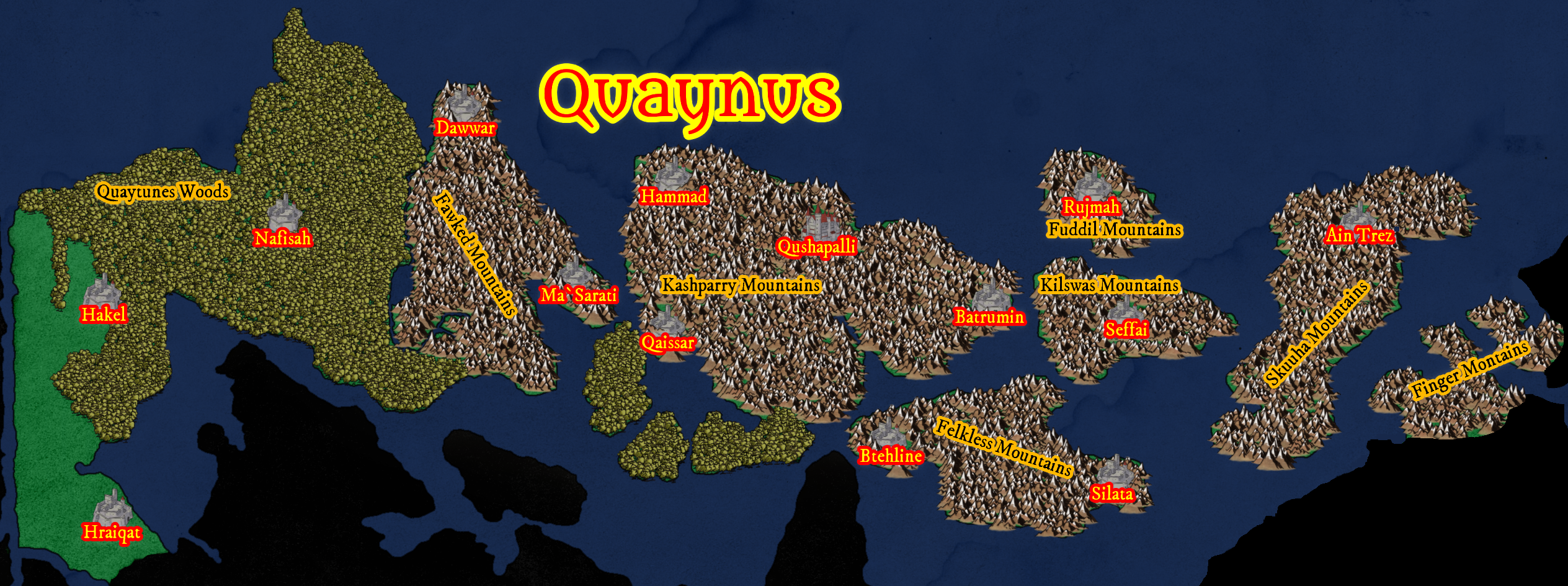
- Mountain Ranges and Peaks: The mountain ranges of Quaynus are the defining feature of the province. These towering peaks, often crowned in snow, are the backbone of the land. The tallest mountains rise like jagged spires from the earth, their rocky faces sharp and inhospitable. Craggy cliffs extend down to valleys that wind like deep scars through the land, leading to highland plateaus and deep ravines. The terrain is not for the faint of heart, with dangerous rockslides, towering icefalls, and unpredictable avalanches threatening anyone who dares to traverse the heights. The province is home to six mountain islands, scattered in a great, arching chain. Each island features a unique ecosystem, with some dominated by steep, windswept peaks, while others have lush valleys that sustain rare, hardy flora. The weather varies wildly with the elevation, shifting from frigid snowstorms to scorching heatwaves within the same day.
- Dense Forests and Verdant Valleys: Three of the islands in Quaynus are covered in dense evergreen forests, their towering trees reaching as high as the mountain ridges themselves. These forests are rich with life, supporting herds of mountain goats, wild boars, and predators like snow leopards and tigers that thrive in the rugged environment. The valleys are cradled by mountain walls and often host hidden springs and rivers that nourish the land. These fertile areas are critical for the Mountain Trolls, who use them for agriculture, growing grains, root vegetables, and medicinal herbs. In contrast, the remaining islands are dominated by rocky outcroppings and barren plains. These areas are often wind-swept and dry, but they hold a wealth of natural resources, including minerals and gems, which are carefully extracted by the Mountain Trolls. The harshness of these lands ensures that only the strongest and most adaptable thrive here, adding to the resilience of the province's people.
- Isolated and Treacherous Terrain: The heart of Quaynus consists of isolated mountain ranges, often enveloped in thick mist or fog, making navigation through the province treacherous. Many of the valleys are hidden deep within the mountains, and reaching them requires crossing narrow passes and precarious footbridges that span vast ravines. These passes, formed over centuries, are labyrinthine and treacherous. The weather here is volatile, with sudden storms of hail and snow that can reduce visibility to mere inches. The winds howl through the mountain peaks, and during the winter months, the snowdrifts can bury entire camps overnight. Despite these dangers, the Mountain Trolls have mastered the land. Their cities are fortified into the very mountains themselves, using the natural landscape to defend against external threats. Fortresses are built into caves and along cliff sides, with only a handful of narrow paths leading to their entrances. Many of these cities are perched on high plateaus, where the people have established their homes and temples to the dragons. The Trolls have mastered the art of stonework, creating cities that seem to rise organically from the rock itself, blending seamlessly into the mountainous environment.
- Natural Defense and Adaptation: The difficult terrain of Quaynus offers natural defense for its inhabitants. The ruggedness of the mountains acts as an impenetrable barrier to invaders, and the Mountain Trolls have evolved to thrive in these harsh conditions. Their cities, built into the rock faces and nestled within valleys, are not just shelter, they are fortresses designed to repel even the most determined attackers. The Trolls have adapted to the terrain through generations of practical ingenuity, creating methods of surviving in such an unforgiving environment. Their roads are narrow, winding through gorges and along cliff edges, and their cities are connected by elevated walkways that wind between mountain peaks. The natural features of the land, the dense forests, rocky cliffs, and rugged passes, are used to their advantage in both defense and attack. Fire magic and stone-based weapons are particularly effective in these mountainous landscapes.
- Mountain Passes and Travel: Travel through the province is treacherous. The mountain passes are the lifeblood of Quaynus, providing the only connectivity between its widely spread settlements. These routes, carved into the mountains over millennia, are narrow, and their winding paths require great care to navigate. In the winter months, some of these passes become impassable due to the heavy snowfalls, while in the summer, they are plagued by rockslides and flash floods from the melting snow. The Mountain Trolls, however, are experts in traversing this terrain. They use their deep knowledge of the land to traverse its challenges with ease, and their mountain climbing skills are unparalleled. When outsiders venture into Quaynus, they often rely on the guides and warriors of the Trolls, who know the paths and hidden ways through the mountains better than anyone else. The geography of Quaynus is a paradox of beauty and danger. The towering peaks and steep cliffs create a challenging environment that has been the crucible for the strength of the Mountain Trolls. Their civilization is built into the land itself, with stone temples, fortresses, and cities carved from the very rock. This rugged terrain provides both a natural defense and an unparalleled connection to the dragon gods that the Trolls worship, ensuring the province's survival and prosperity in a world shaped by mountains, fire, and stone.
History of Quaynus
The history of Quaynus, the Mountain Province of the trolls, is a saga carved into stone, fire, and faith. It is a story of endurance, divine purpose, and the unyielding bond between the Mountain Trolls and the dragons they worship. Isolated among towering peaks and mist-shrouded valleys, Quaynus has always stood apart—unyielding, proud, and fiercely independent.
- The Age of Fire and Stone, Origins of the Mountain Trolls: Long before the rise of the Faltyr Empire or the shaping of modern realms, the land that would become Quaynus was a maelstrom of volcanic mountains and molten rivers. Legends say that the Dragon Gods of fire and stone descended from the heavens during this primordial age, shaping the land with their breath and claws. From the ashes of their sacred flame, the Mountain Trolls were born, beings molded from molten rock and tempered by divine flame. According to Dragonwright scripture, the first of their kind was Kael'Ruun the Forged-Heart, the progenitor of the Mountain Trolls and the first Dragon Priest. He was said to have received the Flame of Sovereignty directly from the great dragon Styphon, granting his people wisdom, strength, and purpose. Under Kael'Ruun's guidance, the trolls learned to forge metal, shape stone, and channel the dragons' power into their creations. These early centuries became known as the Age of Fire and Stone, when the trolls spread across the mountainous islands, carving citadels directly into the cliffsides.
- The War of Ashes, Conflict and Unification: As the Mountain Troll clans grew, so too did their ambition. The once-united people fractured into warring tribes, each claiming to be the truest heirs of the dragons' favor. These internal conflicts, known as the War of Ashes, burned across the mountains for centuries. Clan fought clan amid fire and rock, and entire fortresses were buried beneath avalanches caused by their battles. The war might have destroyed Quaynus entirely, were it not for the emergence of Vael'Druk the Flame-Bound, a warlord and Dragon Priest of immense power. Legends say Vael'Druk communed directly with the Dragon of the Deep Fires, who granted him a vision: to unite the Mountain Trolls under one banner and restore their divine purpose. He wielded the sacred weapon Drakha'Tul, a hammer said to have been forged in the heart of a living volcano, and used it to shatter the strongest fortress of his enemies in a single blow. Vael'Druk united the tribes through conquest, diplomacy, and divine mandate, forming the First Dominion of Quaynus. He established the High Council of the Flame, where Dragon Priests and chieftains ruled together, blending faith and governance. The War of Ashes ended in fire, and from the ashes rose a nation reborn.
- The Age of Fortresses, Expansion and Prosperity: With unity achieved, Quaynus entered an age of prosperity and strength known as the Age of Fortresses. The trolls turned their focus inward, fortifying their homeland and building monumental citadels that defied both time and nature.
- Drakhelm, the capital of Quaynus, was carved directly into the heart of a mountain.
- The Stone Choir, a colossal amphitheater carved from a single ridge, served as both a temple and a council chamber.
- Vast networks of tunnels, known as the Fireveins, connected the mountain cities, allowing travel and trade through the harsh terrain.
During this time, Quaynus became known for its mining, metalworking, and dragoncrafting. The Mountain Trolls perfected the art of forging dragonsteel, a rare alloy said to hold the fire of the dragons themselves. Their goods became highly sought after throughout the surrounding realms, establishing trade with neighboring provinces and even human kingdoms. This period also saw the rise of the Dragonwright Faith as the unifying spiritual force. Pilgrimages to mountain shrines became central to troll culture, and Dragon Priests emerged as both the spiritual and political elite.
- The Age of Shadows, Invasion and Isolation: Peace, however, was not eternal. During the Age of Shadows, Quaynus faced invasion from beyond its mountains. Historians differ on the invaders' origin, some claim they were orcish warbands driven from the eastern plains, others say they were necromantic cults fleeing the corruption of Arangoth. What is certain is that they sought to plunder Quaynus' dragon temples and mineral wealth. The Mountain Trolls responded with unmatched ferocity. Utilizing their mountain fortresses, rhino cavalry, and guerrilla tactics, they repelled wave after wave of invaders. The war culminated in the Siege of Drakhelm, where the trolls, vastly outnumbered, fought for forty days and nights. On the final night, the Dragon Priests invoked the Rite of Flameborn Wrath, calling upon the dragons themselves. A volcanic eruption obliterated the enemy host, sealing Quaynus' victory but devastating parts of the realm. After this cataclysmic event, the Mountain Trolls withdrew from much of the outside world, viewing their isolation as both punishment and divine protection. This began the Era of the Silent Peaks, where contact with outsiders dwindled, and Quaynus turned inward once more.
- The Age of the Empire, Alliance and Renewal: Roughly two centuries ago, Quaynus joined the Faltyr Empire, a confederation of powerful provinces united under the Dragonwright faith and shared history. The integration was not immediate; the Mountain Trolls resisted external authority, seeing themselves as guardians, not subjects. However, the promise of shared divine purpose and mutual defense against foreign threats, particularly from Sythryca's northern undead wars, eventually convinced the High Council of the Flame to join. Today, Quaynus stands as both a spiritual bastion and a military powerhouse within the Empire. Its warriors serve as mountain defenders, its priests as keepers of ancient rites, and its artisans as forgers of relics that embody the dragons' eternal fire. The scars of past wars remain etched into its mountains, but so too does its legacy of endurance and faith.
Legacy and Modern Role: In the modern age, Quaynus continues to uphold its ancient traditions while embracing its place within the greater Faltyr Empire. The Rhino Riders patrol its mountain passes, the Dragon Priests guide both faith and law, and the forges of Drakhelm burn hotter than ever. The Mountain Trolls remain a people of stone and fire, unyielding, devout, and ever-watchful. To them, history is not a distant past but a living memory carved into every peak and echoing through every forge. They believe that the dragons still slumber beneath their mountains, waiting for the day when the Flame of Sovereignty will rise once more to lead them into a new age of divine glory.
Culture and Society of Quaynus
The Mountain Trolls of Quaynus have a culture shaped by the formidable mountain landscape they inhabit. Their society is one built upon strength, honor, and spiritual connection to the dragon gods. The rugged terrain they call home has fostered a people known for their resilience, warrior traditions, and craftsmanship, all of which are central to their identity.
Cultural Practices: At the heart of Mountain Troll culture is the worship of the dragons, particularly those embodying fire, stone, and protection. These dragons are seen not just as deities, but as ancestral spirits and guardians of the mountains.
- Religious Ceremonies: Rituals and festivals in Quaynus are often held at temples and sacred sites carved directly into the mountain rock. Fire plays a central role in these ceremonies, symbolizing the dragon gods' power over both destruction and rebirth. During these ceremonies, sacrificial rites are common, where offerings, both symbolic and material, are made to the dragons in exchange for blessings or protection. Fire dances and ritual combat are frequent parts of these events, allowing worshippers to demonstrate their strength and devotion. One of the most important festivals is the Flame Rite, where warriors undergo tests of strength, endurance, and courage, including combat trials in sacred fire pits. These trials are not only acts of devotion but also serve as rites of passage for young trolls. Successful warriors are marked with dragon sigils, signifying their connection to the divine and their readiness to serve their people.
- Martial Traditions: For the Mountain Trolls, combat training is not just a skill, it is a way of life. Every young troll is trained in the arts of warfare, with a particular emphasis on stone weapons, swordcraft, and fire magic. From a young age, trolls are taught to wield stone axes, swords, and hammers, reflecting the province's deep connection to the mountain's raw materials. Martial skill is not only a source of pride but also essential for defending the province from external threats and maintaining internal order.
- Craftsmanship and Art: Equally important is the skill of stonecrafting and metalworking. The Mountain Trolls are renowned for their ability to carve structures and create armor and weapons from the mountains themselves. Their fortresses, temples, and homes are carved into the mountain rock, blending seamlessly with the natural landscape. Their weaponry is highly sought after throughout the empire, known for both its durability and its spiritual resonance, with many weapons imbued with dragon magic to increase their effectiveness in battle.
Social Structure
The social hierarchy of Quaynus is built upon a meritocratic system that values both combat prowess and spiritual favor. The highest position in Quaynus society is held by the High Chieftain, a leader chosen not only for their warrior abilities but also for their connection to the dragon gods. This position is often earned through combat trials, where the best warriors from the clans compete for the honor of leading the province. The High Chieftain is both a military leader and a spiritual guide, a representative of the dragons on earth.
- Dragon Priests: Below the High Chieftain are the Dragon Priests, who play a crucial role in both religious and political matters. The Dragon Priests are not only revered for their spiritual power but also for their deep knowledge of dragon magic and rituals. They interpret the will of the dragons and guide the people in both everyday matters and in times of war. Many of the most important decisions in Quaynus, from the allocation of resources to the training of warriors, are influenced by the Dragon Priests.
- Warrior Clans: The warrior clans make up the bulk of society. Each clan is responsible for maintaining its ancestral lands, fortresses, and mountain passes. These clans are often bound by blood oaths and ancient customs, and their leadership is generally passed down through familial lines, though the merit of individual warriors plays an important role in determining who rises to the top. The clan leaders, or Warlords, are highly respected for their combat prowess and their ability to lead in battle.
The craftsmen and artisans are also highly valued, but they generally serve the military or the Dragon Priests. Their work, while not always as visible as that of the warriors, is indispensable to the defense of the province. They create armor, weapons, and fortifications, as well as spiritual relics imbued with dragon magic.
Nomadic Tribes and Fluid Governance
While much of Quaynus is structured around its clans and fortresses, there are also nomadic tribes that roam the rugged terrain. These tribes are often seen as independent, with their own forms of governance and leadership. They live outside the city walls and fortifications, moving freely across the harsh mountain passes and plains. These tribes are integral to the province's military structure, serving as scouts, messengers, and light cavalry. The nomadic tribes maintain a fluid system of governance, with each tribe led by a shaman or a war chief. These leaders are chosen for their wisdom, vision, and ability to guide their people through the wilderness. Though these tribes do not have the wealth or infrastructure of the settled clans, they provide invaluable services to the province. They are often called upon to provide reinforcements during times of war or to assist with border patrols.
Social Stratification
The social stratification of Quaynus is clear, with the High Chieftain and Dragon Priests at the top, followed by the warrior clans and their leaders. Below them are the craftsmen and artisans, whose work supports the warrior class. At the bottom are the commoners, many of whom are farmers or stone workers, whose labor sustains the entire province. The nomadic tribes occupy a unique position within this structure. While they do not hold the same wealth or status as the settled clans, they are highly respected for their independence, resourcefulness, and their warrior traditions. They are seen as the guardians of the province's wilds, maintaining the balance between the clans and the untamed wilderness that lies beyond. The culture and society of Quaynus are shaped by the harsh mountain environment and the dragon faith. The Mountain Trolls are a people built on strength, wisdom, and resilience, where martial prowess, spiritual devotion, and craftsmanship are all valued equally. Their society is structured around combat, spiritual connection, and ancestral heritage, with a unique blend of rigid hierarchy and nomadic freedom.
Economy and Agriculture of Quaynus
The economy of Quaynus is shaped by its harsh, mountainous landscape, where limited but highly valuable resources are carefully cultivated and mined. The Mountain Trolls have adapted to their challenging environment by developing a unique blend of agriculture, craftsmanship, and mining. Their economy thrives on resourcefulness and a deep understanding of the land, creating products and commodities that are highly valued within the empire.
Agriculture
Although Quaynus is defined by its rugged terrain, there are pockets of fertile land in the valleys and lowlands where agriculture can thrive. The Mountain Trolls have learned to make the most of these areas, cultivating crops that can withstand the difficult conditions.
- Hardy Crops: In the more sheltered valleys, the trolls grow grains such as barley, oats, and wheat, as well as vegetables like potatoes, turnips, and cabbage. These crops are well-suited to the colder climate and provide sustenance to the population. In addition, herbs such as sage, mint, and thyme are grown for both culinary use and trade.
- Livestock: The Mountain Trolls raise livestock that can withstand the harsh conditions, such as goats and mountain cattle. These animals are crucial for their meat, leather, wool, and milk, which serve as primary resources for both local consumption and trade. Goats are particularly important for their ability to graze in difficult, rocky terrain and are raised for their milk and wool, which is used for clothing and textiles.
Despite the challenges, Quaynus is largely self-sustaining when it comes to agriculture, but its true wealth lies in the resources that lie deep within the mountains.
Mining and Resources
Quaynus' true economic power is derived from its mineral-rich mountains, which are home to vast deposits of metal ores and precious gems. The Mountain Trolls have long been skilled miners, with deep-rooted knowledge passed down through generations on how to extract and process the raw materials from the earth.
- Iron and Copper: The province's mountains are rich in iron, copper, and other essential metals. These materials are essential to the province's craftsmanship, as they are used to create the exceptional weapons, armor, and tools for which the trolls are famous. The mining industry is not only a key source of wealth but also a critical component of Quaynus' military strength, as the finest weapons are forged from these metals.
- Gold and Precious Gems: The mountains of Quaynus also hide valuable gold and precious gems like emeralds, rubies, and sapphires. These are carefully extracted by specialized mining crews and often used in the crafting of dragon-imbued jewelry and religious artifacts. These gems are highly sought after throughout the empire, making them an important part of Quaynus' trade relations.
- Stone Carving and Architecture: The stone of Quaynus is used not only for everyday tools but for the massive fortifications and temples that dot the landscape. These structures are often carved directly into the mountains, blending seamlessly with the natural surroundings. Granite, marble, and limestone are the primary materials used, and the craftsmanship involved in shaping these materials is considered among the finest in the known world.
Craftsmanship and Trade
Craftsmanship is a cornerstone of Quaynus' economy. The Mountain Trolls are known for their unparalleled ability to shape stone and metal, creating some of the finest objects in the empire. Their products are highly valued for both their practicality and spiritual significance.
- Stonework and Architecture: The trolls' expertise in stone carving is reflected in their cities and fortresses, which are built into the sides of mountains. The temples dedicated to the dragons are particularly notable for their intricate designs and carvings, often depicting scenes of dragon gods and their legendary feats. This stonework is highly valued not just for its strength but for its symbolic and religious significance.
- Weapons and Armor: Quaynus is also renowned for its armament industry. The weapons and armor forged here are some of the finest in the empire, crafted from iron, copper, and other precious metals mined from the mountains. Many of these items are imbued with dragon magic, giving them both magical properties and enhanced effectiveness in battle. The weapons are often intricately engraved with dragon motifs and imbued with spiritual power, making them not only functional but deeply symbolic.
- Dragon-imbued Items: The Mountain Trolls are skilled in the art of crafting dragon-imbued items, objects of power that hold spiritual significance. These items range from magical amulets to ritual daggers and sacred relics, all believed to carry the blessing of the dragon gods. These items are prized by scholars, mages, and warriors throughout the empire, making them one of Quaynus' most valuable exports.
Trade and Commerce
Due to its rugged geography, Quaynus is somewhat isolated from the rest of the Faltyr Empire, but its valuable mineral resources and craftsmanship have created strong trade relationships with nearby regions.
- Trade Routes: Trade routes to Quaynus are limited, primarily relying on caravans that brave the mountain passes to transport goods. Despite the difficult terrain, caravans from Faltyra, Sythryca, and other provinces often visit to exchange luxury goods, textiles, spices, and magic-infused artifacts. Quaynus' mountain gems and metal works are highly sought after, making them valuable commodities that fuel the province's economy.
- Exports: Quaynus is known for exporting a variety of high-value goods, including:
- Dragon-imbued jewelry and magical artifacts
- Weapons, armor, and tools
- Precious gems such as emeralds, rubies, and sapphires
- Stonework and architectural components
- Imports: The province primarily imports luxury goods and raw materials that are difficult to obtain in the harsh mountain environment. These include textiles, spices, exotic materials, and magical ingredients that are used for the creation of dragon-infused items and ritual artifacts.
The economy of Quaynus is built upon a foundation of mining, craftsmanship, and agriculture. The province's rugged terrain and abundant mineral wealth provide both the material resources and the cultural significance that fuel its economic success. While Quaynus is relatively isolated, its exceptional craftsmanship, particularly in stonework and metalwork, ensures that it remains an integral part of the Faltyr Empire's trade network.
Military and Defense of Quaynus
The Mountain Province of Quaynus maintains a military that is as formidable as its rugged terrain. The province's military strategy is intricately tied to its natural environment, with the Mountain Trolls utilizing their deep understanding of the landscape to defend their homes and repel invaders.
Cavalry and Dkou`rine Riders
The Dkou`rine (Wooly Rhino) Riders are one of the most feared military units in Quaynus. These elite soldiers ride massive Rhinoceroses specially bred for their strength, endurance, and ability to navigate the difficult mountainous terrain.
- Tactical Advantage: The Dkou`rine Riders excel in charging through the rugged mountain passes and rocky plains, where traditional cavalry would struggle. The sheer force and speed of the Dkou`rines allow the riders to break through enemy lines with devastating impact. Their presence on the battlefield is both intimidating and effective, particularly in offensive mountain warfare where mobility and strength are paramount.
- Elite Force: Training a Dkou`rine Rider is a difficult and intense process, requiring years of preparation for both the rider and the beast. Riders are experts in handling their mounts in the roughest conditions, able to guide their Dkou`rines through steep cliffs, narrow passes, and treacherous ravines.
- Strategic Deployment: The Dkou`rine Riders are most effective when employed in defensive and offensive operations in the mountainous terrain. They are often used to guard strategic passes or fortresses, providing a mobile and highly protective force in times of crisis. In battle, the Dkou`rine Riders charge at enemy formations with devastating impact, causing chaos and disrupting the enemy's line of defense.
Warfare and Tactics
The Mountain Trolls' approach to warfare is shaped by their mastery of the difficult terrain and their spiritual connection to the Dragonwright faith. Their tactics are focused on leveraging the natural environment to their advantage, using everything from mountain passes to rockslides to outmaneuver and defeat their enemies.
- Guerrilla Warfare and Ambushes: The Mountain Trolls excel in guerrilla tactics, making use of the rocky landscapes, hidden caves, and dense forests to launch surprise attacks. Their soldiers are adept at ambushes, hit-and-run tactics, and quick strikes from high ground. They use the terrain to trap and disorient enemies, often launching assaults from unexpected positions.
- Defensive Positions: The Mountain Trolls are masters of fortification, building their cities and fortresses into the very mountains themselves. These structures are incredibly difficult to attack, often carved directly into the rock faces, with natural barriers providing additional protection. The fortresses are well-positioned on high ground, making them nearly impossible to assault without massive losses.
- Siege Defense: Quaynus is renowned for its ability to defend against siege warfare. The mountainous terrain and fortress design make it extremely difficult for invading armies to breach. Additionally, natural disasters such as rockslides and avalanches are used to disrupt enemy forces, either by blocking their path or by causing chaos during a siege. The trolls' knowledge of their environment enables them to exploit these hazards during combat.
- Elemental Magic and Dragon Blessings: The Dragon Priests play a key role in the military of Quaynus. Their ability to channel the power of the dragons, particularly fire and stone, enhances the Mountain Trolls' combat effectiveness. Fire magic is often used in both offensive and defensive strategies, allowing the trolls to launch fire-based attacks or fortify their positions with dragon-imbued fire. In battle, Dragon Priests invoke the blessings of the dragons to enhance the strength, speed, and resilience of the trolls, making them formidable opponents on the battlefield.
- Dragons and Sacred Warfare: The Mountain Trolls believe that they are direct descendants of the dragons' chosen people, and their connection to the Dragonwright faith is reflected in their military prowess. Sacred rituals and invocations are common before and during battles, with Dragon Priests performing sacred rites to ensure the favor of the dragons. The presence of a Dragon Priest on the battlefield is often seen as a signal of divine support, boosting the morale and fighting strength of the Mountain Trolls.
The military strength of Quaynus is deeply intertwined with its Dragonwright faith, creating a unique and formidable defense strategy that combines the power of the dragons with the natural advantages of the mountain landscape. The Dkou`rine Riders provide elite cavalry, while the Mountain Trolls employ guerrilla tactics, elemental magic, and spiritual rituals to defend their land. The Dragon Priests not only guide the spiritual and political life of the province but also enhance its military capabilities with the power of the dragons, ensuring that the trolls remain an indomitable force in the region.
The Dragonwright Faith: Core of Quaynus' Identity
The Dragonwright faith is more than just a religion in Quaynus; it is the foundation of their culture, society, and military identity. The Mountain Trolls view the dragons as divine beings that embody the forces of strength, fire, and protection. These dragons are revered as the guardians of the province, and the trolls see themselves as the chosen people tasked with maintaining the balance of the land and upholding the will of the dragons.
Temples and Sacred Sites
The temples of Quaynus are carved into the very mountains themselves, with stone dragons and other sacred motifs integrated into the architecture. These mountain temples are considered holy sites, where the Dragon Priests perform sacred rites and rituals to honor the dragons.
- Fire and Stone Dragons: The most revered dragons in Quaynus are those associated with fire and stone. These dragons symbolize strength, resilience, and protection, qualities that the Mountain Trolls hold in the highest regard. Rituals often take place at altars dedicated to these dragons, where fire plays a central role in invoking their blessings.
- Sacrifices and Offerings: The trolls make sacrifices and offerings to the dragons in the form of ritual combat, feasts, and burnt offerings. These offerings are meant to please the dragons and seek their favor in matters of war, strength, and wisdom.
- Dragon Priests: Political and Religious Leadership
The Dragon Priests are the highest spiritual and political authority in Quaynus. They interpret the will of the dragons, and their decisions guide both the leadership of the province and its military endeavors.
- Political Role: The Dragon Priests serve as advisors to the High Chieftain and other leaders, ensuring that the laws of the land align with the teachings of the dragons. They also act as mediators and arbiters in disputes, using their spiritual authority to maintain order and harmony within the society.
- Ritual Combat and Blessings: The Dragon Priests are skilled in dragon magic and often perform ritual combat during military campaigns to ensure that the blessings of the dragons are bestowed upon the soldiers. They also play a crucial role in the combat training of the trolls, teaching them to channel the power of the dragons into their weapons and tactics.
- Connection to the Dragons: The Dragon Priests are considered the direct intermediaries between the Mountain Trolls and the dragons themselves. Their connection to the dragons is believed to be divine, and their leadership is seen as a fulfillment of the dragons' will on earth.
The Dragonwright faith is not merely a religion in the Desert Province of Faltyra, it is the very essence of life. It governs how the people live, interact with the world around them, and understand their place in the grand order of the universe. The faith is deeply woven into every aspect of society, from politics to personal conduct, and its influence extends far beyond mere spiritual practice. It forms the bedrock of the Faltyr Empire's unity, guiding its military, governance, economy, and cultural identity.
At the heart of the Dragonwright faith lies the worship of the dragons, revered not just as ancient, mythical beasts but as living gods whose essence is intertwined with the forces that sustain life itself. Dragons embody the most vital forces in the world: strength, wisdom, fire, and protection. They are the ultimate symbols of both the spiritual and physical aspects of life, representing the ideal qualities that followers strive to embody.
Throughout the Faltyr Empire, the reverence for dragons is more than just an act of worship, it is a way of life, shaping the customs, rituals, and societal norms of every region. Each province venerates a different aspect of the dragon, creating a diverse but unified belief system that adapts to the unique geography, culture, and needs of each region.
The Role of the Dragon Priests: At the spiritual heart of Faltyra are the Dragon Priests, an elite class of religious leaders who hold significant sway over both spiritual and political affairs. These priests are not just the keepers of sacred knowledge but also the advisors to the Emperor, ensuring that the ruler's decisions align with the divine will of the dragons. The priests interpret the dragons' teachings, perform sacred rituals, and guide the people in maintaining a strong connection to the divine. Their influence stretches across the empire, as they ensure that the laws, military strategies, and economic practices are all in line with Dragonwright principles.
The dragon temples scattered throughout the empire are not only places of worship but also centers of spiritual learning, where the faithful come to offer prayers, receive guidance, and seek knowledge of the dragons' will. These temples are often located at sites of great historical or mystical significance, where the dragons are believed to have once walked or where their divine essence still lingers in the land.
Regional Variations in Worship: While the central tenets of the Dragonwright faith remain consistent throughout the empire, each province's specific reverence for the dragons reflects its local culture and geography. The Mountain Trolls, for instance, revere the dragons of strength and fire, associating them with the qualities of fortitude, power, and unrelenting endurance. For these people, the dragons are symbols of martial prowess, endurance in battle, and the force that allows them to endure the harshest of environments. Their spiritual practices focus on invoking the dragons for courage and mastery over the element of fire, which is central to their rituals of strength and battle.
In contrast, the Plains Trolls honor dragons of wisdom and protection, believing the dragons are guardians of the desert's many mysteries. The Plains Trolls view the dragons as protectors who not only give them the strength to survive but also offer the wisdom necessary to navigate the desert's dangers. For these followers, the dragon gods are teachers, offering insight into the desert's shifting landscape, its challenges, and its inherent beauty. Their practices are centered on ensuring balance and harmony with the natural world, invoking the dragons to guide them through changing seasons and to provide protection from both physical and spiritual threats.
Across the provinces, the Dragonwright faith adapts, but the core principle remains the same: by aligning oneself with the dragons, an individual can unlock their own potential, finding both purpose and fulfillment in their daily life. The dragon gods are seen as both protectors and teachers, shaping the people's lives in accordance with the divine will and ensuring the prosperity of the Faltyr Empire.
The Academy of Vhashkent: The Faltyr Empire places immense value on the pursuit of knowledge, especially in matters related to the Dragonwright faith and the mystical powers of the dragons. As the empire continues to expand, the capital city of Vhashkent has become the epicenter of intellectual growth, attracting scholars, priests, and magicians from across the world. Within Vhashkent's sprawling academy, students study everything from ancient dragon lore to arcane magic, seeking to unravel the mysteries of the dragons' true nature and their role in shaping the world.
The academy houses some of the most prestigious libraries in the known world, containing vast collections of ancient texts and sacred manuscripts detailing the history of the dragons, their spiritual significance, and their impact on the development of Faltyra. The Aeldar Tribe, known for their advanced understanding of magic, provides much of the foundational knowledge that forms the basis of the empire's magical education. Scholars at the academy work alongside Dragon Priests to unlock new secrets of dragon magic, elemental forces, and the runes that enhance spellcasting abilities.
Arcane Knowledge and Dragon Magic:
The Dragonwright faith is deeply intertwined with arcane knowledge, particularly the use of ritualistic spells and dragon-infused magic. Dragon Priests and sorcerers work in tandem to study and practice dragon magic, focusing on how to harness the dragons' power to influence both the physical and mystical worlds. Rituals that invoke the dragons' presence are highly structured, often requiring precise chants, offerings, and incantations that align the caster with the elemental forces of fire, wind, and earth.Among the most prized knowledge held within the academy are the ancient dragon rituals, which allow practitioners to channel the essence of dragons into their magic. Scholars study these rituals closely, seeking to improve their understanding of the elemental forces and unlock new ways to wield dragon magic. Over time, the knowledge passed down through generations has led to the development of powerful spells that not only serve as a magical defense for the empire but also enhance the empire's connection to the dragons.
Dragon Magic in Society: The influence of dragon magic extends far beyond the academy. It is interwoven into every aspect of Faltyran life. From the most simple rituals performed at the dragon temples to the grand military strategies employed by the Emperor, dragon magic plays a pivotal role in shaping the empire's successes. It is used in healing, ritual combat, temple rituals, and even political decisions, as the Dragon Priests are often called upon to provide guidance or cast spells that influence the flow of power.
As the Faltyr Empire continues to grow, its spiritual and magical connections to the dragons remain its greatest strength, ensuring that the faith endures through both times of peace and conflict. In the Dragonwright faith, the people of Faltyra find not just their purpose but their divine mandate, which unites them under the banner of the dragons, sustaining their empire for generations to come.
Law
Quaynus is governed by a rigid and comprehensive legal system, intricately linked to the Dragonwright faith. The laws of the empire are designed not only to maintain political order but also to uphold the spiritual and divine mandates of the Dragon gods. The legal framework of Faltyra seeks to ensure the stability of the realm and reinforce the empire's sacred duty to the dragons, whose will is seen as the ultimate law.
The legal system is highly hierarchical, with authority granted at various levels depending on the nature of the dispute. However, at all levels, the focus remains firmly on loyalty to the Emperor and the dragons, whose influence permeates both legal and societal matters.
- The Foundation of Law: The Dragonwright Doctrine: At the very core of the Faltyr Empire's legal system lies the Dragonwright Doctrine, a spiritual and legal framework that places the dragons as the ultimate arbiters of right and wrong. In this system, the dragons are not just divine beings, they are living gods whose very essence governs all aspects of life. The Emperor, as the living embodiment of a dragon, is the supreme ruler and enforcer of the law, with his decrees considered sacred and beyond reproach.
- Divine Right: The Emperor is regarded as the chosen of the dragons, the mortal representation of divine will. His decrees are seen as sacred and divinely inspired. To challenge the Emperor's authority is to defy the dragons themselves, an act punishable by severe consequences, including death or exile.
- Dragonkind as Lawgivers: Dragon Priests and Dragonlords are not only the spiritual leaders of the faith but also judges and enforcers of divine law. They interpret the will of the dragons, ensuring that the laws of the empire align with the teachings of the faith. They preside over legal matters in both religious and secular contexts, particularly in cases involving spiritual violations or offenses against the Dragonwright faith.
- Balance and Order: At the heart of the Dragonwright Doctrine is a focus on balance, order, and strength. Dragons are seen as the protectors of balance in the world, and the laws of the empire are designed to preserve harmony between the people, the land, and the gods. This balance is considered essential for the empire's survival and prosperity.
- Structure of the Legal System: The legal structure of the Faltyr Empire is tiered, with various levels of authority managing legal matters based on their scope and significance. The Emperor holds the highest legal authority, but the Dragon Priests, military officials, and local magistrates all play crucial roles in upholding the law throughout the empire.
- The Emperor's Law: The Emperor is the supreme authority in the empire, and his word is law. His edicts are considered inviolable, and they govern the actions of both the people and the rulers. It is a rare and dangerous act to defy the Emperor's decrees, and such actions are swiftly punished.
- The Imperial Council: The Imperial Council consists of high-ranking officials, noble houses, and prominent Dragon Priests. They advise the Emperor on legal matters that have national implications, such as disputes between provinces, matters involving foreign relations, and other significant legal issues. The Council's role is advisory, but their influence in shaping the law cannot be understated.
- Provincial Law: Each of the empire's provinces is governed by a Chieftain, who is tasked with enforcing the Emperor's laws within their territory. Chieftains have the authority to enact provincial laws and customs, but they must not contradict the Dragonwright Doctrine. Local judges, appointed by the Chieftains or the Dragon Priests, oversee most legal cases in their provinces, ranging from criminal cases to civil disputes.
- Dragon Priests and Local Justice: The Dragon Priests play a central role in administering local justice, particularly in cases that involve religious or spiritual matters. They mediate disputes that touch upon faith and morality and serve as final arbiters in cases concerning the Dragonwright faith. In some areas, Dragon Priests are the ultimate legal authority, especially in matters involving sacred sites or offenses against the dragons.
- Military Law: The military maintains its own legal system, known as military justice, which governs the behavior of soldiers and resolves disputes within the ranks. Military tribunals handle offenses like desertion, cowardice, insubordination, and treason, with harsh punishments for violators. The Imperial Guard, as the elite military force, is held to an even stricter code of conduct, with severe penalties for breaches of discipline.
- Religious Law: Religious law is inextricably linked with the secular law of the empire. The Dragon Priests act as moral and legal authorities, interpreting both divine and secular laws. Violations of religious codes, such as failing to properly honor the dragons, committing acts of blasphemy, or engaging in heretical practices, are punished through both spiritual and legal penalties. In extreme cases, heretics or blasphemers may face execution or exile.
- Types of Crimes and Punishments: Crimes in the Faltyr Empire are categorized based on their severity, with spiritual violations and political treason often carrying the harshest punishments. The Dragonwright faith dictates much of the moral and legal structure, with offenses against the gods and the Emperor regarded as the most heinous acts.
- Major Crimes:
- Treason Against the Empire: Treason is considered one of the most severe crimes. Those who plot against the Emperor, the Dragon gods, or the empire face execution by dragonfire, eternal exile, or, in some cases, devouring by sacred beasts. The punishment is swift and brutal, reflecting the grave threat to both the spiritual and political stability of the empire.
- Blasphemy: Any offense against the Dragonwright faith is punishable by death or ritual sacrifice. Blasphemous speech, desecrating dragon shrines, or denouncing the dragons are seen as direct challenges to divine authority. Those found guilty are often executed publicly to serve as a warning to others.
- Desertion and Cowardice: Desertion in the face of battle, especially during military campaigns, is seen as a betrayal of the empire. Soldiers guilty of cowardice or desertion face execution by dragonfire, public disgrace, or even being stripped of rank and honor. For the Imperial Guard, such offenses are met with the most severe punishments.
- Murder and Theft: Murderers may be executed or exiled, depending on the nature of the crime, while thieves are typically punished with amputation, forced labor, or execution. The severity of the punishment depends on the gravity of the crime.
- Sacrilege and Defiling Sacred Sites: Defiling dragon temples or sacred artifacts is a grave offense. Offenders are often burned alive, cast into sacred pits, or subjected to ritual punishments overseen by the Dragon Priests.
- Minor Crimes and Punishments:
- Public Disobedience: Minor offenses, such as failing to attend religious ceremonies or disrespecting the Dragon Priests, are punishable by flogging, public humiliation, or short-term imprisonment.
- Debts and Dishonor: Those who fail to honor their financial obligations or dishonor their family name are often shunned or disowned by their communities. Social punishment is seen as a significant deterrent, especially in the tightly-knit Faltyran society.
- The Role of the Dragon Priests in Law: The Dragon Priests serve as both spiritual leaders and judges in the Faltyr Empire, with their influence extending far beyond religious matters. They are the final arbiters in cases that touch on matters of faith, ritual, and morality. The Dragon Priests also enforce the laws of the empire, ensuring that both spiritual and secular laws align with the Dragonwright faith.
- Legal Adjudication: The Dragon Priests preside over religious courts, deciding cases involving violations of the Dragonwright faith, sacred rituals, or spiritual conduct.
- Moral Authority: The Dragon Priests provide guidance on moral and ethical matters, ensuring that the laws of the empire reflect the divine will of the dragons.
- Spiritual Punishment: In cases of religious offenses, the Dragon Priests often oversee ritual punishments, such as exorcisms, sacrificial rites, or penance to restore balance between the offender and the gods.
The legal system of the Faltyr Empire is a reflection of its deep connection to the Dragonwright faith. The laws are harsh but serve to protect the spiritual and political order established by the dragons. With the Emperor at the helm and the Dragon Priests enforcing divine law, the empire maintains strict control over its people, ensuring that the will of the dragons is followed at all costs.
Population and Demographics
Population Size: The Mountain Province of Quaynus is home to approximately 750,000 inhabitants.
The majority of the population is made up of Mountain Trolls, with some Plains Trolls who have settled in the lower valleys. While many live in the province's fortresses and temples, others live as nomadic tribes, roaming the higher peaks and mountain passes. The Mountain Trolls' culture is closely tied to the mountainous environment, and their way of life is rooted in strength, craftsmanship, and spiritual devotion to the dragons.Cities of Quaynus
- Qushapalli: The capital city of Quaynus, perched high in the central mountains. It serves as both a military and spiritual stronghold, housing massive dragon temples and the seat of the High Chieftain. The city is carved directly into the cliffs, with stone fortifications that symbolize the Mountain Trolls' strength and devotion.
- Dawwar: A major mining hub located in the western mountains, Dawwar is known for its vast ore deposits and skilled blacksmiths. The forges here produce the finest steel and weaponry in the province, often enchanted with dragonfire blessings.
- Nafisah: A cultural center built amidst dense forests, Nafisah is renowned for its artisans and scholars. The city houses the Great Hall of Echoes, where Dragon Priests preserve ancient songs and histories of the Troll clans.
- Hakel: A remote settlement at the western edge of Quaynus, Hakel serves as both a fortress and a trade post.
- Hraiqat: A plains city located near the southern coasts, Hraiqat is known for its rhino breeding grounds and serves as a key military outpost for the Rhino Riders of Quaynus.
- Ma'sarati: Built on the slopes of volcanic ridges, Ma'sarati is home to sacred fire temples dedicated to the dragons of flame. It is a center for spiritual pilgrimage and ritual fire ceremonies.
- Qaissar: A coastal city and trade port that connects Quaynus to other provinces. Its markets are filled with rare minerals, weapons, and crafted goods from the mountain forges.
- Hammad: One of the oldest cities in Quaynus, known for its towering citadel and archives containing the early histories of the Mountain Troll clans. It serves as a secondary religious center after Qushapalli.
- Batrunin: A city renowned for its warriors and training arenas. It is the military heart of eastern Quaynus, where soldiers are trained in mountain warfare and dragon rites of battle.
- Btehtine: Located near the southern mountain passes, Btehtine is famed for its stone architecture and underground halls. It serves as a refuge and stronghold during times of conflict.
- Silata: A coastal fortress city known for its shipwrights and stone docks. It maintains the small naval presence of Quaynus and supports trade with distant provinces.
- Rujmah: Perched high on a mountain plateau, Rujmah is a sacred city devoted to spiritual isolation and meditation. It houses monasteries where monks and priests study dragon lore.
- Seffan: A prosperous city known for its mineral markets and artisans. Seffan is a crossroads of trade and culture, connecting the mountain interior with the island plains.
- Ain Trez: A major eastern city overlooking the sea, Ain Trez is known for its grand harbor, military docks, and towering statues of dragon guardians that protect its shores.
Return to Maps and Floor Plans
Back to Main Page - Major Crimes: