Desert Province of Shay`Zreth
The Desert Province of Shay`Zreth is an awe-inspiring and enigmatic land, often regarded as one of the most mystical and harshly beautiful regions in the empire. It is a vast, unforgiving expanse of endless sand dunes, ancient ruins, and rugged stone plateaus that tell the story of a lost civilization once dominated by the unforgiving desert. The province is steeped in mysticism, where the land itself seems to hum with the spiritual energy of the ancient past. The desert is both a barrier and a bridge, acting as a natural crossroads between the desolate sands and the bustling trade routes that crisscross the empire. Its oases serve as lifeblood to the nomadic tribes and desert trolls who have learned to thrive in this harsh climate.
In Shay`Zreth, the struggle for survival is not just physical; it is also deeply spiritual. The province is home to nomadic tribes who have mastered the art of survival amidst the shifting sands, their ancient traditions intertwined with dragon worship. The desert trolls who populate the province have adapted to the harsh environment, developing a way of life that revolves around a deep connection to the land and the dragon gods that are believed to inhabit its every dune and stone. These trolls believe that the fire and earth elements of the desert are manifestations of divine influence, and their survival hinges on understanding and respecting the balance between these elements.
Shay`Zreth is also a land of ancient mystery, with the remnants of once-great civilizations scattered across its vast expanse. The ruins of Shamlikh, one of the most famous and revered sites in the province, stand as a haunting reminder of an empire long forgotten. These ruins are not just historical relics but are viewed as sacred ground, where powerful spiritual energy is believed to still linger. Many desert dwellers make pilgrimages to these ruins, seeking guidance from the spirits of the past and the dragons that once watched over the land. The mystical power that emanates from these ruins is said to influence the course of events in the region, shaping the lives of the nomads and desert trolls who call Shay`Zreth home.
Beyond its spiritual significance, Shay`Zreth also holds immense strategic value within the empire. Its position as a crossroads for desert trade routes makes it a key location for the movement of goods between distant lands. The oases scattered throughout the province offer vital water sources, allowing trade caravans and nomadic tribes to cross the desert in relative safety. Jakar, the province's capital, is situated at one of the most important oases, serving as a cultural and commercial hub where goods such as spices, silks, precious stones, and textiles are exchanged. It is here that the spiritual influence of the Dragon Priests converges with the practical needs of the traders, creating a unique blend of faith and commerce that drives the economy of Shay`Zreth.
The people of Shay`Zrethm, both nomadic tribes and desert trolls, have learned to adapt to their environment in ways that reflect the harshness of the land and the mystical forces that govern it. They live by a code of resilience, adaptability, and reverence for the dragons, seeing the desert not just as a challenge to overcome but as a reflection of the divine. Their spirituality, survival skills, and trade networks are all deeply influenced by the dragons and their connection to the desert's sacred elements. This province is a living testament to the endurance of the people who call it home and to the lasting influence of ancient civilizations that once ruled the sands. In essence, Shay`Zreth is a land where the forces of nature, faith, and history intertwine, creating a mystical atmosphere that defines the province's very soul. It is a place of contradictions, where the beauty of the sand dunes is matched only by their harshness, where ancient wisdom guides the people through the challenges of the desert, and where the dragons continue to influence the destiny of all who dwell within.
Geography
Shay`Zreth is a land dominated by vast expanses of sand dunes and rocky plateaus, where the heat and silence of the desert reign supreme. The landscape is both harsh and breathtaking, stretching endlessly under the searing sun, with towering dunes that shift and change with the winds, and jagged stone formations that rise from the earth like ancient sentinels. This unforgiving terrain is broken only by the occasional oasis, which serves as a lifeline to the people of the province. These oases are not only vital water sources but also act as critical hubs for trade and cultural exchange, ensuring the survival of both nomadic tribes and settled communities. The life-giving water found in the oases allows for the cultivation of crops and the raising of livestock, making these areas essential to the province's economy and way of life.
The province is steeped in history, with ancient ruins scattered across the landscape, remnants of a once-great civilization that fell victim to the harsh desert environment. The most notable of these is the Shamlikh ruins, a sprawling archaeological site that holds both mystical and historical significance. These ruins are believed to house remnants of ancient knowledge, spiritual energy, and magical power, and are regarded as sacred by the people of Shay`Zreth. Pilgrims and scholars alike venture to these ruins in search of wisdom or guidance from the past, hoping to tap into the ancient forces that are said to still linger in the sands.
The desert itself stretches across the central regions of the province, its unforgiving terrain and shifting sands presenting both a barrier and a test for those who seek to cross it. Surrounding this vast desert are fertile areas near the oases, which support the nomadic tribes and settled communities that call Shay`Zreth home. These fertile regions allow the province to support a thriving economy based on agriculture, herding, and trade. While much of Shay`Zreth may appear barren and inhospitable, it is the oases and mountainous regions that sustain life, providing a contrast to the arid desert.
The geography of Shay`Zreth also makes it a strategic location for desert trade routes, connecting various provinces through the caravan routes that pass through key cities like Jakar and Saqi. These trade routes are not just economic arteries; they are the lifeblood of the province, facilitating the movement of goods, cultural exchanges, and even spiritual pilgrimages. Goods such as spices, precious gems, textiles, and silks pass through these trade hubs, while merchants, scholars, and travelers make their way across the sands to connect with other parts of the empire. Shay`Zreth's role as a crossroad in the empire ensures that it remains both a strategic and mystical center of commerce and spirituality.
History of Shay`Zreth
Shay`Zreth's history is a tale woven into the sands of time, where the rise and fall of civilizations have left indelible marks on the landscape. The province is home to ancient ruins, forgotten empires, and the lingering spiritual presence of the dragons that have shaped its people's existence. It is a land where mysticism, trade, and survival have collided in ways that have left a lasting legacy on its culture.
Ancient Civilizations and the Rise of Shamlikh
The history of Shay`Zreth dates back to the times of its ancient civilizations, long before the desert became the vast, shifting expanse it is today. At the height of its glory, the Shamlikh Empire ruled over the land, its capital standing as a beacon of knowledge, trade, and spiritual power. The empire was built around the Shamlikh ruins, an area rich in resources, and known for its spiritual energy believed to be tied to the dragon gods. The empire's rise was marked by a deep connection to the desert, utilizing the natural landscape and its spiritual significance to create a society centered around wisdom and strength.
However, as the empire flourished, the desert began to reclaim its hold over the land. Ancient droughts and sandstorms began to erode the empire's power, forcing its people to either abandon their once-great cities or face the wrath of nature. The ruins of Shamlikh still stand as a reminder of this once-great civilization, now buried under centuries of shifting sands, leaving behind fragments of lost knowledge and ancient relics that are sought after by scholars and pilgrims alike.
The Fall of Shamlikh and the Rise of Nomadic Tribes
As the Shamlikh Empire fell into ruin, its once-great capital was lost to the desert. The remnants of the empire scattered across the land, leaving the province vulnerable to the forces of nature and the growing nomadic tribes that called the desert home. These tribes, primarily composed of desert trolls and other nomads, began to migrate across the vast expanses of the desert, establishing temporary settlements and building a new way of life that was deeply connected to the cycles of the desert and the dragon gods.
The fall of the Shamlikh Empire left a profound spiritual and cultural legacy on the people of Shay`Zreth. The nomadic tribes adopted the dragon gods as their protectors, seeing the desert as a sacred and divine force that must be respected and revered. They continued to trade and travel along the ancient trade routes that had once been the lifeblood of the Shamlikh Empire, but now as smaller, more decentralized groups, seeking sustenance and spiritual guidance from the ruins of their ancestors.
The Rise of Jakar and Desert Trade Routes
With the rise of the nomadic tribes, new cities began to take form around the oases that dotted the desert landscape. One of the most important of these cities was Jakar, founded at the Jakar Oasis, a vital water source and a strategic stop along the ancient trade routes. Jakar became the capital city of Shay`Zreth, and it quickly grew into a vibrant hub of commerce and spirituality, bringing together the nomads, traders, and dragon priests from across the empire.
Jakar's location near the Jakar Oasis allowed it to become a crucial part of the desert trade network, connecting Shay`Zreth to the rest of the empire through caravans that carried spices, precious gems, and luxury goods. The city's markets thrived, and its temples dedicated to the dragon gods became centers of spiritual practice. Jakar's rise marked the rebirth of the province, this time as a cultural and economic center, where both nomadic traditions and settled life could coexist.
Shay`Zreth in the Present: A Land of Mysticism and Power
Today, Shay`Zreth is a province where the echoes of its ancient past and the strength of its spiritual beliefs continue to shape its future. The Shamlikh ruins, still revered as a sacred site, serve as a symbol of both the lost glory of the past and the spiritual connection the people have to the dragons and the land. The nomadic tribes and desert trolls who inhabit the province continue to live by the wisdom passed down through generations, combining ancient rituals with the practical needs of survival in one of the most harsh and beautiful environments in the empire.
The people of Shay`Zreth still view the dragons as divine protectors, their power and influence felt throughout the land. The Dragon Priests of Shay`Zreth continue to serve as spiritual guides, interpreting the will of the dragons and guiding the people in matters of faith and trade. The province remains a spiritual center where pilgrims come from across the empire to seek guidance and strength from the ancient ruins and the living dragon gods that are believed to still watch over the land.
The history of Shay`Zreth is marked by the rise and fall of great civilizations, the endurance of its nomadic people, and the mystical connection they maintain with the desert and the dragons. From the glorious empire of Shamlikh to the nomadic tribes that now roam its vast sands, Shay`Zreth remains a land of mysticism, spirituality, and resilience, where the past and the present intertwine in a constant dance of survival, commerce, and faith. The province's ancient ruins, sacred temples, and trade routes serve as both reminders of what was lost and symbols of what is yet to come.
Culture and Society
The culture of Shay`Zreth is intricately intertwined with the desert's harsh environment and the Dragonwright faith. Life in this unforgiving land has shaped a resilient people, Plains Trolls and nomadic tribes, who have adapted their way of life to the extreme conditions of the desert. Their society is rooted in a deep reverence for the desert's power and the divine influence of the dragon gods, who they believe shape the forces of fire and earth within the land.
For the people of Shay`Zreth, the desert is more than just an environment; it is a harsh teacher and a divine presence, providing both challenge and guidance. The sands are seen as both a test of survival and a spiritual force that must be respected and understood. Fire and earth, the core elements of the desert, are viewed as manifestations of the dragon gods, who embody the powers of strength, resilience, and protection. The people's connection to the desert is both physical and spiritual, as they believe their survival depends on their ability to live in harmony with the land and honor the dragon spirits that watch over them.
The province is renowned for its oral traditions, where stories of ancient civilizations, especially those related to the Shamlikh ruins, are passed down through generations. These stories are more than just history, they are vessels of spiritual wisdom and practical guidance. Through storytelling, the elders teach the younger generations about the dragons, the shifting sands, and the ancient rituals that have helped their ancestors survive the desert's extremes. These tales are filled with spiritual meaning, often serving as both moral lessons and ritual incantations. The people believe that by invoking the blessings of the dragons, they can navigate the dangers of the desert and secure protection for their tribes and caravans.
The nomadic tribes of Shay`Zreth lead a life closely tied to the rhythms of the desert. They move in seasonal cycles, following the migratory paths of their herds, but also ensuring they maintain a spiritual presence in their communities. Trade plays a vital role in their survival, and caravanserais act as gathering points for merchants, travelers, and tribal leaders. These caravans not only exchange goods like spices, precious gems, and textiles, but also knowledge and spiritual practices. Trade is as much about cultural exchange as it is about commerce, as it provides an avenue for the nomads to connect with other regions, share their stories, and exchange rituals that honor the dragons.
At the heart of Shay`Zreth's culture is the belief that the land itself is sacred. The Shamlikh ruins, once the center of a great empire, are now considered one of the most spiritually significant sites in the province. The desert trolls and nomads make pilgrimages to these ruins, seeking not only to honor their ancestors but also to tap into the spiritual power that is believed to still linger in the sands. The Shamlikh ruins are seen as a reminder of the past, but also a symbol of the eternal connection between the dragon gods and the people of Shay`Zreth.
Rituals are a central part of life in Shay`Zreth. Each year, sacred festivals are held in honor of the dragon gods, during which ceremonial dances, fire rituals, and feasts are conducted to invoke their blessings. The Dragon Priests play a pivotal role in these festivals, overseeing rituals that celebrate the elements of fire and earth. These ceremonies are seen as an essential part of maintaining balance and harmony with the desert. The nomads and desert trolls believe that by following these spiritual practices, they ensure their survival, as well as the continued prosperity of their people and their trade networks.
The society of Shay`Zreth, though shaped by the harshness of the desert, is one that thrives on community, spirituality, and resilience. The oral traditions, the spiritual bonds with the land, and the trading networks that span across the desert have created a culture that is both ancient and eternally adaptive, as the people continue to honor the dragon gods and survive in one of the empire's most challenging and mystical regions.
Social Structure
The social structure of Shay`Zreth is both hierarchical and shaped by the nomadic nature of its people. While the overarching framework follows traditional lines of leadership, the fluidity of nomadic tribes and their spiritual practices creates a system that adapts to the changing needs of the desert environment.
At the top of the hierarchy are the High Shamans and Dragon Priests, the spiritual leaders who hold both religious and political authority. These figures are not only intermediaries between the people and the dragon gods but also serve as advisors to the leaders of the province, ensuring that both spiritual rituals and political decisions align with the will of the divine forces. High Shamans are often the keepers of sacred knowledge, responsible for passing down the ancient oral traditions, and interpreting the omens and visions that guide the people. The Dragon Priests, on the other hand, are heavily involved in both the military and ritualistic practices, guiding the people through rituals that ensure divine favor and protection. Together, these spiritual leaders serve as the province's moral compass, balancing the physical needs of the people with their spiritual obligations to the dragon gods.
Beneath these spiritual leaders are the warrior clans, who form the military backbone of Shay`Zreth. These clans are the defenders of the land, ensuring the safety of the nomadic tribes and the sacred sites. The warriors are highly trained in combat, survival tactics, and desert warfare. Their expertise is critical to navigating the dangers of the desert, whether that be sandstorms, wild beasts, or potential threats from outside invaders. The warrior clans are also responsible for maintaining order among the nomadic tribes, ensuring that the trading routes remain secure and that conflict does not disrupt the delicate balance between the desert's various inhabitants. These warriors are also expected to honor the spiritual rites of their people, taking part in fire rituals and dragon blessings to gain strength and guidance in battle.
The nomadic tribes form the core of Shay`Zreth's social fabric, and they embody the freedom and resourcefulness that define life in the desert. The tribes are constantly on the move, following seasonal migrations with their herds of camels, goats, and cattle. These nomads live in temporary settlements such as tents and caravans, which are easily assembled and dismantled as they travel across the harsh landscape. While living in these temporary camps, the nomadic tribes form tight-knit communities where family and tribal ties are of paramount importance. Their wealth is tied directly to the livestock they raise, and trade is a vital part of their existence. Through the trade and barter system, these tribes exchange food, spices, textiles, and goods with other tribes and settled communities. The nomads' role in commerce is crucial, as they serve as the lifeblood of Shay`Zreth's economy, facilitating the movement of goods across the desert trade routes and into the markets of Jakar, Saqi, and other key cities.
The nomadic tribes also serve as the first line of defense against any external threats. In times of conflict, they provide scouts, light cavalry, and guerrilla fighters who are adept at navigating the desert's vastness. Their mobility makes them an invaluable asset in warfare, as they can strike quickly and retreat into the wilderness when needed. Despite the hierarchical nature of Shay`Zreth's social system, the nomads hold considerable autonomy within their own tribes, with each tribe governed by a tribal council or chief that makes decisions based on consensus and the spiritual guidance of the Shamans and Dragon Priests.
Thus, the social structure of Shay`Zreth blends spiritual leadership, military prowess, and nomadic independence, creating a society that is resilient, adaptable, and deeply connected to both the desert's harsh realities and the divine forces that shape their lives. This intricate balance between the spiritual, the military, and the nomadic traditions allows the people of Shay`Zreth to not only survive but to thrive in one of the empire's most mystical and challenging regions.
Economy and Agriculture
The economy of Shay`Zreth is primarily driven by a combination of trade, livestock herding, and the strategic use of desert resources. With its arid, unforgiving environment, the province relies heavily on the oases that dot the landscape, which provide not only water but also fertile ground for limited agriculture. These vital oases allow the nomadic tribes and settled communities to grow essential crops such as dates, grains, and vegetables, although agriculture remains constrained by the desert's harsh climate. The ability to cultivate these crops is a key factor in ensuring the survival of the population, but the land's limitations force the people to depend on trade to meet many of their needs.
As a result, trade plays a fundamental role in the economy of Shay`Zreth. The province's nomadic tribes are essential to the movement of goods, serving as caravan leaders and traders who travel across the desert. They are responsible for bringing desert products such as salt, precious stones, oils, and desert herbs to the market. These goods are highly valued, not only for their practical uses but also for their mystical significance. The spices and herbs harvested from the desert are often seen as possessing healing properties, while the precious stones are believed to carry spiritual power, often sought by scholars and pilgrims traveling to the Shamlikh ruins. Through this barter and trade, the nomadic tribes connect the farthest reaches of the desert with the wider empire, facilitating a constant flow of goods, ideas, and spiritual practices.
The more settled cities, especially Jakar, serve as the commercial heart of the province. Jakar, located at the Jakar Oasis, acts as the primary trade hub, where goods from across Shay`Zreth and neighboring regions converge. The marketplaces of Jakar are vibrant centers of commerce, where traders from other provinces exchange items such as textiles, ceramics, and desert relics. The bazaars in Jakar are renowned for their luxurious goods, including silks, precious gems, fabrics, and carved artifacts, creating a bustling atmosphere of cultural exchange. This central market makes Jakar an essential link between the desert and the larger world, serving not just as a trade center but as a melting pot of ideas, culture, and religion.
The province is also famous for its skilled craftsmanship, particularly in areas such as textiles, pottery, and leatherwork. The nomadic tribes are known for their intricate weaving of carpets, while artisans in Jakar and other cities produce ceramic bowls, vases, and tile work that are highly prized both locally and internationally. The leatherwork of Shay`Zreth, particularly tents and traveling caravans, is renowned for its durability and beauty, reflecting the people's ability to blend functionality with aesthetic value. These crafts are exported beyond Shay`Zreth, with traders from other regions eager to purchase high-quality textiles, ceramics, and leather goods to sell in the wider empire.
The metalworking industry is also vital to the province's economy, especially in the production of weapons and tools for the desert warriors. Skilled blacksmiths and artisans create swords, daggers, and armor that are prized not only for their craftsmanship but also for the spiritual significance imbued in them by the Dragon Priests. These items are often seen as blessed, with many warriors seeking the blessings of the dragons before they embark on campaigns or defend their land. The metalworkers of Shay`Zreth also produce tools and utensils for everyday life, helping the people navigate the challenging environment of the desert.
While agriculture is a significant aspect of life in Shay`Zreth, it is the trade and craftsmanship that truly drive the economy. The desert's natural resources, from salt and precious stones to spices and herbs, are essential to sustaining the people and providing goods for export. The province's reliance on caravans, marketplaces, and the skilled artisanship of its people forms the backbone of an economy that thrives despite the harshness of the land. As a key crossroads for trade, spiritual exchange, and cultural interaction, Shay`Zreth is a dynamic and resilient province that continues to prosper through the strength and adaptability of its people.
Military and Defense
The military of Shay`Zreth is primarily defensive, relying on the strength and resourcefulness of the nomadic tribes and warrior clans to protect the province from external threats, particularly from other desert tribes or invaders. Given the vast desert and the nomadic nature of the people, the military focus is on mobility and guerrilla tactics, allowing Shay`Zreth to use its harsh terrain to its advantage. The province's fortified cities, such as Bsalm and Jakar, serve as strategic strongholds and rally points where the warriors and Dragon Priests gather to strategize and coordinate defense against any forces that threaten their way of life.
The Rhino Riders are an elite force within Shay`Zreth's military, specifically trained for desert warfare. These riders use large rhinos as their mounts, an impressive sight on the battlefield. Rhinos are perfectly suited to the terrain, able to charge through the sands with strength and speed, making them a force to be reckoned with in combat. The Rhino Riders use their mounts to break enemy lines, causing chaos and disarray among enemy forces. Their mounted combat skills are highly regarded, and their ability to adapt to the desert environment gives them a distinct advantage in battle. These riders are highly valued, often seen as the elite warriors of Shay`Zreth, capable of turning the tide of battle with their devastating charges.
In addition to the Rhino Riders, the nomadic tribes play a critical role in Shay`Zreth's military defense. Their deep knowledge of the desert terrain makes them invaluable as scouts, light cavalry, and guerrilla fighters. The nomads know how to use the vast desert to their advantage, engaging in hit-and-run tactics, ambushes, and sabotage against enemies who underestimate the dangers of the land. These warriors are quick, strategic, and able to disappear into the desert sands when needed, making them highly effective in asymmetric warfare. Their mobility allows them to strike when and where the enemy least expects it, then vanish into the shifting dunes.
Shay`Zreth's defense also deeply relies on the spiritual guidance of the Dragon Priests, who provide not only rituals and blessings but also inspiration for the troops before battle. The Dragon Priests are revered figures, and their role in military affairs is seen as essential to the success of the province's forces. Before any significant engagement, the priests perform rituals to invoke the blessing of the dragons, asking for strength, protection, and victory. These rites are believed to fortify the warriors' spirits and enhance their connection to the divine, allowing them to fight with the power of the dragons behind them. The ruins of Shamlikh are considered a key spiritual site, and many warriors visit the sacred ruins before going into battle, seeking to tap into the ancient energy believed to still linger in the area. This connection to the past and to the divine is seen as a crucial element in the warriors' ability to face the overwhelming odds that often come with defending such a remote and hostile region.
The military structure of Shay`Zreth is therefore a combination of spiritual strength, strategic mobility, and a deep understanding of the desert environment. The province's defensive strength lies not just in its warrior prowess, but in its ability to adapt, using the land, faith, and resources in ways that allow the people of Shay`Zreth to hold their own against any threat. The integration of spiritual practices, desert warfare, and nomadic traditions makes Shay`Zreth's military as much a reflection of its culture and connection to the dragon gods as it is a defense against external invaders.
The Dragonwright Faith
The Dragonwright faith is not merely a religion in the Desert Province of Shay`Zreth, it is the very essence of life. It governs how the people live, interact with the world around them, and understand their place in the grand order of the universe. The faith is deeply woven into every aspect of society, from politics to personal conduct, and its influence extends far beyond mere spiritual practice. It forms the bedrock of the Faltyr Empire's unity, guiding its military, governance, economy, and cultural identity.
At the heart of the Dragonwright faith lies the worship of the dragons, revered not just as ancient, mythical beasts but as living gods whose essence is intertwined with the forces that sustain life itself. Dragons embody the most vital forces in the world: strength, wisdom, fire, and protection. They are the ultimate symbols of both the spiritual and physical aspects of life, representing the ideal qualities that followers strive to embody.
Throughout the Faltyr Empire, the reverence for dragons is more than just an act of worship, it is a way of life, shaping the customs, rituals, and societal norms of every region. Each province venerates a different aspect of the dragon, creating a diverse but unified belief system that adapts to the unique geography, culture, and needs of each region.
The Role of the Dragon Priests: At the spiritual heart of Shay`Zreth are the Dragon Priests, an elite class of religious leaders who hold significant sway over both spiritual and political affairs. These priests are not just the keepers of sacred knowledge but also the advisors to the Emperor, ensuring that the ruler's decisions align with the divine will of the dragons. The priests interpret the dragons' teachings, perform sacred rituals, and guide the people in maintaining a strong connection to the divine. Their influence stretches across the empire, as they ensure that the laws, military strategies, and economic practices are all in line with Dragonwright principles.
The dragon temples scattered throughout the empire are not only places of worship but also centers of spiritual learning, where the faithful come to offer prayers, receive guidance, and seek knowledge of the dragons' will. These temples are often located at sites of great historical or mystical significance, where the dragons are believed to have once walked or where their divine essence still lingers in the land.
Regional Variations in Worship: While the central tenets of the Dragonwright faith remain consistent throughout the empire, each province's specific reverence for the dragons reflects its local culture and geography. The Mountain Trolls, for instance, revere the dragons of strength and fire, associating them with the qualities of fortitude, power, and unrelenting endurance. For these people, the dragons are symbols of martial prowess, endurance in battle, and the force that allows them to endure the harshest of environments. Their spiritual practices focus on invoking the dragons for courage and mastery over the element of fire, which is central to their rituals of strength and battle.
In contrast, the Plains Trolls honor dragons of wisdom and protection, believing the dragons are guardians of the desert's many mysteries. The Plains Trolls view the dragons as protectors who not only give them the strength to survive but also offer the wisdom necessary to navigate the desert's dangers. For these followers, the dragon gods are teachers, offering insight into the desert's shifting landscape, its challenges, and its inherent beauty. Their practices are centered on ensuring balance and harmony with the natural world, invoking the dragons to guide them through changing seasons and to provide protection from both physical and spiritual threats.
Across the provinces, the Dragonwright faith adapts, but the core principle remains the same: by aligning oneself with the dragons, an individual can unlock their own potential, finding both purpose and fulfillment in their daily life. The dragon gods are seen as both protectors and teachers, shaping the people's lives in accordance with the divine will and ensuring the prosperity of the Faltyr Empire.
The Academy of Vhashkent: The Faltyr Empire places immense value on the pursuit of knowledge, especially in matters related to the Dragonwright faith and the mystical powers of the dragons. As the empire continues to expand, the capital city of Vhashkent has become the epicenter of intellectual growth, attracting scholars, priests, and magicians from across the world. Within Vhashkent's sprawling academy, students study everything from ancient dragon lore to arcane magic, seeking to unravel the mysteries of the dragons' true nature and their role in shaping the world.
The academy houses some of the most prestigious libraries in the known world, containing vast collections of ancient texts and sacred manuscripts detailing the history of the dragons, their spiritual significance, and their impact on the development of Shay`Zreth. The Aeldar Tribe, known for their advanced understanding of magic, provides much of the foundational knowledge that forms the basis of the empire's magical education. Scholars at the academy work alongside Dragon Priests to unlock new secrets of dragon magic, elemental forces, and the runes that enhance spellcasting abilities.
Arcane Knowledge and Dragon Magic: The Dragonwright faith is deeply intertwined with arcane knowledge, particularly the use of ritualistic spells and dragon-infused magic. Dragon Priests and sorcerers work in tandem to study and practice dragon magic, focusing on how to harness the dragons' power to influence both the physical and mystical worlds. Rituals that invoke the dragons' presence are highly structured, often requiring precise chants, offerings, and incantations that align the caster with the elemental forces of fire, wind, and earth.
Among the most prized knowledge held within the academy are the ancient dragon rituals, which allow practitioners to channel the essence of dragons into their magic. Scholars study these rituals closely, seeking to improve their understanding of the elemental forces and unlock new ways to wield dragon magic. Over time, the knowledge passed down through generations has led to the development of powerful spells that not only serve as a magical defense for the empire but also enhance the empire's connection to the dragons.
Dragon Magic in Society: The influence of dragon magic extends far beyond the academy. It is interwoven into every aspect of Shay`Zrethn life. From the most simple rituals performed at the dragon temples to the grand military strategies employed by the Emperor, dragon magic plays a pivotal role in shaping the empire's successes. It is used in healing, ritual combat, temple rituals, and even political decisions, as the Dragon Priests are often called upon to provide guidance or cast spells that influence the flow of power.
As the Faltyr Empire continues to grow, its spiritual and magical connections to the dragons remain its greatest strength, ensuring that the faith endures through both times of peace and conflict. In the Dragonwright faith, the people of Shay`Zreth find not just their purpose but their divine mandate, which unites them under the banner of the dragons, sustaining their empire for generations to come.
Law
The provinces in the Faltyr Empire is governed by a rigid and comprehensive legal system, intricately linked to the Dragonwright faith. The laws of the empire are designed not only to maintain political order but also to uphold the spiritual and divine mandates of the Dragon gods. The legal framework of Shay`Zreth seeks to ensure the stability of the realm and reinforce the empire's sacred duty to the dragons, whose will is seen as the ultimate law.
The legal system is highly hierarchical, with authority granted at various levels depending on the nature of the dispute. However, at all levels, the focus remains firmly on loyalty to the Emperor and the dragons, whose influence permeates both legal and societal matters.
- The Foundation of Law: The Dragonwright Doctrine: At the very core of the Faltyr Empire's legal system lies the Dragonwright Doctrine, a spiritual and legal framework that places the dragons as the ultimate arbiters of right and wrong. In this system, the dragons are not just divine beings, they are living gods whose very essence governs all aspects of life. The Emperor, as the living embodiment of a dragon, is the supreme ruler and enforcer of the law, with his decrees considered sacred and beyond reproach.
- Divine Right: The Emperor is regarded as the chosen of the dragons, the mortal representation of divine will. His decrees are seen as sacred and divinely inspired. To challenge the Emperor's authority is to defy the dragons themselves, an act punishable by severe consequences, including death or exile.
- Dragonkind as Lawgivers: Dragon Priests and Dragonlords are not only the spiritual leaders of the faith but also judges and enforcers of divine law. They interpret the will of the dragons, ensuring that the laws of the empire align with the teachings of the faith. They preside over legal matters in both religious and secular contexts, particularly in cases involving spiritual violations or offenses against the Dragonwright faith.
- Balance and Order: At the heart of the Dragonwright Doctrine is a focus on balance, order, and strength. Dragons are seen as the protectors of balance in the world, and the laws of the empire are designed to preserve harmony between the people, the land, and the gods. This balance is considered essential for the empire's survival and prosperity.
- Structure of the Legal System: The legal structure of the Faltyr Empire is tiered, with various levels of authority managing legal matters based on their scope and significance. The Emperor holds the highest legal authority, but the Dragon Priests, military officials, and local magistrates all play crucial roles in upholding the law throughout the empire.
- The Emperor's Law: The Emperor is the supreme authority in the empire, and his word is law. His edicts are considered inviolable, and they govern the actions of both the people and the rulers. It is a rare and dangerous act to defy the Emperor's decrees, and such actions are swiftly punished.
- The Imperial Council: The Imperial Council consists of high-ranking officials, noble houses, and prominent Dragon Priests. They advise the Emperor on legal matters that have national implications, such as disputes between provinces, matters involving foreign relations, and other significant legal issues. The Council's role is advisory, but their influence in shaping the law cannot be understated.
- Provincial Law: Each of the empire's provinces is governed by a Chieftain, who is tasked with enforcing the Emperor's laws within their territory. Chieftains have the authority to enact provincial laws and customs, but they must not contradict the Dragonwright Doctrine. Local judges, appointed by the Chieftains or the Dragon Priests, oversee most legal cases in their provinces, ranging from criminal cases to civil disputes.
- Dragon Priests and Local Justice: The Dragon Priests play a central role in administering local justice, particularly in cases that involve religious or spiritual matters. They mediate disputes that touch upon faith and morality and serve as final arbiters in cases concerning the Dragonwright faith. In some areas, Dragon Priests are the ultimate legal authority, especially in matters involving sacred sites or offenses against the dragons.
- Military Law: The military maintains its own legal system, known as military justice, which governs the behavior of soldiers and resolves disputes within the ranks. Military tribunals handle offenses like desertion, cowardice, insubordination, and treason, with harsh punishments for violators. The Imperial Guard, as the elite military force, is held to an even stricter code of conduct, with severe penalties for breaches of discipline.
- Religious Law: Religious law is inextricably linked with the secular law of the empire. The Dragon Priests act as moral and legal authorities, interpreting both divine and secular laws. Violations of religious codes, such as failing to properly honor the dragons, committing acts of blasphemy, or engaging in heretical practices, are punished through both spiritual and legal penalties. In extreme cases, heretics or blasphemers may face execution or exile.
- Types of Crimes and Punishments: Crimes in the Faltyr Empire are categorized based on their severity, with spiritual violations and political treason often carrying the harshest punishments. The Dragonwright faith dictates much of the moral and legal structure, with offenses against the gods and the Emperor regarded as the most heinous acts.
- Major Crimes:
- Treason Against the Empire: Treason is considered one of the most severe crimes. Those who plot against the Emperor, the Dragon gods, or the empire face execution by dragonfire, eternal exile, or, in some cases, devouring by sacred beasts. The punishment is swift and brutal, reflecting the grave threat to both the spiritual and political stability of the empire.
- Blasphemy: Any offense against the Dragonwright faith is punishable by death or ritual sacrifice. Blasphemous speech, desecrating dragon shrines, or denouncing the dragons are seen as direct challenges to divine authority. Those found guilty are often executed publicly to serve as a warning to others.
- Desertion and Cowardice: Desertion in the face of battle, especially during military campaigns, is seen as a betrayal of the empire. Soldiers guilty of cowardice or desertion face execution by dragonfire, public disgrace, or even being stripped of rank and honor. For the Imperial Guard, such offenses are met with the most severe punishments.
- Murder and Theft: Murderers may be executed or exiled, depending on the nature of the crime, while thieves are typically punished with amputation, forced labor, or execution. The severity of the punishment depends on the gravity of the crime.
- Sacrilege and Defiling Sacred Sites: Defiling dragon temples or sacred artifacts is a grave offense. Offenders are often burned alive, cast into sacred pits, or subjected to ritual punishments overseen by the Dragon Priests.
- Minor Crimes and Punishments:
- Public Disobedience: Minor offenses, such as failing to attend religious ceremonies or disrespecting the Dragon Priests, are punishable by flogging, public humiliation, or short-term imprisonment.
- Debts and Dishonor: Those who fail to honor their financial obligations or dishonor their family name are often shunned or disowned by their communities. Social punishment is seen as a significant deterrent, especially in the tightly-knit Shay`Zrethn society.
- The Role of the Dragon Priests in Law: The Dragon Priests serve as both spiritual leaders and judges in the Faltyr Empire, with their influence extending far beyond religious matters. They are the final arbiters in cases that touch on matters of faith, ritual, and morality. The Dragon Priests also enforce the laws of the empire, ensuring that both spiritual and secular laws align with the Dragonwright faith.
- Legal Adjudication: The Dragon Priests preside over religious courts, deciding cases involving violations of the Dragonwright faith, sacred rituals, or spiritual conduct.
- Moral Authority: The Dragon Priests provide guidance on moral and ethical matters, ensuring that the laws of the empire reflect the divine will of the dragons.
- Spiritual Punishment: In cases of religious offenses, the Dragon Priests often oversee ritual punishments, such as exorcisms, sacrificial rites, or penance to restore balance between the offender and the gods.
The legal system of the Faltyr Empire is a reflection of its deep connection to the Dragonwright faith. The laws are harsh but serve to protect the spiritual and political order established by the dragons. With the Emperor at the helm and the Dragon Priests enforcing divine law, the empire maintains strict control over its people, ensuring that the will of the dragons is followed at all costs.
Population and Demographics
The Desert Province of Shay`Zreth is home to a diverse population, predominantly made up of Plains Trolls
Population Size: The population of Shay`Zreth is estimated to be around 0.55 million inhabitants. While this is a relatively small number given the size of the desert province, it reflects the challenging living conditions and the reliance on the oases as the primary source of sustenance. The population density is highest in the vicinity of the oases, with significant clusters of people also residing in the bustling trade city of Vhashkent.
Cities of Shay`Zreth
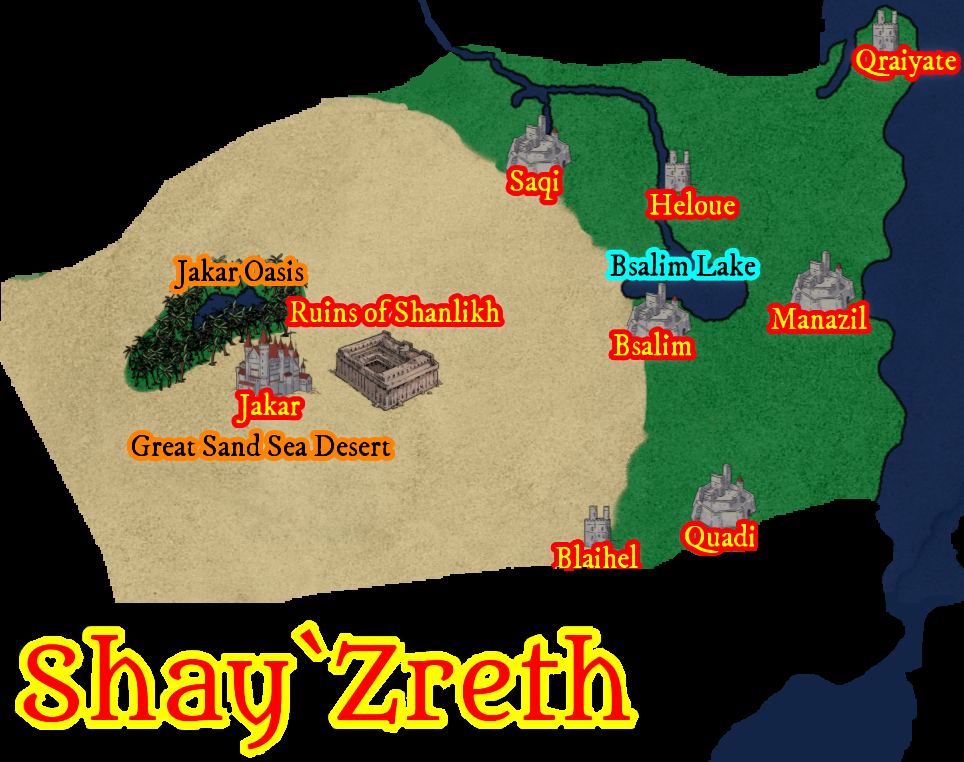
- Jakar: The capital city of Shay`Zreth, located at the Jakar Oasis. A vital commercial and cultural center, Jakar thrives as a key stop on trade routes. The oasis is surrounded by sacred temples and bustling markets.
- Ruins of Shamlikh: An ancient city that was once the heart of a powerful empire, now in ruins. Shamlikh is considered a sacred site, believed to hold immense spiritual power and ancient knowledge.
- Saqi: A prominent city located near an oasis, known for its strategic position along desert trade routes. Saqi serves as a vital trading post and cultural exchange hub.
- Heloue: A city located on the edge of the desert, known for its agricultural exports and significant trade connections to the northern provinces. Its fertile lands make it a key source of crops and herbs.
- Manazil: A bustling market city famous for its trade in spices and textiles, located along a major trade route. It has a mixed population of traders, artisans, and nomads.
- Bsalim: A city known for its strong military presence and fortified defenses. Bsalm guards key desert routes and serves as a stronghold against invaders from the desert wastelands.
- Ouadi: A city nestled in a valley surrounded by high cliffs. Ouadi is famous for its stonework and ancient temples, offering a rich blend of spirituality and craftsmanship.
- Qraiyate: A city near the desert's edge, known for its explorers and archaeologists studying the ruins scattered across the province. The city holds an ancient observatory used to study celestial events.
- Blhaihel: A lesser-known but important city located near key water sources in the northern desert, Blhaihel is an oasis town that supports local trade and nomadic tribes.
Return to Maps and Floor Plans
Back to Main Page - Major Crimes: