Kingdom of Maletra

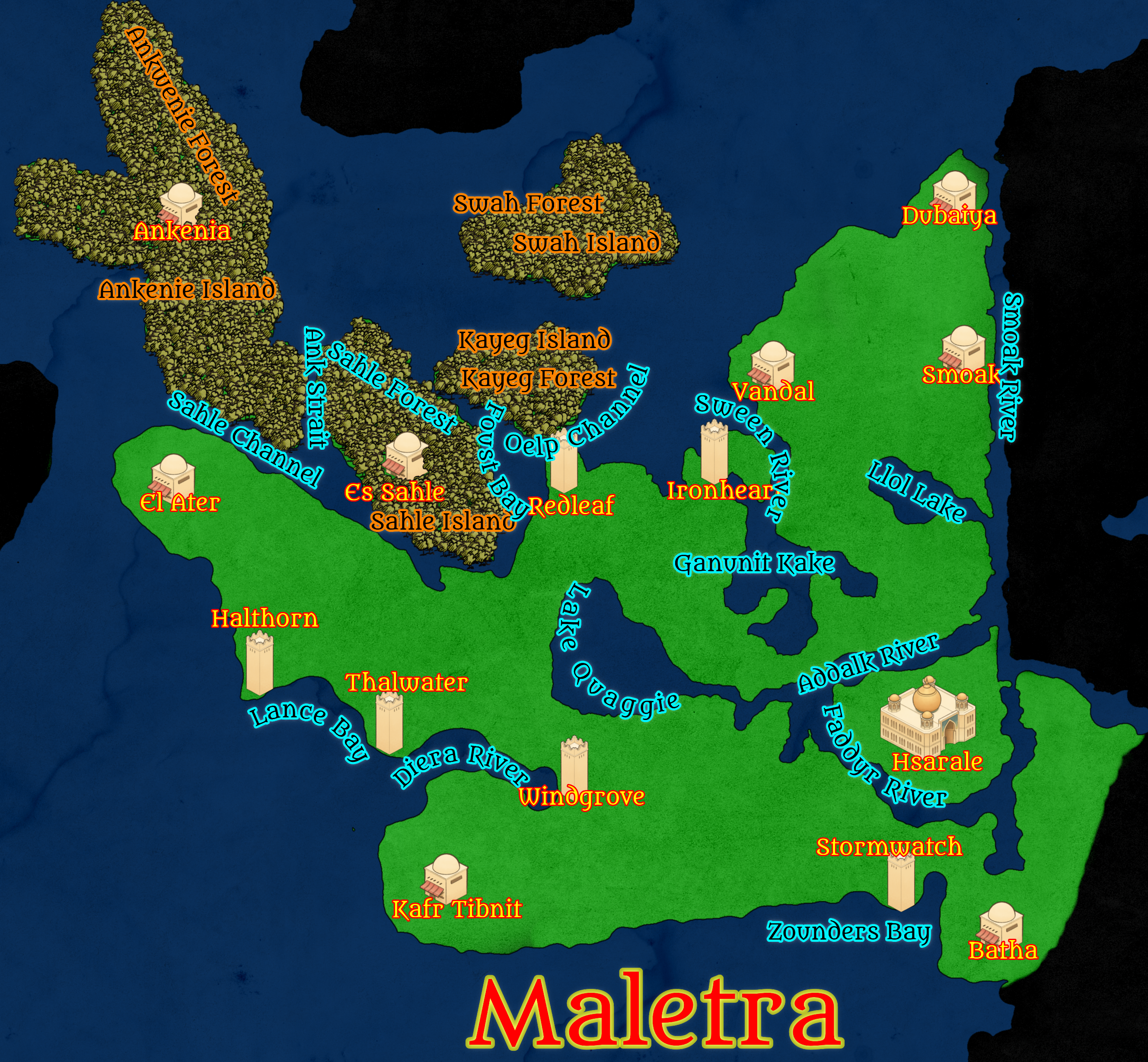
GeographyNestled in the warm southern reaches of the world, this kingdom is a land of contrasts; lush forests teeming with life, broad savannahs stretching beneath an ever-changing sky, and winding rivers that coil like serpents through the vibrant mainland. These rivers are both lifeblood and danger, carving their way through the heart of the kingdom, flanked by dense rainforests, sprawling grasslands, and winding coasts that are kissed by warm, humid winds. The land spans across the mainland and four large islands, each shrouded in a cloak of thick, verdant forests, while the coastal plains are dotted with mangrove swamps that teem with both life and mystery. The kingdom's heartland lies within a humid basin, nourished by a complex web of rivers and their swollen tributaries. These rivers carry life-giving waters to the fertile soil, but their yearly floods also bring destruction, as they swell beyond their banks, sweeping away entire villages in their wake. While the floods enrich the earth, they also claim lives and livelihoods, creating a delicate balance between abundance and peril. To the north, the islands are covered in vast rainforests that seem to stretch endlessly into the horizon. The towering trees, so ancient and enormous, are home to entire communities that live among the leaves, building homes high above the forest floor in the protective embrace of the canopy. The coasts are rich in natural harbors and bustling fishing towns. These towns serve as important trade hubs, where ships from distant lands dock to barter for coveted resources such as exotic spices, fragrant hardwoods, rare dyes, and medicinal herbs. Below the surface, the turquoise waters are home to vibrant coral reefs that shimmer with life, creating a kaleidoscope of color beneath the waves. Yet, the sea is not without its dangers, hidden reefs and jagged shoals make sailing treacherous, and storms roll in quickly, capable of turning the tranquil waters into a furious tempest. The climate is subtropical, with long periods of heavy rain followed by blistering, oppressive heat. The air is thick with the scent of orchids, wet earth, and the salty tang of the sea. Life flourishes here, in all its glory and danger. The abundance of nature is matched only by the ever-present threats that lurk beneath the surface, diseases borne by the humid air, venomous spiders hiding in the underbrush, and wild predators that prowl the vast jungles. Yet, for every danger, there is beauty: the vibrancy of the flowers, the songs of birds and insects, and the richness of the earth that offers sustenance in a land of both bounty and risk. HistoryThe history of the kingdom is one of resilience, struggle, and the continuous effort to live in harmony with the land and its spirits. For centuries, the people have navigated the challenges of their environment, their success and survival tied directly to the health of the land. From ancient beginnings steeped in the mists of time to the present day, the kingdom's past is both a testament to human strength and the delicate balance between progress and preservation. The Early DaysThe earliest inhabitants of the land were nomadic tribes, guided by their deep connection to the spirits of the forest, river, and sky. These early people lived by a simple but profound philosophy; to survive, they must honor the land and its spirits, taking only what was needed and always giving something back. The tribes were small, isolated, and deeply spiritual, following the natural rhythms of the world around them. Over time, these scattered tribes began to merge, drawn together by common rituals, trade, and the need for defense against external threats. As they gathered, the first great leaders emerged, spiritual leaders who understood the land's power and warriors who were able to harness the skills of nature in battle. The foundation of the kingdom was laid, built not by conquest, but through alliances forged in the heart of the wilds. The Rise of the KingdomCenturies passed, and the scattered tribes began to unite under the guidance of a single monarch. This monarch was believed to be the earthly embodiment of Tareh'nal, the Soul of the Earth, and their rule was seen as divinely ordained. The kingdom grew in both size and complexity, with the monarchy becoming the spiritual and political center of the realm. The early kings and queens understood that their strength came not from power over the land, but from unity with it. During this period of growth, the kingdom's agricultural practices flourished. Terraced farming, canal irrigation, and the cultivation of sacred plants became central to the economy. The first great trading cities rose along the coasts, bringing wealth and new goods from distant lands. These cities became vibrant centers of culture, where artisans, merchants, and spiritual leaders gathered to share their knowledge and goods. The people's connection to the land remained strong, and the balance of nature was always prioritized over expansion or greed. Times of ConflictDespite their unity, the kingdom was not immune to external threats. Periodically, invaders from foreign lands would seek to exploit the kingdom's wealth, whether through raiding its coastal cities or encroaching upon its fertile lands. However, the kingdom's people were never defeated for long. Their warriors, whether the silent Vineguard, the swift Riverblades, or the stalwart Sunlancers, fought not just for survival, but for the sanctity of the land itself. During these times of conflict, the law of the land became more strictly enforced. The spiritual leaders and tribal chieftains worked together with the monarch to organize a defense that was as much spiritual as it was military. It was said that, in times of dire need, the land itself would answer their call, with storms, floods, and other natural phenomena driving off invaders, a sign that Tareh'nal was protecting the kingdom. The Golden AgeFollowing a period of intense warfare, the kingdom entered its Golden Age. A time of peace, prosperity, and cultural flowering. The people's connection to the land was at its height, and the sacred balance between humanity and nature was maintained with reverence. The arts, particularly storytelling, dance, and music, flourished, and sacred festivals became larger and more elaborate, drawing people from across the land and beyond. Trade routes grew even more extensive, linking the kingdom to distant lands and bringing with them new ideas, technologies, and artistic influences. This period saw the construction of the Emerald Palace, the grand seat of the monarchy overlooking the Addalk River. It became a symbol of the kingdom's prosperity and the harmonious union between nature and civilization. The palace's design was not merely an architectural marvel but a reflection of the kingdom's deep connection to the natural world, with walls that seemed to grow organically from the very rock itself, and gardens that mirrored the wild beauty of the forests and savannahs. The Decline and RebirthDespite the kingdom's achievements, there were those who sought to disrupt the sacred balance. Over time, corruption crept into the nobility, and some landholders began to prioritize wealth over preservation. Unsustainable practices, such as overharvesting and pollution of sacred rivers, threatened to undermine the kingdom's delicate harmony with nature. As a result, the land itself seemed to begin to resist, storms became fiercer, the rivers swelled with unnaturally frequent floods, and crop yields began to diminish. It was during this period of decline that a new monarch arose, one who was deeply attuned to the needs of the land. They sought counsel with the spiritual leaders and reformed the kingdom's laws to ensure the land's protection. A new era of restoration began, with the people uniting once more to restore the balance. Large-scale reforestation projects were launched, sacred groves were replanted, and the rivers were cleansed. The kingdom gradually regained its prosperity, but it did so with a renewed sense of reverence for the natural world. Modern DayToday, the kingdom stands as a beacon of balance and harmony, though its history serves as a constant reminder that the land is a gift, not a possession. The monarchy continues to rule, but power is shared with the people, who are deeply connected to the earth through their farming, trade, and spiritual practices. The Council of Tribes, which once governed in times of war, now serves as a body of wisdom, guiding the kingdom's leaders with ancient knowledge and ensuring that the people remain in harmony with the land. The kingdom's future is uncertain, as new challenges emerge on the horizon, from the encroachment of foreign influences to the potential degradation of the environment. Yet, the people continue to live by the ancient laws, keeping the balance between nature, spirit, and society at the heart of their existence. The kingdom's legacy is one of resilience, and its future will no doubt be shaped by its ability to adapt, respect the land, and honor the spirits that have guided it through centuries of history. Culture and SocietyThe culture is one of profound harmony, forged through struggle and shaped by the ever-changing rhythms of the land. The people live in constant connection with the natural world, understanding that balance is key to survival and prosperity. Sun-browned and resilient, they adapt to the ever-shifting environment around them, drawing strength from the cycles of the seasons, the rise and fall of rivers, and the pulse of the earth itself. Their vibrant spirit is reflected in the colorful fabrics they wear, which are often adorned with symbols of their heritage, intricate patterns that tell stories of ancestors, spirits, and the forces of nature. Music is the lifeblood of their society, a language that transcends words and unites communities. Songs echo through the dense jungles and across the savannah, carried on the wind like whispers of the ancestors. The people's voices rise in unison, harmonizing with the sounds of natur, birds calling in the treetops, the rustling of the leaves, and the steady pulse of the earth beneath their feet. Drums, flutes, and stringed instruments create a symphony that accompanies daily life, whether in the form of joyous celebration, solemn prayer, or the vibrant dances that mark important rites of passage and seasonal festivals. The people's relationship with the land is one of mutual respect and reverence. They believe that the earth is a living entity, a spirit that sustains them but also demands that they give back. This symbiotic relationship is embodied in the teachings of their spiritual leaders, who serve as guides, mediators between the human and spirit worlds, and caretakers of the ancient wisdom passed down through generations. Every aspect of their lives, be it their agricultural practices, their rituals, or their artistic expressions, is infused with the belief that harmony with nature is not just a way of life, but a sacred duty. Economy, Agriculture and TradeThe fertile soils, coupled with the kingdom's humid climate, have made it a powerhouse of agriculture, where the land yields an abundance of crops year-round. Lush river valleys and terraced hillsides produce a variety of goods that are the envy of the known world. Spices, rich and aromatic, are harvested from the fertile soil, along with sugarcane, tropical fruits, and rare medicinal herbs that are highly sought after for their healing properties. Exotic woods from ancient trees and vibrant dyes made from local plants add further wealth to the kingdom's coffers. These goods are carefully cultivated and harvested by the people, who work in unison with the land to ensure a bountiful yield. While large plantations dominate the river valleys, feeding the kingdom's export economy, smaller jungle communities follow ancient traditions of foraging, hunting, and shifting cultivation. These communities cultivate a diverse range of crops, including root vegetables, tubers, and fruits, while simultaneously practicing sustainable farming techniques that preserve the delicate balance of the ecosystem. The use of shifting cultivation allows the soil to rest and rejuvenate, ensuring the land remains fertile for future generations. The people's expertise in agriculture extends to sophisticated techniques such as terraced farming, canal irrigation, and tree grafting. These methods not only increase yields but also conserve water and reduce soil erosion. In addition to their agricultural prowess, the people are skilled artisans, weaving brightly colored fabrics, carving intricate totems, and distilling fragrant oils and spiced wines. Their markets are vibrant, full of these handcrafted goods, which are sold to both locals and visiting traders. Trade is the lifeblood of the kingdom, fueling its prosperity. Merchant ships from distant lands arrive in the bustling ports to exchange metal, salt, and crafted goods for the kingdom's prized exports. The markets, brimming with exotic goods and raw materials, act as vibrant meeting points for cultures, where goods are traded and ideas exchanged. The wealth from trade flows into the kingdom's coffers, enabling the growth of infrastructure and the expansion of both urban and rural settlements. ReligionThe faith of the people is deeply spiritual, rooted in the belief that nature itself is alive and imbued with a divine essence. This spirit-based and nature-centered faith is upheld by a priesthood that includes Shamans, Spiritbinders, and Seers, spiritual leaders who commune directly with the land's essence. These leaders guide their communities in connecting with the spirits that inhabit every part of the natural world. From the towering trees of the rainforests to the flowing rivers, the mountains that pierce the sky, and even the winds that sweep across the plains, every element of the environment is believed to house a guardian spirit. These spirits protect, guide, and influence the delicate balance of the land, ensuring its vitality and harmony. Central to the faith is the belief in balance, a philosophy that teaches that to take from the land, one must also give back. The people honor this sacred balance in every aspect of their lives. Whether it's the careful tending of crops, the hunting of animals, or the gathering of fruits, herbs, and sacred plants, each action is carried out with reverence for the land and its spirits. Their lives revolve around this principle of reciprocity, where every gift taken from the earth is met with an offering, ensuring the flow of life continues unimpeded. Spiritual leaders emphasize that humanity is but one thread in the intricate web of life, interconnected with all other beings, both seen and unseen. At the heart of their beliefs is Tareh'nal, the Soul of the Earth, a great living spirit that binds all things together, from the smallest grain of sand to the tallest mountain. Tareh'nal sustains, renews, and protects the land, guiding the cycles of nature and ensuring the perpetual cycle of life. Sacred festivals, which coincide with the changing of the seasons, mark the pinnacle of religious expression. These festivals serve as a time for communities to come together, celebrate, and renew their connection with the spirits of nature. Through dance, song, and offerings of fruits, flowers, and fragrant smoke, the people express gratitude for the earth's abundance and seek blessings for the future. These rituals are often performed in sacred groves, beneath the boughs of ancient trees, or by the side of powerful rivers, where the veil between the spirit world and the physical world is believed to be at its thinnest. The air fills with the rhythmic beat of drums, the melodic sound of flutes, and the chanting of voices as the community offers collective prayers. In these moments, they seek to ensure peace, prosperity, and balance within the kingdom and beyond, affirming their place within the grand, living tapestry of the world. Culture, Art and ExpressionThe culture places a deep value on storytelling, dance, and craftsmanship, viewing these not just as entertainment, but as vital means of preserving history, connecting with the spirit world, and celebrating life's rhythms. Music is at the heart of cultural expression, serving both as a form of ritual communication and as a joyful expression of life. The sounds of drums, flutes, and stringed instruments echo through the air at dusk, when the people gather to celebrate, reflect, and share in the collective harmony of their communities. Each instrument, from the rhythmic beat of the drum to the soulful tones of the flute, carries its own significance, whether invoking ancestral spirits or marking the passage of time. The arts of woodcarving, mask-making, and textile weaving are highly revered and are passed down through generations as sacred traditions. Skilled artisans carve intricate totems and masks from the wood of ancient trees, each piece imbued with meaning. Masks, in particular, are of great importance, often representing ancestral spirits, guardian animals, or elements of nature that embody power, wisdom, or protection. These masks are not only worn during ceremonial dances and festivals but are also used in warfare, where they serve to instill courage, strike fear into enemies, or channel the strength of the spirits they represent. The artistry of weaving, too, holds deep cultural significance, with brightly colored fabrics crafted by hand, telling stories through intricate patterns that represent the tribe's history, values, and connection to the land. The people also express their culture through dance, each movement telling a story or honoring the spirits of the land. Traditional dances are performed during ceremonies, festivals, and rites of passage, with the dancers' movements symbolizing the ebb and flow of life, the cycle of seasons, and the relationships between humans, animals, and the land. These dances are often accompanied by chants and rhythmic drumming, the combination of which creates an experience that transcends the physical world, bringing the community together in a shared spiritual journey. Social StructureThe kingdom is a realm of many peoples, unified beneath a single crown but woven together through a rich tapestry of tribal diversity. At the heart of this vast kingdom lies the Royal Court of Sulara, where the monarch rules from the Emerald Palace, a majestic and sprawling complex overlooking the Addalk River. From this high perch, the monarch commands the loyalty of the kingdom's diverse peoples. Yet, true power in the realm is not absolute but shared. The monarch governs alongside the Council of Tribes, a body of chieftains, elders, and spiritual leaders who represent the various clans and territories of the mainland and the islands. This council ensures that the traditions, voices, and needs of all peoples are heard and respected, and it plays a key role in the governance of the land. Hierarchy
Tribal InfluenceThe tribes of the kingdom are both distinct in their ways and deeply interconnected through shared history, culture, and spiritual beliefs. Each tribe has evolved to adapt to the unique landscapes of the realm, creating communities that are as diverse as the land itself. Some tribes are riverfolk, dwelling in stilted villages that rise above the water, their lives closely tied to the flow of rivers. These people navigate their watery world by canoe, their homes built to blend seamlessly with the wetlands and the dense river forests that define their territory. Others reside deep within the jungle, constructing strongholds high in the trees, where rope bridges and tree platforms serve as the only means of traversing their towering domains. These jungle tribes have learned to live in harmony with the wild, their lives shaped by the rhythms of the forest and the spirits that dwell within it. Still, other tribes roam the wide savannahs as nomads, herding vast beasts across the open plains, living a life of constant motion in tune with the changing seasons and the call of the wind. Despite their diverse lifestyles and environments, the tribes share common ties that unite them under the banner of the kingdom. They maintain their unique dialects, totems, and rites, each tribe cherishing its traditions and ancestral customs. These totems, often powerful symbols of their connection to the natural world, are deeply sacred and passed down through generations. While tribal loyalty runs deep, often surpassing even loyalty to the crown, the people of the tribes understand the importance of unity when facing external threats. When foreign armies threaten the realm, the kingdom's tribes, regardless of their differences, rise as one. The call to defend the land and preserve the balance of nature transcends the individual tribes, binding them together in times of war and ensuring the survival of their way of life. MilitaryThe warriors of the kingdom are as adaptable as the land they call home. Their methods of combat are not defined by brute force but by a deep understanding of their environment, using cunning, stealth, and terrain mastery to their advantage. In a land where the natural world itself is both an ally and an obstacle, the warriors are trained to become part of the landscape, moving like shadows through the trees or over the open plains. Their ability to fight from concealment, strike with precision, and retreat without a trace makes them formidable opponents. Forces of the Emerald Kingdom
TacticsGuerrilla warfare is the cornerstone of defense in the kingdom. Warriors of the various tribes and factions melt into the landscape, striking swiftly and silently before vanishing into the wild. Ambushes, traps, and poisons are common tools, making it difficult for invaders to gain a foothold in the dense jungles or vast savannahs. The warriors use their intimate knowledge of the terrain to create havoc in enemy ranks, never facing their opponents head-on but always finding ways to outmaneuver and overpower them through sheer cunning. On the water, the kingdom's forces employ swift war canoes and shallow-draft ships that can navigate reefs, rivers, and coastlines with ease. These vessels are ideal for quick strikes against pirates or raiders who attempt to disrupt trade routes or threaten the kingdom's coastal settlements. The fleet is not only a formidable defense against invaders but also a symbol of the kingdom's dominance over its waterways, with every vessel trained to move with deadly efficiency and speed. Religion and MagicMagic in the kingdom is deeply intertwined with spirituality and the natural world, where the practice of the craft is not bound by written tomes or arcane formulas but is instead drawn from communion with the land, its elements, and its spirits. The people believe that all of nature is alive with spiritual energy, and that by attuning oneself to these forces, one can harness the raw power of the earth itself. Central to this magic are the Spiritbinders, revered figures who serve as healers, diviners, and weather-callers. These individuals are capable of communicating with the spirits of the land, summoning rain to nourish the crops, calming wild animals to ensure the safety of hunters, or invoking the wisdom of their ancestors to guide their people in times of uncertainty. The power of the Spiritbinders is not theirs alone, it is a gift granted by the land itself, a bond that must be respected and maintained. Rituals are a central part of magical practice, with offerings of fruit, flowers, incense, and smoke being made to honor the spirits of the land and maintain the delicate balance between humanity and nature. These rituals are often performed in sacred groves, near powerful rivers, or in the shadow of ancient trees, places where the veil between the physical and spiritual worlds is believed to be thinnest. It is said that the spirits listen most closely in these sacred places, and that the land itself responds to the calls of those who seek its guidance. The kingdom’s temples are open-air sanctuaries, built in harmony with nature, rather than towering structures of stone and mortar. These sanctuaries are often located at the base of sacred trees, near waterfalls, or beside standing stones, natural features of the landscape that hold special significance. Smoke offerings rise from these sites daily, a visual symbol of the prayers and intentions sent to the unseen world. The scent of burning herbs and the gentle hum of chants fill the air, creating a space of reverence, where the living and the spiritual coexist in perfect harmony. While the kingdom's magical practices are often viewed as mysterious by outsiders, they are integral to daily life. Magic here is not a tool to control or dominate nature, but a means to live in tune with it. Whether it's asking the river to guide a canoe safely to its destination or calling upon the spirits to ensure a bountiful harvest, magic in this kingdom is a sacred partnership with the world around them, a constant reminder that life is inextricably linked to the land and the spirits that dwell within it. LawThe legal system of the kingdom is deeply intertwined with its spiritual beliefs and natural philosophy, governed by principles of balance, harmony, and respect for the land. The laws are not merely written codes but are considered part of the very fabric of life, an extension of the forces that govern the world itself. The enforcement of law is less about punishment and more about restoration of order and balance. To disrupt the harmony of the land or its people is seen as a violation not just of society, but of the natural world. The Royal Court is the central authority where the monarch, advised by the Council of Tribes, issues decrees and upholds justice. However, the power to judge and enforce laws is shared by the tribe's spiritual leaders and elders, who are tasked with mediating disputes and overseeing matters that require deep understanding of tradition, spiritual teachings, and the land's will. These leaders are often seen as the living embodiment of the kingdom's laws, their decisions guided by ancestral wisdom and the balance of nature. While the written laws of the kingdom are few, they are considered sacred, and violations are met with great seriousness. Disputes over land ownership, trade, and tribal customs are often resolved in a council of elders, where both the spiritual and legal aspects of the issue are weighed. When someone violates the sacred balance, whether by harming the environment, breaking oaths, or causing disarray in the tribe, the penalty is often aimed at restoring equilibrium, whether through restitution, cleansing rituals, or exile. In extreme cases, a transgressor may be taken into the jungle for a trial by the spirits, where they are left to face the wild to prove their purity or guilt. In this case the Eye for an Eye mentality is often used. The most sacred law of the land is that of respect for Tareh'nal, the Soul of the Earth. Violations against the land, such as polluting rivers or overharvesting, are seen as violations against the very spirit that sustains the people. Such offenses are met with rigorous rites of atonement, where the offender must seek forgiveness from the land through offerings, rituals, or acts of restorative labor. The spiritual leaders act as intermediaries, performing rituals to cleanse the land and restore balance. Offenders are expected to participate in these rites to reintegrate themselves into the community and heal the wounds caused by their actions. In times of war or foreign conflict, the law of the land becomes a collective effort, as all tribes rally to defend the kingdom. The laws of engagement during these times are simple: protect the land, protect the people, and restore peace at any cost. The sacredness of the land and its natural balance dictates that no harm be done to the land itself during war. Thus, while battles may be fought, the kingdom's warriors are forbidden from harming sacred sites, polluting the rivers, or disturbing the natural sanctuaries that serve as conduits for spiritual power. The kingdom's legal system is both practical and spiritual, seeking to uphold peace, balance, and the well-being of the people, while remaining attuned to the will of the spirits and the land itself. This unique blend of law and spiritualism ensures that the kingdom's people live in harmony with one another and with the natural world that sustains them. PopulationTotal Population: Approximately 600,000
Cities of Maletra
|