Kingdom of Tilagos
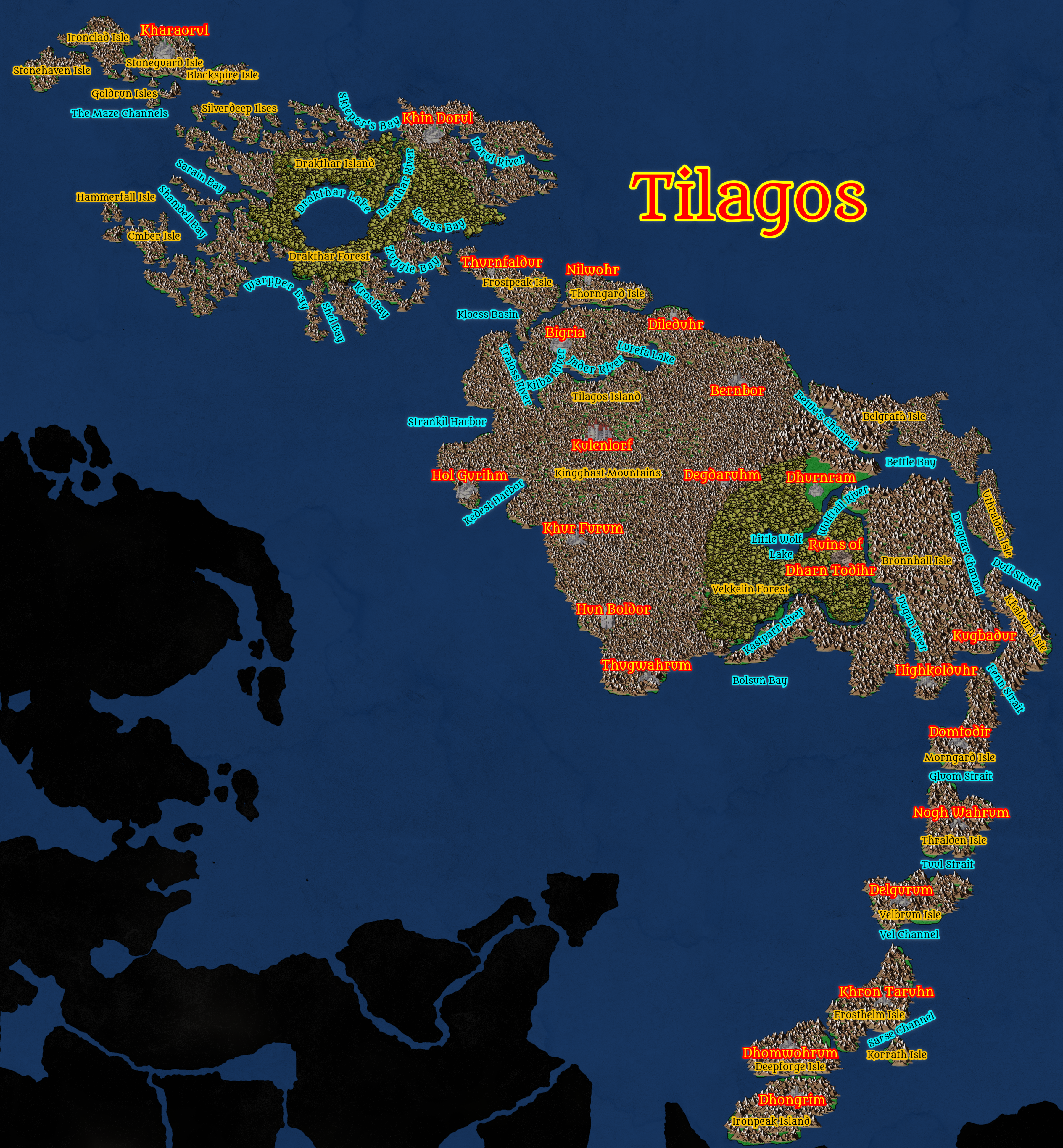
GeographyTilagos is a sprawling kingdom of the Southern Islands, a realm where rugged mountains, fertile valleys, frozen tundras, and volcanic coasts coexist in dramatic contrast. The kingdom is composed of 22 islands, each with its own unique geography and resources, but together forming a cohesive network of Dwarven settlements and strongholds. The main island is divided into three prominent regions: the Central Forest, a dense expanse of towering trees and winding rivers that provide timber, game, and natural resources; the Small Plains, fertile stretches of grasslands and meadows suitable for limited agriculture and livestock grazing; and the Mountains, jagged peaks and deep valleys rich with iron, mithril, gems, and other precious minerals. Hidden caves, subterranean rivers, and ancient tunnels weave through these mountains, forming the backbone of Tilagos' underground cities and mines. The second largest island has a similar geography, with dense forests and towering mountains, though it lacks plains. Its rugged terrain makes it a strategic stronghold, while its mountains harbor untapped mineral wealth. The remaining islands vary in size and character: some are volcanic, with molten rock and black sand coasts, while others are massive with frozen peaks, hosting hardy Dwarven mining outposts. Few islands are fertile enough to support settlements, So are dependent on tradewith the main island's orchards, and pastures. Most serve specialized purposes, mining, crafting, fortification, or trade. Tilagos' maritime geography is as important as its land. Deep natural harbors, treacherous coastal cliffs, and hidden bays make naval travel challenging but secure. Many islands are connected by a network of sea routes patrolled by Dwarven naval forces, ensuring safe transport of goods, miners, and craftsmen. Overall, Tilagos' geography is a reflection of Dwarven resilience and ingenuity, harsh, beautiful, and resource-rich, offering both formidable defenses and abundant opportunities for industry, trade, and settlement. Regions of TilagosMain Island: Tilagos Island; Capital island with the royal palace, largest underground city, central markets, and ceremonial halls.
Second Largest Island: Drakthar Island
Other Notable Islands
HistoryThe Kingdom Tilagos traces its origins back more than two thousand years, to a time of scattered mountain clans, independent strongholds, and fierce tribal rivalries. These early dwarven settlements, dug into the shielded ridges and fire-veined roots of the Stonearth Range, were isolated, bound by shared ancestry but divided by custom,, and ancient grudges. That era of fragmentation came to an end with the rise of Kulenmor Ironmantle, a visionary warlord and priest of Moradin, who would forge a crown from unity and steel. Kulenmor, remembered in songs and carved effigies as "the Flame-Bound," led the Great March of Anvils, a military and spiritual campaign designed to unite all clans under a single banner. Through diplomacy, battle, ritual, and the forging of sacred oaths, Kulenmor succeeded in creating what is now known as the First High Thainate. In the newly established capital of Kulenlorf, named in his honor, clans swore fealty not out of fear, but reverence, believing the Flame-Bound Thain to be personally guided by Moradin himself. Long before the dwarves claimed this highland expanse, ancient structures littered the deep valleys and subterranean tunnels, runed obelisks, collapsed citadels, and strange stonework vastly predating dwarven craftsmanship. Though the exact origin of these ruins remains unknown, dwarven lore keepers believe them to be remnants of an elder civilization lost to time and fire, their purpose and fate obscured by Dumathoin's deepsilence. Some whisper that the Brathmordakin themselves destroyed them when forging the world anew for dwarvenkind. Following the founding, Tilagos entered a transformative era marked by the Great Wars of Unification. These centuries of conflict tested the honor and strength of the young kingdom, as some holdouts resisted Kulenmorian rule. The Age of Iron soon followed, a time of booming forgecraft, deep mining ventures, and the construction of Tilagos's legendary subterranean roads, vault-temples, and hoard-halls. Trade flourished beneath the surface, and Tilagos became not just a kingdom of clanholds, but a beacon of dwarven civilization across the highlands. The High Thains, elected from among the ruling Thains of the great cities and confirmed by the clergy of Berronar and Moradin, oversaw a realm governed by blood, stone, and scripture. Thainic law was etched in copper tablets, and every stronghold kept records dating back to the founding, ensuring continuity of tradition across generations. Despite its strength, Tilagos has never known uninterrupted peace. Its borders have endured orcish raids, giant incursions, plagues from the deep, and three civil schisms, most notably the War of Fractured Anvils, when the northern clans attempted secession during the Third Forgelord's reign. Yet through each trial, the dwarves of Tilagos stood resolute, bound together by the Brathmordakin's light and the indomitable will of the stone. In the present era, Tilagos thrives as a bastion of dwarven heritage. The halls of Kulenlorf still echo with the voice of the High Thain, and ancestral banners line the deep-arched causeways. While modern challenges brew beyond the mountain ridges and old tensions stir in the mines below, the kingdom moves forward with the same slow, steadfast certainty as the bedrock from which it rose. CultureTilagosian culture is a living monument to the values of the dwarven soul, or, craftsmanship, kinship, and reverence for the ancestral past. the soaring vaults of Kulenlorf to the coastal halls of Clan Stonereef, every facet of life within the is imbued with a sense of communal purpose and unshakable tradition. Each stronghold and city under the Thainic banner is fiercely proud of its lineage, tracing bloodlines and titles across centuries carved into stone tablets and iron seals. These lineages are honored with family shrines, ancestral relics, and annual rites of remembrance called the Kinbinding, where dwarves reaffirm their clan ties through oath, feast, and flame. Public memory is maintained by the Skalds of Tilagos, respected historians, orators, and poets who travel from hold to hold to sing the sagas of ancient triumphs, tragedies, and the divine deeds of the Brathmordakin. Architecturally, Tilagosian society reflects both practical necessity and sacred artistry. Stonework is geometric, monumental, and intricately engraved with protective runes and ancestral motifs. Doors are typically framed with heraldic crests, and ceilings shaped like inverted vaults, symbols of the dwarves' dominion beneath the earth. Forges are not simply workshops, but places of worship, where the act of creation honors Moradin's divine gift. Every anvil strike is part prayer, part craft. Craftsmanship is woven into everyday identity, from stonemasons who sculpt bridge buttresses to jewelers who inlay heirloom torcs and armor with painstaking precision. Apprentices begin their training in their youth, often taking a family trade or swearing guild allegiance under the watchful eyes of elders. Competitions of craft are held during seasonal festivals such as the Embermoot, a week-long gathering where master smiths display their work, and new tools or techniques are unveiled and celebrated. Tilagosian festivals often mirror the cycles of the mountain and forge rather than the sky above. Seasonal rites mark mine blessings, forge-lightings, marriage oaths, ancestor recalls, and milestones in Thainic governance. Many cities celebrate a localized holy day in honor of their patron god, Kulenlorf, for instance, hosts the Brightforge Convocation in Moradin's name. Coastal holds celebrate vessel-launchings and distant trade with floating harvest feasts, lighting lanterns on the sea to appease lesser spirits and guide returning ships. Social life is centered around communal spaces such as mead halls, bath-houses, central hearths, guild lodges, and public forges. Debate and storytelling are common pastimes, with evenings given to song duels, game boards of stone and bone, and long toasts in honor of gods, ancestors, and the High Thain. Music is percussive and choral, using deep drums and resonant horns to stir the spirit or summon solemnity, often echoing the rhythm of forge-hammers. Traditional dances are measured and circular, mimicking the turning of wheel or compass, symbols of completion and unity. A deep devotion to the land and its hidden forces permeates everyday life. Though dwarves venerate the gods of the Brathmordakin, they also pay respect to stone spirits, forge-wisps, and watchful ancestors believed to inhabit sacred sites. Small offerings, gems, carved tokens, braids of hair, or bits of raw ore, are left at fissures, shrine-cairns, or flowing hot springs known to shelter elemental favor. Hospitality is held as deeply sacred, a command of both Berronar's mercy and Gorm Gulthyn's vigilance. A guest under one's roof is afforded a measure of safety and dignity, and even feuding clans observe truce rites when crossing certain thresholds, especially during holy tides. To violate such customs is to invite shame and divine reprisal, something no Tilagosian dares lightly. Tilagos resonates with disciplined passion, a culture slow to change, but fiercely creative within the bounds of tradition. It is a society where songs recall not only the past but mend the present, where every forge burns with stories, and where each dwarf lives as both heir and steward of a legacy written into the very bones of the earth. EconomyThe economy of Tilagos is a testament to the union of resource abundance and disciplined craftsmanship, shaped by millennia of labor beneath mountain and wave. As with all aspects of dwarven life, the economic framework is guided by tradition, clan cooperation, and meticulous planning. Self-sufficiency and sustainable exploitation of natural wealth remain the foundational tenets of Tilagosian commerce, though trade with surface realms and distant islands provides additional prosperity and cultural exchange. Mining is the cornerstone of the kingdom's wealth, a tradition as old as the halls themselves. The mountains of central Tilagos are laced with rich veins of iron, copper, silver, and mithril, along with deposits of elemental crystal, jet, and rare gems. Dwarven delvers employ both magic and mechanical ingenuity to tunnel without collapse, guided by generations of stone-lore passed from master to apprentice. Mineblessing is a sacred practice, with new shafts opened only after solemn rituals to Dumathoin, the Keeper of Secrets Under the Mountain. Metallurgy, fueled by this mineral surplus, is perfected in the countless forges of Tilagos, especially in Deephearth and Kulenlorf, where the Iron Guilds hold centuries-old patents on famed techniques such as flamefolded steel and rune-tempered alloy. Blacksmiths, armorers, and engineers harness ancestral methods and divine inspiration in their work. Dwarven steel from Tilagos is envied across the known world for its resilience and balance, and each blade or hammer bears a maker's mark that ensures its legacy. Artisanal skills extend beyond weaponry. Tilagos is known for its intricately carved stoneware, gemstone inlays, runic jewelry, mechanical time-keepers, and codified mapwork etched in electrum plates. The Kingdom's craft exports are high-value and tightly regulated, guilds oversee quality, regulate apprenticeships, and negotiate standing trade charters with favored foreign buyers. Agriculture in Tilagos is adapted to a stony, mountainous terrain. Terrace-farming and subterranean mushroom cultivation thrive across the Heartland Holds, where root vegetables, ryegrain, and fungal meats grow year-round under lanternlight and alchemical heating. Fungal brews, smoked tubers, and nutrient-rich mosscakes form the nutritional bedrock of many Tilagosian households. Orchards near lower hill valleys produce tart fruits and berry wines prized in both sacred feasts and festival markets. Timber is a vital industry in the eastern woodlands and outer islands, managed sustainably by druidic orders allied with Marthammor Duin and Thard Harr. The controlled logging efforts provide the framework for the kingdom's highly advanced shipbuilding sectors. Though landlocked holds deal largely in subterranean innovation, the coastal cities, particularly Thugwahrum, Hol Gurihm, and Highkolduhr, are hubs of naval construction. Their stonelaid drydocks yield merchant vessels, warships, and long-haul ore barges capable of surviving arctic current and sea leviathan alike. The northern ports border the frigid Ethereal Ocean and support dynamic economies rooted in fisheries, whaling, and arctic exploration. Harpoon fleets sail in synchrony with seasonal migrations of skywhales and deep behemoths, returning with bone, oil, hide, and eye-stone, used in high alchemy and luxury crafting. These goods serve religious and industrial needs across the realm and are increasingly exported to realm-kin and human principalities. The southern isles of Tilagos, such as Ironpeak and Deepforge, engage in commerce via the Emberline, an ancient seatrade corridor connecting distant spice archipelagos, coral kingdoms, and jungle-front cities. Here, dwarven merchant clans operate salt markets, exotic dye exchanges, and gemstone caravans. Limited sugar cultivation paired with rum distillation marks the southern economy as a hub for indulgent goods, stimulating both goldflow and cultural fusion. Domestic trade relies on the Deeproads, a subterranean highway system carved through mountain roots and reinforced with enchanted stone to resist tremors. These roads, patrolled by Gorm Gulthyn's faithful and maintained by the Artisan Guilds, support ore convoys, caravan columns, and messenger runescouriers. Inns, supply halls, and stone-camps dot the roads, stocked with provisions and warded against beasts. Currency in Tilagos takes multiple forms, stamped coinage, runebars, and stone-chits, each allocated by regional banks that trace their origin to temples of Vergadain, the Merchant-King. Gems can also serve as tokens of value or promissory offerings during formal transactions, depending on the context of the deal and its parties' status. In international dealings, Tilagos maintains long-standing trade pacts with elven wood-kingdoms, the bannered human alliances of the western lowlands, the merchant lords of the southern coast, and the sea-serpent emissaries of the Spire Shoals. Trade goods include steel and arms, alchemical reagents, ship parts, polished stone, enchanted implements, preserved foods, and grain spirits. In return, the dwarves import silks, rare papers, enchanted inks, livestock breeds, and aromatic spices. While largely conservative in economic growth, Tilagos remains stable, self-reliant, and skilled in expansion through necessity rather than luxury. The economy, like their stone-crafted halls, is built to endure across generations without collapse. Tilagos does not measure wealth by coin alone. In dwarven philosophy, true prosperity lies in the strength of its people, the skill of its craft, the depth of its mines, and the enduring worth of its word. These values echo in every ledger, every trade oath, and every strike of the forge. Government and SocietyThe governance of Tilagos is a reflection of its culture, structured, enduring, and rooted in both tradition and merit. The kingdom is led by the High Thain, a sovereign who rules from the ancestral citadel of Kulenlorf, beneath carved stone domes and iron standards bearing lineages thousands of years old. Though the High Thain holds supreme authority in word and decree, their power is balanced through the long-honored institution of the Council of Thains and the sacred obligations placed upon the monarchy by law, faith, and the will of the clans. Each major dwarven hold throughout Tilagos is ruled by a Thain, a territorial noble and steward of their city's well-being. While the position of High Thain is traditionally passed through hereditary lines, it is not absolute. Candidates must be confirmed both by the Council of Thains and, most significantly, by the anointed Voice of the Forge, a spiritual representative tasked with divinely discerning the worth of any potential ruler through ancient rites, oaths, and communion with the Brathmordakin. Society in Tilagos is layered but not rigid. While noble status, granted through bloodline, extraordinary service, or divine favor, affords great privilege and responsibility, it is social honor, not simply heritage, that defines one's standing. A craftsman of unrivaled skill, a soldier who defends his hold with valor, or a priest who guides with wisdom can earn titles, lands, or even a seat among the city councils. Guilds and religious orders often wield influence equal to minor noble houses, and upward mobility is enshrined in both civil law and Brathmordakin teachings. The everyday governing apparatus of Tilagos is intertwined with communal and divine institutions. Law is memorized in stone, each city etching their updated statutes in open forum walls and vault records inspected by lorekeepers and magistrates. Appeals are handled first in clan tribunals, then guild councils, and if necessary, passed to the thainic throne itself. Punishments favor recompense and oathbond correction over executions, except in high crimes such as oathbreaking, betrayal during wartime, or treason against the gods. Citizenship is defined not only by birth but by oath. Those who join dwarven society from afar, merchant kin, exiles who redeem their lineages, or noble allies from allied kingdoms, may take part in life-long rituals called the Binding of Ironroot, whereby they are formally adopted into a clan and granted all rights therein. There are no serfs or slaves in Tilagos: all freeborn individuals are expected to contribute to the realm's prosperity, and their worth is judged by the strength of their craft, word, or service. Social strata are broadly recognized as follows:
Faith is interwoven into governance. No Thain may rule without the blessing (and oversight) of the Temple of the Brathmordakin. Oaths of office, contracts of trade, and laws of inheritance are often inseparable from religious observance. Temples maintain their own records of law and community disputes, and their scribes ensure that divine law is not violated, a responsibility taken seriously by all but the most reckless of lords. The Council of ThainsAt the heart of Tilagos's federal-civic unity lies the Council of Thains, a governing conclave composed of the leaders of every major dwarven hold within the kingdom. The Council functions in tandem with the High Thain, blessing the throne with legitimacy and checking it with deliberated consensus. Together, they shape both the letter and soul of dwarven law. The Council meets quarterly in Kulenlorf within the Hall of Granite Voices during grand conclaves known collectively as the Allthains. These seasonal assemblies not only dictate national policy but affirm the cultural year, marking cycles of tradition, rulership, and remembrance.
Allthains of the YearEach Allthain marks not only a political session but a cultural turning point, and each is surrounded by festivals, public announcements, performances, and diplomatic receptions. The customs associated with each are considered sacred time across Tilagos.
Attendance at the Allthains is mandatory for every recognized Thain. Absence without grave cause, such as illness verified by temple physicians, is met with severe consequence, ranging from temporary loss of Council voting rights to full banishment from Thainic status. This ensures continuity, cohesion, and the uninterrupted chain of dwarven governance. Through this ordered and venerable system, Tilagos has endured for centuries with little internal collapse. The balance between divine mandate, clan tradition, and structured meritocracy allows its society to evolve slowly yet securely, like stone shaping water, it bends with time but never breaks. Governance in Tilagos is not merely statecraft; it is sacred stewardship of a legacy as old as the mountains themselves. MilitaryThe military of Tilagos, known throughout the region as the Iron Hosts, stands as a symbol of dwarven discipline, strategy, and unyielding defense. Forged in the fires of ancient wars and tempered by centuries of vigilance, the Iron Hosts are not merely a single army but a tiered, regionally organized force composed of standing regiments, city-based levies, elite companies, and a powerful naval fleet. Each component works in rhythmic coordination with the others, much like a forge mechanism turning under masterful hands. Command of the Iron Hosts is divided between local Thains, who maintain their own garrisons and militia forces, and the High Thain of Kulenlorf, who oversees the realm's royal legions and high command. While each city-hold fields its standing cohorts, ranging from shield walls to tunnel scouts, all swear oaths to the Iron Pact, a sacred compact binding them in common defense of the kingdom. These oaths are registered in stone annals and honored by penalties as severe as clan excommunication or divine censure. The Iron Hosts are trained from youth in the art of war, often beginning their apprenticeship in clanwatch duties or guild-sponsored defense drills. Martial education includes heavy arms, shield wall discipline, siege tactics, subterranean warfare, and increasingly, naval operations. Training often takes place within subterranean arenas or deep-routed war caverns known as Stoneholds, massive chambers carved for the purpose of hammer-combat, spear formations, and maneuver drills. Branch Structure and Specializations
Elite Orders Among the vast ranks of the Iron Hosts, a few elite units stand apart by rite, reputation, and regalia:
The Tilagosian Navy: Pride of the Deeps and Currents Despite dwarven stereotypes of being landlocked, the coastal cities and island outposts of Tilagos boast one of the most advanced seafaring forces. The Navy is headquartered jointly at Hol Gurihm and Dileduhr. These naval bastions launch ships of ironwood and rune-inked hulls, vessels specially designed to endure arctic flow, leviathan pressures, and elemental tides. Tilagosian warships range from swift skirmish sloops, used to intercept pirates and engage corsairs, to defensive juggernauts, floating fortresses that demand tides bend or break. Naval officers are trained in formation sailing, seabeast engagement, and elemental storm channels. Local fishers and whalers often double as naval scouts, while harpoon-tailed triremes enforce trade consistency through the kingdom. The Royal Fleet's flagships, Thunderwake, Oathbreaker, and Berronar's Shield, stand as symbols of national pride, frequently mooring at diplomatic ports during high treaties or festivals. Naval veterans are honored with tattoos and salt-forged medalry, and ship names are remembered in saga-form by the coastal Skalds. Military Philosophy Above all, Tilagosian military strategy is defined by discipline, inter-coordination, and adaptability. War is viewed less as glory and more as sacred necessity, a crucible within which loyalty and purpose are manifest. The Brathmordakin are invoked before every march, and no campaign begins without the reading of ancestral battle-chants carved upon shield and helm. Beyond brute strength, Tilagos excels in maintaining layered defense networks, mountain watchstations, rune-wards, observatory beacons, and subterranean bunkers that house stockpiles of arms, medicine, and lore-ready tacticians. Civilian militias train regularly, and defensive tenets are taught as part of childhood education in all holds. While constantly prepared for conflict, the realm of Tilagos does not warmonger. Its armies are slow to anger but relentless once roused. To raise a banner in war is seen as invoking the Brathmordakin's eyes, and must be done with honor, purpose, and unwavering resolve. In the end, the Iron Hosts do not fight for conquest or ambition, they rise for kin, for stone, and for the sacred legacy entrusted to them by blood and god alike. Their shields are the wall behind which Tilagos dreams, and their axes the final word spoken when peace is no longer heeded. ReligionThe Brathmordakin , The Sacred Pantheon of the Dwarves "In the deep places of the world, where stone sings and fire never dies, the gods still hammer at the forge of eternity." Among the deep places of Tilagos, where veins of ore glimmer like stars in the dark and the forges burn without end, the dwarves revere the Brathmordakin, the Sacred Pantheon of their people. These gods are not distant or abstract; they are the very essence of dwarven identity, carved into stone and breathed into the rhythm of hammers and heartbeats alike. The Brathmordakin embody the ideals of creation, endurance, and kinship. Every oath sworn, every weapon forged, every hall raised in Tilagos carries their presence. The dwarves hold that the Brathmordakin dwell within the heart of the world itself, their divine forge burning in the molten core, ever shaping both the souls of dwarves and the stone around them. The Origin of the Brathmordakin Dwarven cosmology tells that before all ages, there was only the Forge of Souls, a cosmic anvil set upon the bones of the world. From its fire rose Moradin, the Soul-Forger, first among the gods. With hammer and flame, he shaped the dwarves from living stone and tempered them in the fire of endurance. Other gods emerged from that same spark, each born of the same divine forge, yet embodying a distinct aspect of dwarven life: duty, family, labor, discovery, and death. Together, they formed the Brathmordakin, bound not by hierarchy but by purpose, to guide the dwarves as their eternal kin and guardians. Core Principles of Dwarven Faith
The Greater Brathmordakin
The Gods of the Shadowed Path
Rites and Rituals of Dwarven Worship
Ancestral Reverence Beyond the gods themselves, dwarves revere their ancestors as living intermediaries between mortal and divine. Shrines to the forebears, crafted from ash and stone, stand in every home. Candles burn before carved likenesses, where dwarves whisper thanks, advice, or apology. These honored spirits are believed to commune directly with the Brathmordakin and watch over their descendants. The Divine Echo of the Stones The Brathmordakin endure not as myth, but as living tradition, a faith forged in stone, blood, and fire. Every hall of Tilagos resounds with their presence; every hammer blow is their hymn. To live in the service of the Brathmordakin is not an easy path, but a righteous one. Theirs is the song of the forge and the heartbeat of the mountain. When the forges fall silent and the stone claims all, dwarves believe the gods still whisper in the mountain's breath, forever watching, forever waiting, for kin who live by stone, steel, and song. "In the depths where no light shines, faith alone burns eternal." The LawIn Tilagos, law is not merely governance, it is sanctity embodied in word, stone, and song. Known among the dwarves as the Old Law, the legal code of Tilagos binds clan to clan, citizen to ruler, and dwarf to god. These laws are etched upon copperplates, runestones, and temple walls, handed down across generations with only occasional amendments, each requiring the consent of the Thainic Council and a divine rite of recognition. Law in Tilagos is lived, sworn, and sung; it is a sacred trust that traces its origins to the founding of the High Thainate and even earlier, to the ancient compact made between the dwarves and the Brathmordakin. Every stronghold or city-hold within the realm maintains a version of the Old Law, tailored with local addenda but always honoring its core pillars: Honor, Oath, Kin, Craft, and Protection. City Thains serve as the primary justiciars, personally presiding over major cases or appointing judges from among senior lorekeepers and high priests. Trials are open to the public and follow a strict ritual format wherein the accused may present their case, supported by Testing Oaths, statements sworn upon holy relics or forge-bound tokens. Witnesses are summoned under pain of perjury, and false testimony is considered a grave sin equivalent to oathbreaking. Appeals to the High Thain's court in Kulenlorf are rare and reserved for high-profile disputes between noble houses, guild grievances beyond local jurisdiction, or any case involving questions of succession, divine heresy, or crimes thought to endanger the unity of the realm. The High Thain's dais, known as the Shielded Hall, is sanctified by both the Forge Priesthood and the Skaldic Circle, ensuring that all judgments echo not only civil authority but legacy and faith. Major Offenses and Consequences
The Skalds and the Memory of Justice In Tilagos, justice is not simply recorded, it is immortalized. The Skalds of the Realm serve not only as entertainers and historians, but as witnesses and guardians of law. Their impeccable memory, trained through ritual and divine blessing, ensures that all major legal proceedings are preserved in both song and stone. Every verdict rendered by a Thain or High Thain is sung into the Echo Hymns, bardic records that recount trials, rulings, and lessons as part of the collective dwarven saga. These songs are passed from skald to skald and are drawn upon when establishing precedent during future tribunals. It is considered a high honor, or a stinging shame, to have one's name echoed in the Voice of Judgment sagas. Skalds cannot lie, for their tongues are bound by oath and tradition; tampering with bardic memory is an act of erasing history, and thus a severe blasphemy punished by rune-burning or exile. Forms of Justice Justice in Tilagos takes several forms, chosen based on the nature of the crime, the accused's station, and whether divine matters are at stake:
Restitution and Mercy Tilagosian law, while strict, is not without mercy. Compensation through service, public penance, ritual pilgrimage, or oath-renewal is encouraged in lower cases. Priests of Berronar have the right to invoke the Mercy Clause, an ancient law allowing redemption through hardship, often sending offenders to serve in forge-shrines, battlefront aid stations, or reconciliation caravans seeking to repair damages wrought by their deeds. Even in punishment, the goal is to restore balance, heal the wound to community, and protect the integrity of clan and kingdom. Execution is only invoked when spirit or kin cannot recover from the harm committed. Honor as the Fifth Pillar In Tilagos, honor is more than a virtue, it is the foundation of lawful society. One's word is their bond, and once spoken before witness and god, an oath carries weight equal to law. Breaking an oath is not simply a personal failing, it is seen as an act of spiritual decay that stains one's name across generations. Many dwarves request oaths to be carved onto family stones or etched upon tradeblades, visible to kin and carried for life. In this way, law and life are inextricably linked in Tilagos, a world where judgement is not just a function of authority, but a sacred act of remembering who we are, who we've vowed to be, and the stone-deep consequences of breaking faith with either. PopulationTotal Population: Approximately 2.5 million.
The vast majority of Tilagos' inhabitants are dwarves, descended from the exiled survivors of Kharaz'Drak and the clans that later united beneath the banners of the High Thain. The dwarves are spread across mountain citadels, deep halls, and surface fortresses carved from the living stone of the Tilagos Range. Their population is concentrated in the great strongholds and mining holds of the interior, while smaller surface communities cluster around trade roads and forges that never sleep. The remaining three percent of the population, collectively referred to as "the Others", are made up of traders, diplomats, and settlers from neighboring realms. These include humans, elven envoys from Arethane, gnomish engineers seeking dwarven patronage, and a few halfling merchants who have earned the trust of the Thains. Though few in number, these outsiders are respected for their service to the realm and live under the protection of dwarven law, contributing to Tilagos' growing network of trade and diplomacy beyond the mountains. Cities of Tilagos
|