Kingdom of Valigor
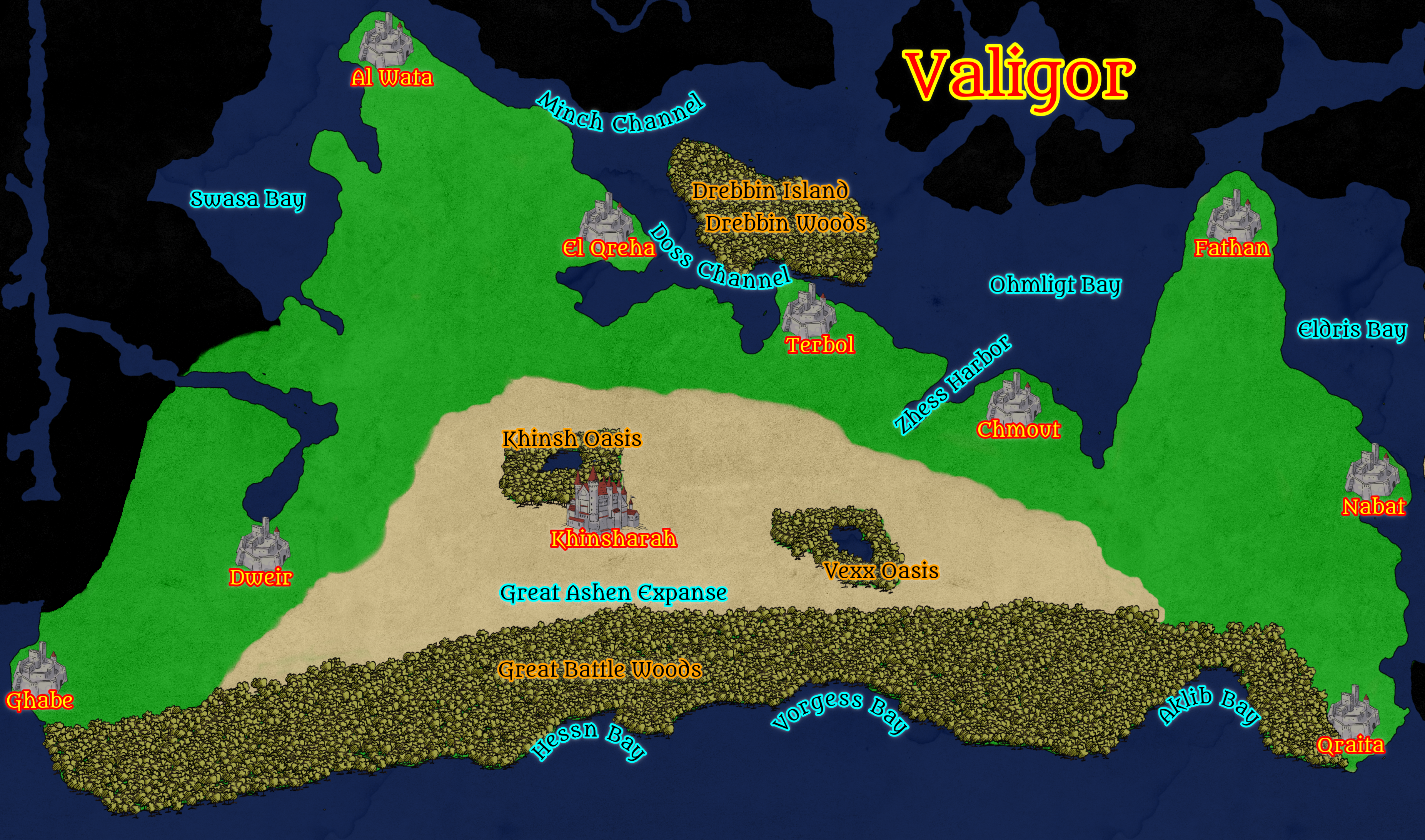
GeographyBeyond the capital, Valigor stretches into a harsh and unforgiving landscape, a tapestry of rugged valleys, burning deserts, and forgotten ruins that whisper tales of empires long erased by time and sand. The desert itself seems alive, its winds carrying the echoes of forgotten cities and the wails of rulers who sought dominion over the barren lands. Half-buried stone cities emerge from the dunes like jagged teeth, their walls etched with weathered symbols whose meanings are lost to the ages. Towering obelisks pierce the horizon, engraved with runes that shimmer faintly in the heat haze, warning travelers of both the power and folly of those who came before. Tombs of kings and warlords lie hidden beneath dunes, their entrances sealed by stone and magic, yet sometimes disturbed by the relentless winds, revealing treasures, and curses, to the unwary. Legends tell of kingdoms that flourished where now only sand stretches endlessly, their armies crushed not by rivals but by the relentless desert itself, and their grand libraries swallowed by storms of dust. Travelers and scholars speak in hushed tones of the "Sunken Cities," where ghostly silhouettes glide between crumbling columns at dusk, a reminder that even the mightiest fall to time’s unyielding grasp. Merchants and caravans often avoid these ruins, wary of sudden sandstorms or mysterious disappearances, though some daring treasure-seekers brave the deserts in search of lost artifacts and forbidden knowledge. To the south, the landscape softens into the Great Battle Woods, a vast forest scarred by centuries of conflict. Here, the canopy is dense and shadowed, the air thick with the scent of pine, iron, and damp earth. Ancient trees rise like silent sentinels, their trunks etched with the marks of old wars, deep gouges from axes, scorch marks from magical fires, and carvings left by armies long gone. Legends claim that entire regiments vanished within these woods, their banners still whispered to flutter in the wind long after their deaths. The forest is alive with creatures both natural and unnatural, prowling predators, enchanted beasts, and spirits of fallen soldiers who wander, bound to the land by unresolved battles. Paths twist unpredictably, and those who enter unprepared often find themselves retracing steps they never intended to take, as if the forest itself reshapes to guard its secrets. The Great Battle Woods stand as a living testament to Valigor's history of conquest and survival, a place where the past and present intertwine, and where only the most vigilant or the most foolhardy dare to tread. It is a region of both peril and promise, a natural fortress, and a repository of the realm’s deepest mysteries. Culture and SocietyValigor's culture is one of endurance through scarcity and strength through struggle. The kingdom's harsh desert landscape has shaped its people into survivors who prize self-reliance, resilience, and combat prowess. In Valigor, every drop of water is precious, every scrap of shade is a gift, and every piece of metal is forged through blood, sweat, and effort. This scarcity of resources has bred a society that values hardship as a pathway to greatness and struggle as the very foundation of existence. The desert teaches a brutal lesson, only the strong survive, and those who falter are consumed by the sands. Warrior Ethos The heart of Valigor's culture beats with the rhythm of battle. From an early age, every Valigoran is trained in the arts of war, for survival in the desert is a constant fight against the land itself. Combat is not just a means of defense, it is a rite of passage, a sacred duty, and the very fabric of society. The strongest among them rise to positions of leadership, while those who fail to demonstrate their worth are relegated to the harshest of fates. The Trial of Strength, an ancient rite, is the cornerstone of Valigoran society. It is a test of both physical prowess and mental fortitude, where warriors compete in deadly contests of skill, endurance, and will. Victory in the Trial of Strength brings glory, land, and the respect of the people, while failure means dishonor, exile, or even death. The Warlord-King of Valigor is chosen through the Trial, with only the strongest of warriors ever rising to the throne. The title is not inherited, it is earned, and the crown is but another weapon in the hands of the king. The Role of Honor Honor is the bedrock of Valigoran society. It is not defined by wealth or birthright, but by the warrior's skill in battle, their courage in the face of adversity, and their loyalty to their clan. A warrior's honor is marked by their deeds, each scar, each victory, each triumph is a symbol of their strength and their place in society. The Code of Blood, an unwritten but deeply respected law, dictates that loyalty to one's clan and bloodline is sacred. Betrayal is met with swift and brutal punishment, while acts of valor are celebrated with the highest honors. Valigoran warriors wear symbols of honor, tattoos, scars, and ceremonial war paint that mark their victories and status. A warrior's armor is often adorned with the marks of their deeds: the number of enemies slain, the battles fought, and the hardships endured. These marks are not just for show, they are testaments to a life lived with purpose and strength. The greatest warriors are often legendary figures, with stories of their deeds passed down through the generations. The honor of one's family or clan is paramount, and a warrior's legacy is their most prized possession. The Desert Code In a land where life is a constant battle against the elements, survival is its own form of honor. The Desert Code governs every aspect of life in Valigor, emphasizing the necessity of self-sufficiency, courage, and unyielding determination. The Code dictates that no warrior should ever rely on another for survival, each must earn their place in the world through their own strength. This brutal ethos has created a fiercely independent society where self-reliance is a point of pride, and those who fail to carry their weight are left to the desert's mercy. The desert itself is the greatest teacher in Valigor, and those who live by its laws are deemed worthy of respect. Respect for the land is taught from birth, never to waste water, never to waste food, and always to live in harmony with the unforgiving environment. Valigorans view the desert not as an enemy to be defeated, but as a living entity to be respected. Those who fail to respect its power find themselves swept away by the storms. Life in the Cities and Tribes Valigoran society is structured around a combination of tribal clans and fortified cities, each governed by its own chief or warlord. While the cities, such as Gorhald, are centers of power and wealth, the heart of Valigor beats in the tribal territories that stretch across the desert. These tribes are often in competition for resources, land, and honor, engaging in both alliances and blood feuds to establish dominance. The tribal hierarchy is built on a system of strength, where the warlords rule through their military might and ability to conquer and protect their people. Despite the competitive nature of these tribes, there exists an overarching respect for the chain of command. The Warlord-King, who holds the title of monarch, is the ultimate authority and is considered the embodiment of the kingdom's strength and will. Below him are the Clan Chiefs, each leading their own tribe and vowing allegiance to the crown. While these chiefs often maintain a great deal of autonomy, their power is always subordinate to the king, and the kingdom's military strength lies in the unity of its tribes. Community and Loyalty In a land where resources are scarce, community and loyalty are the glue that binds Valigor's people together. Families and clans are tightly-knit, with each member having a defined role to play. The strong protect the weak, and the elderly are respected for their wisdom and experience. Children are raised to become warriors, while women are revered for their strength in managing the household and contributing to the survival of the tribe. Honor and respect are the currency of Valigor, and to lose face is to be cast into the wasteland, abandoned by those who once called you family. Each clan has its own rituals and customs that are passed down through generations. The most sacred of these are the coming-of-age trials, where the youth are tested in various forms of combat, survival, and strength. These trials are not only physical tests, but spiritual ones as well, marking the transition from child to warrior. It is in these moments that a young Valigoran truly begins their journey in life, earning their place in the hierarchy of society. The Role of Religion and Shamanism Valigor's religion is deeply intertwined with the kingdom's culture of strength and survival. The gods of the Iron Pantheon are believed to watch over the people, guiding them in their struggle to endure and conquer. Shamans and warpriests are the spiritual leaders of Valigor, interpreting the will of the gods through omens and rituals. They serve as advisors to the warlords, offering counsel before battle and interpreting signs from the desert itself. The spiritual leaders of Valigor are as feared and respected as the warriors, for they hold the power to bless or curse individuals based on their actions. The most revered are those who can commune directly with the gods, offering sacrifices in times of great need and blessing warriors before they embark on raids or battles. However, the gods of Valigor do not reward weakness, and it is only through strength and sacrifice that the people can earn the gods' favor. Ultimately, Valigor's culture is built upon a foundation of sacrifice, honor, and strength, traits that are essential for survival in such a brutal and unforgiving land. It is a kingdom that thrives not despite its harsh conditions, but because of them, where only the strongest of heart and will can carve out a place in the world. The Warrior CreedValigor's Humans see battle not merely as glory, but as necessity. They believe conflict is the crucible through which strength is forged , both physical and spiritual. Every tribe and fortress-city maintains warbands that roam the dunes, protecting caravans, raiding rivals, and hunting monstrous desert beasts. Combat serves as ritual, judgment, and sport. Duels at sunrise settle disputes, while great gladiatorial events , the Games of the Burning Sun , are held at the turning of each season, celebrating endurance and ferocity. Rites and MarkingsIn Valigor, the body is a living canvas, a sacred testament to a warrior's journey through life. Every marking, every scar, and every layer of paint is imbued with spiritual significance, a visual record of the trials, victories, and sacrifices that define the warrior's place in society. These rites and markings are not just decoration, but sacred symbols of a life lived in the shadow of the desert gods. Tattoos: Tattoos in Valigor are much more than ink on skin, they are prayers, oaths, and family histories made permanent. They are crafted from soot mixed with desert clay, an ancient tradition passed down from the first warriors who survived the desert's unforgiving heat. The ink used for tattoos is sacred, made from the ash of sacred desert trees and the crushed remains of desert minerals, ensuring that each mark holds the power of the desert itself. Tattoos depict a warrior's victories, oaths, and lineage. A warrior who has won a great battle will have the symbol of the sun inked onto their chest, each ray of the sun representing a different foe defeated. A warrior who has completed the Trial of Strength will have a serpent winding up their arm, symbolizing both the endurance needed to survive and the venomous dangers that must be overcome. Tattoos that mark clan lineage are often placed across the back, with each warrior carrying the symbol of their ancestors. These marks signify that the blood of the clan flows within them and that they carry the weight of their lineage into battle. Each tattoo is more than a personal symbol, it is a sacred covenant with the gods. The act of receiving a tattoo is seen as an offering to the gods of the sun and sand, a bond between the warrior and the divine. When a tattoo is completed, the warrior must perform a personal rite of thanksgiving, offering a prayer and a sacrifice to the gods, ensuring that the ink on their skin brings not just pride, but divine favor in their struggles ahead. Scars: In Valigor, scarring is a deliberate and revered practice. Scars are marks of honor, symbols of survival and a testament to a warrior's trials. Young warriors undergo the Rite of Scarring upon coming of age, where they are subjected to ceremonial cuts, each incision representing a trial or challenge faced and conquered. These cuts are made carefully, with each scar representing not just physical pain but spiritual triumph. The scars are typically made across the chest, arms, or face, and each warrior has their scars in different patterns, with some being straight lines and others more intricate, depicting the journeys they have walked. A warrior who has survived a particularly difficult battle might scar themselves with a spiral pattern, symbolizing the labyrinthine struggle of life in the desert. These scars are treated with oils and herbal salves to ensure they heal properly and become as permanent as the warrior's connection to the gods. Every scar is a prayer, each cut is an offering to the gods, asking for their protection, strength, and favor in the trials to come. As warriors grow older and gain experience, they continue to scar themselves, each new mark reflecting a battle fought, a challenge overcome, or a promise made to their clan or to the gods. War Paint: Before every battle, the warriors of Valigor paint their faces and bodies with ochre dust and ash, a ritual that prepares them for the coming fight and invokes the protection of the desert gods. The paint is made from crushed ochre, mixed with ash from sacred fires that burn throughout the night before battle. This war paint is applied not just for appearance, but to forge a spiritual connection with the land itself, a way of invoking its strength and power before heading into the fray. The paint is not only for protection, it is also a way of marking the warrior's status and role. A warrior who is about to undertake a great raid will paint sun motifs around their eyes, symbolizing the divine favor of Arath-Kar, the god of the sun. Those preparing for the Trial of Strength will cover their faces in intricate patterns of desert storms, each stroke a visual reminder of the chaos and fury they must overcome. Warriors of high rank or those embarking on a sacred mission might paint symbols of the Iron Pantheon across their bodies, each god representing a different aspect of their strength, Thorgul's hammer, Vaela's winds, or Zhur's fire. This paint serves as an armor of faith and will, a shield against fear and doubt. After battle, the war paint is cleansed in a sacred river ceremony, where warriors strip off their marks, washing away the blood of combat. This act symbolizes that their deeds are done, and they are ready to return to the world as humble servants of the gods, cleansed and reborn for the next trial. Rites of Passage: The markings and rituals surrounding rites of passage are sacred to Valigoran society. As warriors mature, they undergo a series of initiations, each marked by the receiving of a new tattoo, scar, or war paint. The most significant of these is the Trial of the Sun, a grueling test of survival in the desert heat. After completing the trial, the warrior is adorned with a sunburst tattoo on their back, and their first scars are carved into their chest to mark their resilience. The Warrior's Walk is another important rite, where warriors must walk across the desert at midday, without food or water, to prove their endurance. Upon completing this, they are granted a tribal marking in the form of a wind pattern around their legs, symbolizing their journey through the harsh desert winds and their ability to persevere against all odds. In Valigor, these rites and markings serve as both spiritual acts and cultural declarations. They are visible signs of strength, honor, and survival, a way for the people of Valigor to remember the struggles of their past and to prepare for the battles of the future. Every tattoo, every scar, and every brush of war paint binds the warrior not only to their clan but also to the very land that has shaped their destiny. They are more than symbols of physical prowess; they are sacred promises to the gods, to their ancestors, and to the desert itself. ArchitectureValigoran architecture is a testament to the kingdom's resilience, resourcefulness, and pride. Every structure is designed not only to withstand the harsh desert environment but also to reflect the strength and endurance of the people who live within it. The buildings of Valigor are monumental in scale and function, built to survive the desert's fury and to embody the warrior spirit that defines the culture. Fortified Oases and Towers The cities of Valigor are fortified oases, where towering walls of sandstone and black basalt rise like teeth of a great beast from the vast expanse of desert sands. These towering fortresses are designed to defend against both invaders and the unforgiving desert storms that can sweep across the land without warning. The walls are thick and reinforced, built to withstand the heat, sand, and battering winds of the desert. The fortresses serve not just as military bastions, but as symbols of the people's unbreakable will to thrive in one of the harshest climates on the planet. The towers of Valigor's cities, often shaped like jagged spires, rise above the sands like fangs poised for battle. These towers are both defensive and ceremonial, serving as watchpoints to spot incoming threats and to signal the presence of hostile forces. In times of peace, the towers are used for rituals, war councils, and feasts, where leaders and warriors gather to discuss matters of state, battle, and culture. The high, piercing spires also act as beacons for travelers, guiding them safely to the oasis cities amidst the desert's vastness. Cisterns, Aqueducts, and Water Storage Water, the most precious resource in the desert, is stored and guarded with utmost care. Every Valigoran city is built around a deep cistern system, designed to capture and store the precious rainfall that occasionally blesses the desert. These cisterns are carved into the stone or dug deep beneath the cities, ensuring a steady supply of water in times of drought or siege. The aqueducts that connect these cisterns are marvels of engineering, bringing water from distant sources to quench the thirst of both the people and the land. These structures are vital to the survival of the kingdom and are treated with the reverence of sacred shrines. In each city, public fountains and water wells are common, but only those with high rank or special permission may access the most guarded cisterns that store the kingdom's lifeblood. As a result, water rights are as much a matter of honor and political power as they are a practical concern. The control of water is a symbol of strength, those who control the flow of water wield immense power in Valigor. Halls of Power Within the fortified cities, the great halls are where the kingdom's councils, feasts, and war rites are held. These halls are immense, hewn from the red sandstone of the desert itself. Carved with the likenesses of legendary warriors and ancient gods, the halls are both functional spaces for governance and places of worship and ritual. Their sheer size is meant to symbolize the strength and majesty of Valigor's rulers. The halls are always at the center of the city, often situated at the heart of the royal citadel or near the sacred River Thal that flows through Gorhald, the capital. In these halls, the Sunforged Monarch holds court, surrounded by their council of warlords, advisors, and priests. It is here that decrees are made, alliances are forged, and wars are declared. During feasts, warriors and citizens alike gather to celebrate victories, pay respects to the gods, and renew oaths of loyalty to their king and their land. Massive banquet tables line the halls, laden with desert game, fruit, and wine, a feast to honor the kingdom's strength and prosperity. The walls echo with the sounds of laughter, singing, and the clash of metal as warriors spar in celebration. Roofs and Climate Control In Valigor's desert cities, the sun's oppressive heat is ever-present. As a result, Valigoran architecture incorporates practical features to protect against the desert's blistering sun. Flat, domed roofs are the standard, reflecting the heat away from the buildings and providing cool spaces for relaxation and respite from the sun. These roofs are often constructed from light-colored stone and covered with sun-bleached cloth banners that flutter in the hot wind, providing shade to those below. Some roofs are equipped with small gardens of drought-resistant plants, a symbol of wealth and self-sufficiency. These garden roofs serve not only as places of tranquility but also as areas for ritual and prayer. Warriors, after returning from battle, may climb to the rooftops to offer thanks to the gods for their survival and strength, looking out over the vast desert below. The banners of the sun, bright, faded cloths adorned with symbols of the gods, flutter in the wind, always present as a reminder of the kingdom's devotion to Arath-Kar, the god of the sun. Arenas of Battle The most imposing structures in any major Valigoran city are the massive arenas that dominate the center of the settlements. These open-air coliseums are used for the Trial of Strength, gladiatorial combat, and the occasional public execution of traitors. The arenas are carved from the same sandstone as the rest of the city, with towering walls that encircle the pit, where the warriors fight under the relentless sun. In these arenas, warriors offer their sweat and blood to the gods, each battle a sacrifice and a ritual of endurance. The crowds gather in the stands, chanting and cheering for their champions, while the air is thick with the scent of sweat and the roar of combat. The arenas are not only used for combat but also for ceremonies and celebrations. The Feast of Flame, a great annual festival, is held in these arenas, where the greatest warriors show off their skill and bravery in a competition of strength and speed, culminating in a final battle that will determine the greatest warrior of the year. Symbolism of Architecture The architecture of Valigor serves as a constant reminder of the kingdom's dominance, survival, and warrior culture. The fortifications represent the strength and resilience of the people, while the towers and great halls reflect the importance of leadership, community, and tradition. The arenas embody the martial spirit that defines the kingdom, while the rooftops and cisterns are a testament to the Valigoran's ability to thrive in one of the harshest environments known to humankind. Social StructureValigor's social structure is as unforgiving and rigid as the desert itself, built on a foundation of strength, honor, and loyalty. Power is not inherited but earned through combat, endurance, and sacrifice. In Valigor, a warrior's worth is measured not by their birth, but by the battles they fight and the strength they prove, both on the battlefield and in their daily survival in the desert. The Sunforged King At the pinnacle of Valigor's society stands the Sunforged King, the supreme ruler of the kingdom. The position is not inherited but is won through the Trial of the Sun, a brutal and merciless contest of strength, leadership, and endurance held every generation. To become king, a warrior must prove themselves in single combat, face down rivals, and endure a series of trials set by the gods themselves. The king is not simply a ruler; they are seen as the chosen of the gods, a divine avatar of Arath-Kar, the god of the sun, whose strength and spirit are believed to infuse the monarch's very being. The Sunforged Monarch's reign is absolute, but it is not without challenges. Though the king holds the throne by divine right, their power is constantly tested by the Trial of Strength, where rival warlords may attempt to overthrow them in a bid for the throne. The king's legitimacy comes not from birth, but from their victory in battle, ensuring that only the strongest and most capable can claim the throne. As such, the Sunforged Monarch's rule is one of constant vigilance and combat, ensuring that only the truly powerful hold the mantle of leadership. The Clan Warlords Below the king are the Clan Warlords, powerful leaders who govern the desert territories and the precious oases of Valigor. Each warlord is the head of a Desert Clan, a group of warriors, herders, and artisans bound by blood and oath. The clans are fiercely independent, often claiming dominion over specific regions of the desert. They rule over their territories with the authority of kings, controlling access to water, food, and the very land itself. However, their power is ultimately secondary to the will of the Sunforged King, whom they swear allegiance to. The Clan Warlords are not only rulers, but also warriors, leading their people in battle and defending their lands against outside threats. Their loyalty to the Sunforged King is tested during times of war, when the tribal rivalries of the clans must be set aside in the face of an external enemy. In these moments, the warlords unite under the king's banner, offering their armies to defend the kingdom from invaders or to expand its borders. Despite their loyalty, the clans often feud amongst themselves, vying for power, resources, and honor. Such feuds are a natural part of life in Valigor, where strength is the ultimate currency. The Warpriests and Oracles The Warpriests and Oracles form the spiritual backbone of Valigor society, serving as both religious leaders and advisors to the king and the clan warlords. They are the keepers of the Iron Pantheon, interpreting omens from the desert sands, the winds, and the flames of sacred fires. These spiritual figures are believed to possess a direct connection to the gods and are consulted on matters of war, rituals, and divine favor. In times of war, the Warpriests bless the armies, offering prayers and sacrifices to ensure victory, while the Oracles interpret the signs that will determine the best course of action. Their words carry the weight of divine will, and a warrior's success or failure is often believed to be influenced by the favor of the gods. The Warpriests also serve as mediators between the rival clans, using their spiritual power to keep the peace or to stoke the flames of battle, depending on the will of the gods. They are both revered and feared, for their ability to invoke divine judgment is seen as the ultimate form of authority. The Forgemasters The Forgemasters are the craftsmen and blacksmiths who forge the weapons, armor, and tools of war that sustain the might of Valigor. They are held in the highest esteem, for the blades and armors they craft are not simply tools of battle, they are divine instruments imbued with the strength of the gods themselves. Forgemasters work in sacred forges built into the heart of the desert, where the desert's raw materials, iron, obsidian, and bronze, are transformed into tools of war that can withstand the fury of the desert and the battlefield. The Forgemasters are considered artisans of divine purpose. They are entrusted with the sacred task of crafting the weapons that will defend the kingdom and honor the gods. To wield a Forgemaster's blade is to wield the power of the gods, and only the greatest warriors are honored with weapons forged in these sacred fires. As a result, the Forgemasters command the respect of the entire kingdom, for without their skill and devotion, the warriors of Valigor would be powerless against the harsh desert and their enemies. The Freeborn and the Thralls The foundation of Valigor society is built upon the labor of the Freeborn and Thralls. The Freeborn are commoners, herders, farmers, and laborers, those who live to serve the needs of the warriors and leaders. While they hold little political power, their role is vital to the survival of the kingdom. They cultivate the few fertile lands near the oases, tend to the battle beasts, and work in the forges and workshops. In times of war, the Freeborn are called upon to support the army, either by tending to the wounded or by forming auxiliary units to fight in battle. Though not warriors themselves, they are the lifeblood of the kingdom, and their work is highly valued. The Thralls, on the other hand, are slaves and captives, often taken from neighboring kingdoms or defeated enemies in raids. They serve in the harshest roles: as manual laborers, as slaves in the households of the rich and powerful, or as gladiators in the arenas. While their lives are bleak and their status is low, some Thralls may earn their freedom through service or by proving their worth in battle. Those who rise above their station are respected, for their determination and strength have earned them the right to stand among the Freeborn. Hierarchy and Loyalty The social hierarchy of Valigor is simple but absolute. The king rules above all, followed by the powerful warlords and their clans. The Warpriests, Forgemasters, and Freeborn serve beneath them, each class playing a vital role in the kingdom's survival and strength. Though there is rigid social stratification, loyalty to the king and to the clan is paramount. The desert's harshness fosters a strict sense of duty and respect for one's place in the world, and any challenge to this order is seen as a challenge to the very survival of the kingdom. In Valigor, the strong lead, and the weak follow. Those who prove themselves in battle or through service are rewarded, while those who fail to meet the kingdom's demands are cast aside. Survival is the ultimate measure of worth, and only the most resilient and loyal rise to the top. Economy and TradeValigor's economy thrives on a combination of mineral wealth, beast husbandry, and the spoils of conquest. The unforgiving desert offers few natural resources in terms of agriculture, but beneath its vast, arid expanse lie veins of iron, copper, and obsidian, materials that fuel Valigor's legendary weapon forges. These precious metals are the backbone of Valigor's military might, providing the kingdom with the armaments and armor necessary to maintain dominance over its rivals and to carry out its unrelenting raids. Mineral Wealth Though Valigor is a desert kingdom, its mountains and riverbeds are rich with natural resources. The Stonefang Mountains, in particular, are known for their deposits of iron, obsidian, and copper, which are extracted by the kingdom's mining clans. These materials are refined and smelted into tools, weapons, and armor, which are not only used by Valigor's warriors but are also traded with neighboring kingdoms. The kingdom's blacksmiths and Forgemasters are considered some of the finest in the world, capable of crafting weapons that are as durable as the desert itself. The wealth from these mines fuels not only the military but also the kingdom's craftsmanship and artistry. Jewelry, ceremonial artifacts, and finely crafted goods are made from the precious metals, which are then sold or traded in exchange for goods Valigor cannot produce, such as grain, luxury goods, and freshwater. Trade and Caravans Trade is a lifeline for Valigor, a kingdom where resources are scarce and the harsh environment makes every journey a dangerous gamble. Caravans are the lifeblood of commerce, carrying goods such as metalwork, salt, hides, and weaponry across the desert. These caravans are often accompanied by warriors, tasked with protecting the precious cargo from the many dangers that threaten travelers in the vast expanse of sand. The sacred nature of the caravan is reflected in its protection: the caravans are blessed by priests before embarking on their journey, ensuring their safe passage and divine favor along the way. Valigor's trade routes are perilous, winding through the desert wastelands and often plagued by sand wyrms, raiders, and sandstorms. Despite these dangers, caravans play a vital role in maintaining the kingdom's economy, as they exchange Valigoran goods for water, grain, and luxury items from neighboring lands. The salt mined from the desert's salt pans, along with furs and hides from desert creatures, are highly sought after by other kingdoms, making these caravans a critical part of Valigor's trade network. For the common people, these trade routes are a lifeline, providing them with necessary goods that the desert cannot naturally yield. For the warrior elite, trade represents opportunity, the chance to barter spoils from conquest and raiding expeditions for goods and allies from outside the desert. Raiding and Tribute Raiding is not only a matter of survival for Valigor, it is a cultural constant and a religious duty. Valigor's warrior clans frequently raid the borderlands and rival tribes to seize wealth, slaves, and glory. The act of raiding is intertwined with the kingdom's belief in the desert gods, especially Zhur the Thirsting Flame, who demands sacrifice through bloodshed. These raids are seen as rituals of purification, a way to please the gods and earn divine favor in future battles. The most significant of these raids are the Sun Wars, which are massive campaigns launched every decade to expand Valigor's dominion or avenge past grievances. These campaigns are both economic and religious in nature. The spoils of war, treasure, captives, and land, are divided among the clans, but it is the glory and the honor won in battle that holds the greatest value. Warriors return from the Sun Wars laden with riches and the pride of victory, their bodies marked with the scars and tattoos that signify their place in Valigoran society. Though raiding is an integral part of Valigoran culture, it is also a means of establishing tribute. Conquered tribes or neighboring kingdoms must pay tribute to the Sunforged King in exchange for protection or to avoid further raids. Tribute can come in the form of resources, slaves, or even the exchange of royalty, young princes or princesses sent as hostages to ensure loyalty. This system of tribute ensures that Valigor maintains its status as a dominant force in the region. Beasts of the Desert In addition to its wealth and military might, Valigor's economy is also supported by its domestication of desert beasts, creatures that serve both as mounts and war beasts, vital to the kingdom's survival in the harsh environment.
These desert beasts are not only essential for transportation, hunting, and warfare, but they are also integrated into Valigor's social structure. The ability to control and care for these animals is a mark of status, a true warrior is known by the beasts they command. The herders who raise these creatures hold a significant role in Valigoran society, ensuring the supply of beasts for both commerce and warfare. Valigor's economy is a delicate balance between scarcity and resourcefulness. The kingdom survives through its control of mineral wealth, beast husbandry, and the spoils of war. The raiding culture, combined with the sacredness of the caravans, ensures that Valigor's people are both self-sufficient and expansionist. With beasts like the Dunserpent, Sand Mammoth, and Fire Hound at their command, the people of Valigor are not only formidable in battle but also skilled in the ways of the desert. This combination of military prowess, resource control, and strategic raiding ensures that Valigor continues to thrive in one of the harshest environments in the world. MilitaryThe army of Valigor is a force of relentless endurance , warriors forged under the unyielding sun, sculpted by wind, and tempered by endless conflict. Their armor glints like molten bronze in the heat, and their war cries roll across the desert like distant thunder, striking fear into friend and foe alike. Military service is both a sacred duty and a rite of passage; every Valigor soldier is trained to survive extremes, wield weapons with precision, and endure hardship beyond imagination. Forces of the Sun
Tactics and StrategyValigor's warfare is a blend of endurance, cunning, and sheer brutality. Armies rarely engage in prolonged sieges; instead, they exploit the desert itself as a weapon. Columns of warriors move like mirages, striking with overwhelming force before vanishing behind dunes, leaving enemies disoriented and exhausted. Heat, sandstorms, and barren landscapes are allies , Valigor soldiers are trained to survive where foes would perish. Supply lines are mobile, fortified by hidden wells and caches of provisions, allowing armies to march farther and strike harder than outsiders can imagine. Open desert battles favor stamina, resolve, and timing over complex maneuvers. The Ironclads hold the center, unyielding and disciplined, while Sandriders execute lightning-fast flanking attacks. Ashborn units break enemy morale through sheer ferocity, and the Flameguard delivers precise, decisive blows at critical moments. Commanders emphasize flexibility: desert warfare demands adaptation to ever-shifting terrain and sudden sandstorms, with communication through horns, fires, and runners trained in desert survival. FortificationsThough sieges are uncommon, Valigor's fortresses are masterpieces of endurance. Built from sun-baked stone and reinforced with obsidian and metal, they are designed to withstand both assault and drought. Water storage, food caches, and concealed escape tunnels allow garrisons to endure months of siege. Towers provide high vantage points over desert expanses, while thick walls deflect scorching winds and bombardment alike. Each fortress is both a bastion and a symbol , an unyielding testament to the resilience and ingenuity of Valigor's people. Religion and MythologyThe faith of Valigor is inseparable from the desert itself. The people revere the Sun and the Forge as twin aspects of creation and destruction, believing that life and death, fire and sand, are tools by which the gods temper mortal souls. The desert is not merely a homeland , it is a divine crucible, where the weak are burned away, the clever endure, and the brave are shaped into instruments of destiny. The Sunforged Pantheon
Sacred Rites
Shamans, warpriests, and Sunforged oracles serve as intermediaries between mortals and the divine. They read omens from cracked bones, the patterns of shifting sand, the flight of desert birds, and the glow of flames. They guide armies, advise kings, and interpret the will of the gods, ensuring that both survival and conquest are in harmony with the divine order. Religious Architecture and SymbolsTemples and shrines are crafted to withstand desert extremes: open courtyards for solar worship, subterranean chambers for meditation and preservation of sacred relics, and towering braziers that are lit at dawn and dusk. The sunburst motif dominates Valigor iconography, often combined with stylized flames and obsidian inlays. Warriors inscribe these symbols on shields and armor, invoking divine protection in battle. LawThe Code of the Desert SunIn Valigor, law is not a set of abstract rules but a living reflection of the desert itself: harsh, unforgiving, and absolute. Strength is law, and those who cannot prove themselves through endurance, combat, or skill are cast aside. The ruling Sunforged Monarch maintains the Code of the Desert Sun, a body of legal principles that governs both warrior elites and commoners alike. Enforcement is carried out by a combination of military might and religious authority, with warpriests and commanders acting as both judges and executioners.
Religious Influence on LawValigor's legal system is inseparable from its religion. Warpriests interpret the will of the gods, particularly in cases involving faith, betrayal, or blood feuds. Divine omens or visions can override standard legal procedures, and the Sunforged Monarch is regarded as the living embodiment of divine authority. Laws are often proclaimed as the will of the gods, blending piety with governance, and ensuring that spiritual and temporal power reinforce each other. EnforcementLaw enforcement is carried out by the Desert Guard, an elite corps of warriors tasked with patrolling cities, trade routes, and borderlands. They hunt criminals, suppress rebellion, and mete out punishment with precision and ruthlessness. The Desert Guard is feared as much as respected; their presence embodies the omnipresent reach of Valigor's law and the divine justice of the sun. Even nobles and warriors must answer to their authority, reinforcing the principle that no one is above the Code of the Desert Sun. Valigor is a kingdom forged from stone, sand, and flame. Its people are hardened by the desert, disciplined by law, and guided by the gods. Strength is sacred. Struggle is holy. Under the unyielding sun, Valigor thrives where others would perish, a realm of warriors, artisans, and believers united by fire and blood. They are the Children of the Sun, rulers of stone and sand, forged in flame, and unbroken by time. PopulationTotal Population: Approximately 800,000.
Population Distribution and Culture/h4>Valigor's population is heavily concentrated around fortified cities, oasis settlements, and key trade routes. Urban centers are hubs of administration, military planning, and religious worship, while the desert outskirts are sparsely populated by nomadic humans and allied non-Human groups. Social hierarchies emphasize martial skill, loyalty, and survival expertise over wealth alone, and non-Human groups often gain status through service, martial prowess, or specialized knowledge. Despite their differences, humans and non-humans in Valigor share a culture of endurance, loyalty to the Sunforged Monarch, and reverence for the gods of the sun and forge. The harsh desert shapes every aspect of life, from education and labor to military training and religious ritual, creating a society where survival is sacred, and strength is the highest virtue. CitiesKhinsharah (Capital) – located near Khinsah Oasis in the Great Ashen Expanse. Al Wata – northwest of Khinsharah. El Qreha – north of Khinsharah. Terbol – northeast of Khinsharah. Chumout – along the coast, northeast. Nabat – east of Khinsharah. Fathan – far northeast, near the Edge of the Winds. Dweir – west, near the Dweir River. Mabe – near the Great Oasis (Vexx Oasis area). Qraita – southeast, near the border of the Great Battle Woods. Ghibe – far southwest, near the coast.
|