Kingdom of Glaiven
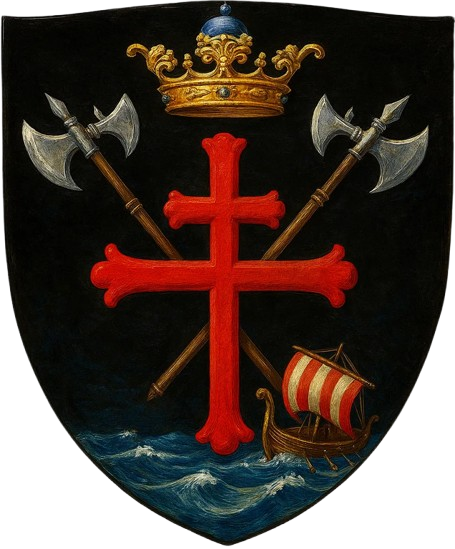
History of Glaiven
Glaiven's history stretches across 25,000 years, beginning as an Elven-controlled region under the barony of Kael'Vashara, to its eventual rise as an independent kingdom following the Myraletchian mercenary conquest. The humans who now rule Glaiven arrived as foreign invaders, shaping the land's history and culture in ways never anticipated by the Elves.
- Era 1: The Elven Rule of Kael'Vashara (25,000 - 24,500 years ago): Before the fall of the Elven Empire of Kael, the land that would become Glaiven was part of the Elven barony of Kael'Vashara, located at the far western edge of the Empire. This region was a hub of Elven culture, home to magnificent cities, temples to the Seldarine gods, and lush natural landscapes. For millennia, Kael'Vashara remained under Elven rule, with Elves living in peace, guided by their connection to the Seldarine and their reverence for nature. Humans were nonexistent in the region at this time. The Elven aristocracy ruled with grace, and the land was governed by Seldarine priests and Elven nobility. The humans that would later shape Glaiven's future were not yet part of the equation.
- Era 2: The Fall of Kael and the Arrival of the Myraletchian Mercenaries (24,500 - 24,000 years ago): As the Elven Empire of Kael began to crumble under internal strife and external threats, Myraletch, a dark kingdom to the east, began plotting the downfall of the Elven territories. Myraletch was a power driven by necromancy and dark sorcery, and its ruler sought to destabilize the great Elven Empire to expand his own power. Myraletch's influence slowly spread westward, corrupting the Elven leadership and bringing dark magic into their courts. The Elven Empire's inability to handle this growing threat led to the weakening and eventual collapse of Kael. The Elven rulers of Kael'Vashara were unable to defend their lands against these arcane manipulations, and they eventually fell. Myraletch, seeking to secure the region of Kael'Vashara for its own purposes, sent a force of mercenaries to secure the land. These mercenaries, the first humans ever to arrive in Glaiven, were tasked with the overthrow of the Elven barons and the conquest of the land. These mercenaries were foreign invaders, brought by Myraletch to establish a new order. The Myraletchian mercenaries invaded Kael'Vashara, swiftly overpowering the Elven defenders with their ruthless tactics and dark sorcery. The Elven cities were ravaged, and the temples of the Seldarine were desecrated. Kael'Vashara, once a land of Elven nobility, became a battleground for the invading force. Within a few years, Kael'Vashara fell completely into human hands, as the Myraletchian mercenaries claimed the land as their own.
- Era 3: The Establishment of Glaiven and the Charter of Liberties (24,000 - 22,000 years ago): After the Elven fall, the Myraletchian mercenaries were left to govern the land. These foreign invaders, having toppled the Elven aristocracy, decided to establish Glaiven as a new kingdom, a human-ruled realm that would grow from the ashes of Kael'Vashara. The mercenaries, who had originally come to conquer, took over the cities and ruled the land with an iron fist. The region was restructured, and the first human government took shape, with a Marquesa or Marquess elected from the ranks of the mercenaries and their military allies. In the wake of their conquest, the Myraletchian mercenaries introduced a Charter of Liberties, a legal document that granted rights to free citizens, especially those within the military, mercantile, and guild classes. The Charter became the foundation of Glaiven's political structure and ensured that the mercenaries remained in power. The Myraletchian mercenaries brought with them the Church of Light and Dark, a belief system that emphasized the eternal struggle between light and darkness, order and chaos. The Seldarine gods, once revered by the Elves, faded from prominence as the Church of Light and Dark took hold, becoming the dominant faith in Glaiven. The newly established Kingdom of Glaiven was built on Myraletchian foundations, with the mercenaries serving as the ruling elite, shaping the kingdom into a militaristic yet thriving maritime power.
- Era 4: The Rise of Dragonwright and Glaiven's Golden Age (22,000 - 17,000 years ago): The next several millennia marked a Golden Age for Glaiven. Under the leadership of the Myraletchian mercenaries, the kingdom's naval fleets grew to dominate the seas, establishing Glaiven as a formidable maritime power. The kingdom's merchant fleets carried Glaiven's goods across the oceans, and its navy protected its shores from invaders. During this time, Glaiven became a center of culture and learning. The capital city, Amarante, flourished with grand architecture, art, and intellectual pursuits. The College of Star-Wise became renowned for its studies in astronomy, navigation, and cartography, shaping Glaiven into a hub of scientific discovery. Meanwhile, the Dragonwright faith began to take root. As Glaiven's power grew, so too did the worship of Bahamut and Tiamat, the dragon gods who embodied both order and chaos. Temples dedicated to dragons were built, and the faith began to permeate all levels of society, overtaking the Church of Light and Dark as the dominant religion in the kingdom.
- Era 5: Decline and Restoration (17,000 - 5,000 years ago): Despite its Golden Age, Glaiven eventually entered a period of decline. Internal political struggles, economic hardship, and external threats weakened the kingdom. The Charter of Liberties became less meaningful, and the Myraletchian mercenaries lost some of their unified strength. However, around 7,000 years ago, a restoration movement arose. New leaders emerged from the sea-lords and guilds, and the kingdom was unified under a new, strong Marquesa. The navy was rebuilt, the merchant fleets once again flourished, and the Dragonwright faith became a unifying force for the kingdom.
- Era 6: The Modern Era (5,000 - Present): Glaiven stands as a small yet fairly powerful, independent kingdom with a strong maritime presence. The kingdom continues to worship the dragon gods, with Dragonwright shaping its politics and culture. Glaiven's naval strength, trade networks, and cultural heritage make it one of the most influential states in the world. The Myraletchian mercenaries who once conquered the land are now remembered as the founders of Glaiven, and their legacy is deeply embedded in the kingdom's identity. Dragonwright is the dominant religion, with Bahamut and Tiamat revered above all, while the Charter of Liberties continues to guide the kingdom's governance.
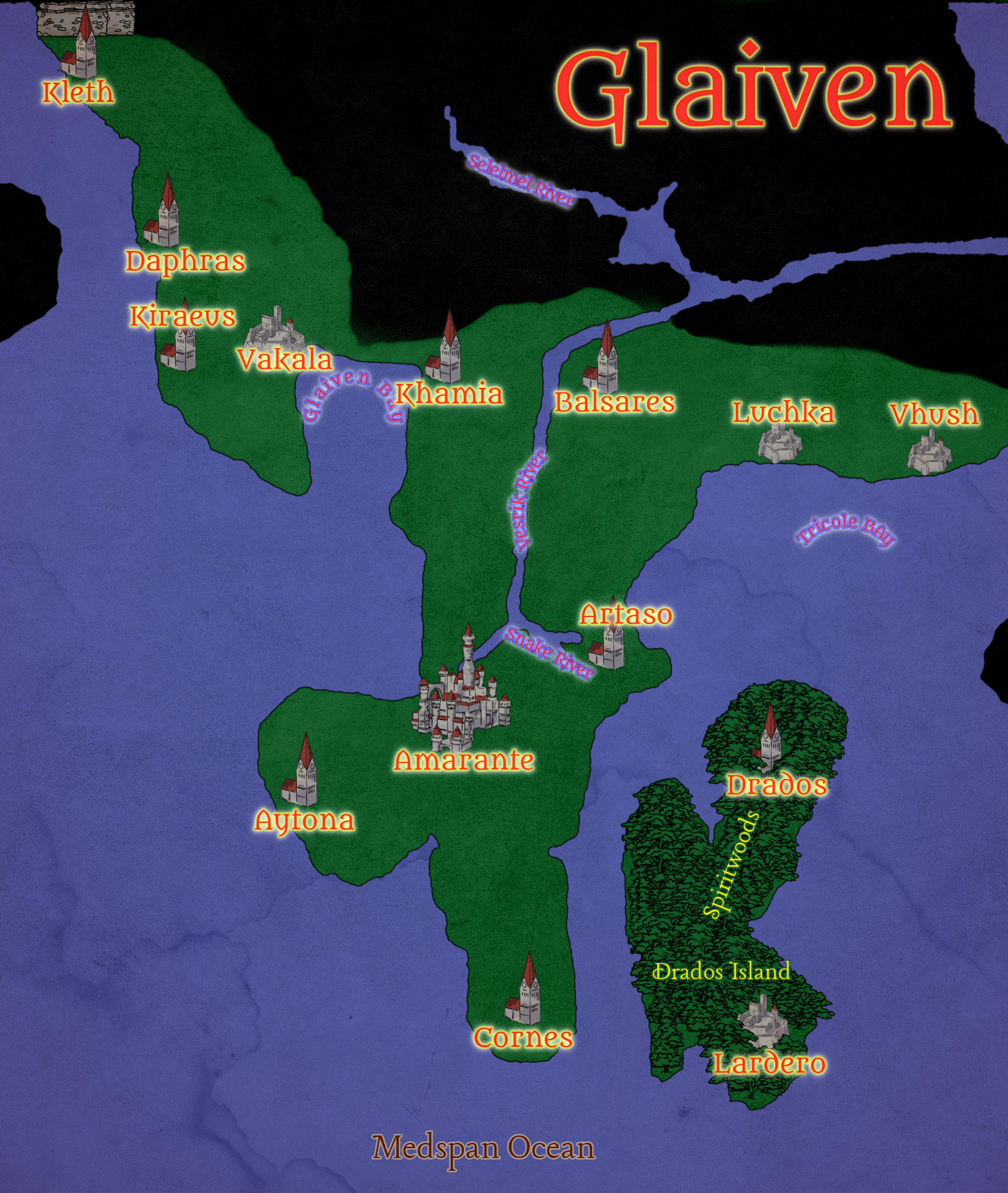
Geography and Climate: Glaiven is a peninsula of olive groves, craggy hills, sea cliffs, and white-walled towns crowned with tiled roofs. Its coastline is deeply indented with natural harbors, ideal for a strong merchant fleet. The inland hills are dotted with ancient fortresses and vineyards, while offshore lies the Isle of Drados, a strategic and spiritual location.
Government and Culture: Amarante, the capital, serves as both royal seat and economic powerhouse. The kingdom is ruled by the Marquesa or Marquess of Glaiven, elected by a council of sea-lords, nobles, and guildmasters. Glaiven prides itself on its Charter of Liberties, a foundational legal document that grants significant rights to free citizens, making it a beacon of proto-democratic governance in a feudal world. Music, philosophy, and shipbuilding are pillars of Glaivenic culture. The College of Star-Wise, located in Amarante, is revered for its celestial charts and early navigators. Towns and City:
- Amarante (Capital): A brilliant jewel with terraced buildings cascading down to a crescent harbor. Red-tiled roofs, arched plazas, bustling fish markets, and colorful mosaics define the cityscape. The Great Dockyards sprawl along the river, while hilltop fortresses protect against raiders. The city also houses the Sapphire Forum, where nobles and guildmasters debate policy under frescoed domes.
- Lardero: A fortified port and naval outpost, crucial for Glaiven's defense. Shipyards here specialize in swift, narrow warships known as dartgalleys.
- Vakala: Vakala is a bustling trade city on the coast of the Western Prong of Glaiven. Known for its twin harbors that allow for constant trade and naval traffic, the city is a vital hub for exotic imports and exports. The skyline is dominated by tall watchtowers and merchant houses, where silks and spices are sold alongside rare artifacts. The city is also home to the Vakala Markets, a famed bazaar that draws traders from all corners of the kingdom and beyond. In addition to commerce, Vakala is known for its scholarly institutions focusing on astronomy and navigation.
- Luchka:Luchka is a seafaring city located on the eastern coast of Glaiven, known for its brilliant sunsets, luxurious shipyards, and flourishing mercantile market. Built along serene bays, the city is a stunning sight, with ivory-colored buildings contrasting against the deep blue of the sea. Its harbor is surrounded by grassy embankments and stone-paved quays, where merchant fleets dock to unload spices, silks, and exotic goods. Luchka’s shipwrights are famed for their skill in constructing sleek trading vessels and luxury yachts, and the city’s Grand Shipyard is a wonder of engineering, drawing admirers from distant lands. Beyond the bustling docks, Luchka is also known for its theatrical arts. The Royal Amphitheater, perched high above the harbor, hosts grand performances of both drama and dance, making the city a cultural capital in Glaiven. The people of Luchka have a deep appreciation for music and poetry, and the city is a popular destination for artists and bards. The Luchkan Festival of Lights, a celebration held every year to mark the changing of the seasons, fills the city with colorful lanterns and music, transforming the entire town into a radiant display of art and joy.
- Vhush: Located on the sea coast, Vlush is a mysterious city known for its ancient ruins, enigmatic artisans, and arcane heritage. The city is famous for its craftsmen, who are skilled in working with rare materials like obsidian, crystal, and moonstone, creating wondrous artifacts that are sought after across the kingdom. Vlush was once a center of knowledge for the Elves before the Myraletchian mercenaries arrived. The ruins of ancient Elven libraries and arcane academies dot the city’s outskirts, and vibrant crystals that glow faintly with residual magic can still be found in the deep caves beneath the city. Over the years, many sorcerers, mages, and scholars have come to Vlush to study the forgotten arts and uncover the secrets of the past, making it a hub for magical research and arcane experimentation. While Amarante may be the political and economic heart of Glaiven, Vlush is the kingdom’s spiritual and intellectual capital, attracting those who seek mystical knowledge. The city's Crystal Spire, a towering, luminous structure, stands as a symbol of arcane power, housing the Arcane Order of Vlush, a group of mages dedicated to uncovering and safeguarding the kingdom’s magical heritage. The city is also famous for its annual Twilight Festival, during which the skies above Vlush are filled with floating lights and arcane phenomena. It is said that during this time, the spirits of ancient mages wander the streets, offering visions and prophecies to those who seek them. Visitors from across the kingdom travel to witness the festival, hoping to catch a glimpse of the mystical wonders that emerge from the veil between worlds.
- Drados: The spiritual heart of Glaiven, home to sea temples and monasteries dedicated to wind and wave deities. Pilgrims come from afar to seek blessings before voyages. Its cliffs are said to echo with oracles' voices.
- Cornes: Known for its horse fairs and cavalry traditions. Its position at the tip of southern Glaiven makes it a key military mustering ground.
- Aytona: A cliffside town famous for ceramic arts, wine production, and outdoor amphitheaters carved into the stone.
- Artaso: A trade town centered between the base of the Vesrik River and thewest coast of the Drados Bay is home to merchant caravans and traveling entertainers. It is said that anything can be bought in Artaso, for a price.
- Balsares: Inland and on the bank of the Vesrik River, Balsares is a sleepy fishing town with surprisingly well-armed.
- Khamia: Khamia is a mountainous town located at the tip of the Kaellaer Mountains is famous for its stone quarries. The locals, Known for their expert sculptures and stone construction are typically sought out throughout the kingdom.
- Kiraeus: Located on the western coast of the peninsula, Kiraeus is a large Fortified town that has large docks to accommodate trade from the Mage Island of Kiadroth. The city's cliffs are dotted with defensive structures, including bastions, Ballista emplacements, and lighthouse towers. Kiraeus is a strategic military stronghold, with elite naval forces stationed there to defend against raiders and enemy fleets. The city is also home to the Order of the Crescent, a respected knightly order sworn to protect Glaiven's sovereignty at sea.
- Daphras: Daphras like Kiraeus, lies on the west coast, but is known for its rolling vineyards and lush. This city is renowned for its wine production, with vineyards stretching as far as the eye can see. It is also known for the Grand Wine Festival, a time when merchants and nobles from all over the kingdom gather to sample the best of Daphras' harvest. Daphras' wealth stems from both its vineyards and the crafting of fine wines, which are exported throughout Glaiven and beyond. The city is home to elegant manors, tasting halls, and artisan workshops.
- Kleth: A city that lies along the western coast and just south of the Massive Myraletch Wall, Kleth is a harbor town built on the jagged cliffs. Its population lives in a complex of terraces and tunnels carved directly into the cliffside, allowing the city to blend seamlessly into its rugged surroundings. Kleth is a hub for sea explorers and cartographers, who often set off from its ports to chart the distant reaches of the ocean. The city is also home to the Naval Academy, where Glaiven's elite sailors are trained in navigation, combat, and cartography. The people of Kleth are hardy, resourceful, and known for their resilient spirit.
Religion and Influence:
Glaivenic faith centers on the Dragonwright. Sailors, merchants, and mages alike offer them tribute before every crossing. The Isle of Drados is considered sacred, and no blood may be shed upon its shores without invoking a divine curse.