Grondar Desert
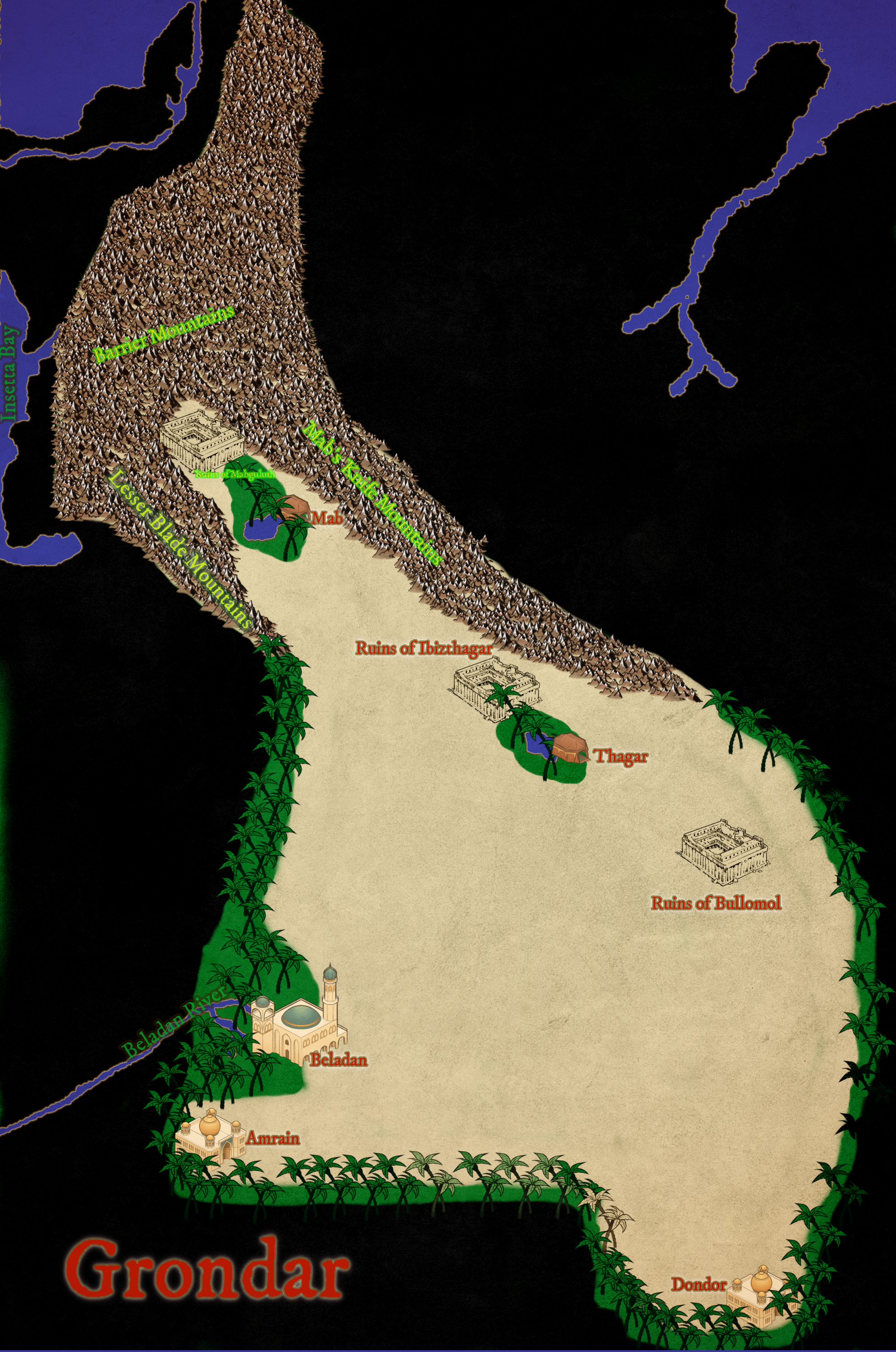
The History of the Grondar DesertThe Vale of Faron and the Grondar Desert In the southwestern reaches of Vron, a northern province of the ancient kingdom of Kael, there once lay a land of verdant splendor, known as the Vale of Faron. Rivers gleamed like silver threads beneath towering forests, and the meadows were rich with herbs, flowers, and the songs of countless birds. It was a place of beauty and learning, where mages and scholars alike came to study the deepest secrets of the arcane. At the heart of the Vale stood the city of Mabguluth, a bastion of mystical knowledge and the seat of some of the greatest elven academies of the age. Spires of polished stone and ivory rose above the treetops, their summits crowned with crystal observatories, while libraries housed tomes penned in languages long forgotten by lesser mortals. Yet the peace of the Vale was not to endure. The magics of war and ambition, the summoning of forces beyond mortal reckoning, and the arrogance of men and elves alike converged to bring devastation. From that once-fertile vale arose what is now called the Grondar Desert, a blasted wasteland of cracked earth and bone-strewn plains, where life struggles against the lingering curses and taints of sorcery. When the majority of Elves from Miryth Dragkor and Kael chose the path of the Retreat, seeking safety and renewal in distant lands, one figure remained. Arekal Mordnakon, a warrior-mage of considerable power and cousin to King Endar, belonged to a lesser house, with no claim to the throne. Yet his desire was vast: he sought dominion not merely over Vron, but over the entirety of the world. Charismatic and cunning, he gathered those willing to follow him, elites who hungered for power, scholars who sought forbidden knowledge, and warriors disillusioned by the Retreat. As Kael fell to the Thrall and the advancing human armies of Myraletch, Arekal led his followers from Kael into Vron. Salisan, the former capital, was renamed Veridistan, a beacon of his rising power, while the northern reaches became known as the Kingdom of Vron, the seat of his growing dominion. Within the Vale, Mabguluth became a bulwark against the tides of invasion. The mages of the city sought to resist both the Myraletch hordes and the creeping corruption of Arekal's dark powers. For a time, their wards and spells held the enemy at bay, and the Vale became the stage for battles of arcane fire, of lightning, of enchantments so potent they shook the heavens. But Arekal's ambition knew no bounds. Devoted to Thaid, God of Death, he turned to necromancy, raising the fallen from both the battlefield and the cities they once defended. His Army of Darkness, an unholy legion of undead, corrupted Thrall, and twisted humans and elves, spread across the continent like a black tide, leaving ruin in its wake. Entire villages were reduced to ash, forests were scorched, and rivers ran dark with the blood of the fallen. The spread of Arekal's forces galvanized the nations of the continent. Taki Rassien, a half-elven general of Rhyanne, marshaled a coalition of elves, humans, dwarves, orcs, and allied peoples, leading them to ShadowGuard Fortress, the last stronghold capable of halting the undead advance. Though the fortress eventually fell and the defenders were annihilated, the valiant stand inspired unity among the disparate races of Otara. From that moment, the armies of dwarves, orcs, halflings, sylvankind, humans, and elves fought not as isolated peoples, but as a single force against the encroaching darkness. In the Vale, the mages continued their struggle. They were joined by exiled sorcerers from Kiadroth, former denizens of Myraletch who opposed both the Vale's methods and the corruption of Arekal. Together, they waged a war of spells and wards, magical beasts and summoned horrors, attempting to stem the tide of both undead and demonic forces. Years of stalemate brought desperation. The Kiadrothi, a secretive order of human mages, conceived a plan of unmatched audacity. During the final assault on Veridistan, Arekal unleashed his most terrifying creation: the Banshee, a wraith of decayed flesh whose screams forced soldiers to their knees and shattered entire battalions. In answer, the Kiadrothi drew upon the latent magics of Mabguluth and summoned lesser demons, spirits first called by the Vale's mages, bending them to their will. Then, invoking the might of heaven, they called down a storm of divine lightning. The fury of the sky shattered Veridistan, smote the undead, and left portions of the Vale itself in ruin. In the aftermath, the surviving mages and priests sought to seal the threat of Arekal's undead for eternity. They cast a great curse upon Vron, yet Thaid intervened, and Arekal, now risen as a lich, twisted the spell to serve his will. From that day forward, all who died within Vron would rise again as undead. These creatures could not survive beyond the borders of the cursed province, save for the most powerful among them, and Arekal himself became an immortal servant of Thaid. Thus, Vron became known as the Cursed Land, and the Grondar Desert a testament to ambition, forbidden sorcery, and divine wrath, a realm where death was no longer the end, and life was bound to the shadow of undeath. Though the allied nations had triumphed, they feared the Kiadrothi's actions. For opening the veil to demons, the order was exiled to Rhoska-Tor, where they later founded the Mage Kingdom of Kiadroth, a realm devoted to study, vigilance, and the careful balance of power. The scars of war, the haunting cries of the undead, and the shattered lands of the Vale of Faron remain to this day, a warning of what happens when ambition, magic, and hubris collide. Today, the Grondar Desert is a land of harsh survival, its once-lush forests reduced to endless sands and jagged rock. The desert is sparsely inhabited, home primarily to Desert Elves and Orcs, each carving out their dominions amidst the ruins of a forgotten age. The Desert Elves, descendants of the eleves of the vale that survived the devestation, have established themselves around two isolated oases: Thangar Oasis and Mab Oasis. These verdant pockets, small yet vital, offer respite from the relentless sun and wind-blown dunes. Mab Oasis lies adjacent to the ruined city of Mabguluth, a place still steeped in arcane resonance, while Thangar Oasis neighbors the ancient stronghold of Ibizthangar, its fallen walls a silent testament to past wars. The Elven tribes, though united by ancestry and blood, remain separate political entities. They rarely associate beyond occasional trade or coordinated raids against the Orcish kingdoms that encroach upon their lands. Their culture is one of resilience and secrecy, adapted to the unforgiving desert and the lingering taint of the Cursed Lands. The Orcs, meanwhile, have taken dominion over the three Free Cities, establishing a small but firmly held kingdom. Fierce and numerous, their population far exceeds that of the Desert Elves, numbering approximately ten thousand. The Orcs maintain a martial society, fortified within the ruins and fortified settlements, ever vigilant against the incursions of the desert tribes. For seven centuries, this uneasy balance has persisted. The Elves and Orcs remain locked in a perpetual state of warfare. Raids and skirmishes flare often, yet neither side has been able to gain lasting advantage. Each conflict leaves scars upon the desert, but the boundaries endure. The Desert Elves number around four thousand, hardy and cunning in the harsh terrain, while the Orcs dominate in strength of numbers and martial prowess. Between these contested and settled lands lies a ruin long forsaken: Bullomol. Once a formidable military garrison, Bullomol held a strategic position in its prime, commanding routes across the desert and providing refuge for soldiers and caravans alike. Today, it is abandoned and desolate. Without a water source, neither Elf nor Orc has claimed it, and it stands as a silent sentinel over the desert, a monument to past ambitions and the harshness of Grondar itself. Its walls are battered by wind and sand, and the empty towers cast long shadows over the dunes, reminding all who venture near that some places are too unforgiving even for those who thrive in this cursed land. Thus, the Grondar Desert remains a land of tension and survival, where old ruins whisper of bygone power, and the descendants of the Cursed Lands struggle to endure under the relentless sun and the shadow of history. Major Cities
|