Kingdom of Harak
The History of the Kingdom of Harak
The origins of Harak lie in the aftermath of the First Elf-Human Wars, a time when the Elven Kingdom of Kael still dominated the continent. In those days, the lands that would become Harak were part of the southern duchies of Rhyanne, a proud Elven province. But the rise of the human wizard-kings of Myraletch challenged Elven supremacy, igniting a series of brutal conflicts that reshaped the world. The First Elf-Human Wars ended with the near-total retreat of the Elves from the mainland, leaving Rhyanne as the last remnant of Kael's once-vast empire. Harak, then a human-populated region under Elven rule, simmered with unrest. It was in this crucible of resentment and ambition that Mikal Corvase rose. A charismatic warlord and visionary, Mikal united the human tribes of Harak and led them in the Second Elf-Human War, known to history as the Great War. His crowning triumph came at the Battle of Black Fire Pass, where his forces shattered the Elven lines in a display of tactical brilliance. With this victory, Mikal declared independence from Rhyanne and founded the Kingdom of Harak, establishing the Corvase dynasty and forever altering the balance of power on the continent. Mikal's reign introduced the Rite of Dominion, a sacred tradition that defined Harak's monarchy. Unlike other realms where bloodlines dictated rule, Harak's throne was earned through ritual combat overseen by the Church of Light and Dark. The victor of this trial would wield the Rod of Judgment, a scepter-blade symbolizing the burden of leadership and the divine balance between light and shadow. This rite ensured that only the strongest and most worthy could rule, binding the monarchy to both martial prowess and spiritual legitimacy. In the centuries that followed, Harak expanded its influence. Alliances were forged, most notably the Oath of Stone with the Dwarves, securing mutual protection and economic cooperation. The kingdom's culture flourished, deeply entwined with the ideals of honor, faith, and strength. The Trial by Combat became not only a political tool but a cultural cornerstone, used to resolve disputes and test claims of leadership. Yet, as the Second Millennium dawned, Harak's unity began to fracture. Weak kings and internal rivalries led to the secession of several provinces, each claiming independence and forging their own identities. Among these were Synarrin, Huralas, Elizarain, Kithrenna, Khelerha, Amarenicea, and Kolvydaer. This fragmentation weakened the central authority and left the kingdom vulnerable to darker forces. Amid the chaos, the Order of the Black Flame emerged, a cult devoted to chaos, destruction, and the unraveling of divine balance. Exploiting the kingdom's instability, the Order spread fear and dissent, undermining the authority of the Corvase line and threatening the very soul of Harak. It was during this time that one of Harak's darkest figures rose to prominence: Seth Corvase, uncle to the reigning King Sigmund. Once a respected duke and general, Seth's ambition and jealousy led him down a forbidden path. Embracing necromancy, he transformed himself into a Death Knight, becoming the infamous Prince of Shadows. His campaigns against Elven communities were brutal, culminating in the massacre of 25,000 Elves in Vordan. His betrayal plunged Harak into renewed conflict and internal strife, threatening to undo everything Mikal had built. Today, under the rule of King Sigmund Corvase, Harak stands at a crossroads, a kingdom forged in war, tested by darkness, and bound by faith. Its history is one of triumph and tragedy, unity and division, light and shadow. And though the future remains uncertain, the legacy of Harak endures, carved into the land, the sword, and the soul of its people.
Trial by Combat in the Kingdom of Harak
The Trial by Combat is a revered and brutal tradition in the Kingdom of Harak, serving as both a method of justice and a means of determining leadership. Here's a detailed overview of how it works:
- Purpose and Significance: The Trial by Combat is held to resolve disputes, challenges to authority, or to elect a new king. It embodies the kingdom's martial culture, emphasizing strength, honor, and the divine right of the strongest.
- Challengers: Any noble or warrior can challenge the reigning monarch or another noble to a Trial by Combat. Challenges can arise from personal grievances, political disputes, or even as a means to claim a title or territory.
- Rituals and Preparation: Before the combat, rituals are performed to invoke the favor of the Church of Light and Dark, with participants seeking blessings and guidance from their deities. These rituals also serve to legitimize the trial and ensure a fair contest.
- The Arena: Trials typically take place in a designated arena, surrounded by spectators, including nobles, commoners, and clergy. The atmosphere is charged with tension, as the outcome of the combat could alter the kingdom's power dynamics.
- Combat Rules: The combatants may choose their weapons, though a code of honor mandates that the fight remains fair, no ambushes or underhanded tactics. The combat can be to the death, though yielding is also an option, allowing for mercy and maintaining honor.
- Judging the Outcome: A panel of judges, often composed of respected nobles or clergy, oversees the trial to ensure the rules are followed. They have the authority to intervene if necessary, although such interventions are rare.
- Aftermath: The victor is celebrated as a hero, receiving accolades and possibly a title or land as a reward. The defeated may face exile, death, or be granted mercy depending on the circumstances and the outcome of the trial.
- Cultural Impact: The Trial by Combat is deeply ingrained in Harak's culture, symbolizing the values of strength and honor. It reinforces the idea that power belongs to the strongest and that justice is served through might.
In essence, the Trial by Combat is not just a mere contest of strength; it is a vital aspect of Harak's identity, reflecting its tumultuous history and the warrior spirit that continues to define its people. The history of the Kingdom of Harak is one of triumph and tragedy, shaped by the valor of its founders and the struggles of its people. As Harak looks to the future, the echoes of its past serve as both a warning and a guide, reminding all of the price of ambition, the weight of legacy, and the power of unity in the face of adversity. It should be noted that in all the years of the Trial by Combat, 90% of them were won by a Corvase.
Population: Harak's population numbers approximately 250 million souls, of which 95% are human, with the remaining 5% belonging to assorted minor races (mostly halflings, dwarves, and humans of mixed ancestry). No elves are allowed within the kingdom, reflecting centuries of bitter enmity and suspicion. This human dominance is reinforced by a rigid social structure centered on agriculture, martial service, and religious devotion.
Government: Harak is a monarchy ruled by King Sigmund Corvase, a formidable Paladin-Priest who embodies both martial prowess and fanatical religious conviction. His reign is defined by a deep-seated hatred for elves, a sentiment passed down through the Corvase bloodline. Though Sigmund burns with a desire to see the Elven people exterminated, he is acutely aware of the power wielded by the Elven King and his host, forces that once defeated Harak in a humiliating war during the reign of Sigmund's great-uncle, King Seth Corvase.
Publicly, King Sigmund adopts the persona of a reluctant monarch, maintaining a strained but deliberate peace with the Elven realms. This political mask keeps his kingdom stable and avoids provoking the powerful elven armies. However, behind closed doors, Sigmund is a schemer and strategist, quietly building alliances, stockpiling arms, and plotting for a day when war may once again be waged, a war he intends to win.
At his side stands Queen Issabella Corvase, a calculating and enigmatic figure whose influence is said to stretch even into the secret councils of the Church. She is both consort and advisor, and her true role in Sigmund's ambitions is a matter of whispered speculation.
Military: Harak maintains a formidable and disciplined military, shaped by its dual priorities of conquest and internal stability. At its heart stands King Sigmund Corvase, a warrior-king whose presence on the battlefield is both symbolic and strategic. Sigmund does not merely command from afar, he rides with his soldiers, embodying the martial and religious ideals of the kingdom. His leadership inspires loyalty and fear in equal measure.
While Harak's ambitions stretch beyond its borders, much of its military strength is devoted to safeguarding the kingdom's lifeblood: its agricultural heartlands. The fertile plains that feed the realm are heavily protected, not only from external threats but from internal unrest. The kingdom's emphasis on food production means that its armies are often deployed to patrol farmland, defend supply routes, and ensure the stability of rural provinces.
This balance between expansion and preservation defines Harak's military doctrine, a force built not only to conquer, but to endure. From elite paladins to citizen militias, every soldier serves a purpose in the grand design of Harak's destiny.
- Sigmund's Paladins of Light and Dark: An elite order of warriors who combine holy and dark magic, embodying Sigmund's dual religious doctrine. These warriors are feared for their ferocity and their ability to use both healing and destructive magic.
- Harakite Farmers' Militias: Since Harak is a breadbasket kingdom, many of its soldiers come from farming backgrounds. The militias are highly disciplined, protecting the vast farmlands from raiders, monsters, and external threats.
- The Iron Shield: Harak's heavy cavalry unit, known for its impenetrable formations and ability to quickly mobilize across the kingdom's sprawling plains.
- Frost Reavers: Trained for cold-weather combat, these warriors defend Harak's northern borders, where the kingdom meets harsher climates and mountainous regions.
Religion: The dominant and state-sanctioned faith of Harak is the Church of Light and Dark, a dualistic religion that shapes not only the kingdom's spiritual life but its political and military institutions. Unlike traditional faiths that cast light as good and darkness as evil, the Church teaches that both are divine, eternal forces, each essential to the balance of the cosmos and the soul.
Light is the force of law, purity, healing, and revelation. It brings clarity, order, and the power to mend what is broken. Darkness, by contrast, is the force of strength, ambition, mystery, and resilience. It is the will to overcome adversity, the courage to face the unknown, and the power to act when light alone is not enough. To reject either is to fall into spiritual blindness or corruption.
The Church is divided into two sacred orders, each representing one half of the divine spectrum. The Luminous Order consists of clerics, healers, and priests who guide communities, offer divine wisdom, and nurture the faithful. The Veiled Path is its shadowed counterpart, inquisitors, seers, and enforcers who root out heresy, manipulate secrets, and protect the kingdom from threats both seen and unseen.
Together, these orders form the Council of Balance, a powerful religious body that advises the King and enforces orthodoxy throughout Harak. Their influence is felt in every aspect of Harakite life, from battlefield blessings to judicial decrees.
Temples dedicated to the Church of Light and Dark are architectural embodiments of its creed. Each features twin spires, one radiant white, the other shadow-black, rising together in harmony. Within, rituals are performed beneath mirrored altars, and sermons echo with the teachings of unity through duality.
In Harak, faith is not a passive belief but a living force. It guides the sword, the crown, and the soul. And in the eyes of the Church, only those who walk in both light and shadow can truly see the path ahead.
The Church of Light and Dark is not universally accepted outside of Harak, especially by Elves, who view it as a corruption of natural harmony. Nonetheless, within Harak, it is both a source of spiritual guidance and a tool of control, reinforcing the monarchy's legitimacy and shaping the worldview of its people.
Though Sigmund desires the destruction of the Elven Kingdom, Harak currently avoids direct military confrontation, focusing instead on defending its land, especially its valuable farmlands, while subtly gathering strength for a future opportunity.
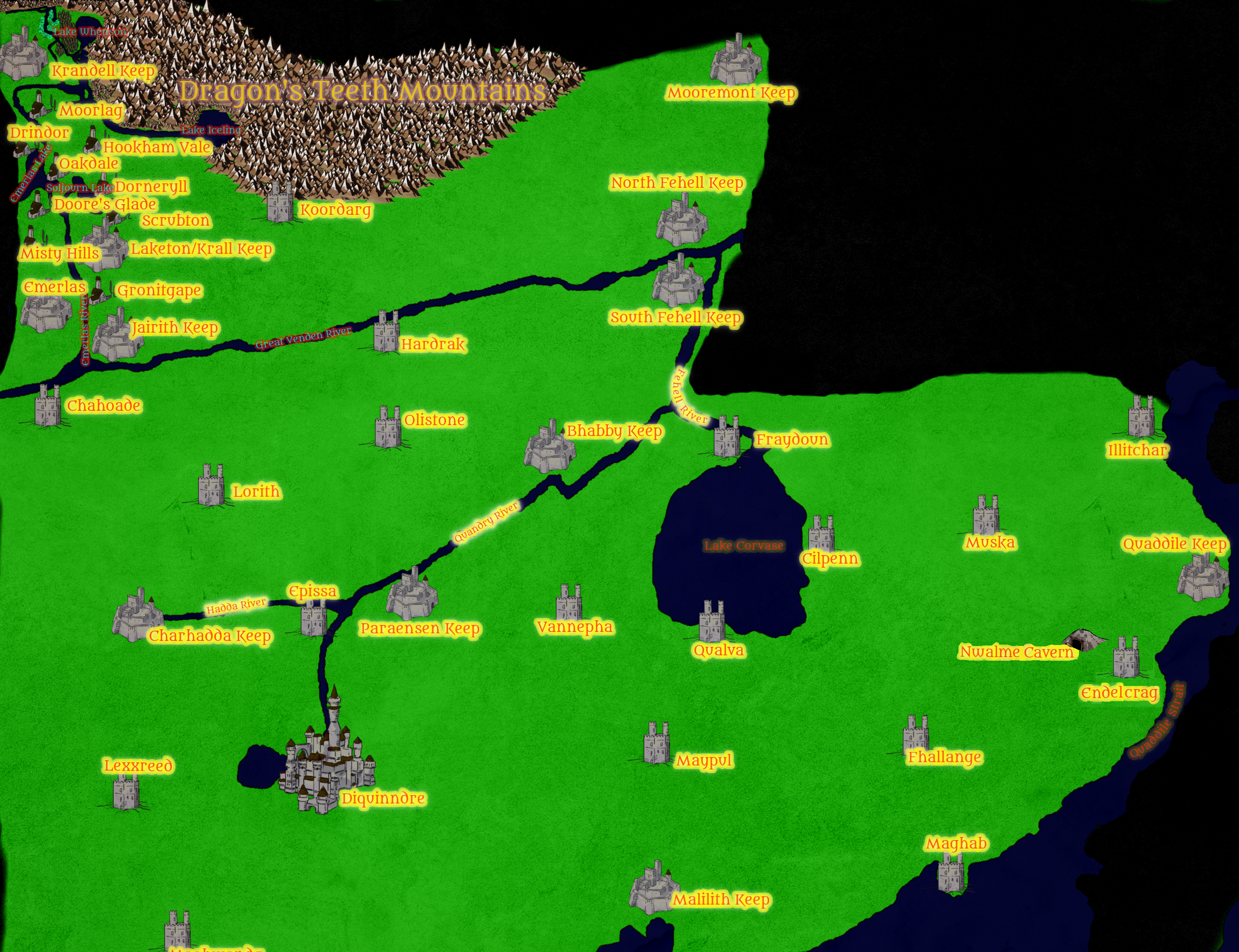
Geography and Economy: Harak stretches across a land of striking duality, a kingdom blessed with both fertile abundance and rugged strength. Its southern territories are a tapestry of wide-open plains and gently rolling hills, bathed in a temperate climate that nurtures life and labor. These lands are the agricultural heart of the realm, where wheat and barley sway in the wind, vegetables grow in orderly rows, and livestock graze across sunlit pastures. The soil here is rich, the seasons kind, and the people industrious. It is from these fields that Harak draws its wealth, feeding not only its own population but exporting vast quantities of food to neighboring kingdoms less fortunate in their geography.
To the north, the terrain shifts dramatically. Jagged mountains rise into colder skies, their slopes less hospitable to farming but rich in mineral bounty. Iron, copper, and other metals are drawn from the earth by miners hardened by the cold and the stone. These resources fuel Harak's forges and armories, supplying the kingdom's military with the tools of war and the infrastructure of power. Though the north is harsher, it is no less vital, a crucible of industry and resilience.
This geographic diversity makes Harak economically self-sufficient and strategically formidable. Its southern breadbasket sustains the population and generates wealth, while its northern mines ensure military readiness and industrial strength. The kingdom's economy is a reflection of its values: productive, disciplined, and enduring.
Trade is conducted with caution. Harak maintains strong economic ties with trusted human neighbors, forging alliances through grain and steel. However, it avoids direct commerce with the Elven realms, preferring to rely on intermediaries for rare goods and arcane materials. This policy reflects both cultural tension and strategic prudence, ensuring that Harak's sovereignty remains uncompromised.
In Harak, the land is more than territory, it is identity. From the golden fields to the iron peaks, every acre serves the kingdom's purpose. And under the watchful eye of King Sigmund, the realm continues to grow, not just in power, but in destiny.
Culture: The culture of Harak is deeply rooted in the land and the divine. It is a kingdom where agriculture is not merely an economic engine, but a sacred calling. The majority of Harakians work the soil, and farming families enjoy elevated social status, revered for their role in sustaining the kingdom's prosperity. The government actively supports agricultural efforts, offering protections for farmsteads and incentives to expand cultivation. In Harak, to till the earth is to serve the gods.
Religion permeates every aspect of daily life. The people of Harak follow the teachings of the Church of Light and Dark, a dualistic faith that preaches balance between opposing divine forces. Light is the force of law, healing, and revelation; Darkness is the force of ambition, mystery, and strength. This spiritual duality is reflected in Harak's values: while the people prize hard work, discipline, and community, there is also a darker undercurrent of conquest, vengeance, and the will to overcome adversity.
Martial service is a rite of passage for many. Citizens are trained in arms from youth, and military honor is held in high esteem. The kingdom's ethos blends spiritual devotion with readiness for war, creating a society that is both pious and formidable.
Harak's relationship with the Elves is strained. Generations of isolationist policy and cultural indoctrination have fostered deep resentment toward Elvenkind. Though King Sigmund Corvase maintains a pragmatic peace with the Elven Kingdom, tensions simmer beneath the surface. Harakians view Elves as ancient rivals, aloof, untrustworthy, and dangerous. Trade between the two realms is minimal, conducted only through intermediaries, and the borders are tightly controlled.
Much of Harak's wealth, drawn from its fertile fields and mineral-rich mountains, is reinvested into its military and religious institutions. Temples rise beside granaries, and soldiers march alongside farmers. It is a kingdom of balance, between light and dark, peace and war, tradition and ambition. And in the hearts of its people, the soil and the sword are equally sacred.
Religion: Harak's people follow the Church of Duality, a religious order that worships both the forces of light and dark. This reflects the kingdom's belief in balance: while the people strive for prosperity and peace, they also recognize the darker aspects of ambition, vengeance, and power. Sigmund Corvase himself is a devout practitioner of this faith, and the church holds significant influence in the kingdom's politics and culture. The religious doctrine encourages both hard work and the acceptance of harsher realities, such as war and survival. Farmers often invoke blessings of light for bountiful harvests, while soldiers and the more ambitious seek the favor of the darker aspects for strength and victory in battle.
Notable Locations:
- Sigmund's Capital (Diquinndre): The political and religious heart of Harak, where King Sigmund Corvase holds court. The city is known for its impressive temple to the dual gods of light and dark.
- The Southern Farmlands: Vast expanses of fertile fields, producing the grain and livestock that form the backbone of Harak's economy. These lands are heavily protected by the Harakite militias.
- Northern Mines: Though less hospitable, the northern regions are rich in minerals, contributing to the kingdom's wealth and supplying the forges that arm the Harakite military.
|
Harak is a kingdom defined by its ancient struggle against the elves, its dualistic religion, and a martial culture that prizes strength, honor, and divine balance. Though currently at uneasy peace with the elven realms, King Sigmund Corvase's iron will and secret machinations set the stage for a future where Harak aims to reclaim its ancient glory and purge the elven presence forever.
Return to Maps and Floor Plans