The Kingdom of Kael
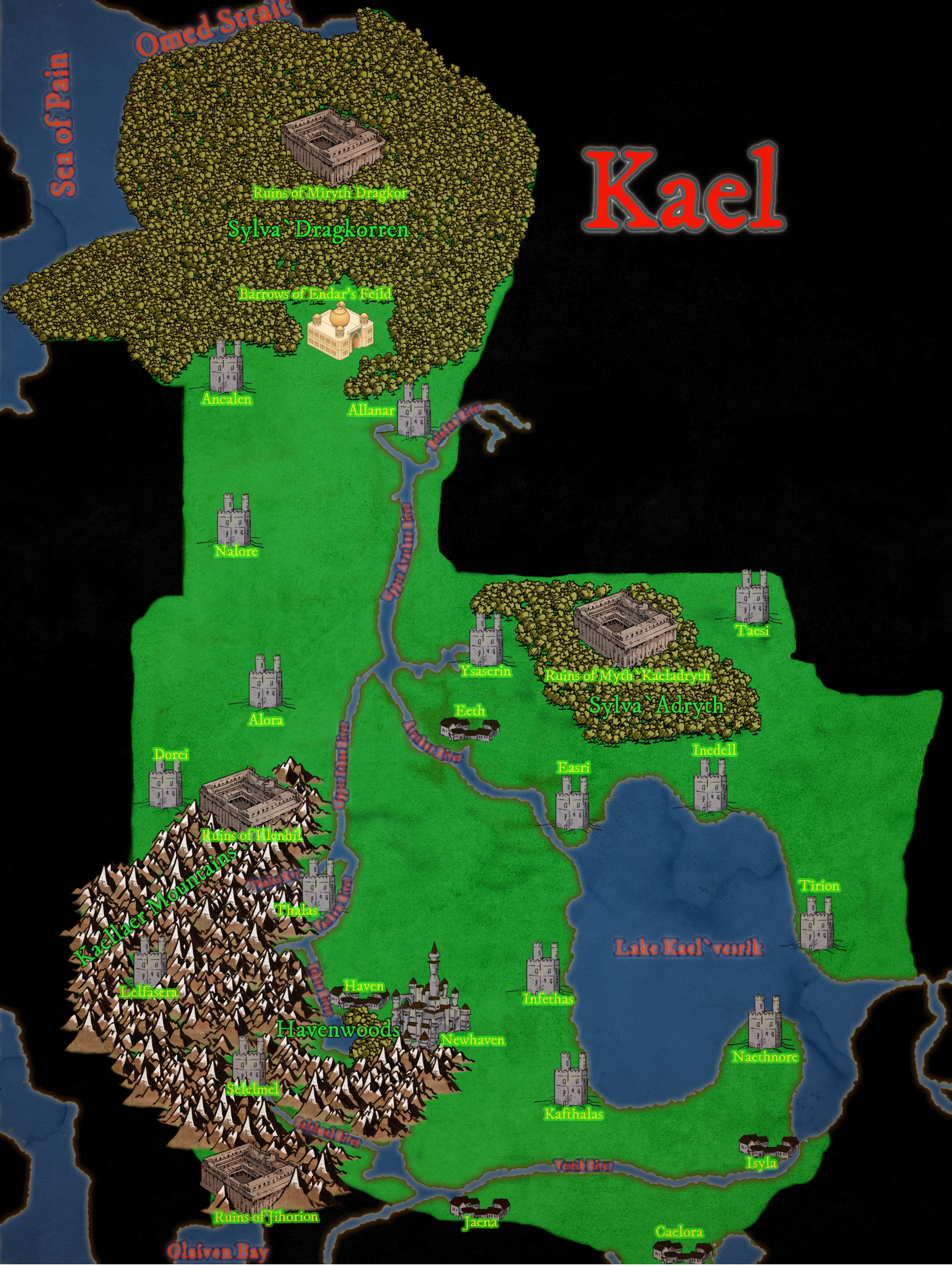
The History of KaelThe Kingdom of Kael, a once-vibrant jewel of Elven civilization, stood as a testament to the magnificence of the Elven people, an empire whose very essence was woven into the fabric of the world itself. In its prime, the kingdom sprawled across most of the Laridian Continent in endless stretches of verdant forests, their canopies like a sea of emerald above crystalline lakes that sparkled with the magic of the earth. The cities, carved from living stone and grown in symbiosis with nature, were marvels of Elven craftsmanship, their towers reaching for the sky, interwoven with vines of luminescent flowers. These cities were not mere settlements, but living works of art, filled with the hum of arcane energies and the harmonious whispers of Elven wisdom. In the capital of Kael, Miryth Dragkor, lay the Great Library of Ormenos, a vast repository of knowledge containing tomes of magic, philosophy, and history that spanned millennia. The Elves of Kael were not only masters of magic but of the very forces of nature, capable of commanding the winds, shaping the land, and speaking to the spirits of the world. Scholars and mages from every corner of the known world journeyed to Kael to learn, to study, and to partake in the ancient traditions that permeated every facet of life. The Kingdom was a bastion of Elven ideals, beauty, harmony, and a deep connection to the land. The Elven people were renowned for their intellectual pursuits, their artistry, and their unparalleled magical prowess. Kael's courts were filled with the finest poets, philosophers, and musicians, and the kingdom itself became a beacon of enlightenment in a world often dominated by conflict and turmoil. Internally, Kael faced its own challenges. While the Crown Wars were long over and the kingdom was a place of enlightenment, it was also a land divided by age-old rivalries, political machinations, and dissent. Factions vied for power, and beneath the veneer of beauty and harmony, tensions simmered. The great Elven families, once united in their pursuit of wisdom and peace, found themselves at odds, driven by ambition, envy, and a thirst for control over Kael's vast resources and magical knowledge. And still with all this the Elves were in a golden age. This golden age proved to be a time of greatness for other races as well, but foremost of these were the Dwarves. During this time the Dwarves constructed incredible underground realms that rivaled the Elven cities and were considered the greatest feats of engineering in the world. The Dwarves too were masters of their own forms of magic, and they used them to bring their empire to greater glory. For millennia, the Elven and the Dwarven realms peacefully co-existed, exchanging gifts of magic and wealth. Where the Elves ruled the surface world, the dwarves reigned supreme under the ground and there did the two realms live almost as one. But as they say, familiarity breeds contempt, and slowly the closeness of the Elves and Dwarves began to dissolve. The Elves became haughty and superior, while the dwarves grew bitter and vengeful. The two realms began to drift apart. Although many great magic-wielders, clergy, scholars, sages and statesmen tried to heal the growing rifts between the two races, the seeds of schism had been sown, and a tree bearing bitter fruit began to grow. Too make matters worse, the Goddess Lolth, ever watchful for an opportunity to harm the Elves of the surface , decided to take advantage of the growing rift and set into motion several atrocities to the Dwarves. The Dwarves, not knowing of the Drow and growing more distrustful of the Elves, blamed the elves of the surface for these heinous acts and retaliated by utterly destroying one of the Elven cities. And lo, did the elf and dwarf draw unto arms against the other, causing the golden age of peace to collapse before the iron age of war. For one hundred years did both do war on the other and many were the lives lost. And for one brief second did it seem that this bloody conflict would draw to a close. In the lands of the surface did these great powers meet for one final reckoning of peace before both were flung headlong into the abyss. As the great armies glowered at each other, far across the field as their generals met and traded words edged with steel, a great disturbance between the two hosts drew them into arms. The Dwarves thought they detected an Elven ambush heading for the conference tent, while the elves thought the same of the dwarves. Both rushed to their generals aid and met with a terrible clash of arms. Thick into the press did both armies fly, and a day of hideous bloodshed soaked the earth and split the air with cries of dying. By the sun s retreat, the field was piled high with the fallen, and the fates of the two empires were sealed. The elf/Dwarf war lasted nearly eight thousand years, and in the end though the elves stood victorious both peoples suffered great losses in both people and culture. A time of quiet settled over the lands and in time the survivors of both races looked to the errors of the past and overtures of peace were made, but never again would Elf and Dwarf be as close as they once were. During the many years of the Elf/Dwarf wars, a third race rose to greatness and soon began to spread over the world. This race, the humans, while short of life when compared to the elves, proved to be extremely adaptable and nearly as fertile as the Orcs. The humans quite literally flooded the lands with people and by the close of the Elf/Dwarf war, were pushing the elves out of their long held territories. The elves, weakened by the devastating battles with the dwarves, and the many millennia of battles fought with the Drow and Orcs, were unable to stem the tide of human encroachment and retreated to the only still purely Elven holding, The forests of Kael, and the city of Miryth Dragkor. Peace was maintained for a time and the elves began to slowly recover from the great Wars, but soon the humans again started to push into Elven holdings and the Elves once again found themselves at war. The Elf/Human Wars were fought over a period of 1,000 years and fought in a series of 4 wars. The Bloodshed in this short time made the losses during the Elf/Dwarf wars pale in comparison. Almost were the Elves brought to the point of extinction. And then the last great king of Miryth Dragkor came to rule, Endar Arcelduin. King Endar, was both a great warrior and a very devoted priest to the Seldarine. He knew that unless something was done soon, the elves would cease to exist, and so prayed to the Seldarine, seeking an answer to the dilemma. For many years did he remain in prayer, devoting much time in service to the gods, while allowing the ruling of the Kingdom to fall to his most trusted general, Jeraillae Elessedil, who later became his consort, then wife. As General Elessedil fought, an answer to the prayers of the king was granted. The King fell into a deep sleep, and there he saw a vision of two Island realms form from the mists of his dream. The voice of the gods called these lands Arethane and Lorien, and Endar was instructed to Divide the remaining elves into three parts. The first group would go to the Land of Arethane under the leadership of Endar s younger brother, a High Mage named Marek. The second group of Elves, under the leadership of Jeraillae Elessedil and with her their infant daughter, Sylvranae, would go to Lorien later to form their new Kingdom. To the third and smallest group would fall the price of these new realms. Endar and his remaining peoples would remain in Kael, and protect the retreat of the others and later join Elessedil in Lorien, once the way was safe. Unfortunately, Endar's daughter, who was staying in the royal sanctuary until the retreat could be implemented was lost when the sanctuary was overrun by High Orcs in the service of the Archwizards of Myraletch. Jeraillae barely escaped with her life, and in fact was dragged away by her retainers, grievously injured, while she tried to rescue her daughter. As earlier stated, when the human kingdoms began to rise up and challenge the elves for supremacy of Otara, the elves feared the worst. The cruel Archwizards of Myraletch had control of mighty magics, the likes of which, thankfully, have not been seen since. With the Myraletch encroaching upon the High Forest, some of the Elven clans there began a migration elsewhere, following the instruction provided by the vision of King Endar Arcelduin. Other elves in other parts of the World slowly began to follow their brethren. The plan of eventual Retreat was formally adopted by the Elven race. After considering ways best to consolidate Elven power, large numbers of elves joined the Retreat and after years of secret preparation, many elves left the mainland. Elven settlements that were indefensible or too near encroaching humans would be moved to Arethane or Lorien. Even as the retreat grew more popular, and more Elves left the mainland for the Island strongholds, King Endar held fast to the high forest realm of Kael and fought the human armies that threatened to overwhelm his people. In this he was successful for several months, covering the retreat of the others to their respective islands. However, the Human armies continued to come, and the Elven defender's numbers continued to dwindle in what was fast becoming a war of attrition. King Endar, saw only one chance to accomplish his goal of protecting the island strongholds of the retreat, though it would surely result in the death of most of the remaining Elves of Kael. It has been speculated that he had yet another of his prophetic visions, though no one knows for sure. Endar decided to bring the war to the humans. The loss of his daughter and a desire for revenge, may also have added to lead him to this decision. His plan was to force the humans of Myraletch to bring the bulk of their forces to the fight, thus weakening Myraletch enough that they would be vulnerable to their other enemies, and saving the elves as a whole. As stated, he knew this would certainly spell the death of the elves of Kael, but would in the end achieve the goal he had set the elves upon. One bright morning he gathered the whole of his army, as well as any elf that was able to carry arms and formed a mighty host which then marched out of the high forests and brought the battle to the Myraletch city of Faredshaer. In a swift and bloody battle the city was completely leveled and the humans of the city, save a handful of survivors left to carry word of the attack back to Myral, were slaughtered. Surrounding villages were put to the sword and the lands salted and put to the torch. Fortifications were then constructed from the rubble of Faredshaer, and Endar's army waited there in the fields for the Myraletch force's retaliation. The battle with the humans of Faredshaer, and the surrounding area, was not an easy one and Endar had less then 5000 soldiers left to hold the field. Myraletch did not make the elves wait long. In a battle that became known as the Battle of Endar's field, they arrived in mass and attacked the remaining Elven host with everything they had. Myraletch, with nearly 30,000 soldiers, struck the Elven defenders and in a battle which lasted nearly 25 days, completely slaughtering the remains of the Elven army, leaving none alive. Although Endar and his elves were dead, the last plan of the King was a vast success. Of the nearly 30,000 soldiers that attacked, a mere 500 left the field alive, and most of them wounded. The Battle of Endar's field changed much of the power structure on the mainland. With the loss of most of it's army, Myralrech was nearly defenseless against the armies of other races and other human kingdoms, and in short order were themselves eliminated as a power on Otara. With the death of King Endar and the massacre of the remaining Elven army on the mainland, it was decided by Most of the elves remaining in Miryth Dragkor to evacuate the city and join the retreat. The Bulk of the Kael Elves took all they could carry and left the city to it's own devices. Many of these elves went to Lorien, but in the end most elected to settle in Rhyanne, a large forested stronghold of elves on the mainland used as a staging point for the retreat. Another faction fled to the northern province of Vron under the command of Arekal Mordnakon. Although it would never achieve the greatness of Kael nor the splendor of Miryth Dragkor, Rhyanne became a strong Elven Kingdom, that due to the elimination of the Myralrech threat, was able to survive and thrive, acting as a bastion for the elves on the mainland Vron, the thriving northern province of Kael. was taken over by Arekal Mordnakon, who in time would become a lich of Thaid. He sought to dominate the world. Veridistan, was the capital of the province, itself a beacon of Elven culture and magic was a hub of art, knowledge, and power. Mordnakon however was defeated and Vron was cursed. Daxe Salvitar was born to a Half-Elven family in the ancient and proud kingdom of Kael. Her mother, an Elven noble, and her father, a Human knight of high honor, both served in the Royal Guard of Rhyanne. Daxe's upbringing was marked by the fusion of two worlds, her Elven grace and wisdom, combined with the strength and resilience of her Human heritage. Raised within a warrior's family, she learned the art of swordsmanship and the ancient teachings of Mirigan, the War Goddess, who taught her that war and balance were inevitable forces in the world. From a young age, Daxe was destined to become a protector of her people. She was trained not only in combat but in the ways of her father's Faith, the Church of Light and Dark, a faith devoted to the balance of light and shadow. Her life was one of devotion, discipline, and service, and as she grew, so did her reputation as a brave and capable paladin. Her talents were recognized, and soon she became one of the most respected leaders of the Order of the Radiant Path, an order known for its fierce protection of the innocent. However, the winds of war were coming. The growing shadow of Arekal Mordnakon, the Lich King, threatened the peace of Kael. The undead armies of Vron were rising, and the land itself began to wither under the weight of necromantic magic. The Elves of Kael, once rulers of a proud and magnificent kingdom, found themselves pushed to the brink of destruction. When the Lich King's forces began to overwhelm Kael, the decision was made to retreat. Daxe, along with many others, was forced to leave behind her homeland and seek refuge in the neighboring Kingdom of Rhyanne, a land that offered safety to the fleeing Elves. The city of Haven became their new home, but it was not a place of rest for Daxe. The mountains and forests near Haven were haunted by the memories of Kael, and the weight of her lost homeland pressed heavily on her heart. Though she continued her work as a commander and protector of her people in Haven, Daxe could never truly shake the feeling of emptiness that came with her exile. The kingdom of Rhyanne, though beautiful, felt foreign to her. The quiet forests surrounding the town became a painful reminder of everything she had lost. Still, she continued to fight for the Church of Light and Dark, keeping the balance of war and peace that Mirigan had taught her. It was during the Siege of Vron that Daxe's path took its most tragic turn. The Church of Light and Dark, sensing the rising threat from the necromantic forces in Vron, decided that the time had come to wipe out the dark influence once and for all. Daxe was sent to lead the crusade, a mission to destroy the forces of the Lich King and put an end to the cursed land's growing power. However, the land of Vron had already been touched by something far darker than the forces of Arekal Mordnakon. In the ruins of Veridistan, now called Grimvorne, once the jewel of Vron, Daxe encountered the dark god Thaid, the Lord of Betrayal and Deception. Thaid, ever a manipulator of souls, saw an opportunity to use Daxe's loyalty and righteousness against her. In a moment of deception, he cursed Daxe with the Mark of the War-Bound, forever binding her to a life of unending conflict. The curse of Thaid did not transform Daxe into one of the undead, as it would with those trapped by Arekal's curse. Instead, it placed her in a state of limbo. She became a warrior trapped between life and death, her soul pulled into a constant battle of light and shadow. She could leave Vron, but the curse of Thaid would remain with her for the rest of her days. She was marked for betrayal, never to find peace, always haunted by the very essence of war she had once fought for. Daxe's fate was sealed when she was struck down in battle years later, during one final confrontation with the undead forces that still plagued the lands. As she died, her warrior spirit, already touched by Thaid's curse, became the perfect vessel for the transformation into a Death Knight. However, her body did not rise immediately, as was the case with others turned by necromancy. Instead, her soul remained trapped in the mountains near Haven, wandering in a restless existence. For millennia, Daxe's ghostly form haunted the forests and mountains surrounding Haven, a tragic figure bound to her past. Her appearance was spectral, her once-glorious armor now tarnished and corrupted, her blade still held but no longer a symbol of justice. Daxe's haunting presence became the stuff of legend, those who wandered too close to the forests would feel the cold chill of her passing, and the brave few who ventured to the mountains would sometimes hear whispers of vengeance in the wind. It was not until many millennia later that Daxe's transformation into a Death Knight was complete. Her undead form was now fully realized, a warrior clad in blackened plate armor, the sword she once wielded still glowing with the taint of necrotic energy. Her eyes, once vibrant and full of life, now glowed a deep red, reflecting the internal conflict and torment that had followed her from the moment she was cursed by Thaid. Her blade, once a tool for justice, now struck down all who crossed her path, its strikes filled with both radiant light and darkness. Though she had become a Death Knight, the humanity of Daxe's spirit still lingered beneath the curse. She remained trapped in the mountains near Haven, her spirit torn between the forces of light and dark, haunting the land she once swore to protect. Her transformation was both a blessing and a curse, as she could never escape the cycle of war and conflict that had defined her existence. Forever bound to the land, she could never return to the peace she sought, forever cursed, forever a warrior lost to the darkness. And so, Daxe Salvitar remains a figure of legend in the mountains and forests near Haven, a tragic soul who once fought for balance and justice, now trapped in a timeless cycle of undeath and vengeance. Her story is one of betrayal, redemption, and loss, the tale of a paladin who sought to protect her people, only to become a weapon of darkness. Her very existence serves as a haunting reminder of the cost of war and the price of betrayal. In the aftermath, the once-glorious Kingdom of Kael faded into legend, its memory preserved only in the songs of bards and the dreams of those who remembered its splendor. Kael became the domain of human tribes, Orcs and many of the monster races. Though Kael's physical remnants may have crumbled, its influence continued to reverberate through the world, as its magical secrets and philosophies lived on in the hearts of those who remembered the light that had once shone so brightly. As the millennia passed, the kingdom fell into ruin. The once-glorious cities crumbled, and the Elven way of life was lost to time. With the rise of humanity, the ruins of Kael were overtaken, and eventually, the humans replaced the Elven gods with their own pantheon, most notably the worship of Dragonwright. The proud lands of Kael, now forgotten, became human-dominated, its legacy all but erased from history. It was into this transformed world that a group of adventurers ventured, drawn by tales of riches and glory. They set their sights on the ancient land of Kael, now little more than a patchwork of ruins, overgrown and abandoned. Yet, even in its decay, the land whispered of a past long gone, a past that beckoned Ce'Nil, a Paladin devoted to justice and honor. Ce'Nil had long walked the path of righteousness, her heart bound by the ideals of duty and protection. But a deeper yearning stirred within her, she felt a longing for something greater, something divine, that transcended her vows as a Paladin. When the opportunity arose to journey through the ancient lands of Kael, Ce'Nil saw it as a calling from the gods themselves. Her journey led her to Haven, a small, quiet town nestled amidst the ruins of Kael. The people of Haven had embraced the worship of Dragonwright, and while they were pious, they knew nothing of the ancient Elven ways. It was here that Ce'Nil's path would forever change. The adventurers were approached by a priest, who offered them a task that promised not only wealth but a greater purpose. After their success, the priest, recognizing Ce'Nil's strength and virtue, gave her a vial of holy water to carry, a simple gift that would soon become the catalyst for her transformation. But as Ce'Nil and her companions traveled deeper into Kael's forgotten heart, an encounter with the divine would reshape her destiny. On their road, Ce'Nil was visited by Larani, the goddess of justice and honor, who appeared before her in a vision of breathtaking beauty. Larani's presence filled Ce'Nil with awe and reverence. In that moment, the goddess spoke, affirming Ce'Nil's commitment to the ideals of justice. Yet, it was not just the words of the goddess that changed Ce'Nil, but an act of divine power that would mark the beginning of her true calling. Larani, understanding Ce'Nil's deep desire to reconnect with the ancient gods of the Elves, allowed her to gather sacred dirt where the goddess had walked. The dirt, imbued with divine essence, became a symbol of Ce'Nil's newfound connection to Larani. With this gift, Ce'Nil's path shifted. She was no longer simply a Paladin, but a servant of the divine, a Priestess of Larani, dedicated not just to justice, but to the restoration of the old ways of the world. In a moment of profound clarity, Ce'Nil made a choice. She discarded the holy water given to her by the Dragonwright priest, replacing it with the sacred dirt she had gathered. To her, it was more than a token, it was a direct link to the old gods she had longed to honor. Her decision was clear: she would walk the path of a priestess, not just a warrior. As Ce'Nil embraced her new role, the group continued their journey to clear Kael of chaotic and dark influences. They eventually came into possession of a small island off the coast of the mainland, which they began to rebuild as a sanctuary, a place of peace and purpose. But peace would not last. The shadow of death soon descended upon them in the form of Daxe Salvitar, a Deathknight of pure darkness. Daxe Salvitar wreaked havoc across the land, murdering townspeople without mercy. Driven by her newfound sense of purpose, Ce'Nil was determined to stop the Deathknight. But in her haste to confront the threat, she rushed into battle unprepared. In the heat of the fight, Ce'Nil nearly lost her life. During this time, she also took a stand against her companions' decision to kill a group of troll children. Instead of allowing them to be slaughtered, Ce'Nil arranged for the orphans to be taken to a temple, where they could be raised in safety and given a chance at life. In the aftermath of their battles, Ce'Nil used her share of the spoils to build a temple to Larani, a place where the faithful could gather and seek solace in the goddess's guidance. The temple was not only a place of worship but also a sanctuary for those seeking justice. However, in her zeal, Ce'Nil made a grave mistake. In the midst of an unrecognized transformation, becoming a were-creature, she inadvertently consecrated the temple's land. This act left the temple vulnerable to desecration, and it was not long before Daxe Salvitar took advantage of this weakness. The Deathknight defiled the sacred ground, yet Ce'Nil, resolute as ever, found a way to restore the temple's sanctity and drove Daxe Salvitar off, though not without cost. But the battle had only just begun. With the Deathknight defeated, Ce'Nil and her companions discovered the tomb of a human king, a ruler from a time long after Kael's fall. The tomb had been hidden for centuries, and the king's remains lay undisturbed in the ruins. In an act of defiance against the finality of death, the adventurers resurrected the king, though not without complications. The king, now returned to life, found himself in a world far different from the one he had known. Yet, the group continued their journey deeper into the heart of Kael, uncovering the dark secrets of the kingdom's downfall. They learned that the king's own human kingdom had risen in the aftermath of Kael's destruction, shaped by the very forces that had brought about the Elven kingdom's fall. As they ventured deeper, they discovered that the land of Kael itself still echoed with the tragic and tragic greatness of the past. Ce'Nil's resolve only grew stronger as she realized that the resurrected king, now frail and broken, was no match for the dark forces that still haunted Kael. The ruins were not just home to enemies of the flesh but also to the lingering shadows of a forgotten past, echoes that refused to be forgotten. Acting as the voice of justice, Ce'Nil confronted these dark forces. Though her battle was fought with honor, it was ultimately in vain. The ruins of Kael were fully overtaken by chaos, and Ce'Nil's beloved temple was once again threatened. In her final act of preservation, she used her divine power to move the temple out of time itself, ensuring its safety from the destruction that had consumed the land. It was only thanks to the intervention of King Rhysanus of Arethane that the Elves were saved. Rhysanus, leading a powerful army, arrived just in time to pull the remaining survivors of Kael to safety. However, it was not a moment of triumph, it was a decision borne out of necessity. Rhysanus, rather than facing Lady Daxe directly, made the difficult choice to strategically retreat. The Elves were forced to leave their homeland behind, seeking refuge in the Kingdom of Arethane, and thus, the last remnants of Kael were preserved. Yet, as the Elves withdrew, whispers began to circulate in their ranks. It was clear that the attack on Newhaven was no ordinary assault. It was not just the death and destruction wrought by a single Deathknight, it was part of a greater scheme. The Elves began to suspect that Lady Daxe Salvitar was but a pawn in a larger, more insidious plan. Whispers of dark alliances reached their ears, hinting at the involvement of Thaid, working alongside Lolth, the Queen of Spiders. They were not simply battling against Lady Daxe's army, they were battling against forces that wanted to eradicate the Elven race from the world entirely. But the Elves were not without hope. In the wake of this devastating blow, King Rhysanus made the decision to create the Phoenix Guard, an elite and secretive force dedicated to the protection of the Elven people. Their primary mission was simple: preserve the Elves. Should any Elven kingdom be threatened, the Phoenix Guard would ensure that the Retreat could continue. They were to act in secrecy, always working from the shadows, never revealing their true identity. For now, the Elves could not afford to draw attention to themselves, nor could they risk alienating the other races. Their survival depended on secrecy and stealth. With their people now united within the borders of Arethane, the Elves began the painstaking process of gathering their history. The remnants of their once-great civilization were scattered far and wide, and adventurers were dispatched across the world to recover ancient Elven artifacts, relics, and lost knowledge. This task would take generations, perhaps even centuries, but the Elves were committed to preserving their history, as they knew their survival depended on it. Key Locations
Ruler:Lady Daxe Salvitar is the current ruler of Kael. Under her rule, Kael has been transformed into a land of eternal darkness, ruled by the dead and populated by monstrous races. Her Deathknight powers allow her to command both the living and the dead, creating an army that marches without fear of mortality.Lady Daxe Salvitar rules Kael with an iron grip. Her rule is defined by fear, dark rituals, and an unyielding desire to reshape Kael into a kingdom of the dead, where the undead reign supreme and the living are mere pawns in her eternal game of power. Daxe commands vast armies of undead, using her necromantic powers to raise soldiers, beasts, and creatures from the grave. These legions are at her beck and call, a terrifying force that can overwhelm entire armies of the living. Daxe has forged alliances with various monstrous races, including orcs, trolls, and goblins, promising them power and dominion over Kael's shattered territories in exchange for their loyalty. These creatures serve as her foot soldiers and protectors, ensuring that no rival factions can threaten her reign. The land itself has become tainted by her dark influence. The forests, once vibrant and full of life, now lie in decay, and the skies are perpetually overcast, casting Kael in an eternal twilight. The ruins of Elven cities are now home to undead horrors and twisted abominations, the remnants of the once-proud Elven civilization desecrated under Daxe's rule. Kael's Population Breakdown
Total Population: 5 Million Capital: |