Kingdom of Khelerha
Geography
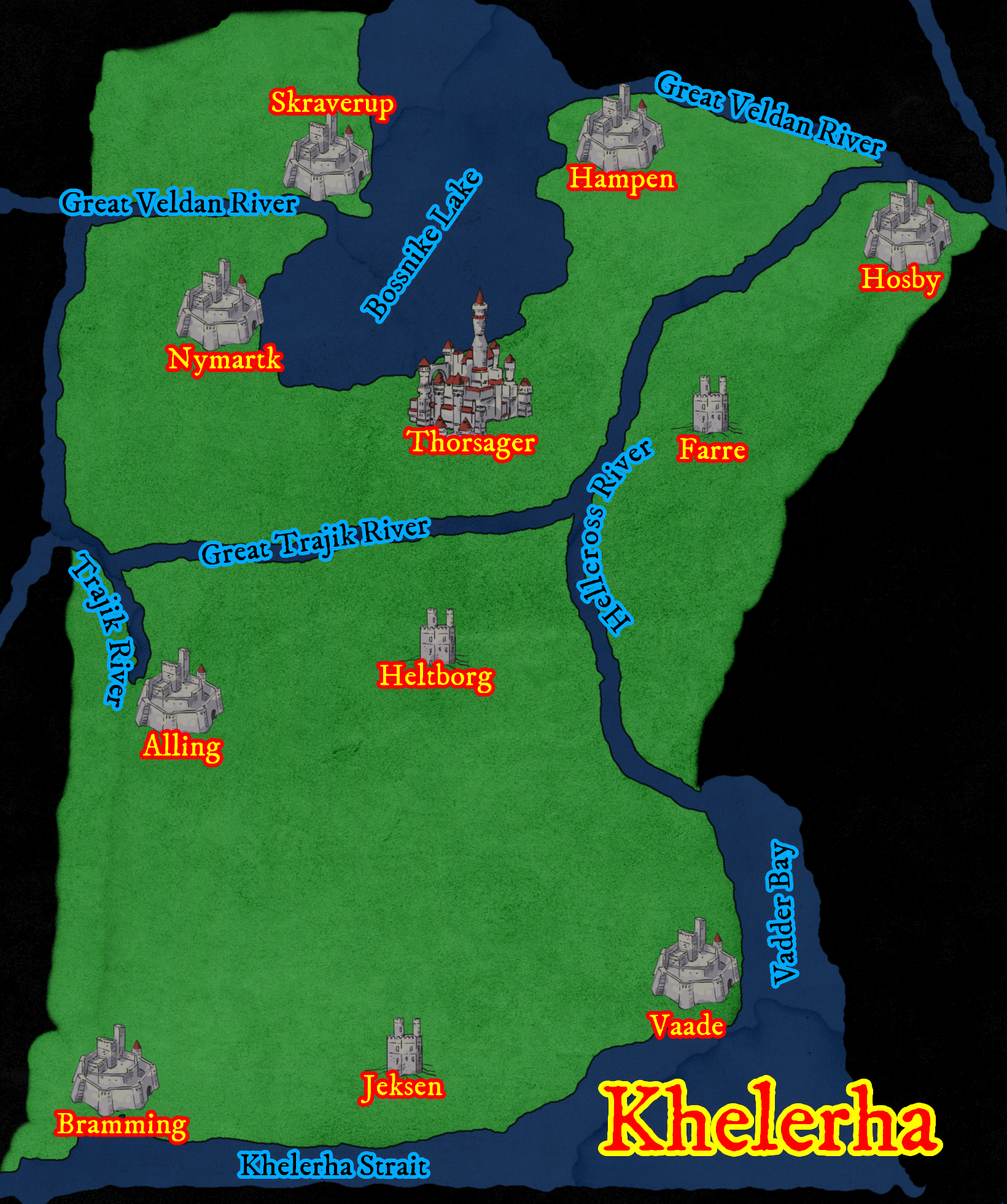
Khelerha is a land of striking contrasts, where sweeping plains and fertile valleys meet the shimmering waters of the Lake of Thorsager, the kingdom's lifeblood. The geography of Khelerha is predominantly flat, with gently rolling hills and expansive grasslands stretching in all directions. The lake, positioned at the heart of the kingdom, not only provides a vital source of fresh water but also acts as a central hub for commerce, fishing, and transportation. Its shores are dotted with bustling cities and quiet fishing villages, all benefiting from the rich ecosystem and the prosperity it offers.
The lack of towering mountains or dense forests gives Khelerha a wide-open feel, with the land ideal for large-scale agriculture and the settlement of new towns and cities. The fertile soil surrounding the lake is cultivated for a variety of crops, including grains, vegetables, and fruits, while the flat plains provide ample space for herding and livestock farming. With an abundant supply of natural resources, the kingdom has become a major food producer, known for its thriving markets and bountiful harvests.
The rivers that crisscross the kingdom serve as vital arteries for transportation, trade, and irrigation, connecting the various settlements and facilitating the flow of goods and people. These waterways are often lined with orchards and small farming communities, which add to the kingdom's overall agricultural wealth.
Although Khelerha does not possess the towering peaks or thick forests found in some neighboring kingdoms, it has made up for this with innovation and careful stewardship of its environment. The Eastward Settlement program, a long-standing initiative, has allowed Khelerha to expand into previously uninhabited or sparsely populated lands. This program has not only brought new settlers from across the continent but has also unlocked new agricultural zones, rich mining deposits, and unexplored forests that are slowly being integrated into the kingdom's economy. These regions are now home to a variety of industries, including textile production, tool crafting, and magical resource harvesting.
The kingdom's rivers, including the East River and Northern River, are crucial for irrigation, particularly in the more arid areas to the south and east. Their steady flow ensures that crops can be grown year-round, while also providing water to the burgeoning towns along their banks. In addition to the fertile farmland, Khelerha's eastern border is marked by a series of low hills that offer natural protection from external threats and a defensive line for the kingdom. Beyond the hills lies the wild and untamed wilderness of the Khelerhan Borderlands, a region sparsely populated by nomadic tribes and dangerous beasts.
Khelerha's geography, while lacking the dramatic peaks and dense forests of other kingdoms, offers a unique blend of tranquility and opportunity. Its open plains and rich agricultural lands have helped Khelerha maintain a stable economy, with room for growth and expansion as new settlers flock to its shores. Whether along the shores of the Lake of Thorsager or the fertile plains to the north, Khelerha remains a land of promise for those who seek to build a new life in its expansive, yet welcoming, terrain.
History
Khelerha's history is one of transformation and resilience, rooted in the shadow of a once-great empire. Long before its rise as an independent kingdom, Khelerha was a key province within the vast Harak Empire, a sprawling dominion that controlled much of the known world. For centuries, the Harak Empire was the dominant force in the region, its influence stretching across continents, its armies marching across deserts, plains, and mountains to enforce imperial rule. Khelerha, though a relatively small province within the empire, was crucial for its agricultural output, supplying the empire with vital foodstuffs and resources that fueled its military campaigns and urban centers.
However, the empire's dominance began to crumble under the weight of internal strife. A series of revolts and territorial disputes fractured the once-unified empire, sparking an era of turmoil and conflict. Rebellions broke out in nearly every corner of the empire, fueled by the harsh rule of the imperial elite, resource shortages, and the growing desire for autonomy in far-flung provinces. The Harak Empire, once mighty and unchallenged, began to fragment, its central authority weakening with each passing year. Amidst this chaos, Khelerha seized the opportunity to break free, declaring itself an independent kingdom.
The decision to assert independence was not without its challenges. In the aftermath of the empire's collapse, Khelerha found itself surrounded by both internal and external pressures. Rival factions within the former imperial territories sought to reclaim control over Khelerha's fertile lands, while neighboring kingdoms viewed the new kingdom with suspicion, uncertain of its future. Despite these challenges, the people of Khelerha were determined to forge a path of their own. The kingdom's leaders, wise and shrewd, focused on utilizing the vast agricultural potential of their fertile plains, which allowed them to quickly stabilize their economy and secure their place in the region. The Lake of Thorsager, situated at the kingdom's heart, proved to be an invaluable resource, not only for trade and irrigation but also for providing the kingdom with a central hub for political and cultural life.
Over time, Khelerha grew in strength and influence. Its strategic position at the center of the continent made it a natural crossroads for trade and commerce, attracting merchants, settlers, and artisans from across the known world. The kingdom's abundant resources, including grain, textiles, and magical trinkets, allowed it to establish itself as a vital economic power. Khelerha's leadership worked tirelessly to build a distinct identity, one that celebrated its agricultural heritage and sought to distance itself from the former imperial influence of Harak. The development of its own military and cultural institutions further solidified this autonomy.
Yet, despite its newfound independence, Khelerha continues to face external pressures. The remnants of the Harak Empire still linger, with many former imperial factions attempting to reclaim lost territories, including Khelerha's rich farmland. The kingdom's proximity to the lands once ruled by Harak makes it a target for intrigue and external influence, particularly from those who believe the old empire can and should be restored. Additionally, neighboring kingdoms, some of which once owed fealty to Harak, view Khelerha with a mixture of envy and caution, unsure of the kingdom's long-term stability.
Despite these challenges, Khelerha remains steadfast in its commitment to preserving its independence and cultivating its unique identity. The kingdom has grown into a vibrant and prosperous land, one that stands as a testament to the strength and determination of its people. As it continues to build on its agricultural prosperity and embrace its cultural heritage, Khelerha stands firm in its resolve to remain free from the shadow of the Harak Empire, shaping its destiny on its own terms.
Culture and Society
Khelerhan culture is a dynamic blend of time-honored traditions and new influences shaped by the kingdom's expansion. At its core, Khelerhan society values honor, respect for the land, and deep loyalty to family. These principles are woven into the very fabric of daily life, with a strong focus on communal gatherings, shared rituals, and the cultivation of both agricultural and personal prosperity. The kingdom's culture is largely shaped by its natural surroundings—its fertile plains, abundant harvests, and deep connection to the Lake of Thorsager—which all contribute to a society built on cooperation, hard work, and mutual respect.
As Khelerha expanded, new influences and customs arrived, particularly from trade with neighboring kingdoms. These influences have been integrated into the kingdom's traditional ways, creating a society that values both the preservation of its ancient customs and the embrace of new ideas. At the heart of Khelerhan society are communal activities that celebrate the land, its people, and the changing seasons, ensuring that both the kingdom's rich traditions and evolving culture remain in harmony.
Cultural Practices
- Festivals and Gatherings: The people of Khelerha celebrate a number of seasonal festivals, each honoring one of the Four Winds: Air, Earth, Fire, and Water. These elements are central to Khelerhan agriculture, each representing a different stage in the farming cycle. The festivals occur throughout the year, each aligned with a specific phase of planting, growth, or harvest. During these festivals, the people come together for grand feasts, music, dancing, and rituals that ensure a bountiful harvest and the continued prosperity of the land. The Windriders' Festival in spring, for example, celebrates the Air element with ceremonial dances in open fields, while the Flamebound Festival in summer honors Fire through large bonfires and storytelling contests.
- Art and Music: Artisans in Khelerha are renowned for their craftsmanship, particularly in textiles, pottery, and enchanted items. The kingdom's cities, especially the capital, Thorsager, are hubs of vibrant artistic expression. Traditional Khelerhan tapestries and pottery are often adorned with symbols representing the Four Winds, and many of these creations incorporate magical elements, imbued with protection or blessings. Music and storytelling are also vital parts of Khelerhan culture. Each town has its own troupe of minstrels and bards, who travel from village to village, singing songs of Khelerhan heroes, legendary creatures, and ancient myths. The Song of Thorsager is a famous ballad that recounts the founding of the kingdom, and its haunting melody is performed during important national celebrations.
- Rites of Passage: As part of their transition into adulthood, young Khelerhans undergo rigorous rites of passage that test their strength, intelligence, and leadership potential. These trials are diverse, ranging from physical endurance tests in the plains to diplomatic challenges within the royal courts. One of the most revered trials is the Trial of the Winds, which takes place in the heart of the Khelerhan plains. Candidates must demonstrate their ability to survive in the wilderness, navigate by the stars, and form alliances with the various peoples of the region. Those who succeed are celebrated as full members of society and are expected to take on leadership roles in their communities. The rites also include a public festival where the young initiates demonstrate their skills before their families and peers, solidifying their place in Khelerhan society.
- Family and Community: Family is the cornerstone of Khelerhan society, and the extended family network is crucial to the functioning of villages and towns. Children are raised in close-knit households, and elders are deeply respected for their wisdom and guidance. The community plays a vital role in the care and upbringing of children, and it is common for multiple generations to live under one roof. Family loyalty is paramount, and it is not uncommon for young Khelerhans to take on the family trade or inherit land passed down through generations. Large family feasts, where the entire extended family gathers to share food, music, and stories, are a common practice and serve to reinforce the bonds of kinship.
- Spirituality and Beliefs: Spirituality is deeply intertwined with the Khelerhan way of life, and the people of the kingdom practice a polytheistic belief system that honors the Four Winds as manifestations of divine forces. Temples dedicated to each element dot the kingdom, with the Temple of the Winds in Thorsager being the most prominent. Priests and priestesses serve as both spiritual guides and magical practitioners, offering blessings to farmers for good harvests, protection for travelers, and healing for the sick. The worship of nature is not just religious but is considered a way of life. Many Khelerhans engage in daily rituals to honor the elements, whether through prayer, offerings, or simple acts of reverence such as planting trees or lighting candles in the home.
The Khelerhan people are, at their core, a proud and resilient people. Their culture, rooted in tradition yet open to new influences, continues to evolve as the kingdom flourishes and grows. Whether through their celebrations of the Four Winds, their artistic contributions, or their emphasis on family and community, the people of Khelerha have created a society that values both its past and its future, ensuring that the kingdom's legacy will endure for generations to come.
Social Structure
Khelerhan society is built upon a strong sense of hierarchy, with clearly defined roles that reflect both traditional values and the evolving dynamics of a growing kingdom. At the top of the social pyramid is the monarchy, followed by the nobility, merchants, and peasants. Each class has its own responsibilities and privileges, contributing to the kingdom's stability and prosperity. However, as the kingdom grows, the influence of the merchant class, especially in urban centers, has become increasingly significant, challenging the traditional power structures.
- Monarchy: The monarch, seated in Thorsager, serves as the central figure of authority, a symbol of unity and the embodiment of the kingdom's values. The role of the monarch is largely ceremonial in nature, with many decisions being delegated to the governing bodies of the kingdom. However, in times of crisis or war, the monarch holds the power to call upon the kingdom's military forces and make important decisions that affect the welfare of Khelerha. The monarch's influence extends beyond politics, often acting as a spiritual leader who oversees the kingdom's annual festivals and rites, ensuring the land remains in harmony with the Four Winds.
- Nobility: Beneath the monarchy lies the nobility, a class of wealthy landowners who hold significant political, economic, and military power. The noble houses of Khelerha are vast and diverse, each controlling different regions of the kingdom. These houses are often in competition with each other for resources and influence, yet they are united by a shared loyalty to the crown. Many noble houses maintain private armies and control large swaths of farmland, vital for the kingdom's prosperity. Nobles also play a key role in the kingdom's governance, with each house represented on the Council of Lords, which assists in decision-making and the implementation of laws. The power of the nobility is often seen in the maintenance of their lavish estates, their patronage of the arts, and their influence over the political and economic landscape.
- Merchants and Burghers: As Khelerha's cities grow in size and importance, so too does the merchant class. Wealthy merchants, craftsmen, and traders are becoming an increasingly influential force, especially in the capital, Thorsager. With their control over trade routes, goods, and the flow of currency, they hold significant sway in the kingdom's economy. In many ways, the growing influence of the merchant class has led to a shift in Khelerha's social structure, with some merchants acquiring titles or land, gaining privileges once reserved for the nobility. The merchant class is highly active in the political sphere, often funding campaigns or aligning with particular noble houses to influence city policies or secure advantageous trade agreements. The city of Thorsager, in particular, is home to an increasingly powerful council of wealthy burghers who have a voice in matters of city governance and economic development.
- Peasants: The majority of Khelerha's population is made up of peasants, who form the backbone of the kingdom's agricultural system. These hardworking individuals live in rural villages and small farming communities, working the land to produce food for the kingdom. Many peasants are part of the Eastward Settlement initiative, a program that encourages the expansion of settlements into previously uninhabited or underdeveloped areas. While peasants have limited political power, their labor is vital to the kingdom's economy. In exchange for their work, peasants receive land to farm and, in many cases, protection from the noble houses. Life for peasants is difficult, but there is a strong sense of community, with villages often gathering for festivals, markets, and religious observances that reinforce their cultural and social bonds.
While the social hierarchy remains firmly entrenched, the growing influence of the merchant class and the changing dynamics of urbanization are slowly altering the traditional power structures in Khelerha. The rise of wealthy merchants and craftsmen has led to greater social mobility for some, and the balance of power between the nobility and the new urban elite is shifting. As Khelerha continues to evolve, it will be interesting to see how these social classes interact and how the kingdom's governance adapts to the changing landscape.
Occupation and Economy
The economy of Khelerha thrives on a diverse combination of agriculture, trade, and craftsmanship, each supporting the kingdom's stability and growth. The fertile plains surrounding the Lake of Thorsager provide abundant resources, making agriculture the primary economic driver. In addition, Khelerha's strategic location at the crossroads of several major trade routes has helped the kingdom become a bustling hub of commerce. Craftsmanship, particularly in textiles and magical items, plays a crucial role in the kingdom's export economy, making Khelerha a center for fine goods in the region.
Agriculture
At the heart of Khelerha's agricultural economy is the rich, fertile land that stretches across the plains around the Lake of Thorsager. The kingdom's climate, with its seasonal rains and warm summers, makes it ideal for cultivating a wide range of crops. Khelerha produces vast quantities of grain, vegetables, and fruits, ensuring that both the kingdom's people and its trade partners are well-fed. The fertile regions surrounding the lake are especially renowned for their abundance, with grain fields, orchards, and vegetable gardens dotting the landscape.
In addition to basic food crops, Khelerha has become famous for its cultivation of spices and herbs, which are considered some of the finest in the region. These aromatic goods are highly sought after in markets across the continent, with rare herbs and exotic spices fetching high prices in both local and foreign markets. The kingdom's herbs are used not only in cooking but also in alchemy and magic, making them a valuable commodity. Khelerha's spice markets, especially those in the city of Thorsager, are renowned for their vibrant colors and rich fragrances, attracting traders and buyers from across the known world.
Much of the kingdom's agricultural labor is carried out by peasants, who work the land in exchange for a portion of the harvest and protection from the nobility. However, many of the lands have been expanded through the Eastward Settlement program, which has opened up new areas for farming and settlement. This initiative has allowed for the kingdom to grow its agricultural output even further, tapping into previously unclaimed or underdeveloped regions. These newly settled areas contribute not only to food production but also to Khelerha's ongoing territorial expansion.
Craftsmanship and Trade
Khelerha's cities, particularly Vaade and Bramming, are known for their fine craftsmanship, producing some of the finest goods in the kingdom. Artisans in these cities are skilled in textiles, pottery, metalwork, and the creation of enchanted items. These crafts are highly prized, both within Khelerha and in foreign markets. Khelerha's textiles, known for their intricate designs and magical properties, are especially sought after. These woven fabrics are not only beautiful but are also often imbued with protective spells, making them popular in both everyday wear and ceremonial garb.
- Textiles and Pottery: The skilled weavers of Khelerha produce fine fabrics, including silks, wool, and linen, which are used both for clothing and trade. Pottery from Bramming is highly valued for its quality, with many pieces being crafted for both practical use and decorative purposes. These goods are regularly exported, bringing wealth into the kingdom.
- Enchanted Goods: One of Khelerha's most lucrative exports is its magical items. Enchanted swords, amulets, and charms are created by skilled artisans, often in collaboration with wizards or other magic users. These items are sought after by adventurers, nobility, and collectors, adding a layer of magical prestige to Khelerha's economy.
- Metalwork: Khelerha is also known for its finely crafted metalwork, particularly weapons, tools, and decorative items. The kingdom's blacksmiths are highly regarded, and their blades, often forged with both practical and magical properties, are in high demand throughout the continent.
Trade Routes
Khelerha's central location at the crossroads of several major trade routes has made it an economic powerhouse. The kingdom is positioned as a strategic hub for the flow of goods between various regions, facilitating commerce not only within its borders but also across the continent. The kingdom's well-developed river systems, such as the East River and Northern River, serve as vital trade routes, connecting Khelerha's cities and towns to distant lands.
The rivers are essential for transporting both bulk goods, like grain and livestock, and luxury items such as silks and magical artifacts. In addition to the waterways, the kingdom's roads and caravan routes link Khelerha with neighboring kingdoms and regions, further bolstering its economic standing. Merchants from across the continent travel to Khelerha, bringing rare goods, exotic spices, and luxury items to trade, while Khelerhan merchants are known for exporting their agricultural goods, enchanted items, and crafted goods to far-off lands. This constant exchange of goods has made Khelerha a melting pot of cultures and ideas, further enriching the kingdom's economy.
Military and Defense
Khelerha's military forces are well-trained and ready to defend the kingdom's borders against potential threats. The kingdom's cavalry is particularly renowned for its skill, and its defense strategies are based around controlling the flat plains that dominate the kingdom's geography.
Warfare and Tactics
Khelerha's warfare tactics are based on mobility and the ability to control key river crossings and trade routes. The military often relies on swift cavalry maneuvers, hit-and-run tactics, and fortified positions along riverbanks. The use of magical enhancement in warfare is also common, with Khelerha's spellcasters providing support in battles.
Religion
Khelerha follows the ancient and revered Faith of the Four Winds, a polytheistic belief system that venerates the fundamental natural forces of air, earth, fire, and water. These elements are not only the cornerstones of the kingdom's agricultural prosperity but are seen as divine manifestations of the natural world, each representing essential aspects of life, growth, and transformation. The Four Winds are believed to be the spirits of nature itself, embodying both the life-giving and destructive powers of the natural world. The faith is deeply woven into the fabric of Khelerhan society, influencing everything from daily activities to grand festivals and national holidays.
Temples dedicated to each of the Four Winds are scattered throughout Khelerha, with the most magnificent and sacred of them all located in the kingdom's capital, Thorsager. The Temple of the Four Winds in Thorsager is a grand structure, built to honor the elemental deities in all their forms. This vast temple complex serves as both a place of worship and a center of learning, where priests and scholars alike study the nature of the Four Winds and their impact on the kingdom. Pilgrims from all over Khelerha travel to the temple to seek blessings, offer sacrifices, and participate in the sacred rites of the Four Winds.
In Khelerha, religion is not just a private matter but a central part of community life. Every city, town, and village has its own temple or shrine to the Four Winds, where local religious leaders guide the community in their spiritual and everyday lives. The faith teaches that by respecting the balance of the elements, individuals and communities can live in harmony with nature and ensure the continued prosperity of the kingdom. Seasonal rituals and offerings are made to appease the Four Winds, asking for their favor in agriculture, health, and general well-being.
Church of Light and Dark
The religious structure of Khelerha is governed by the Church of Light and Dark, an institution that plays a central role in both spiritual guidance and the administration of the kingdom. The Church is divided into two main branches: the Order of the Radiant Winds, which venerates the bright and life-affirming aspects of the Four Winds, and the Order of the Shadowed Winds, which focuses on the darker, more mysterious, and often misunderstood forces of nature. Together, these two orders represent the duality of the Four Winds and the belief that both light and shadow are necessary for balance in the world.
The Order of the Radiant Winds is dedicated to the cultivation of the elements' positive aspects, including fertility, growth, healing, and renewal. Priests and priestesses of this order often serve as healers, herbalists, and caretakers, guiding the people in their spiritual practices and offering guidance during times of hardship. They believe that the Four Winds bring both blessings and challenges, and it is through reverence and respect for the natural world that the people of Khelerha can flourish. The Order of the Radiant Winds is the most visible and accessible of the two branches, with its priests often performing public ceremonies, festivals, and rites that celebrate the life-giving aspects of nature.
On the other hand, the Order of the Shadowed Winds embraces the more enigmatic and mysterious sides of the Four Winds, acknowledging the destructive and transformative power that nature can wield. This order is often seen as more secretive and is associated with the elements' darker, more chaotic aspects—storms, fire, and the deep forces that shape the world in unseen ways. While their practices are less understood by the general populace, the Shadowed Winds are essential to maintaining balance, as they teach that destruction is as much a part of nature as creation. Members of the Order of the Shadowed Winds are often consulted in times of war, political unrest, or environmental disaster, providing guidance on how to navigate through times of turmoil and transformation.
Rituals and Festivals
The Faith of the Four Winds is celebrated through a variety of rituals, festivals, and observances, each dedicated to one of the four elements. The most significant of these are the Wind Festivals, which mark the change of the seasons and are celebrated with great fanfare across the kingdom. Each festival is dedicated to a specific element, and during each one, Khelerhans engage in rituals to honor that element's power and influence on their lives.
- The Festival of Air: Held in the spring, this festival honors the element of air, symbolizing new beginnings, fresh winds, and the renewal of life. It involves outdoor dances, ceremonies to call the winds, and offerings of incense and aromatic herbs. The people of Khelerha believe that by honoring air, they ensure a good growing season for crops.
- The Festival of Earth: Held at the height of summer, this festival celebrates the earth and its ability to nourish and sustain life. Farmers offer the first fruits of their crops as sacrifices to the earth, and large feasts are held to share the bounty of the land. Earth-based rituals include stone blessings and the planting of sacred trees.
- The Festival of Fire: Celebrated during the autumn months, this festival honors fire, symbolizing transformation, change, and purification. Bonfires are lit throughout the kingdom, and rituals are performed to ask for the fire's power to cleanse and renew. The festival includes storytelling contests, where bards recount tales of past heroes and battles.
- The Festival of Water: In winter, the people of Khelerha honor water, the element of renewal, healing, and change. The Festival of Water includes ceremonies by rivers, lakes, and springs, where the faithful ask for rain to nourish the land in the coming year. Offerings of water-filled vessels and poems dedicated to the spirit of water are part of the festival's observances.
Through these festivals, rituals, and the duality of the Church of Light and Dark, Khelerha's people maintain a deep connection to their faith, ensuring that the natural world is respected and balanced. The belief in the Four Winds permeates all aspects of Khelerhan life, from farming and trade to governance and personal identity.
Law
Khelerha's legal system is built upon a foundation of feudal laws established by the monarch and enforced by the nobility. These laws have evolved over time, blending ancient traditions with the emerging influence of urban centers and trade. While the legal framework is largely based on feudal principles, it has adapted to the changing needs of a growing kingdom, where commerce, diplomacy, and social mobility are becoming increasingly important.
The monarch holds the ultimate authority in legal matters, issuing royal decrees and codifying laws that affect the entire kingdom. However, much of the day-to-day legal administration is carried out by the nobility, with local lords serving as judges in their respective territories. These lords have the power to resolve disputes, settle minor legal issues, and administer punishment within their domains. The decisions made by these local lords are often based on a combination of tradition, royal edicts, and the local customs of the region they govern.
Local Courts and the Council of Elders
In the rural and less populated regions, legal disputes are typically handled by the local lords, who act as both judges and law enforcers. These lords are expected to maintain peace within their territories, ensuring that justice is carried out fairly and in accordance with the laws of the kingdom. Disputes over land ownership, inheritance, and minor criminal offenses are commonly addressed by these local courts. The nobility's role as judges is a cornerstone of feudal governance in Khelerha, and the lords' decisions are respected as final in their regions.
However, more significant or complex legal cases are brought before the Council of Elders in the capital city of Thorsager. This council is composed of the most respected legal scholars, wise elders, and high-ranking nobles, who are entrusted with interpreting the laws of Khelerha and ensuring that justice is served impartially. The Council of Elders serves as the highest court in the kingdom, resolving matters that have far-reaching implications or involve disputes between the nobility or powerful merchant families. In addition to legal matters, the Council is also responsible for advising the monarch on the kingdom's policies and ensuring that laws align with the kingdom's changing needs.
Feudal Law and Trade Influence
The legal system in Khelerha is heavily influenced by feudal practices, where land and property are held in exchange for service and loyalty to the crown. Under this system, individuals swear allegiance to their local lord or the monarch in exchange for protection, land rights, and social status. Feudal contracts and oaths of loyalty are at the heart of Khelerhan law, and breaches of these contracts—such as betrayal, dishonor, or failure to uphold one's duties—are among the most serious offenses.
In recent years, however, the growing influence of urban centers, particularly in cities like Vaade and Bramming, has led to the emergence of new legal concerns, particularly surrounding trade and commerce. Merchants and craftsmen have increasingly become a powerful force in Khelerha's legal system, and their need for protections, contracts, and dispute resolution has influenced the evolution of the kingdom's laws. As a result, the kingdom has seen the gradual development of legal norms that focus on trade agreements, property rights, and the regulation of urban markets. These laws are often enforced by local guilds and merchant councils, which hold significant sway in the larger cities.
Criminal Law and Punishment
Khelerhan law maintains a strong focus on maintaining order and upholding societal norms. Criminal offenses are categorized based on their severity, with lesser crimes typically resulting in fines, public shaming, or corporal punishment, while more serious offenses, such as theft, treason, or murder, are met with harsher penalties. In some cases, particularly for noble families or wealthy merchants, restitution and reparations may be made as a form of compensation for damages done.
Criminal trials are held publicly in towns and cities, where witnesses testify, and both the prosecution and defense have the chance to present their case. In rural areas, the local lord often makes the final judgment, while in more urbanized regions, trials may be presided over by a council of local officials, guild representatives, or the lord's appointed magistrate. Serious offenses like murder or high treason, especially when they involve noble families, are often sent to the Council of Elders for judgment. Punishments for serious crimes may include imprisonment, exile, or even execution, depending on the nature of the crime and the individual's social status.
Social Justice and Reforms
In recent years, there has been increasing interest in social justice reforms, particularly in the urban areas where the influence of the merchant class and growing wealth inequality have raised concerns. As Khelerha continues to evolve, there is a growing push for legal reforms that address issues such as the treatment of peasants, labor rights, and the fair distribution of wealth. Some progressive voices within the noble houses and merchant guilds have advocated for legal reforms that would limit the power of local lords and provide greater protection for common folk, particularly in the realm of commerce and property rights.
As the kingdom's economy becomes more complex, it is likely that the legal system will continue to adapt to accommodate new challenges and ensure that justice is balanced between the old feudal systems and the modern demands of trade and urban governance. The interplay between tradition and progress will shape the future of Khelerha's laws, and it remains to be seen how these reforms will impact the kingdom's social and political landscape.
Population and Demographics
Khelerha's population is estimated to be around 600,000 inhabitants, with a diverse mix of races and cultures. :
- Humans: 480,000 (80% of the population)
- Half-Elves: 60,000 (10% of the population)
- Halflings: 42,000 (7% of the population)
- Dwarves: 12,000 (2% of the population)
- Gnomes: 6,000 (1% of the population) This gives a more detailed and concrete representation of the population numbers, adding a sense of scale to Khelerha's demographic makeup.
Half-Elves
Half-Elves, making up a significant portion of the "Other Races" demographic, are particularly prominent in the kingdom's arts, magic, and intellectual pursuits. Known for their long lifespans, graceful demeanor, and exceptional talents, Half-Elves are highly respected and integrated into Khelerhan society. They are especially revered for their magical prowess and artistry, with many Half-Elven families serving as scholars, mages, and renowned artists. The influence of Half-Elves is most visible in the cultural and academic hubs of Khelerha, especially in the arts of painting, sculpture, music, and the arcane arts.
Half-Elven enclaves are scattered throughout the kingdom, with larger communities located in major cities like Thorsager, where Half-Elves often serve as advisors to the royal court or run prestigious magical academies. While they are a minority in the population, their contributions to Khelerhan society, especially in the fields of education and magic, are invaluable. The presence of Half-Elves is also felt in the kingdom's elite, as many noble houses have either Half-Elven bloodlines or maintain strong ties with the Half-Elven community for magical support and cultural prestige.
Halflings
Halflings make up a smaller, yet important, portion of Khelerha's population. Known for their jovial and community-oriented nature, Halflings are primarily involved in agriculture, trade, and hospitality. Many Halfling families have established themselves as skilled farmers, growing crops and herbs that are highly valued across the kingdom. They also run many of the taverns, inns, and markets, offering warm food and a welcoming environment to travelers and traders from afar.
Halfling villages and settlements are often located on the outskirts of larger cities, where they thrive in close-knit communities. Though they remain outside the formal nobility, Halflings are well-respected for their resourcefulness and are often seen as the heart of Khelerha's rural economy. Their ability to make the most of small spaces and their extensive knowledge of herbalism, agriculture, and food production makes them an indispensable part of Khelerhan society.
Other Races
In addition to Humans, Half-Elves, and Halflings, there are smaller populations of other races within Khelerha. These include Dwarves, Gnomes, and a few other more exotic races, each contributing their unique skills and perspectives to the kingdom. Dwarves, often known for their expertise in metalworking and stonecraft, have a small but influential presence in Khelerha's northern regions, where they are involved in the production of fine weapons and enchanted items. Gnomes are often found in the more urban centers, working as engineers, inventors, and craftsmen, bringing innovation and technical ingenuity to Khelerha's burgeoning industry.
While these other races are in the minority, their presence adds to the cultural diversity and complexity of Khelerha. The kingdom's openness to different peoples has helped foster a relatively peaceful and cooperative environment where various races live side by side, contributing to the kingdom's overall prosperity.
Urban and Rural Populations
Khelerha's population is also divided between urban and rural areas. The urban centers, particularly the capital of Thorsager, are home to the kingdom's political, economic, and cultural elite. These cities are bustling with merchants, nobles, and artisans, and they attract a large number of visitors from across the continent. Life in the cities is fast-paced, with a focus on commerce, education, and the arts.
In contrast, the rural areas of Khelerha are home to the majority of the kingdom's population, who work the land, tend to livestock, and support the kingdom's agricultural economy. These rural areas are often more traditional in lifestyle, with tight-knit communities centered around farming villages and local markets. While the pace of life is slower and more connected to nature, these rural populations play an essential role in the kingdom's food production and overall stability.
The rural areas are also the primary focus of Khelerha's Eastward Settlement initiative, which seeks to expand the kingdom's population and cultivate new lands. As the kingdom grows, the balance between urbanization and rural life continues to evolve, shaping the future demographics of Khelerha.
Cities
- Bramming
Located to the southwest, near a major river outlet from the lake. Bramming is the kingdom's agricultural hub, known for its vast fields of grain, vegetables, and orchards. It is a vital city for food production, and its markets often supply the rest of the kingdom with the necessary provisions for daily life.
- Jeksen
To the south, Jeksen serves as a fortress city guarding one of the kingdom's southernmost rivers. Its strategic location makes it a key defensive point, but also a center of military training and tactics. The Army of Jeksen is famous for its disciplined soldiers and its reliance on cavalry, which is essential for combat across the plains.
- Hosby
Located in the northeast near a river outlet from the lake, Hosby is a vibrant, artistic city where music, dance, and performance are highly valued. The Hosby Academy of Performing Arts is renowned for its training in the arts, and the city hosts annual festivals celebrating the kingdom's cultural heritage.
- Farre
A port city located along the East River, Farre is known for its shipyards and boat building. As the only port city directly linked to the lake, it serves as a key point for trade between Khelerha and neighboring kingdoms. The Fleet of Farre is highly regarded for its strength and naval prowess, and it is an important strategic asset for the kingdom.
- Skraerup
Located on the northwestern border, Skraerup is known for its fortified walls and its role as a military outpost. The city houses The Skraerup Guard, a special unit of elite warriors tasked with protecting the kingdom's northern border. Skraerup's military influence makes it an important city in the defense of Khelerha.
Return to Maps and Floor Plans
Back to Main Page