Kingdom of Lumea`Masinilor
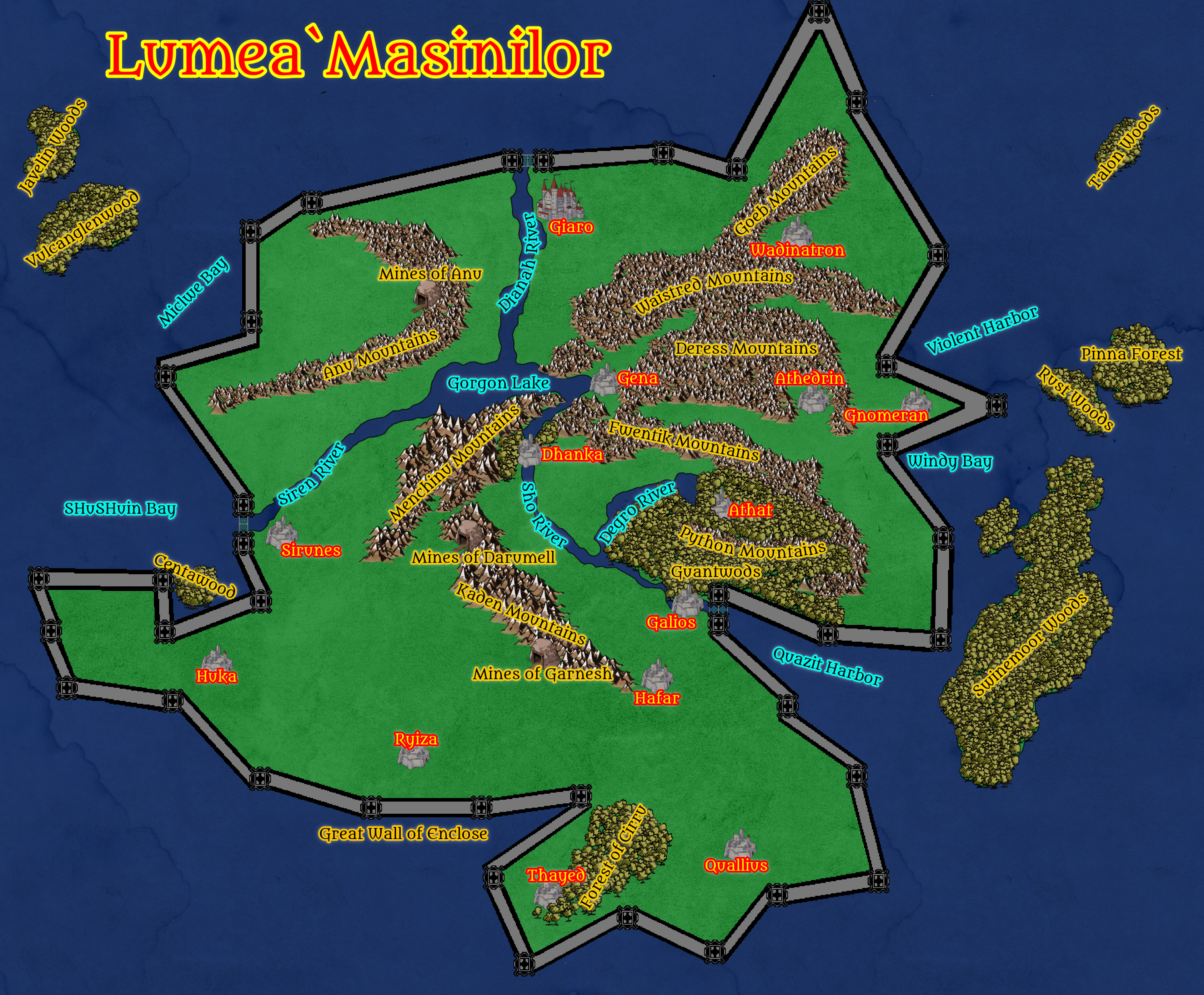
GeographyLumea`Masinilor is a land enclosed by the imposing Great Wall of Enclose, standing at 50 feet tall and stretching around the entire kingdom. The kingdom is situated on a rugged island surrounded by the Fae`Bane Ocean. The terrain is a mix of rocky highlands, lush valleys, and expansive mining regions. Within the kingdom, vast underground tunnels extend deep into the earth, holding precious minerals and rare ores that fuel the gnomes, economy. The natural beauty of the land contrasts with the harsh engineering marvels created by the gnomes, including intricate bridges, tunnels, and towering fortifications. A hidden world lies below, home to an underground population of ratlings. HistoryThe Founding of Lumea`MasinilorLong ago, the land of Lumea`Masinilor was a rugged and untamed place, where deep caverns and mountains filled with precious resources attracted the ingenuity of the first gnome settlers. The earliest gnome explorers, led by a visionary named Lord Fenkor Ironsoul, discovered the hidden valleys and intricate cave systems beneath the land, rich in minerals and vast enough to support an entire kingdom. Driven by their innate curiosity and mastery of mechanics, the gnomes set to work carving a world that would be a marvel of both engineering and natural beauty. Lord Fenkor Ironsoul, alongside his closest allies, established the first fortified settlement, Gnomenari, where they began their work on both above-ground cities and an intricate series of underground tunnels. These tunnels would eventually lead to the discovery of veins of precious ore and gems deep within the earth. As the kingdom grew, so did the gnomes, desire for security and isolation. To protect their kingdom from the dangers of the outside world, whether marauding invaders or natural disasters, Lord Fenkor ordered the construction of the Great Wall of Enclose, a monumental feat of engineering that would encircle the entire kingdom. The wall stood 50 feet tall, with strongholds at regular intervals, allowing gnomes to live safely within the boundaries of their self-sufficient realm. Over time, the Great Wall of Enclose became a symbol of the kingdom's unity and determination to maintain control over its destiny. The Rise of FeudalismAfter the establishment of the Great Wall, the gnomes continued to expand and refine their society, creating a strict feudal system of governance. The Lords of the Gnomehold, a group of powerful families, controlled different regions within the kingdom, each overseeing important mining operations, technological advancements, or military defenses. These noble families often competed for power, but their common interest in protecting the kingdom kept the peace. The Mines of Ant, Mines of Damuka, and Mines of Garnell became critical to the gnome economy, providing the kingdom with the resources needed to sustain its growing population and technological marvels. Athedrim, Gena, and Quallius developed into centers of learning and invention, with gnome scholars and engineers focusing their energies on perfecting their craft. The kingdom flourished, and gnome society became highly structured, with each noble house controlling vast estates that included villages, mines, and research laboratories. The gnome artisans and inventors, including master clockmakers, artificers, and engineers, began creating marvels that would define the kingdom. Gena became known as the center of gnome architecture and magical research, while Thayed grew into a military stronghold, training gnome soldiers and engineers who would defend the kingdom against any invader. The Hidden Underground SocietyWhile the gnomes focused on their above-ground progress, the tunnels they dug for mining and exploration unknowingly became the home of another, far darker secret. Unknown to the gnomes, deep beneath the Mines of Damuka, a race of ratlings, a secretive and cunning underground species, began to thrive in the shadows. These ratlings, once a forgotten race of burrowing creatures, began to grow in numbers and develop their own underground civilization. They constructed their own network of tunnels, unknowingly intersecting with the gnome kingdom's subterranean spaces. For centuries, the gnomes remained oblivious to the presence of the ratlings, focusing on their technological advancements and the prosperity of their kingdom. The ratlings, though, began to notice the gnomes, presence above and felt the first stirrings of resentment. They were a resourceful people, and as their society developed, they began to view the gnomes, prosperity with envy and distrust. The First Conflict: The Great Tunnel WarEventually, the peace between the gnomes and the ratlings would fracture. As the gnomes expanded their mining operations, they unknowingly encroached on ratling territory. Tensions escalated when gnomes inadvertently cut off an important ratling trade route through a mining expansion in the Mines of Garnell. What followed was the Great Tunnel War, a brutal underground conflict between the two races. The gnomes, with their superior technology and ingenuity, fought back against the ratling incursions. However, the ratlings proved to be cunning adversaries, using guerrilla tactics, ambushes, and the labyrinthine tunnels to their advantage. The war raged for decades, with neither side gaining a decisive upper hand. Finally, in an effort to preserve their kingdom's future, the gnomes established a fragile peace, sealing off the deeper tunnels and cutting off access to the mines that were closest to ratling territory. For the time being, the underground conflict was halted, though the tension remained, and both races knew that this was only a temporary truce. The Rise of the Noble Houses and the Current AgeIn the centuries following the Great Tunnel War, the kingdom of Lumea`Masinilor continued to prosper. The noble houses maintained control over their respective regions, but the Kingdom as a whole began to show signs of decay. Lord Fenkor Ironsoul's descendants continued to rule, but with growing internal political conflict among the noble houses. The growing discontent within the kingdom led to periodic skirmishes and political intrigue, as each family sought greater power. Meanwhile, underground, the ratlings have quietly rebuilt and grown stronger. Their resentment toward the gnomes festers, and many ratlings now whisper of rebellion. The gnomes, however, remain unaware of the true extent of the ratling population, believing that the peace holds. Yet, the mines that once brought prosperity now whisper of something far darker lying beneath. The gnome kingdom remains enclosed by its towering walls, safe from external threats but blind to the dark secrets hidden in the earth beneath their feet. For now, Lumea`Masinilor stands as a kingdom of invention and industry, with the specter of an ancient war simmering just below the surface. Current DayToday, Lumea`Masinilor faces new challenges: internal feuds between the noble houses, increasing pressure from the ratlings below, and the possibility of an external threat beyond the Great Wall of Enclose. The kingdom's engineers and scholars continue their work in their grand cities, but the shadow of what lies beneath, and what may yet come to pass, haunts them. CultureThe culture of Lumea`Masinilor is a rich tapestry woven with the gnomes, unparalleled passion for invention, engineering, and craftsmanship. It is a society that thrives on intellectual curiosity and a deep respect for knowledge. For the gnomes, creating intricate machines, clockwork devices, and magical innovations is not only a way of life but a form of art. Each invention is a blend of practical application and aesthetic beauty, and even the most mundane objects are crafted with a level of skill and care that reflects their commitment to perfection. At the heart of gnome society is a profound reverence for education and the pursuit of knowledge. Schools, workshops, and academies are scattered throughout the kingdom, but it is in the cities of Gnomenari and Gena that the most prestigious intellectual endeavors are undertaken. These cities are home to the Guilds of Invention, where gnome artisans, engineers, and mages gather to share knowledge, collaborate on projects, and push the boundaries of magic and technology. Noble families sponsor research and innovation, not only for the glory of their houses but to elevate the kingdom as a whole. Some of the greatest gnome inventions, such as clockwork golems, automated farming systems, and magical constructs, have originated from these collaborative centers. The gnomes celebrate their love for creativity and ingenuity with a series of grand festivals throughout the year. The Festival of Inventions is one of the most anticipated events, held during the changing of the seasons. This festival showcases the latest creations, ranging from mechanical wonders to magical marvels. Gnomes from all walks of life gather to exhibit their works, whether it be the smallest mechanical device or an entire city's worth of innovation. The event is marked by extravagant parades, where clockwork animals, animated statues, and hovering airships glide through the streets, dazzling the crowds. These celebrations are also a time for feasts, where the finest food and drink are served, and families and friends come together to revel in the success of their intellectual pursuits. Alongside these grand festivals, music, poetry, and storytelling are integral to gnome culture. While their technological accomplishments are often the focus, gnomes have a rich tradition of artistic expression. Many gnomes play instruments crafted with meticulous precision, from flutes made of polished crystal to stringed instruments designed to resonate with magical energy. Music is a key part of celebrations and ceremonies, and many gnomes participate in orchestras or chamber ensembles that perform both traditional and contemporary compositions. Poetry holds a special place in gnome society, often written to celebrate the beauty of their creations, the seasons, and the wonders of the natural world. These poems are sometimes recited at public gatherings or inscribed into the very architecture of their cities, blending art with functionality. Storytelling is another cherished tradition, with gnomes passing down their histories, inventions, and myths through generations. Bards and storytellers are highly respected, and their performances are eagerly attended by young and old alike. These tales often involve legendary figures like Lord Fenkor Ironsoul, the first ruler, or the daring escapades of gnome explorers who ventured deep into the earth. The stories often feature magical creatures, clockwork beasts, and heroic adventures, all imbued with lessons about ingenuity, perseverance, and the importance of knowledge. Additionally, gnome craftsmanship extends beyond technology and art into architecture and design. Gnomenari, the capital, is a marvel of gnome ingenuity, where towering structures are designed to be both beautiful and functional. Buildings are crafted with an eye for detail, incorporating intricate geometric patterns, mechanical doors, and magical wards that enhance both their beauty and security. Public spaces, such as grand halls and temples to Fencora, are adorned with sculpted reliefs, moving statues, and animated murals, each telling a story of the gnome people's heritage and achievements. The gnomes also value community and collaboration. While the society is hierarchical, with noble houses wielding significant power, the gnomes believe that the greatest advancements come when individuals work together. It is common for gnome families to invite other artisans, scholars, and inventors into their homes or workshops to work on joint projects. The Guilds of Invention function not just as professional organizations but as social hubs where gnomes of all backgrounds come together to exchange ideas and support one another in their quests for knowledge. Despite their love for innovation, the gnomes maintain a deep connection to the land and nature. While their cities are marvels of engineering, their gardens and parks are designed to blend seamlessly with the natural world. The gnomes take pride in their eco-engineering, where they have developed automated irrigation systems, bio-enhanced crops, and magical growth accelerants that allow them to live in harmony with their environment. Even their mines, though a source of industry, are carefully planned to minimize their impact on the natural world. In all things, the gnomes strive to balance the art of creation with the art of living, always seeking ways to make their society more efficient, more beautiful, and more intellectually fulfilling. Their culture is a testament to their unyielding belief in the power of innovation and the idea that progress, when done with care, can lead to a utopian world where knowledge and art flourish hand in hand. EconomyThe economy of Lumea`Masinilor is intricately tied to the gnomes, unparalleled skills in mining, craftsmanship, and magical innovation. At its core, the kingdom thrives on the extraction of precious minerals and rare ores, primarily sourced from the Mines of Ant, Mines of Damuka, and various other mining complexes scattered throughout the kingdom. These mines, often located deep within the earth, yield valuable materials such as mithril, adamantium, arcane-infused crystals, and precious gemstones, all highly sought after by both gnomes and foreign traders. Mining operations are carefully organized and run with precise engineering techniques, utilizing clockwork miners, magical excavators, and automated systems to maximize efficiency while maintaining minimal environmental impact. In addition to mineral extraction, the gnomes are renowned for their exceptional craftsmanship. Gnome artisans, working in guilds and workshops, produce intricate clockwork devices, mechanical creations, and magical artifacts that are celebrated not only within the kingdom but across the known world. These works of engineering and magic are highly coveted for their precision, ingenuity, and beauty. Some of the most notable exports include automated servants, magical tools, alchemical instruments, flying airships, and magical constructs, many of which are used by scholars, engineers, and noble families throughout the realm. Each creation is a fusion of art and science, with careful attention paid to both form and function. Agriculture, while secondary to the kingdom's industrial activities, plays a vital role in ensuring the kingdom's self-sufficiency. Vast subterranean farms, hydroponic greenhouses, and magically-enhanced crop fields are carefully maintained to provide food for the gnome population. The gnomes have developed advanced agricultural techniques, such as magical growth accelerants, self-sustaining ecosystems, and automated harvesters, which allow them to grow a wide variety of crops, including fruits, vegetables, and medicinal plants. While the kingdom is not heavily reliant on agriculture for trade, it ensures that the gnomes are able to maintain a high standard of living, free from reliance on outside resources. Trade is somewhat limited due to the kingdom's isolation, but it plays a crucial role in the kingdom's interactions with the outside world. Gena, one of the kingdom's largest cities, acts as the primary trade hub. Situated near the heart of the kingdom, Gena is home to bazaars, guild halls, and merchant houses that facilitate the exchange of goods between the gnomes and other cultures. Though the Great Wall of Enclose has kept the kingdom insulated from many external threats, it has also restricted the flow of trade. However, the gnomes still engage in limited commerce, primarily with those who value their advanced technology and magical creations. As such, Gena has become a cosmopolitan center, where traders from distant lands come to purchase gnome-crafted goods, while gnome merchants seek exotic materials for their innovations. Within the kingdom, trade is primarily conducted between the noble houses, each of which controls different regions and resources. These noble families often engage in both internal trade and barter systems. Each house is responsible for the production and distribution of certain goods, from mining ores to the creation of enchanted items. The nobles also maintain vast libraries of blueprints and patents, which are passed down through the generations, ensuring that their intellectual property remains in the family. Guilds, composed of skilled artisans and inventors, play a significant role in regulating craftsmanship and overseeing the production of new technologies. One of the most lucrative sectors of the gnome economy is the production of magical items and enchanted tools. The gnomes are masters of artifice, and their creations often incorporate both arcane magic and mechanical engineering. Items like enchanted hammers, automated clockwork golems, magical potions, and staves of power are sold not only within the kingdom but also exported to distant realms. These items are highly valued by scholars, mages, and adventurers, who seek the gnomes, superior craftsmanship and the magical enhancements that accompany their inventions. The kingdom's economy is also supported by the crafting of advanced mechanical contraptions. From flying airships to subterranean transport systems, the gnomes have revolutionized transportation and industry with their groundbreaking inventions. The airships crafted by the gnomes, powered by a combination of magical energy and mechanical propulsion, are some of the most prized creations. These ships are used not only for travel but also for transporting valuable resources, including the minerals mined from the kingdom's depths. The gnomes have also developed subterranean railways and automated mine carts, which ensure the smooth transport of ores and goods throughout the kingdom's vast underground network. While Lumea`Masinilor's economy is focused on industry and trade, the kingdom also has a thriving internal market for luxury goods. Artisans create elaborate works of art, from sculptures to woven tapestries, that showcase the gnomes, appreciation for beauty in all things. High-quality clockwork toys, fine jewelry, and engraved musical instruments are also highly sought after by the gnome nobility and are often exchanged as gifts or used for ceremonial purposes. The demand for these luxury goods fuels a flourishing craftsman class, where gnome artisans and creators are highly respected for their talent and dedication. Overall, the economy of Lumea`Masinilor is a dynamic blend of engineering marvels, magical innovation, and agriculture, all intertwined to create a prosperous and self-sustaining kingdom. The gnomes, ingenuity has allowed them to build an advanced economy that is largely independent, yet still interconnected with the outside world through trade. Their constant drive for innovation and improvement ensures that the kingdom will continue to thrive, pushing the boundaries of both magic and technology for generations to come. Government and SocietyThe kingdom of Lumea`Masinilor operates under a feudal system, a structure deeply embedded in its culture and traditions. The land is divided among powerful noble houses, each family governing a specific region or city. These noble houses are the backbone of the kingdom's political, economic, and social life, and their influence extends across every aspect of gnome society. The largest and most influential families control the most resource-rich regions, particularly the mining complexes, where the kingdom's wealth in minerals and magical ores is extracted. These noble families maintain their power through a combination of land ownership, military might, and control over guilds of craftsmen and scholars. At the top of the hierarchy is the gnome king, who is chosen from among the noble houses. This monarch, traditionally the most politically astute and capable of leading the kingdom, rules from the capital, Giaro. The king's role, however, is not an absolute one, as the political landscape is fraught with complex webs of political intrigue, alliances, and betrayals. The gnome king must navigate a careful balance between maintaining the loyalty of the noble houses, ensuring the prosperity of the kingdom, and managing the delicate power struggles that are an inherent part of gnome politics. While the king holds significant authority, the true power lies within the noble families, each of whom seeks to expand their influence and secure their own place in the kingdom's future. Each noble family is responsible for overseeing various aspects of their domain. They control key resources such as mining operations, invention workshops, and magical laboratories, often maintaining a retinue of skilled workers that includes engineers, miners, artisans, scholars, and mages. These workers are tasked with ensuring the continued productivity and prosperity of the kingdom, and they receive compensation in the form of land, protection, and the opportunity to rise within the social ranks. As the kingdom's economic foundation is based on industry, mining, and craftsmanship, gnomes from all walks of life are expected to contribute to the kingdom's growth. This social system is structured to ensure that each gnome has a defined role and that everyone plays a part in the greater whole. While the nobles stand at the pinnacle, artisans and laborers form the backbone of society, working tirelessly in the mines, workshops, and manufacturing plants that drive the kingdom's economy. The gnomes take immense pride in their craftsmanship, with each individual contributing their skills, whether in construction, mining, or invention, knowing that their efforts sustain the prosperity of the kingdom. Despite the rigid structure, the gnome society is far from static. There is room for upward mobility based on merit and invention. A talented artisan, for example, may rise to prominence within the noble houses through groundbreaking creations, while a scholar may gain the favor of a noble house by developing new magical techniques or engineering marvels. This blend of hierarchy and innovation encourages a dynamic society where both tradition and progress coexist. Guilds play a critical role in this, acting as the intermediary between the noble houses and the artisan class. These guilds not only govern the production and distribution of goods but also serve as centers for education, where gnomes can acquire the knowledge necessary to advance in society. While the nobles hold political and economic power, there is also a profound sense of community that binds all gnomes together. Gnome society values the collective good, and the kingdom's success is seen as a result of every gnome's contribution. It is this shared commitment to the prosperity of the kingdom that allows the feudal system to function despite its inherent inequalities. Gnomes, regardless of their station, are united by a common goal: to build a future that reflects their ingenuity, creativity, and intellectual prowess. However, this hierarchy also brings about tensions. While the noble houses maintain their influence, there are factions within the artisan class who seek to challenge the established order. Some gnomes, particularly those with great creative or intellectual talents, question why they should be bound by the rigid structures of the feudal system. These movements, while still small, hint at potential social unrest. The desire for greater autonomy and recognition within the kingdom could lead to conflict between the noble families and the working class. The social stratification within Lumea`Masinilor has a profound impact on day-to-day life. The noble families live in opulent palaces and fortresses, surrounded by wealth, art, and scholarly works. These homes are both functional and aesthetic, filled with mechanical wonders, magical artifacts, and advanced technologies. They are places of governance and innovation, where decisions are made that affect the entire kingdom. By contrast, artisans and laborers live in workshops and communal housing, where they focus on their crafts and contribute to the kingdom's economy. Though not as luxurious as the nobles, quarters, these spaces are designed for efficiency and productivity, with advanced clockwork machines and magical tools to assist in daily life. The Law, a set of regulations that govern the kingdom's social and economic activities, reinforces the existing power structure. The law dictates who can own land, who can join certain guilds, and who is eligible to hold office. The noble houses maintain control over the highest echelons of society, while the artisan guilds and labor unions hold sway over the working class. It is through the Law that the gnomes regulate not only their industries but also their moral codes, ensuring that all citizens contribute to the prosperity and security of the kingdom. Despite the rigid structure, Lumea`Masinilor is a society that celebrates individual achievement and innovation. Every gnome, regardless of their social status, is encouraged to think critically, create boldly, and improve their world. This culture of constant intellectual pursuit ensures that the kingdom remains at the cutting edge of both magic and technology, while also fostering a strong sense of unity among the gnome people. MilitaryThe military of Lumea`Masinilor is a unique blend of gnome ingenuity, technological innovation, and ancient martial traditions. The gnome soldiers, known as the Ironclads, are equipped with a wide variety of specialized gear, each designed to maximize their effectiveness in battle. Gnome armor is a fusion of mechanical enhancements and magical wards, creating suits that are both lightweight and extremely durable. These armors are powered by clockwork mechanisms that enhance the wearer's agility, strength, and endurance, allowing gnomes to engage in both close combat and ranged attacks with ease. The armor is further augmented with magical runes that provide additional protection against elemental and arcane forces, making the Ironclads a formidable force. Gnome soldiers are also armed with a wide variety of clockwork weapons, from spring-loaded crossbows to magical pistols that can fire both physical bolts and arcane projectiles. These weapons are designed to be highly customizable, allowing each soldier to modify their armaments for the specific demands of a mission. Explosive traps, barbed snares, and net-launching devices are common in gnome military tactics, leveraging both their mechanical expertise and their affinity for magical enchantments. These traps are often set in advance to thwart enemy advances, with some triggered by mechanical or magical sensors hidden within the landscape. The kingdom's primary defensive strategy is centered around the Great Wall of Enclose, a monumental structure that encircles the entire kingdom. This 50-foot-tall barrier serves not only as a physical defense against external threats but also as a symbol of unity and security for the gnomes. Gnomish soldiers are trained to defend the wall from any incursions, utilizing both artillery and traps strategically placed along its length. Watchtowers, magical barriers, and automated defenses manned by clockwork sentinels are also positioned along the wall, ensuring that any invader will be met with overwhelming force before they can breach the kingdom's defenses. Despite their reliance on defensive strategies, Lumea`Masinilor maintains a small but highly elite offensive force to respond to external threats and internal uprisings. These elite forces, known as the Stormwrights, are handpicked from the best soldiers in the kingdom and are tasked with critical missions, such as defending the kingdom's mining operations, neutralizing rogue factions within the kingdom, and repelling any significant external invasion. They are often deployed for covert operations, where stealth, speed, and precision are more important than brute strength. The Stormwrights are armed with specialized magical gear, including teleportation devices, invisibility cloaks, and arcane explosives that allow them to strike quickly and with devastating effect. One of the most unique aspects of the military is its focus on underground warfare, a direct response to the ratling threat lurking beneath the kingdom's surface. As tensions with the ratlings have never truly subsided, the gnomes maintain specialized underground units known as the Subterran Legion. These soldiers are trained to navigate the treacherous underground tunnels, using tunneling machines, mining drills, and magical sensing devices to detect and neutralize ratling forces before they can pose a significant threat. The Subterran Legion also specializes in laying magical wards and mechanical traps within the ratlings, territory, ensuring that any hostile movements are quickly detected and dealt with. The Thayed region serves as the primary military stronghold of the kingdom, where gnome soldiers receive their elite training. The Thayed Academy is a prestigious institution dedicated to the study of military strategy, engineering, and magic. Here, gnomes are trained in both traditional combat and advanced tactical maneuvers, including the use of clockwork siege weapons, defensive fortifications, and magical warfare. The Thayed region is also home to several training grounds where gnome soldiers practice their skills in a variety of environments, from underground tunnels to rocky highlands to dense forests. These varied settings ensure that gnomes are prepared for any kind of terrain or enemy they may face. The military also plays a key role in maintaining order within the kingdom. While internal uprisings are rare, the gnomes are ever vigilant against any threat to their social order. The Enforcers of Kos, a specialized military police unit, is tasked with maintaining law and order within the kingdom. They are highly trained in both combat and investigation, ensuring that any acts of rebellion, sabotage, or treason are swiftly dealt with. The Enforcers are also responsible for ensuring that the Great Wall of Enclose remains secure, patrolling its length and checking for signs of sabotage or infiltration. Despite the emphasis on technology and innovation, the military of Lumea`Masinilor also respects tradition. The Battle of the Forge, a ceremonial event held every decade, serves as both a test of skill and a way to honor the kingdom's martial heritage. During this event, gnome soldiers compete in a series of challenges that test their abilities in combat, strategy, and engineering. The winning team is awarded the title of Master Engineers of the Forge and is given the privilege of designing and overseeing the construction of new military technology for the kingdom. Overall, the military of Lumea`Masinilor is a highly organized, efficient, and innovative force that blends the gnome people's love for technology, magic, and tradition. From defending the kingdom's borders to engaging in underground warfare with the ratlings, the gnomes are always prepared for any threat that may arise, ensuring that their kingdom remains both safe and prosperous for generations to come. ReligionThe gnomes of Lumea`Masinilor predominantly worship their own pantheon of deities, known as the Lords of the Golden Hills. These gods embody various aspects of gnome life, from invention and craftsmanship to nature, protection, and the pursuit of knowledge. The most revered of these deities is Garl Glittergold, the trickster god and patron of gnomes, followed by a variety of other deities who each represent different facets of gnome existence. The gnome pantheon includes both benevolent gods and more morally complex deities, reflecting the diverse nature of gnome culture. The gods of the gnomish pantheon include:
The gnome pantheon is diverse, with deities representing both light and dark aspects of gnome society. The gods are worshipped through rituals that honor their domains, with each god having their own sacred animals, symbols, and holy days. Festivals, particularly those tied to the full moon or seasonal changes, are celebrated with music, dances, and offerings, often held in the open air or forest clearings. Temples and shrines are dedicated to each god in cities like Gnomenari, Gena, and Athedrim, with priests and priestesses offering guidance, protection, and blessings to the faithful. While the gods are generally seen as benevolent, gnome society also acknowledges that there are darker forces at work, such as the rivalry between Garl Glittergold and Gelf Darkhearth. This rivalry serves as a reminder that even in a society founded on invention and joy, there are elements of discord and destruction that must be navigated. The gnomes, devotion to their gods is intertwined with their daily lives, guiding their actions, shaping their culture, and protecting them from the forces of entropy and greed. In times of crisis, it is to the gods that gnomes turn, invoking the divine to restore balance, ensure victory, or safeguard the kingdom from threats, both external and internal. Whether in the form of ceremonial rites, prayers, or sacrifices, the gnomes, relationship with their gods is one of mutual respect and deep devotion. The gods watch over them as they continue their pursuit of knowledge, innovation, and the greater good. The LawThe Law is a strict and unyielding system of regulations that governs the kingdom of Lumea`Masinilor. Established by the first rulers, and maintained by every noble house, these laws have evolved to prioritize the core values of order, innovation, and loyalty. They are the backbone of a society defined by its mechanical ingenuity and the unrelenting pursuit of progress. Major principles of the law include:
Crime and PunishmentCrimes in Lumea`Masinilor are regarded as a direct threat to the delicate balance between order, progress, and stability. The kingdom operates on a zero-tolerance policy for any act that could disrupt this harmony. Each crime is met with a punishment proportionate to its severity, ensuring that order is maintained at all costs.
Rehabilitation and RedemptionDespite the severity of punishments, there is a belief in the possibility of rehabilitation, especially for those who have shown genuine remorse for their crimes. The kingdom offers the chance for redemption through service, particularly in the form of working in one of the royal workshops or as an engineer for the crown. However, such paths are only open to those whose actions have been deemed worthy of forgiveness by the ruling house. Those who take this route must demonstrate their loyalty to the crown and the principles of Lumea`Masinilor, often undergoing rigorous re-education programs focused on the kingdom's values of order, progress, and innovation. EnforcementThe enforcement of these laws is the responsibility of the Gilded Guards, an elite force of gnomish soldiers who are selected for their loyalty, strength, and mechanical expertise. These guards are trained not only in traditional combat, but also in the use of advanced weaponry and mechanical devices designed to keep the kingdom secure. Their primary task is to maintain order and ensure that the laws of the kingdom are upheld, using both diplomacy and force when necessary. The Gilded Guards answer directly to the ruling house, and their word is considered law in matters of enforcement. PopulationThe kingdom of Lumea`Masinilor is home to an estimated total population of approximately 1,500,000 inhabitants, with a carefully structured division between its two primary groups: the gnomes, who live above ground, and the ratlings, who reside in the kingdom's underground tunnels and chambers. This balance between the two populations reflects the harmony and occasional tension between the kingdom's mechanical ingenuity and the secretive, darker underbelly of the land.
|