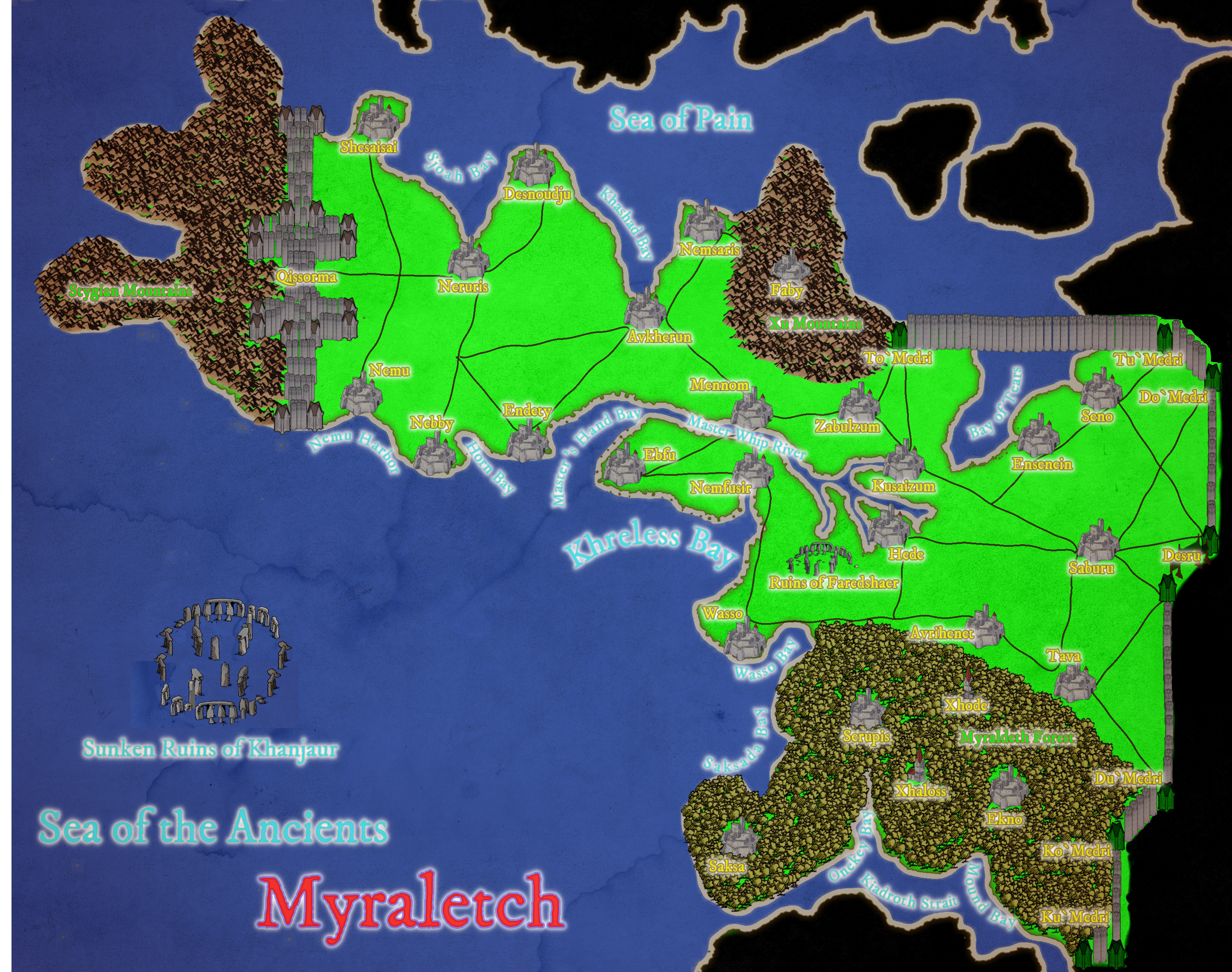
The lowlands, rolling hills, river valleys, misty forests, and fertile plains, are the domain of the Thralls: Created to Serve, the Thralls are a designed race: hybrid semi-clones of human, elf, and orc stock. They are bred for strength, loyalty, and obedience. All Thralls are nearly identical in physique, tall, powerful, clean-boned, and broad-shouldered. There is no visible diversity except that between the sexes.
The Thralls do not understand magic and are blind to the Arcane. Not simply untrained, they are fundamentally incapable of perceiving it. Spells pass unnoticed, glyphs mean nothing, and magical phenomena are rationalized as weather, dreams, or tricks of the mind. They call sorcery "Whimtricks", and speak of it with wary indifference. Even if a fireball erupts before their eyes, a Thrall might shrug and say, “The air was angry today.” This Arcane Veil, whether by design or curse, renders them immune to magical fear, charm, and awe, but also bars them from understanding magical healing, religion, or enchantment. A wounded Thrall will bleed out before accepting "ghost-light" from a cleric's hands.
Thrall Society & Order
Every Thrall city is a self-contained military hive. There are no civilians, only active duty or logistical support roles. Their culture is one of purpose, unity, and stoic clarity. They do not argue, question orders, or believe in gods. Each citizen belongs to a Legion, trained from childhood for a specific role:
- Shieldwalkers: Heavy infantry and guardians.
- Veilhounds: Scouts and runners.
- Stonehands: Engineers and laborers.
- Ashseers: Loremasters who interpret battle history and command structure.
Their lives revolve around discipline, legacy, and marking. To assert individuality, each Thrall tattoos their life story across their body. These marks are sacred, symbols of memory, achievement, and self. A Thrall gains tattoos with every personal act, defending a comrade, slaying an enemy, raising a child. A Thrall without tattoos is either newly born, disgraced, one of the Tattoo Priests who are reserved from marking and are identified at birth with a birthmark shaped like a hand holding a needle or a Masked One, a Thrall created and sealed within the mountain citadel of the Myraletchi Mages.
The Disgraced or "Inkless"
Rarely, a Thrall is born who perceives magic. These outliers, known as Inkless, are feared by their own kind and hunted by the Maskbearers. To the Myraletch, they are unacceptable flaws, proof that control is not perfect. Some Inkless escape. Legends tell of hidden enclaves deep in the old woods or ancient ruins where the Inkless gather, crafting tattoos not of deeds, but of visions. It is whispered that one Inkless has begun writing a new language "magic", etched into skin, visible only by firelight.
Both males and females are indistinguishable in strength, endurance, and stature, differing only subtly in secondary sexual characteristics. They live in militarized city-states, each ruled by appointed officers. Everything in their society is functional and communal: food, clothing, tools, and even children are shared by the unit, not the individual. Their settlements operate like clockwork, governed by ancient protocols instilled by the Myraletch.
This land is lush, temperate, and ancient, crisscrossed with fortified cities. There are no deserts, only mist-drenched wilderness and rain-slicked stone.
History of Myraletch
The Origins of Myraletch: The Rise of the Wizard-Kings
In an age before the dawn of the great conflicts between Elves and Humans, a cabal of ambitious sorcerers known as the Wizard-Kings emerged from the forgotten depths of the world. These human sorcerers, brilliant but driven by hubris, were drawn to the ancient and forbidden arts of necromancy, seeking to transcend death itself and achieve god-like dominion over the forces of life and mortality. While the Elves pursued harmony with nature and magic, Myraletch's founders turned their backs on such lofty ideals, choosing instead to command the very powers of destruction and life.
The Wizard-Kings of Myraletch ruled from a ountain citidel of towering obsidian spires and shadowed streets, where dark rituals were performed in secret, and the boundary between the living and the dead was constantly blurred. These sorcerers sought not only mastery over magic but absolute dominion over the land. They summoned beings from beyond the veil, drawing power from the dead and bending their wills to their purposes. The dead did not rest in Myraletch; they served.
In their relentless pursuit of power, the Wizard-Kings set their eyes on the Elven Kingdom of Kael, a paradise of ancient beauty and magical grace. The stability of the Elven lands, once seen as unshakable, was perceived by the wizards as a weakness, a weakness they would exploit to their advantage. Myraletch did not rise by overt force but through manipulation, dark magic, and the careful sowing of discord.
The Fall of Kael: A Kingdom Crushed Under Shadow
At its zenith, Kael was a kingdom of unmatched beauty and grace. Its forests stretched across vast lands, its cities stood as towering symbols of Elven ingenuity, and its magic flowed harmoniously with the natural world. Yet, over the centuries, a rot began to take hold of Kael. The Elven nobility became entangled in petty rivalries, succession disputes, and political decay, their once-unified front crumbling under the weight of internal strife.
In this moment of weakness, Myraletch struck. The Wizard-Kings launched covert operations, infiltrating the Elven courts with spies and assassins, using dark sorcery to manipulate the minds of the Elven aristocracy. Kael, too proud to recognize the creeping threat, focused its energies inward, further fracturing the Elven unity. At the same time, the wizards of Myraletch unleashed necromantic plagues and spells, poisoning the minds of Elven leaders and turning them against one another.
The Elves, unable to confront Myraletch's necromantic power and subversive tactics, retreated to the High Forest of Kael and the fortified city of Miryth Dragkor, hoping to stave off their eventual collapse. But the Wizard-Kings' forces, bolstered by vast armies of Humans, Thrall and dark magics, pressed the Elven defenses, eventually leading to the fall of Kael. With the Elven race weakened and fractured, Myraletch's shadow stretched over the continent, its arcane dominance unchallenged.
The Kingdom of Myraletch: Age of Arcane Dominance
With the fall of Kael, Myraletch ascended as the new power of the continent. Its Wizard-Kings, now rulers of a kingdom forged through necromantic sorcery and dark ambition, sought to reshape the world in their own image. Their mastery over necromancy allowed them to create vast legions of Thrall, servitors bound to their will through horrific rituals. The Thrall were not mere soldiers, but the very backbone of Myraletch's might. They served in all capacities: as soldiers, laborers, and instruments of terror.
As Myraletch expanded, its influence spread from its city-states to the untamed wilderness of the Wilderlands of Vron, where the boundaries between the living and the dead became increasingly blurred. The Thrall were not just soldiers; they were tools of conquest, helping to subjugate any kingdom that dared to defy Myraletch's rule. Myraletch's arcane power reached new heights, creating fortresses and arcane constructs that stretched across the land. It was a kingdom of perpetual darkness, where the very air seemed thick with the scent of decay.
The Necromantic Sorcery: The Heart of Darkness
At the core of Myraletch's power lay its unparalleled mastery of necromantic magic. Unlike the Elves, who revered the forces of life and nature, the Wizard-Kings of Myraletch sought to control death itself. The land of Myraletch became a testament to their perversion of life's natural cycle. Necromantic rituals, forbidden blood pacts, and the summoning of unspeakable horrors were all commonplace in the kingdom's shadowed halls.
Among the most notorious sects of necromancers was the Order of the Black Flame, a secretive and heretical group that believed in chaos, betrayal, and the absolute destruction of the natural world. Cloaked in shadows, they performed dark rituals in hidden chambers, sacrificing both the living and the dead to fuel their dark power. Their influence permeated every level of society, sowing distrust, paranoia, and fear among the ruling classes.
The Undead War and the Decline of Myraletch
No empire, however powerful, is immune to collapse. As Myraletch's power grew, so too did the forces that sought to bring it down. The Undead War, a catastrophe of Myraletch's own making, began when Arekal Mordnakon, a powerful elven necromancer, unleashed a new breed of undead horrors that threatened to consume the entire continent. Arekal's necromantic armies, fueled by forbidden magic, spread like a plague, leaving devastation in their wake. With the balance of life and death tipping towards oblivion, Myraletch found itself fighting a war on two fronts: against the undead legions and the corrupting influence of its own magic.
In a desperate bid to end the undead plague, a group of powerful human mages, the Kiadrothi Mages, Exiles of the Myraletch Sorcerors, summoned demons to fight back against Arekal's forces. While their actions succeeded in eliminating the undead menace, the demons they summoned unleashed a new crisis: the opening of the veil between worlds, allowing demonic forces to pour into Otara. The resulting chaos further destabilized Myraletch, and the kingdom's power began to fracture.
The Thrall Rebellion: A Kingdom Shattered
In the wake of Myraletch's internal collapse came the Thrall Rebellion, a violent uprising by the very servants who had once been enslaved to the Wizard-Kings. Fueled by newfound freedom and the ancient magics of the Kiadrothi, the Thrall rebelled against their masters, destroying much of the old order. The rebellion drove Wizard-Kings deep uderground into thier Mountain Citidel Qissirma and fractured the rest of Myraletch into warring factions, each vying for control of the kingdom. Some factions sought to restore the old necromantic ways, while others, disillusioned by their past servitude, sought to build a new future. Through it all, the Kidrothi Mages watch over the fragile veil between life and death, ensuring that the dark magics of Myraletch did not spill over once more.
After nearly a decade of brutal conflict the Thrall Rebellion was thrown down but the Wizard-Kings chose to remain in their mountain sanctuaries. ruling through Servant Messengers called the Masker Bearers.
The Future of Myraletch: Shattered Shadows
Millenia have past and Myraletch stands as a stagnant Land. Its past hangs over the present like a suffocating shadow, and its future remains uncertain. Inside the Stygian Mountian Citidel Qissimra, The Dark Sovereign Tyran Vashtar, a charismatic and ruthless leader, seeks to unite the Thrall factions under his banner and restore the ancient ways. He thus far lacks support for this endeavour but as time passes his support grows.
Myraletch's Population Breakdown
Myraletch, a kingdom steeped in dark sorcery and necromantic arts, is a land defined by stark contrasts and strange alliances. The kingdom's population is shaped by the power dynamics between two distinct groups: the humans, who inhabit the subterranean Citadel of Qissirma, and the Thrall, an enigmatic and often subjugated race that inhabits the rest of the kingdom.
Humans: 22% (12,760,000): The human population in Myraletch is a complex and isolated group, living deep within the Stygian Mountains, primarily within the vast and impregnable Citadel of Qissirma. This mountain-sized fortress is the heart of Myraletch, home to the elite ruling class and the kingdom's most powerful sorcerers. The humans here are well-versed in dark magic, necromancy, and ancient rituals, making them formidable but insular. They are often seen as aloof, hidden away from the rest of the kingdom, seen mostly as fable and myth.
Thrall: 78% (45,240,000): The Thrall are are spread throughout the rest of the kingdom in fortified Cities.
Capital: Qissirma: A sprawling, near-impenetrable citadel carved deep into the heart of the Stygian Mountains, Citadel Qissirma is the capital and political hub of Myraletch. It is a place of foreboding spires, labyrinthine tunnels, and arcane laboratories where necromantic and dark sorcerous rituals are performed. The city is both awe-inspiring and terrifying, with the oppressive atmosphere of the Thrall subjugation felt throughout.
Ruler: Sovereign Tyran Vashtar: Tyran Vashtar is a powerful sorcerer, the absolute ruler of Myraletch. Once a mortal, he has transcended his human form through dark rituals, becoming a being of unimaginable power. His reign is marked by absolute control, enforcing a strict caste system where the Thrall are forced to serve the human elite. Under his rule, Myraletch remains a kingdom of ancient power, cloaked in secrecy and arcane mastery.
Military Might of Myraletch
Myraletch's military structure is both a reflection of its necromantic and sorcerous origins and a necessary defense against both internal uprisings and external threats. The kingdom's military forces are highly specialized, designed to maintain the continued stability of the free Thrall.
- Army: The Myraletch army is a deadly force of soldiers. The army specializes in siege warfare and swift strikes. The Thrall were created as warriors and so every Thrall is in the military. the entire Thrall popultion function as military units and divisions not by Family structure
Languages of Myraletch
The kingdom of Myraletch is a place of dark sorcery, and its language structure reflects this. While Humans and the freed Thrall are the only two groups in the kingdom, both of them seperated from each other, the languages spoken are varied, steeped in ancient rites, magic, and necromancy.
- Common (Myraletchian): The most widely spoken language, especially among humans in Citadel Qissirma. It is used for daily life, governance, and command within the military.
- Thrall Tongue: A language spoken by the Thrall. This language is still used for internal communication and celebration of their cultural heritage, which was once suppressed. It has become a symbol of pride and defiance.
- Elven: While not as prevalent, the Elven language is spoken. It is tied to ancient rites and the dark history of the Elf/Human wars.
Religion in Myraletch
Religion in Myraletch is deeply intertwined with its dark culture. Worship is centered around the themes of domination, death, and necromancy, with several deities and spiritual practices binding the kingdom together.
- The Gods of Light and Dark: The primary religion, focusing on gods of death, entropy, and domination. These deities are closely associated with necromantic practices, and their followers believe that ultimate power lies in the control over life and death.
- The Necrosphere: Practiced primarily by Myraletch's necromancers, this belief system revolves around the idea of achieving immortality and transcending the limitations of the mortal form through necromancy.
- Ancestral Worship: Thrall practice worship of their ancestors, seeking guidance from the spirits of their forebears.
Exports, Industry, and Resources
Myraletch's economy is defined by its mastery of rare resources drawn from the Mountains. While the human population does not engage in trade or have a military presence, the Thrall within Myraletch drive the kingdom's economic output.
- Necromantic Artifacts: Myraletch exports cursed artifacts and enchanted objects used in dark rituals. These objects are highly sought after by collectors, mages, and other kingdoms that dabble in forbidden magic.The Thrall have no use for such items and do not understand anyone finds great value in them but they are not going to look a gift horse in the mouth.
- Dark Gems and Minerals: The Mountains of Myraletch are rich in charged gems and minerals, which are used in magical crafting and spellcasting. These precious stones are traded with other magical kingdoms for valuable goods.
- Black Steel and Weapons: Skilled blacksmiths forge weapons and armor using black steel, a dark metal that is highly resistant to magical and physical damage. These items are used by the kingdom's military and sold to those who seek it.
Equs: Equs are unusual creatures resembling a strange cross between mammal and reptile. They are typically sleek and muscular of build, with scaly hide and a long mane and tail, the color of which varies according to type. Equs are quite intelligent, and have their own language, called equine. Some are even able to speak the languages of humanoids, though a natural tendency toward secrecy forbids most equs from boasting of this ability. They are prized as steeds throughout the world, and seldom sell for less than four hundred gold apiece.
The Thrall's Existence and Collective Consciousness
The Thralls, while hybrids, are still products of a meticulously controlled system. They are constructed to be part of a greater whole, with no one Thrall standing out as superior to the others, each is merely a part of the collective. They are born in litters, with each litter being considered as a "whole." Each Thrall in a litter shares a unique psychic link, meaning that they experience the same thoughts, memories, and emotions, no matter how far apart they are physically.
This shared consciousness ensures perfect cooperation among the Thralls. If one Thrall learns a skill or gains new knowledge, the rest of the litter instantly shares in that experience, making them a terrifyingly effective force. The tattoos marking the Thralls' identity are a key part of their structure, with each Thrall being assigned a number to signify their position in the litter, e.g., "1 of 6," "2 of 6," etc.
Despite the unity, however, there are factions among the Thralls, especially as some question the path laid out for them. While most remain loyal to their creators, others begin to feel the stirrings of rebellion. The shared consciousness, while a tool for control, also serves as a foundation for the slow-growing desire for autonomy among the Thralls.
Thrall Cities: A Unified System of Hybrid Control
The Thrall cities of Myraletch, while exact in design and function, serve as more than just settlements, they are the very foundation of the Thralls' existence. These cities, constructed to reflect the necromantic and arcane nature of their creators, are the product of centuries of dark experimentation. The Thralls themselves are genetically engineered hybrids, created through arcane and forbidden sciences, their bodies and minds crafted from the very essence of life and death. These cities are not simply homes, but carefully planned ecosystems meant to keep the Thralls bound to their creators' will, suppressing individuality while ensuring cohesion among their ranks. The Thralls were originally created by the necromancers and sorcerers of Myraletch through a combination of necromantic sorcery and arcane bioengineering.
Their origins lie in a long-forgotten experiment to create the perfect race of servitors, beings that could perform every task, from menial labor to the front lines of battle, without question or defiance. Starting as constructed clones, the Thralls were engineered in vats beneath the earth. These clones were not created as mindless servants, however, they were designed to think, feel, and function as individuals within a collective. They are able to retain a sense of unity and shared purpose, ensuring that they never act against the interests of their creators. The architecture of the Thrall cities reflects the uniformity and order that the creators sought to impose on the Thralls themselves. Each city is designed to reinforce the ideals of discipline, control, and consistency. The cities are not built for comfort or beauty; rather, they serve as large, functional machines, places where everything operates with efficiency and obedience.
The Central Hub/Citadel: At the heart of every Thrall city is the Citadel, a sprawling complex of chambers, and vats. Here, thye Mask Bearers and Tatoo Priest do their specific duties. The citadel stands as both the city's power center and the grim reminder of the Thralls' origins.
The Districts of Labor and Order: The city is divided into several distinct districts, each assigned specific roles for the Thralls to perform. These districts are designed to maintain strict organization and order:
Military Districts: These areas house the Thralls trained for combat. These Thralls are augmented with enhanced physical capabilities and sometimes even enchanted armor or weapons. They are the army of Myraletch, an ever-present threat to the neighboring kingdoms. Despite their training, these warriors are bound to the Thrall collective mind, ensuring that no soldier acts outside the orders given to them.
Labor Districts: Here, Thralls are tasked with menial and necessary labor, construction, farming, manufacturing, and more. Though their work is physically demanding, they are bred for endurance and efficiency. Each Thrall knows its task and fulfills it with unyielding precision, never pausing or questioning the labor they perform.
Research Districts: These areas were dedicated to the ongoing experimentation that is the Thrall race. Bio-mages and necromancers studied genetics, magic, and arcane rituals to further enhance their creations. This was also the place where genetic alterations occurred, and where the first generation of Thralls was "hatched."
Residential Districts: While each city is functionally the same, the residential districts where the Thralls live are a reflection of the brutal order of the system. The homes are uniform in design, small, gray stone structures devoid of decoration, each house identical to the next. There is no individual ownership of property here, as each Thrall is seen as a part of the collective whole, a cog in the great machine of Myraletch.
Arcane Towers and Magical Wards: Scattered throughout the city, towering structures called "Holy Shrines" by the Thrall, draw on the arcane energy of the land, providing the magical power needed to keep the city functioning. These towers are not only sources of magical energy but also serve as monitoring stations for the Thralls' actions. Necromancers use them to maintain surveillance over the population, ensuring that no individual or group acts in rebellion.
The Thrall cities, though a uniform reflection of Myraletch's cold and calculated power, stand as a testament to the dark hybridization that the kingdom has mastered. Their existence is a blend of life, death, and arcane science, perpetuating an unyielding order that seeks to bind the Thralls in eternal servitude.
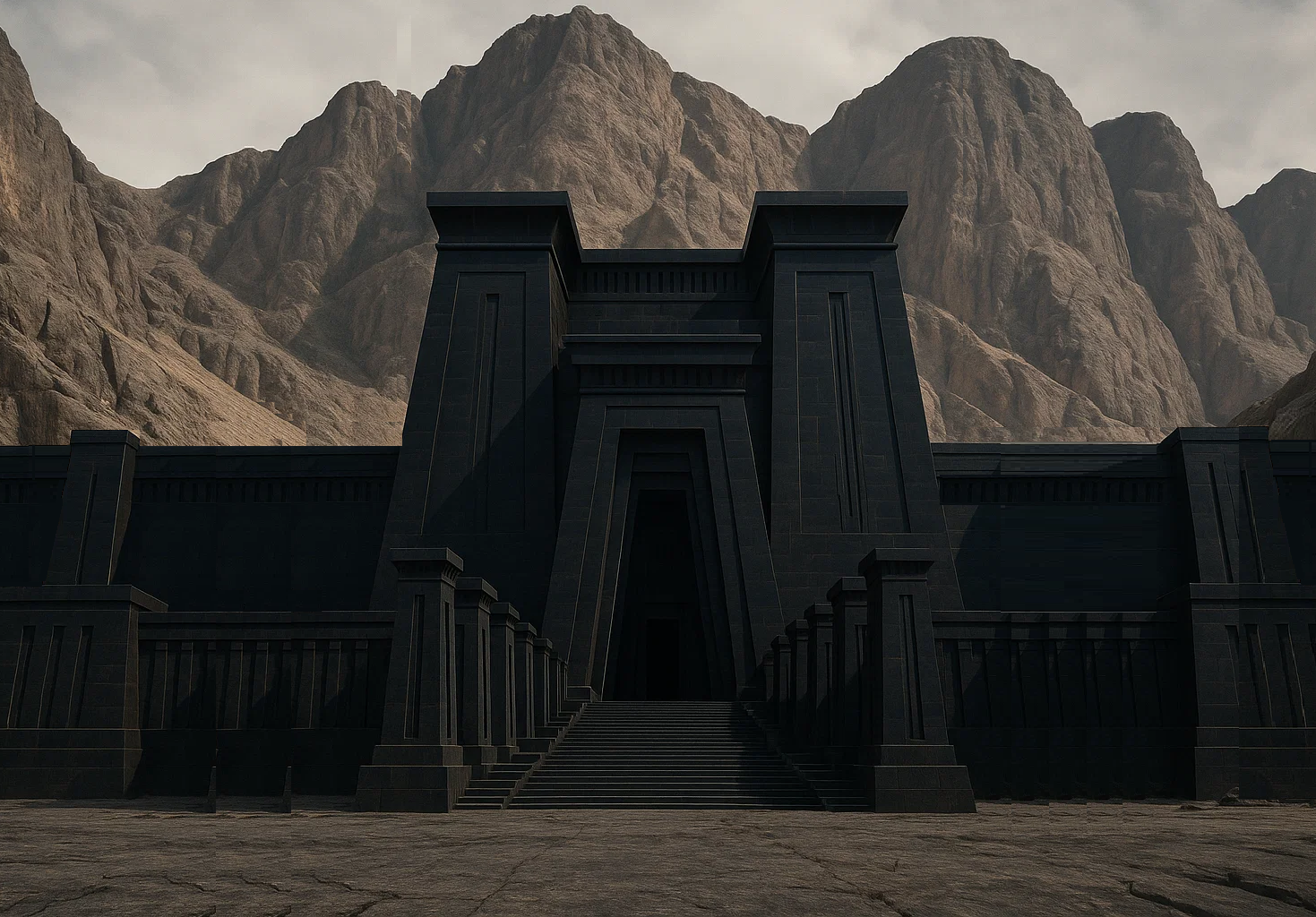
Capital: Qissirma - The capital city of Qissirma, nestled beneath the towering mountain range, is a vast, monumental fortress, its entire span stretching over 100 miles of rugged terrain, with the entrance standing as the only known gateway to the realm below. The mountain range itself is a single, cohesive city, with its jagged peaks and cliffs serving as the backdrop to an underground empire built by the necromancers of Myraletch.
The massive obsidian walls that front the mountain range form an impenetrable barrier. They are not merely walls, but immense fortifications of solid obsidian, towering far above and stretching for miles along the mountainous horizon. The stone, black as night, reflects no light but absorbs the harsh rays of the sun, creating a seemingly infinite dark expanse of gleaming, sharp-edged barriers. These walls form the first line of defense and symbolize the kingdom's strength, unyielding and eternal.
The only entrance to the vast subterranean city of Qissirma is through the great obsidian facade, a singular, awe-inspiring gateway that leads into the heart of the mountain. This entrance, set into the towering obsidian walls, is the only point of access to the sprawling metropolis hidden within the rock. The gate is massive, flanked by towering pillars carved from the same black stone, each etched with arcane symbols and the runes of necromancy. The path leading up to the entrance is lined with steep steps, an almost ceremonial climb for those daring enough to enter.
Not that it would ever happen but, travelers who found their way inside would find themselves in a vast network of tunnels, chambers, and subterranean streets, all hewn from the solid rock of the mountain itself. The city below is a labyrinth of necromantic architecture, where the dark power of the necromancers has shaped the very structure of the mountain into a living, breathing kingdom.
Every inch of Qissirma is a testament to Myraletch's arcane supremacy. The obsidian walls that guard its outer perimeter are not merely functional but also serve as a symbolic barrier, an impregnable shield protecting a civilization built on ancient dark sorcery. From this imposing, shadowy entrance to the depths of the kingdom, Qissirma stands as a singular monument to necromantic power, isolated and impenetrable to all who do not know the way. Unlike the cities of the Thralls, the capital is a place of both grandeur and decay, a city that reflects the twisted, decaying nature of Myraletch's history. It stands as a place of contrast, where the ancient power of the necromancers is still visible in its towering spires, yet the cracks in its foundation are undeniable.
The Grand Necropolis of Qissirma: The necropolis is far more than a graveyard, it is a vast network of crypts and tombs where the first Thralls were created, and where many of the ancient hybrid creations are kept as relics. The capital's necropolis is filled with dark energy, its streets a place of eerie silence broken only by the hum of magical wards that keep the dead, those ancient predecessors of the Thralls, contained.
The Heart of Qissirma: The Obsidian Spire
At the center of the capital stands the Obsidian Spire, an imposing structure made of black stone, pulsing with necromantic energy. It is the seat of the ruling necromancers, and the heart of the entire kingdom's power. The Spire houses the ruling council, made up of the highest necromancers, who make decisions regarding the fate of the Thralls and the future of Myraletch.
The Living Citadels: Instead of the silent, watchful towers of the other cities, the capital boasts the Living Citadels, massive structures created from living hybrid creatures, genetically altered to serve as both architecture and living defense mechanisms. These citadels are alive, pulsating with dark energy, and act as both fortresses and symbols of the necromantic might of the capital.
p>
Major Cities
Return to Maps and Floor Plans
Return to Arethane