Kingdom of Slandrig
The Isle of Sladrig
Where the trees touch the sky, and the sky touches the soul. Nestled off the southern coast of Laridian, the Isle of Sladrig rises like an emerald fortress from the sea, its cliffs jeweled with spray and its crown forever lost in mist. The entire island is a single, ancient forest whose titans, trees older than kingdoms, knit their boughs into a second earth suspended far above the ground. No stone roads run between towns, no plowed fields scar the loam, and no cities of mortar and brick catch the sun. Instead there are lanterns that sway in the high winds, rope bridges that hum like harp strings, and roosts and walkways carved into living wood. The forest floor is sacred, untrodden by most, a hushed and leaf-dim cathedral guarded by taboo and memory.
Above that consecrated silence, life flows in the canopy. The Aarakocra, the island's winged people, make their homes where the wind is at its clearest and the stars can be seen through the leaves. They claim stewardship over sky and root alike, and they treat the forest as a breathing ancestor rather than a resource to be spent. Below the highest roosts, humans and halflings have learned to live in accord with the trees, building their own cliffside dwellings and lower-canopy hamlets that cling to the margins of sea and height. Between the three peoples, an uneasy harmony has endured long enough to become tradition.
People of the Isle
Sladrig is home to six hundred thousand souls. Most are human or halfling, a balance born of old migration and newer necessity. Roughly three hundred and thirty thousand are human, adaptable and restless, eager to find space for family and trade along the cliffs and in the lower boughs. Some are shipwrights and wardens, others gardners of shade-loving crops, others scouts who have learned to read the language of wind-sway and leaf-fall. Two hundred and ten thousand are halflings, quick-footed and sure-handed, guardians of hearth and craft and the quiet ties that hold neighborhoods together when storms turn the world to noise. Many halfling families in Colonsay and Tyndrum keep the gentle arts of tending and mending, while those who dwell nearer Skye and Kinross carry slings and short bows and can traverse a web-bridge like a melody. Forty-two thousand Aarakocra complete the triad, a number small beside their ground-kin but heavy with authority. They consider themselves custodians of the sacred canopy and the untouched floor beneath it, liaisons between the island and the sky that crowns it. A final scattering of other folk, perhaps eighteen thousand in all, make their lives in the island's margins: curious gnomes who adore Kinross's workshops, half-elves who settle in the softer lights of Colonsay, and traders who never planned to stay but found the wind would not let them go.
Humans and halflings dwell where the island allows them, often in cliff-burrows dressed with timber and in lower walkways that seem to grow out of the trunks themselves. They tend fungus-gardens and cloud-fruit orchards in places where the leaves break to let in gentler light, and they herd tree-goats on ledges that only a sensible fool would call pasture. They do these things with reverence, for even those who do not pray to sky or star believe that the forest is listening, and that unkindness is remembered.
Faith Beneath the Open Sky
The Path of the Sky is more than doctrine. It is posture, practice, and the courage to be small. Aarakocra teach that the wind is a library, that stars are the punctuation of a god's speech, and that every great tree is both anchor and bell. Each clan venerates a Wind Ancestor tied to a season or a storm, and the rites that honor them range from glide-battles to silent night flights when the canopy's lanterns are dark. Among the ground-kin, faith is a broad field; humans and halflings keep the altars of their forebears while leaving space in their hearts for the Sky Ancestors. It is not uncommon to see a halfling healer from Colonsay whisper a prayer to Bastisor in the morning and lift her eyes to the Wind at dusk. The forest does not seem to mind the plurality. The forest, after all, outlasts our names for it.
Defenses of a Shrouded Realm
Sladrig has never been conquered, and not for lack of trying. The island is difficult to approach, treacherous to land upon, and impossible to truly understand from below. The Aarakocra strike like the weather itself, seen only as they are leaving, and their hit-and-fade tactics turn every would-be invasion into a ledger of embarrassment. On the cliffs, human militias and halfling wardens keep vigil with horn and bow, while Kinross's skyboats prowl the margins of sea, each crew a compact of makers and daredevils. If the Feathered Sentinels of Troon lift their hands, the warning passes from promontory to promontory on wings and wire, and soon Dunvegan's lanterns burn like a constellation in command.
A History Written in Wind
What the Aarakocra call the Time of Winds lies beyond dates and closer to story. In those earliest tellings, Hravax the Sky-Winged raised Sladrig from the yawning sea and planted the first trees, which leapt toward the moon as if answering a promise. For many uncounted generations only the winged roosted here, and the ground went untroubled by the steps of people.
Then came storms that pushed human and halfling ships from their reckoning and drove them ashore along the southern cliffs. The castaways learned caves and lower boughs and the language of fear, for the Aarakocra saw in them the prelude to desecration. There were skirmishes between air and rope, between claw and steel, and for a time it seemed that the forest itself would have to choose. It did not. Instead it held fast while minds changed. Some shamans began to preach that the strangers were not intruders but foundlings, blown to the island by the same breath that carried their own.
Seven centuries ago a covenant was sung and signed in Dunvegan. The Aarakocra would keep and consecrate the forest floor and crown of leaves, and the ground-kin would dwell in the lower heights and along the cliffs, offering craft, food, and service to the common good. In return, the winged would defend the island and guide its spirit. The Covenant of Dunvegan endures, weathered but unbroken, the scaffold on which the island's precarious harmony rests.
Four hundred years past, pirates and slavers found Sladrig's silhouette and mistook it for prey. For fifty years their black sails bit at the horizon. The Feathered Sentinels were born in those days, and human militias learned to fight in step with Aarakocra flights, while halfling wardens turned their quiet patience into mastery of watch and ambush. The Pirate Wars did not merely end. They taught the island that survival was a chorus each voice must join.
Prosperity followed, long enough to be called ordinary. Colonsay sent medicines into the world, and Kinross taught mortals to fly in bodies not meant for it. Trade undulated around the island rather than through it, and in that gentle rhythm cultures braided together. Then, a century ago, the Storm-Sundering unmade certainties. A tempest of unnatural force tore roosts from branches and wrenched bridges from their anchors. Dunvegan's lattice failed in places that had never failed before. Ground-kin braved the taboos to haul timbers and bind wounds, and in the aftermath the island's stories changed in subtle ways. There are some who say the storm was rebuke; there are more who say it was a reminder that even the sky carries no promises we do not make to one another.
Today Sladrig lives in a balance that feels both time-tested and fragile. The Skycircle still rules, but human councils have grown more confident, and halfling elders speak with a weight no storm can shake. Outsiders tell myths about a hidden isle where birds are people and trees are temples, but those who dwell beneath the canopy know the truth is simpler and stranger: this is a place where the wind keeps faith with those who keep faith with each other.
Whispers and Weather
Beyond its borders, Sladrig is a rumor traded between tavern lamps and temple steps. Sailors swear they have seen skyboats that cast no shadow, and apothecaries boast of phials with a Colonsay ribbon that coax life from the edge of departure. Priests argue, quietly, about whether the winds that cross Sladrig are ordinary winds at all. On the island itself, children of every people learn to read the moods of branches and the temper of tide. They grow into lives that are half habit, half vigilance, because every story that matters here begins with watching the sky.
Some places are defended by walls. Sladrig is defended by understanding, the practiced art of knowing what the wind intends.
When evening comes and the forest turns to bronze, Dunvegan's lanterns open one by one, the coastal towns thread their signals along the rim of the sea, and the lower walkways fill with the household sounds that make a nation out of neighbors. The forest floor remains inviolate, a sacrament of silence beneath the living roofs. Above it, six hundred thousand voices breathe, and the island breathes with them. If there is a secret to Sladrig's endurance, it is not magic alone but the covenant that lives in ordinary hands: the alchemy by which craft becomes care, vigilance becomes kinship, and a place becomes a promise kept.
Population Summary:
- Total Population: 600,000
- Humans: 330,000 (55%)
- Halflings: 210,000 (35%)
- Aarakocra: 42,000 (7%)
- Other (gnomes, traders): 18,000 (3%)
Cities and Towns:
- Capital:
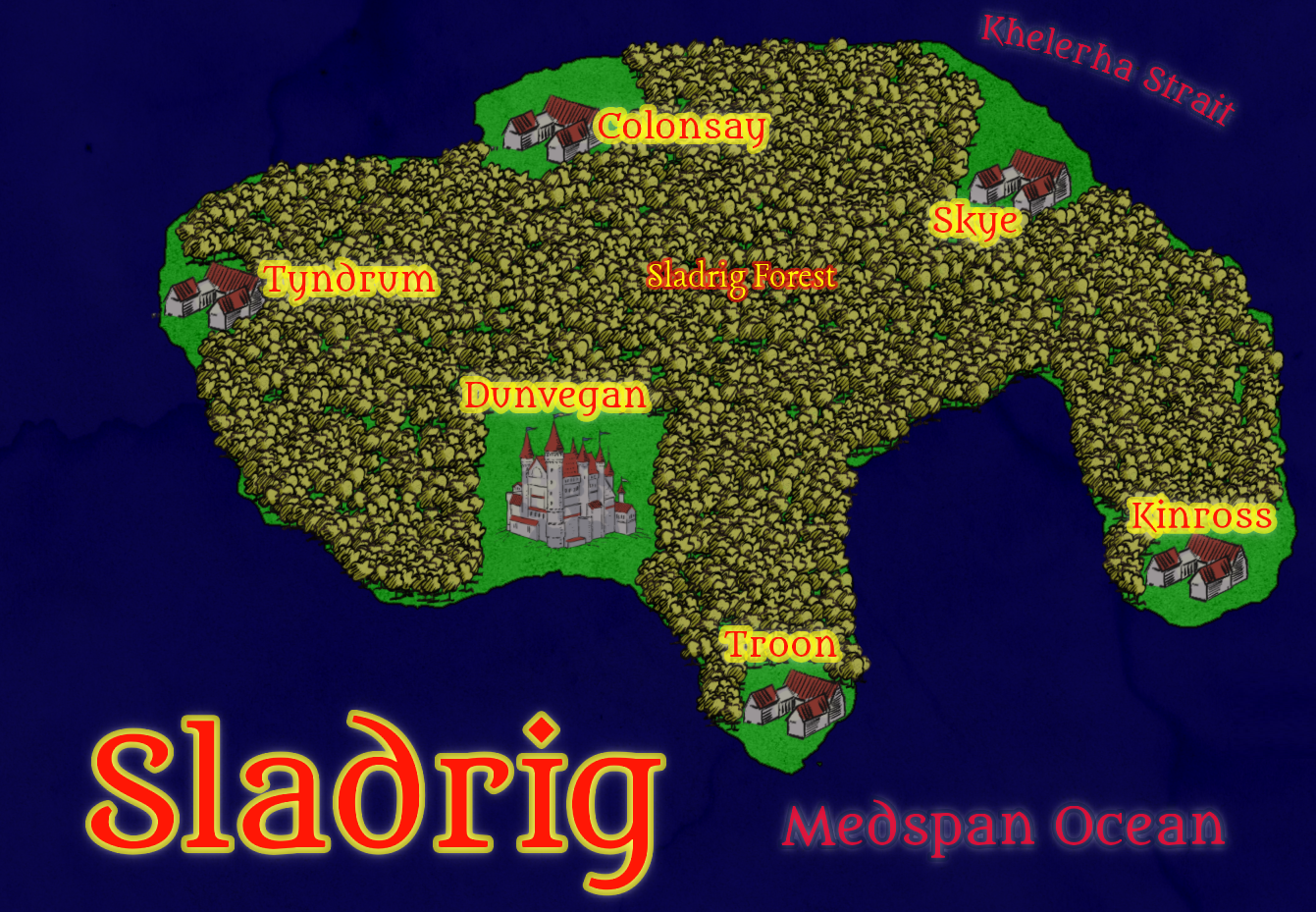
- Dunvegan: On a southern escarpment where the wind rolls in blue and salt-sweet from the open water, the city of Dunvegan stretches in a lattice of bridges between six colossal trees. At night the air fills with the amber glow of wind-lanterns, each a votive to those who have flown before. From these high promenades the Skycircle rules, Windcallers who read the temper of storms, Roost-Masters who tend the groves and the flocks, and Memory-Keepers who bind the past to the present with song. Decisions are not cast by stones or signatures but by ritual flight, by arcs written against the sky, and by the interpretation of star-roads and the whorl of cloud. In Dunvegan, law is a choreography and history a choir that never truly ends.
- Tyndrum: lifts its bridges on the western headlands, where the moon lays a silver road over black water. The town's stormwardens keep company with oracles who braid prophecies into the long feathers that mark their station. When the moon is full, the people gather at the windward lip of the cliffs to begin the gliding rites, and from far away one might mistake their descending lanterns for a small constellation slipping toward the sea.
- Colonsay: leans into the northern winds and smells of sap and tincture. In its hanging gardens, herbalists and cloudvine apothecaries draw sweetness and remedy from flowers that bloom only in the updrafts. There, medicine is sung into spirit as much as distilled into glass, and healers keep their ledgers as if they were family histories. The town's trade has carried its name across Laridian; in many a distant infirmary, a jar with a green ribbon marks a gift from Colonsay.
- Skye: gazes northeast into the vacant blue, austere and keen. Its terraces furnish the island's finest warriors, who test one another with aerial duels above the wave, painting their movements with the thunder of ceremonial drums. The city's discipline has the shape of stone: it is precise, unapologetic, and unafraid of the fall.
- Kinross: holds the southeast, pragmatic and inventive. Here gliders are stitched and skyboats framed, and messenger birds launch at dawn to carry the day's breath to far towns and hidden roosts. The people of Kinross are equal parts craft and courage, for every vessel they make they first hurl into the wind over their own cliff, trusting design and faith in the same heartbeat.
- Troon: keeps the southern promontory and speaks little of its work. In its shadowed towers, the Feathered Sentinels keep watch over sea and sky alike. The first streak of unfriendly sail on the horizon is known there before it is known anywhere, and if the Sentinels give a silent-winged signal toward Dunvegan, every lantern along the coast will burn blue by nightfall.