Yarinsloth, The Ork Empire
Kingdom Heraldry
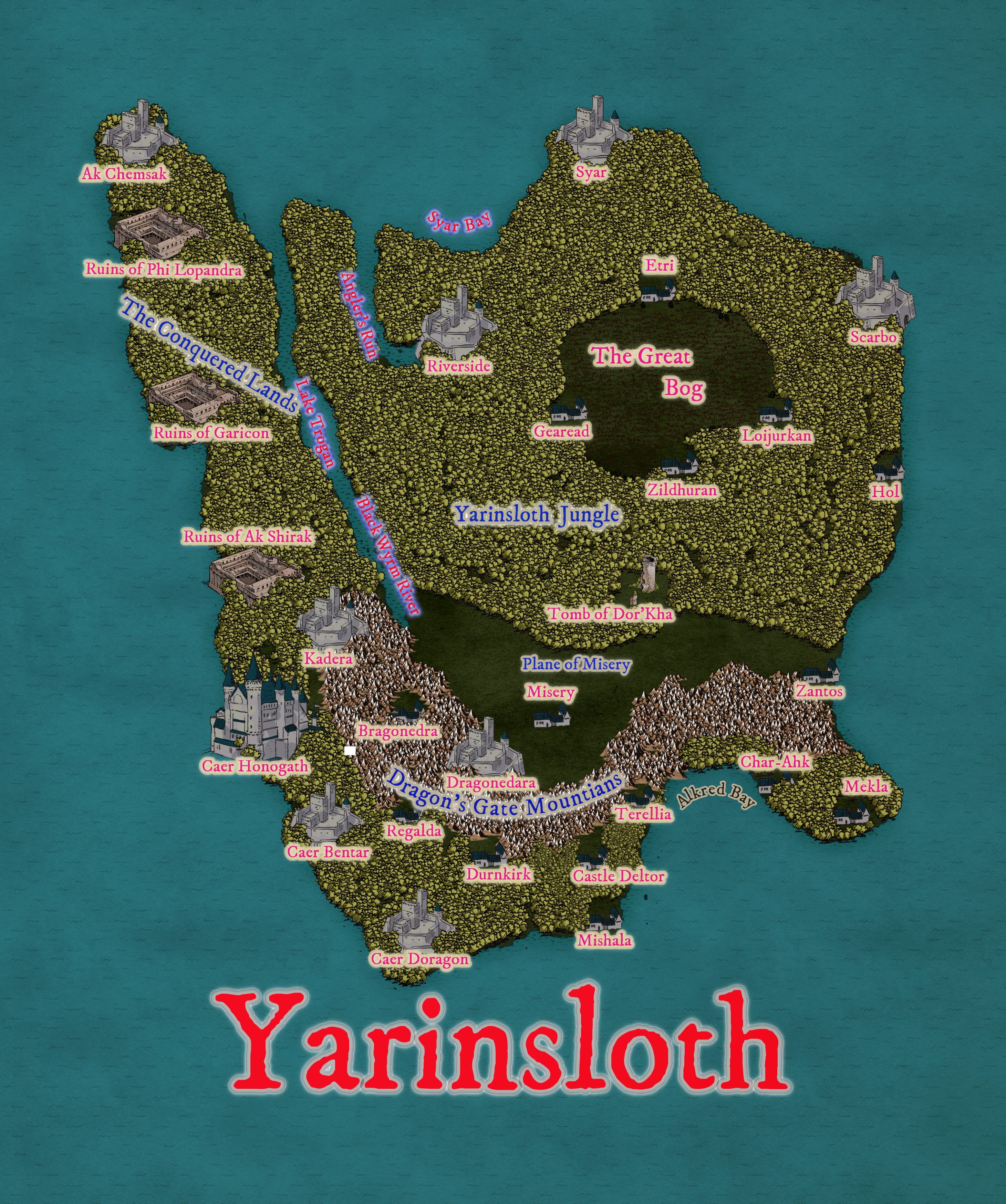
Yarinsloth is the Southern most island of the Lorienian Continent, but unlike the rest of the continent it is not protected by the Magic of the Elves and the weave.
Climate:
Temperature
- Warm to hot temperatures (25-35 c/ 77-95 f) year-round.
- Very little seasonal variation in temperature.
- Nights are slightly cooler but still warm and humid.
Humidity
- Extremely high humidity levels, often 80-100%, making the air feel heavy and damp.
- Persistent moisture leads to frequent mist and fog, especially in the mornings.
Rainfall
- Heavy and consistent rainfall, often exceeding 2,000-4,000 mm (80-160 inches) per year.
- Some jungles experience daily rain showers, while others have a pronounced wet season and a slightly drier period.
- Rain can be sudden and intense, often accompanied by thunderstorms.
Vegetation & Canopy Cover
Wildlife Adaptations
- Animals are adapted to heat, humidity, and dense vegetation.
- Many species, such as monkeys, birds, and insects, thrive in the canopy layer.
- Dense Jungles: Thick, nearly impassable forests cover much of the land, providing both natural defenses and challenges for expansion.
- Mountain Ranges: The Dragon's Gate Mountains create a formidable natural border, home to kobold strongholds and hidden paths.
- Swamps and Marshlands: Certain regions are dominated by vast wetlands, where dangerous beasts and disease thrive.
- Ancient Ruins: Scattered throughout the jungle, remnants of lost civilizations serve as both treasure troves and deadly traps for explorers.
- Rivers and Waterways: The empire's many rivers serve as vital trade routes, cutting through the thick jungle and connecting settlements.
- Capital: Caer Honogath
- Ak Chemsak
- Ruins of Phi Lopandra
- Ruins of Garicon
- Ruins of Ak Shirak
- Tomb of Dor'Kha
- Kadera
- Caer Bentar
- Caer Doragon
- Dragonedara
- Riverside
- Syar
- Scarbo
- Bragonedra
- Misery
- Regalda
- Durnkirk
- Mishala
- Castle Deltor
- Terellia
- Char-Ahk
- Mekla
- Zantos
- Hol
- Zildhuran
- Loijurkan
- Gearead
- Etri
- Strength Above All: Weakness is a curse, and only through strength, whether physical, mental, or strategic, can one earn the gods' favor.
- Honor the Blood Price: Life and death are part of the cycle of war. Blood spilled in battle is an offering to the gods.
- The Empire is Eternal: The Gruntassh gods have chosen the Orcs to carve out a lasting kingdom. To expand and defend the empire is to serve the divine will.
- Survival is Glory: Overcoming hardships, whether in war or through endurance, is proof of divine blessing.
- 1 rk
- 5 rk
- 10 rk
- 50 rk
- 100 rk
- 01-20% Lucked out, no encounters or attacks.
- 21-25% 1D4 Bogies; evil Faerie Folk.
- 26-30% 1D4 Harpies or Avians; the latter may not be hostile.
- 31-35% 1D4 Pucks; evil Faerie Folk.
- 36-39% 1D6 Toadstools; evil Faerie Folk.
- 40-44% One Kelpie; evil Faerie Folk.
- 45-48% 1D6 Timrek.
- 49-51% One Melech or a Minotaur. At G.M.'s discretion, 1D4 others may be nearby.
- 52-54% One Krel or predatory animal.
- 55-57% 1D4 Rock Crawlers.
- 58-60% One Peryton or Dragondactyl, or other airborne predator.
- 61-63% One giant Blow Worm (they love living in quagmires).
- 64-66% One Chimera or 1D4 murderous Kelpie on the hunt.
- 67-69% 1D4+1 Nippers; Worms of Taut.
- 70-72% One foul Adram on full display, but unwilling to help unless they are complimented and paid for any assistance, but it may steal any valuables and leave without assistance, or finish off those in trouble and take what it wants.
- 73-75% 2D4 Tomb Worms slide into the bog/pool and swim toward their prey stuck in the mud.
- 76-78% 1D6+1 Hoppers appear from the grass and make tagteam attacks, leaping on the person or animal trapped in the mud, biting and clawing before leaping back onto solid ground. In the alternative, the horrid little creatures may attack those attempting a rescue, knowing they can take their time with whoever is trapped in the bog pit.
- 79-80% 1D4 Fire Worms
- 81-83% One Leopard.
- 84-86% One Tiger.
- 87-89% One agitated Acid Lizard or snake (python or poisonous).
- 90-91% 1D4+4 Hyenas or wild dogs.
- 92-94% One or two Tri-Fang or Fire Worms
- 95-96% One Werepanther or Weretiger or Werepython, however, its mate is nearby.
- 97-98% Two giant Blow Worms or one Blow Worm and 1D4 Nippers or Tri-Fang!
- 99-00% A rare Kilin. The creature may be willing to lend a hand and help, though is likely to demand payment in precious gems or a magic item, or worse, a favor. A favor will be a trade of services that is almost certainly dangerous for the person(s) who makes such a deal, but will lead to adventure and possibly treasure. In the alternative, it might attack adventurers if they have something it wants and it believes it can overpower them.
- 01-20% Lucked out, no problems.
- 21-25% One witch in the service of Yarinsloth the Destroyer, two Pucks or Satyrs are her minions.
- 26-30% One Lesser Fire Elemental.
- 31-35% Two Pucks (evil Faerie Folk) or Tezcat warriors.
- 36-40% Two Fire Worms; Worms of Taut.
- 41-45% 1D4 Poltergeist Entities or Haunting Entities.
- 46-50% 1D4+1 Fire Sprites. 51-53% One meanspirited Bogie. 54-56% One hungry Chimera or Dragondactyl.
- 57-59% One Leopard. 60-62% One Tiger. 63-65% 1D6+1 Hyenas or wild dogs.
- 66-68% 1D6+1 Goblins or Orks.
- 69-71% One or two Corpse Creatures.
- 72-73% 1D4 Sand Serpents looking for trouble.
- 74-75% Two or Three Fire Worms; Worms of Taut.
- 76-77% 1D4 Tri-Fangs or one Blow Worm; Worms of Taut.
- 78-79% 1D6+1 Fyr-Kree Insectoid warriors or Lizard People.
- 80-81% 1D4+1 Fire Worms; Worms of Taut. 82-83% 1D4+1 Nippers or one Blow Worm; Worms of Taut.
- 84-85% One Serpent Beast that commands two Nippers or two Fire Worms.
- 86-87% One Cockatrice worshiped by a band of 1D4+2 Tezcat or Ratton that live nearby and will respond to their dragonmaster's cries for help or assistance.
- 88-89% One Dragon Spawn for each player character, and they are spoiling for a fight. Can substitute with Tezcat, Dogres, or Ratlings.
- 90-91% One Gallu Demon Bull or Baalrog. Yikes!
- 92-93% 1D4+4 Tezcat or Ratton cultists of the pantheon of elder Jungle Deities looking for slaves and people to sacrifice.
- 94-95% One Nimro Fire Giant. May substitute with a Jotan or a Gromek.
- 96-97% Two Gigantes.
- 98-99% One Fire Dragon.
- 100% One friendly and helpful Kukulcan.
- 01-20% Not poisonous: Edible and tasty.
- 21-40% Not poisonous: But tastes awful and is inedible.
- 41-00% Poisonous: Roll for damage and symptoms, below.
- 01-15% Foul Tasting: This plant tastes too terrible to describe. It causes the character to choke and gag, eyes tear, and burns the mouth. The victim loses 1D4 melee rounds trying to spit it all out and rinse with water to get rid of the taste; choking and gagging all the while. Penalties: During this time the character loses initiative and one melee attack per round, and is -2 to strike and parry. Moreover, any attempt to be quiet and stealthy is ruined by all the hacking. Worse, the wretched taste stays in the mouth for 2D4 hours, killing the taste of all but the strongest flavored foods and drinks.
- 16-25% Food Poisoning: It tasted pretty good, but within 2D6x10 minutes after eating, the character is racked with stomach cramps and suffers from nausea, sweats, and diarrhea (or vomiting), all of which make him feel weak. Duration: 2D6 hours. Penalties: Reduce speed by half, -30% on the performance of all skills, -3 on initiative and Perception Rolls, -2 to strike, parry, dodge, and disarm, and the victim needs to stop to relieve himself once every hour.
- 26-35% Mild Allergic Reaction: An itchy rash or boils break out in patches all over the victim's face, hands, and body. Duration: 1D4 days. Penalties: -1 on initiative and Perception Rolls, temporarily reduce Spd by 10%, and P.B. attribute by 30%.
- 36-40% Severe Allergic Reaction: The tongue and lips become swollen, face burns and hurts, muscles ache, and the stomach feels queasy. Duration: 2D4 days. Penalties: -3 on initiative and Perception Rolls, and temporarily reduce P.S., Spd and the performance of most skills by 30%; skills that require talking or entertainment are -50% for the duration. In addition, practitioners of magic have a difficult time casting spells, only one spell per melee round!
- 41-55% Mild Poison: Tasted yummy. Damage: 2D6 points five minutes after ingestion. Symptoms: Damage occurs and mild nausea begins 10 minutes after ingestion. Vomiting occurs once every hour. Penalties: In addition to the damage and symptoms, the victim is -1 on initiative and Perception Rolls, -10% on skill performance, and reduce Spd by 10% for the duration. Duration: 1D4 hours.
- 56-65% Deadly Poison: The plant contains lethal chemicals which can kill most Humanoids. Thankfully, the plant or fruit tastes bitter and it is not likely that larger quantities will be eaten. Damage: 3D6 from a bite or two, 5D6 from three to five morsels, and 1D6x10+6 damage for large quantities such as an entire plate/meal. Damage occurs 5 minutes after consumption. Symptoms & Penalties: Sharp, stabbing stomach cramps so severe that the victim doubles over in pain every 10 minutes and loses all melee actions when this happens (lasts 15 seconds). Otherwise, the victim feels sick, feverish, and nauseous, reduce Spd and attacks per melee by half, -4 on initiative and Perception rolls, -50% on skill performance, and -2 to strike, parry, and dodge. Duration: 2D6 hours.
- 66-75% Mild Sedative: This food is a mild narcotic causing nausea, dizziness, and drowsiness. The affected character enters a foggy state which can only be described as “high.” Penalties: -5 on initiative, -15% to all skills, reduce speed by 10%, and the individual zones out or dozes off when things are quiet or he sits down to rest a while. Duration: 1D4 hours.
- 76-80% Heavy Sedative: Unless the character saves vs non-lethal poison (16 or higher), he lapses into a sound sleep or stupor. He can only be awakened and made to respond for 1D4 minutes at a time, but even then is groggy and slow. Penalties: Skill performance is impossible (-90%), reduce Spd by 90%, melee actions are reduced to one per melee round (15 seconds), the individual has no initiative or awareness (no Perception Rolls) of his surroundings, and is -9 to strike, parry, and dodge. If the character makes a successful save, reduce penalties and duration by half. When given a jungle remedy, reduce penalties by half again and the duration is only another 1D6+4 minutes.
- 81-85% Blinding Headache: Five minutes after consumption, the victim is racked with a crushing migraine and severe blurred vision. Damage: 2D6 points 15 minutes after ingestion. Penalties: -1 attack per melee round, -4 to strike, parry, and dodge, -6 to strike with long-range and thrown weapons, Called Shots are not possible, reading and writing is not possible, -40% on skills requiring sight and concentration. Duration: One hour.
- 86-90% Severe Indigestion and Flatulence: The toxin causes bloating and gas 10 minutes after ingestion. Damage: 1D6 points. Symptoms & Penalties: The victim releases a loud, foul-smelling fart every 1D6 minutes, making prowling and stealth impossible, and stomach discomfort reduces Spd by 10%. Duration: 1D6 hours. Note: A successful save or jungle remedy means the character spends four melee rounds (15-60 seconds) vomiting, but there are no lasting penalties or flatulence.
- 91-95% Paralysis: A neural toxin that causes paralysis within 1D6 minutes after the first few bites. The victim falls over and is unable to move or speak, but breathing is fine and though he cannot act on them, he retains his awareness and wits. Duration: 2D4 minutes of paralysis, however, the victim's limbs continue to feel stiff and a bit numb and tingly for an additional one hour, during which they are -1 on initiative, -1 to strike, parry, and dodge, and speed is reduced by 20%. Note: A successful save or jungle remedy means the individual feels dizzy and his body tingles for 1D4+1 melee rounds (30-75 seconds), but is otherwise okay and the feeling soon passes.
- 96-00% Worms: The food eaten was infested with tiny parasites invisible to the naked eye. They infect the body and take up residence in the victim's stomach where they feed on food and waste. The first signs of trouble do not show up until four weeks later when the character's stool is a green color and has small but obvious worms in it. The victim feels hungrier than usual, and tired and worn out; fatigues in half the time. Penalties: Reduce P.S. and P.E. by 20%, and apply any applicable modifications or penalties. Moreover, 01-50% chance the individual collapses from exhaustion at the end of every battle or period of strenuous activity. Duration: This problem can only be cured by the following means: The spells Remove Curse or Restoration, or via traditional jungle remedies - typically a foul tasting potion or cup of herbal tea that kills the worms and restores the individual to normal in 1D4 days.
- Food: Fresh food, including bread, cheese, picked vegetables, and recently killed meats, fish, and poultry spoil and become moldy or riddled with fungus within 5D6 hours. Even the best preserved and prepared jerked, smoked, or salted meats suffer a similar fate and are ruined and inedible within 1D4+4 days (normally lasts weeks).
- Clothing: Clothes become mildewed, moldy, and covered in fungus within 4D4 days. They have a mildewy smell and begin to deteriorate, showing signs of wear, with many small holes and threadbare locations. A suit of clothes, cape, cloak, padded armor, and similar items are ruined and foul smelling after an additional 2D6+16 days; wool fabric in half that time.
- Leather goods: Leather armor, boots, gloves, leather bags, backpacks, belts, and other leather goods look terrible and exhibit rapid signs of discoloration and stains, giving them an aged and blemished appearance within 1D6+16 days, but will last 3D4 months before falling apart.
- Metal Armor: The weight and bulk of chain mail, scale, splint, laminated, plate armors, and the rest cause individuals wearing them to sweat and chafe in the jungle. These areas are targets for fungus, molds, and bacterial agents that cause skin irritation, itching, and rashes. The armor itself will, over time, become discolored or develop patches of fungus and may begin to rust in places within a few months. Moreover, armor may snag and get caught on vegetation, hampering movement. Penalties for Metal Armor in the Jungle: The wearer suffers fatigue in half the time and reduces speed by 20%.
- 01-10 Pox (non-lethal): The victim breaks out in spots, hives, or a rash that covers the entire body. The skin is extremely sensitive to the touch and itches terribly – but don't scratch! Armor and heavy backpacks cannot be worn. The eyes become extremely sensitive to light, preventing the character from seeing more than 100 feet (30.5 m) away in daylight. The body feels tired, itchy, and achy. Penalties: Reduce speed and combat bonuses by half, -2 attacks per melee round, and -20% to performance of all skills. Duration: 2D4 days.
- 11-18% Delirium Fever (non-lethal): Also known as the Fever of Madness or the Madness. All the usual fever symptoms plus bouts of delirium. Penalties: -20% to all skills, -2 on initiative and Perception Rolls, and -1 to strike, parry, and dodge. In addition, the victim suffers from periods of delirium lasting 1D6+10 minutes at a time. They occur under duress, when afraid, in combat and high-stress conditions, or at night. Roll on the table below to determine the delusion and how the ill person is likely to respond. Depending on what is rolled, the character imagines it whether they are actually present or not, and responds accordingly. (“Do you hear music? The drums? Make them stop! If you won't I will!” Followed by the individual destroying musical instruments that aren't there or attacking people imagined to be musicians and destroying property that isn't a musical item. If Phobia: Spider or Snakes is rolled, the sick person will scream about them coming toward him and either run away or climb a tree to escape them or start flailing around and swatting at a menace only they can see. Screaming and unpredictable and wild actions may draw the attention of enemies and predators.) Duration of Delirium Fever: 1D4+3 days.
Common Delusions and Fevered Nightmares:
Roll percentile dice.- 01-10 Phobia: Snakes.
- 11-20 Phobia: Spiders or worms.
- 21-30 Phobia: Cannibals.
- 31-40 Affective Disorder: Disgusted by anything sticky.
- 41-45 Neurosis: Fear of the dark, including Shadow Beasts, dark magic, and creatures of darkness like vampires.
- 46-55 Neurosis: Can't tell the truth; talkative but makes up stories, makes accusations, and tells lies and tall tales that may cause trouble.
- 56-65 Affective Disorder: Hates music/destroys instruments.
- 66-75 Phobia: Quicksand and bogs.
- 76-85 Affective Disorder: Obsessed with cleanliness and dislikes swamps, dirt, goo, bugs, etc.
- 86-95 Neurosis: Invasion of the Body Snatcher's syndrome.
- 96-00 Affective Disorder: Intimidated by the spoken word.
- 19-27% Jungle Fever (occasionally lethal): Victims burn up with a high temperature, suffer from constant dizziness and weakness, their vision is blurred, every muscle in their body aches, they lose their appetites, and it is difficult for them to concentrate as their body quickly dehydrates. They will need to drink fluids or they will die. Penalties: Reduce speed by 80%, reduce the number of melee actions to one, all saving throws are half, all combat bonuses are reduced to zero, and skills are performed at -50%. There is a 01-75% chance of collapsing during any sort of physical exertion. To travel, the individual(s) will need to be carried or pulled in a cart. Duration: 1D6+4 days.
- 28-33% Fungus Congestion (non-lethal): Victims suffer from fungus in their lungs which causes coughing and makes breathing difficult, especially when involved in exhausting activities such as running, climbing, swimming, and fighting. Penalties: The ill individual fatigues more rapidly than normal (30% faster), gets winded, and has a chronic cough that makes stealth difficult. -10% to Prowl, Climb, Dance, Acrobatics, Juggling, and Swimming skills. Duration: Until cured by the magic spells Remove Curse or Restoration, or various jungle remedies/teas/potions from a Shaman, etc., familiar with the disease. It can also be cured by leaving the jungle and living in a warm, dry climate for 1D4 years.
- 34-40% Nightmare Fever (non-lethal): Victims are burning up, they feel dizzy and weak, their vision is blurred, every muscle in their body aches, it is difficult to concentrate and their body quickly dehydrates; they must drink fluids or they will die. Penalties: Reduce speed and parry bonuses by half, -2 melee attacks, all other combat bonuses are reduced to zero, and skills are performed at -30%. Duration of the Fever: 1D4+1 days. Duration of each Hallucination: Until the fever breaks, though the Nightmare Reality may switch from one to the other. The Nightmare Reality: Roll percentile or pick the one that makes the most sense under the circumstance. The worst part is the victims burning with fever are either thrashing about in a semi-conscious, tortured sleep filled with nightmares or awake but suffering from hallucinations. These episodes occur 1D6 times every 24 hours and when threatened or under duress. Roll on the table below to determine their delusional state of mind and reaction. Bouts of delusions and hallucinations last for 1D6x10 minutes and may require restraining the individual to prevent him from running away or hurting himself or an innocent bystander. Roll percentile dice or pick one of the following:
- 01-25% Disassociation and paranoia. Doesn't recognize those around him, not even friends, allies, and family, but is sure they are out to get him. Doesn't trust them and demands to see family members and worries about their safety. This compels the individual to want to escape and run off to find them.
- 26-50% Doesn't know where he is, or who he is, and sees those around him, including friends and teammates, as the enemy. (“What have you done to me?! Why can't I remember anything? What do you want from me?! Let me go!”) Again, the deluded individual feels compelled to escape and repeatedly tries to leave, fighting only enough to escape, not to kill.
- 51-75% Relives a traumatic battle, fear, or past event and sees everybody around him as someone else, friend or foe. Nothing the ill person says is likely to make any sense.
- 76-00% Sees those around him as monsters and villains out to hurt and enslave him. The sick person screams in terror whenever approached, shouts warnings, runs around, points to things that are not there, and attacks anyone who comes near him.
- 41-50% Common Fever (non-lethal): The character suffers from a constant low-grade fever, is weak, lethargic, and dehydrated. Penalties: -10% on all skills, -4 on initiative, -2 on Perception Rolls, and -2 to strike, parry, and dodge. Duration: 1D4+2 days.
- 51-60% Viral Sickness (non-lethal): Victims experience flu-like symptoms: Nausea, headaches, runny nose, draining sinuses, watering eyes, vomiting, diarrhea, body aches, physical weakness, and extreme fatigue and a need to sleep. They cannot hold down food, making them weaker as time passes. If the victim tries to push himself in any way (always roll at the beginning of each melee round), there's a 01-66% likelihood of collapsing into unconsciousness for 2D6 melee rounds. The ill individual must sleep for two hours after every hour of activity or awake time, if not they pass out for 1D6x10 minutes. Penalties: Reduce speed, P.S. and P.P. attributes by half and modify all bonuses accordingly; also reduce the number of attacks per melee by half (round down), and physical S.D.C. by half! Skills are performed at -20%, and remember to roll for losing consciousness every time the character exerts himself or is awake for more than two hours. Duration of Sickness: 2D4+3 days.
- 61-65% Plague (lethal): The victim turns pale and dark brown or red blotches cover the body. The individual becomes delirious, with a burning fever, won't eat and is so weak that he can barely stand. The ill look like they teeter at death's door. Penalties: One attack per melee round, no bonuses of any kind, -4 on all combat rolls and saving throws; temporarily reduce physical attributes and Hit Points by 75%, and the performance of skills is impossible. The victim must sleep 90% of the time. If plague victims try to engage in lengthy combat or exertion of any kind, there is a 01-70% chance of lapsing into a coma after six minutes. A coma state means Hit Points are reduced to zero and roll to save vs coma/death (immediate medical attention is suggested). A successful save vs (lethal) disease adds +10% to save vs coma and the duration of the sickness is reduced by half. Duration: 2D4+2 days. Recovery: At the end of the plague's duration, the character's Hit Points slip to zero and a roll to save vs coma/death is necessary. If medical attention is provided for at least the last two days (by clergy, Shaman, Psi-Healer, Alchemist, etc.) the character is +20% to save vs death. A successful save vs coma means the character instantly regains six Hit Points and 6 S.D.C., and recovers twice as quickly as normal. Magic, psionic and herbal healing can bring the character back to full health and Hit Points even quicker. A failed save results in death unless magical healing is available.
- 66-75% A Terrible Cold (non-lethal): The head is congested, sinuses drain like crazy, victims have a slight fever, the nose is constantly running, and the character is continually sniffling and coughing or sneezing. The noise from the sniffling and coughing/sneezing makes it impossible to prowl or remain hidden; even the chameleon spell is -20%. Penalties: Reduce speed by 10%, initiative by half, attacks per melee by one, all combat bonuses are -1, and skills are -5%. The character also tires twice as quickly. Duration: 2D4+1 days.
- 76-85% Open Sores (often lethal): A viral, bacterial, or fungal infection that gets worse without treatment. The victim has 1D6+1 sores and gets an additional 1D6+1 with every passing week. Healing potions and healing touches only get rid of one sore each and only restores two Hit Points per each application, but the sores still keep returning. Penalties: -2 on initiative, reduce P.B. by half, -10% on skill performance, and has trouble sleeping and concentrating due to the constant discomfort and minor pain. Each sore reduces the character's Hit Points by two points! When down to zero the character dies, unless he saves vs coma and death. Duration: 3D4 weeks until it runs its course. Sores disappear and Hit Points return at the end of the duration; if the character survives. A jungle remedy reduces duration and damage by half, while Remove Curse and Restoration will eliminate and cure the malady with sores vanishing overnight.
- 86-90% Jungle Parasites (non-lethal): Though there are several ways to acquire parasites, the most likely are by drinking tainted water, eating raw or improperly cooked meat, or trudging through swamps, marshes, and bogs. Jungle parasites cause the body to degenerate and the character's health to diminish. It takes four weeks before the problem is discovered, typically by noticing the parasite's eggs in the victim's feces. Penalties: Reduce the character's P.S. and P.E. attribute by one point for every week after the initial four and P.P. and Spd by one for every two weeks. These penalties are cumulative and eventually the person is unable to do anything. There is also a 01-50% chance that the victim collapses from exhaustion at the end of every fight or period of strenuous activity. Duration: Until the parasites are eliminated! This problem can only be cured by the Remove Curse or Restoration spell, and some jungle remedies (find a jungle priest, Shaman, Herbologist, or Alchemist quickly). The attributes of a cured character return at a rate of two points per day until back to full strength and health. Note: There are also rumors of ancient spells that specifically rid the body of parasites. Rumor has it, these spells were developed long ago by a civilization now extinct, but from time to time, are discovered in moldering scrolls hidden in jungle ruins. Another rumor speaks of kindly mages who wander the Yarinsloth Jungles willing to tell other magic practitioners this curative spell. The same rumor claims these mages to be the secret descendants of this lost civilization.
- 91-00% Jungle Foot Rot (can become lethal): A fungus resulting from not keeping your feet clean and dry. This is an extremely common condition since one cannot travel through a rainforest without getting both feet and footwear wet. After three days without cleaning or drying one's feet and footwear, there is a 30% chance of fungal infection. Each successive day another check must be made with a 10% increase to the chance of infection. (Does not apply if the feet and footwear are cleaned and dried every 24 hours.) Once Foot Rot develops, the feet must be healed/cured by a Shaman or member of clergy, magic, or psychic healing, or healing via an herbal salve, balm or ointment known to most Shamans and jungle Sages. There are drastic effects for not treating this infection. Every week the character loses two points from speed to a minimum of four. When the feet have been infected for more than two months they become so festered and sore that every step hurts (reduce Spd by 50% and Hit Points by 20% until healed). Unless the infection is cured magically at this stage, the feet must be removed or the infection will spread to the rest of the body and the character will die within six months. As usual, Remove Curse and Restoration can cure this malady.
- Spear with Stone Tip: 1D6.
- Stone Knife: 1D4.
- Stone Axe and War Hatchet/Tomahawk: 2D4+1.
- Stone Hand Axe (tool): 1D4+1.
- Stone Short Sword/Machete: 1D6 (large swords are not possible).
- Large Stone Battle Axe: 2D6 (weighs an additional two pounds/0.9 kg and requires a minimum P.S. of 20 to wield without a -2 penalty).
- Stone Mace/War Club: 2D6.
- War Club with stone shards or large animal teeth, or wooden spikes like a morning star: 2D6+1 damage.
- Short Bow and Arrow: 1D6
- Bone Short Sword/Machete: 1D4 (large swords not possible).
- Hand Axe: 1D4.
- Bone or Wood Axe and War Hatchet/Tomahawk: 1D6.
- Large Bone or Wood Battle Axe: 2D4 (weighs an additional two pounds/0.9 kg and requires a minimum P.S. of 20 to wield without a -2 penalty).
- Bone or Wood Mace/War Club/War Hammer: 2D4.
- Bone or Wood War Club with stone shards or animal teeth, or wooden spikes like a morning star: 2D6.
- Bone or Wood Throwing Stick or Boomerang: 2D4.
- Iron Throwing Iron: 2D6
- Bone or Wood Short Spear and Javelin: 1D6+1.
- Bone or Wood Large Spear: 2D4+1 damage (+2 with stone tip).
- Wood or Bone Short Staff: 1D6.
- Wood or Bone Long Staff: 2D4.
- Wood or Bone Bo Staff: 2D6.
- Slings: These are one of the simplest and most effective weapons to make. All that is required is a strip of material made from animal hide or plant vines, and a stone to be “slung” from it. Smooth stones ranging from the size of a robin's egg to a golf ball are the most common among Ork-sized beings. Of course, the stones lobbed by giants are considerably larger. Damage: 1D6 for stones used by Orks, 2D6 for Minotaur, Wolfen, and Troll-sized beings; 4D6 for true giants like Jotan and Gigantes. Range for Orks: 200 feet (61 m); 300 feet (91.5 m) for larger beings, but half the distance in a dense jungle.
- Bola: The bola is a simple weapon designed to entangle rather than damage victims. The bola is a pair of weights attached by a cord and spun above the head before being released at the intended target. It is used to entangle the legs to trip and capture people and animals. It can also be used to knock weapons out of a person's hands as well as to knock birds, lizards, monkeys, and fruit from trees. To entangle or strike a specific small target (hand, weapon, bird, etc.), roll to strike as a Called Shot. Damage: 1D4. Range: 100 feet (30.5 m), half in dense jungle areas. Penalties for entangled victims: Entangled feet/legs are tied together, making the victim fall or stumble. The victim of a knockdown loses initiative and is -1 to strike or parry, -6 to dodge while entangled, and speed is reduced by 80%. All penalties are enforced until the character gets himself untangled or cut loose which takes 1D4 melee actions.
- Bow & Arrow: These are identical to those listed in the Palladium Fantasy RPG, though the short bow is most common among tribal people. Arrowheads made of bone or stone are commonly barbed or coated with poison. Damage: Short bow 1D6. Range: 300 feet (91 m) for short bow, half that range in dense forests. Line of sight required.
- Footbow: The footbow is a strange weapon developed for jungle warfare. Twice as large as a longbow, it is used to fire upon big, immobile or slow-moving targets like buildings, ships, and the occasional dragon. It is most frequently used against buildings and boats by launching flaming arrows into them. The archer must lay on his back, press his feet against the bow and pull the string back with both hands. Damage: 3D6 normal or 5D6 for flaming arrows. The weapon suffers a -5 penalty to strike a person or moving target, -10 if the target is moving fast. This bow is not meant for accuracy against small, moving targets. Note: The one exception to these penalties applies to Avians who have mastered the O.C.C. of Long Bowman. Avian characters whose O.C.C. is Long Bowman and at least 3rd level have only a -3 penalty to strike a human-sized or moving target. See the Avian R.C.C. for more details. Range: The weapon has an incredible range of 1,500 feet (457 m).
- Blowgun: A hollow rod through which darts are launched by air pressure. Jungle people frequently coat the darts with poison to inflict damage or immobilize an opponent. The blowgun can be fired with surprising accuracy and is virtually silent. Many jungle folk use them to hunt small birds, lizards, and mammals. Damage: Only one point, plus the effects of poison, if any. Effective Range: 40 feet (12 m). The maximum range is 80 feet (24.4 m), but -3 to strike beyond 40 feet.
- Lethal Poison: 4D6 damage plus the normal weapon damage. A successful save vs lethal poison (14 or higher; very potent) means the victim suffers only 1D6 damage.
- Burning Poison: This chemical causes the wound to burn like the dickens and causes the victim to lose initiative and is -1 to strike and parry for 1D6 melee rounds due to the distraction of the fiery pain. Penalties are cumulative for each successful burning poison attack. A successful save vs non-lethal poison (16 or higher) means minor pain and no distraction or penalties.
- Paralytic Poison: This poison is effective only when the toxic weapon, arrow, or dart strikes an arm, hand or leg. The appendage affected becomes numb and less effective. If an arm is struck with the poison, the character loses one attack per melee round. If the hand is struck, he cannot hold a weapon or grasp with any strength! If the leg is struck, reduce the character's speed and Prowl skill ability by 30%. A successful save vs non-lethal poison (16 or higher) means only a tingling sensation in that limb and no penalties, but damage from the weapon is applied.
- Sleep Poison: At the start of the next melee round, the victim feels drowsy and struggles to stay awake even in combat! Duration: The intense sleepiness lasts for 1D6 melee rounds (15-90 seconds). Penalties: Reduce the victim's speed by 10%, -3 on initiative and Perception Rolls, and -3 to strike with long-range or thrown weapons due to difficulty focusing and concentrating; -20% on skill performance too. There is a 01-70% likelihood that individuals who are not actively engaged in combat (standing guard, resting, sitting, talking, etc.) fall asleep for 2D6 melee rounds. A successful save vs non-lethal poison (16 or higher) means the poison has no effect.
- Fever-Inducing Poison: This poison has a delayed reaction that induces fever 1D6 hours after the victim is inflicted with the poison. Suddenly, the individual feels hot, thirsty, weak, muscles ache, and sweats profusely. Penalties: -1 attack per melee round, -2 on all combat bonuses, reduce speed and skill performance by 50%. Duration: 1D4+1 days. The character must roll to save for each time he is struck with the poison, but the effects are NOT cumulative in this case. A successful save means no fever or penalties.
- 01-50% No animal; fall does 1D6 damage.
- 51-60% 1D6 snakes or insects; none are poisonous, just icky.
- 61-70% 1D6 poisonous snakes or insects. Try to avoid them and not get bitten.
- 71-80% Bush pig, wild boar, wild dog, or hyena; terrified and fights to the death.
- 81-90% Tiger, leopard, jaguar, or other jungle cat; terrified and fights to the death.
- 91-00% Other dangerous animals like a Jungle Kodiak, Cockatrice, Rock Crawler, Chimera, and so on.
Animal Snare: Causes the character to trip. This trap does no damage, but the victim loses initiative, the fall is embarrassing and makes a loud noise that will alert nearby enemies and predators to the character's location. Reasonably common near villages, at sacred places, or off to the sides of paths.
Crossbow Trap: A heavy crossbow attached to a tree shoots when a tripwire is pressed or broken. Does 2D6 damage. This is a modern weapon and rare within the jungle interior. It is most likely to be found in areas inhabited by mercenaries, pirates, and “civilized” towns and cities in the Western Empire colony lands, the Conquered Lands, the Orcish Empire, the Dragon's Gate, and the Commonwealth.
Punji-Stake Pit: A pit in the earth 8-10 feet (2.4 to 3 m) deep, the top of which is covered with twigs and leaves. The bottom of the pit is lined with a bed of sharp wooden stakes. Roll 1D6 to determine how many stakes the falling character lands on. Each inflicts 1D6 damage. These traps are usually meant to kill dangerous, larger animals, enemies, and invaders.
Punji Sticks: Sharp wooden stakes stuck into the base of trees or in tree branches, or on the ground at strategic locations near a village, at sacred places, and off to the sides of paths. People who stray off the path or go where they don't belong may stumble, trip, fall, or lean into 1D4 sharp stakes. Each inflicts 1D6 points of damage. Designed for use against humanoid enemies and invaders. Traveling slowly and carefully, these are easy to notice and avoid. Being reckless or running, a character is likely to run into them headlong.
Punji-Stick Drop-Fall Trap: A large weight bristling with sharp wooden stakes is suspended in a tree. It is released by a tripwire and either drops down or swings across the target area. Individuals can try to dodge but need a 13 or higher. This trap inflicts 5D6 damage! Located at strategic locations near villages, at sacred places, or off to the sides of paths.
Rope Snare: This is a concealed, lasso-style snare tied to a tree. When the snare is triggered, the lasso snares the foot or feet and whips the character or animal up and suspends them in the tree, usually 5 to 10 feet (1.5 to 3 m) above the ground. No damage but the character loses two melee actions and needs another two melees to cut himself down. Uncommon.
Snake Pit: A shallow pit, 4 or 5 feet (1.2 to 1.5 m) deep, filled with Yarinsloth adders, cobras, boomslang, and other kinds of poisonous snakes. By the time people who fall into a snake pit can climb out, they receive 1D4 bites. See the Monsters & Animals sourcebook for specific descriptions of snakes, venom, and the damage they inflict. In the alternative, roll 3D6 for damage of each poisonous bite. This trap is usually intended to hurt/kill rival tribesmen, enemies, and invaders. This trap is comparatively rare.
Return to Arethane
Landscape of the Orcish Empire
The landscape of Yarinsloth is a mixture of dense jungles, towering mountains, and sprawling river basins. The land is wild and untamed, teeming with dangerous creatures, ancient ruins, and vast resources that the empire has sought to claim.
Population Breakdown
The total estimated population of the Orcish Empire is approximately 2,500,000, composed of the following races:
| Orcs | 60% (1,500,000) |
| Ogres | 15% (375,000) |
| Goblins | 10% (250,000) |
| Hob-Goblins | 5% (125,000) |
| Kobolds | 5% (125,000) |
| Other (Trolls, Beastmen, Half-Orcs, etc.) | 5% (125,000) |
Ruler: Emporer Dor'Kha the 4th
Settlements:
Barely a century old, the Ork Empire is the youngest recognized nation within the known lands of Otara. Its origins stem from the brutal enslavement of Orks, Ogres, and other non-human peoples by the human-led Kingdom of Harak. For centuries, Harak thrived on conquest and expansion, establishing colonies along the eastern coast and on several Islands. These lands became the proving grounds for Harak's ambition, built on the backs of enslaved laborers forced to toil in mines, fields, and arenas for the entertainment of their overlords.
Orks, valued for their brute strength and resilience, were among the most common slaves, often used for grueling labor and gladiatorial combat. Ogres, though rarer, were prized for their sheer power and were frequently used as enforcers against their own kin. Goblins and Kobolds, though smaller, were exploited as scouts, builders, and expendable frontline soldiers. This cycle of oppression continued until one warlord, a visionary High Ork named Dor'Kha the Unyielding, rose to prominence.
Dor'Kha had once been a slave himself, toiling in the gold mines of Harak's Island Colony of Yarinsloth, A towering figure of unmatched endurance and tactical brilliance, he recognized that no single tribe could overthrow their oppressors alone. Through a combination of diplomacy and brutal efficiency, he united disparate bands of fugitives and rebels, forging a disciplined army from former slaves and outcasts. Under his command, the rebellion struck at critical Harakian supply lines, liberated entire slave camps, and waged a war of attrition against their former masters.
The conflict, known as the Breaking of Chains, lasted over a decade. What began as scattered uprisings soon coalesced into a full-scale war. The Kingdom of Harak, unwilling to accept such defiance, launched wave after wave of legionnaires to crush the insurgency. Yet, against all odds, the rebels endured, bolstered by their knowledge of the terrain and the unwavering determination of their people. With every battle won, their ranks swelled, as more Orks, Ogres, Goblins, and other outcasts joined their cause.
The turning point came at the Siege of Karvag's Maw, a crucial stronghold on one of Harak's eastern Island Colonies, Yarinsloth. Dor'Kha's forces, outnumbered but strategically superior, lured the Harakian legions into a deadly trap within the ravines of the Maw. What followed was a slaughter that shattered Harak's hold over the western reaches. With their forces devastated and unable to sustain the costly war, Harak was forced to abandon its colony, ceding vast territories to the rebels.
Dor'Kha, now hailed as the Great Unchained, declared the birth of the Ork Empire, a nation forged in the fires of resistance. Though still young and fiercely independent, the Empire remains wary of external threats, particularly from Harak, which refuses to acknowledge its legitimacy. In the present day, the Ork Empire is a land of warriors and survivors, where strength and unity dictate leadership. It is a nation that seeks not only to survive but to prove to the world that Orks and their kin are more than mere slaves or savages, they are a people worthy of respect and sovereignty.
The Ogres led their predominantly Ork army into the jungle, along the ocean coast, and stopped just beyond the Dragon's Gate Mountains. A natural-born leader, Dor'Kha was able to turn the inhuman anarchists into productive citizens of a fledgling empire. The Orks had to first deal with the jungle natives before building their kingdom. After a short series of successful battles, the jungle people standing in their way were defeated and either chased off into other parts of the jungle or captured and enslaved. With the new slaves as a supplemental labor fOrke, they cleared parts of the jungle for sprawling farming communities and established a number of villages and cities, many of which rest on the ruins of the ancient cities. The Goblins and Hob-Goblins proved too chaotic to remain in the society without destroying any sense of order, so Dor'Kha gave them a place of their own, an ancient city in ruins deep in the jungle. This has kept them quite happy.
In the early stages, they established unorganized groups and city-states, but with time, the Ogres and Orks created a thriving kingdom they call the Orkish Empire. The leader of the Orkish Empire is of course an Emperor, specifically a descendant of the great Ork chieftain, Dor'Kha. The remainder of the government consists of administrative, legislative, and judicial branches, as well as a strong military responsible for defense. The descendants of the Ogre tribe serve the Orks as hereditary advisors. These men and women enjoy a position of great respect although most have little real authority.
Note: It is ironic, but their society is inspired by what they saw of Harak during their enslavement.
Every male citizen must serve as a soldier in the Orkish legions and remain a member of the militia for life. Each male is first and foremost a warrior who prides himself on his fighting prowess. The Ork women are the lore masters and tend to serve as the healers, priestesses, artists, engineers, chefs, and scholars. The manual labor force is composed entirely of slaves directed by the females and guarded by the males. The true power rests with the Emperor, who rules with absolute authority, backed by a council of high-ranking Orkish generals and statesmen. The Orkish Empire is a highly militarized society, with every able-bodied Ork expected to train for combat. Military service is not just a duty but a path to honor and prestige. Orks who distinguish themselves in battle are rewarded with land, wealth, and positions of influence. The empire's expansionist nature has led to frequent conflicts among the tribes, though it has also fostered a strong sense of unity among its people.
Despite its warrior culture, the empire is not without structure or civilization. Orkish engineers, using the labor of slaves and lower-caste Orks, have constructed impressive fortresses, roads, and irrigation systems that support their agricultural endeavors. Trade with outside nations is heavily regulated, with the Empire exporting raw materials, exotic jungle goods, and mercenary services in exchange for metalwork, luxury items, and rare magic.
Religion plays an important role in Orkish society, with many worshiping gods of war, strength, and conquest. Shamans and priests hold influence, offering spiritual guidance and divine blessings before battles. While traditional animistic beliefs persist among some of the jungle tribes, the dominant religious institutions are tied closely to the Empire's ruling class.
The cities of the empire vary in design and function. Some are massive military strongholds, while others serve as trade hubs or centers of administration. The capital, built atop the ruins of an ancient metropolis, is a testament to the might of the empire, featuring towering stone structures, expansive training grounds, and a sprawling palace where the Emperor resides.
Though ruled with an iron fist, the empire has remained stable for generations, thanks to a combination of military dominance, economic pragmatism, and cultural cohesion. However, tensions always linger, both within, as various factions vie for influence, and outside, as enemies plot the empire's downfall.
Orkish Empire Foreign Relations
The Orkish Empire's existence remains shrouded in mystery for much of the known world, and the few who have ventured into its borders often return with strange tales. Despite its seclusion, its influence is growing, and there are whispers of secret alliances with unexpected factions. The empire, while underestimated, is far from a failing state. Its infrastructure is sophisticated, and the population is fiercely loyal to the Emperor, whose rule is seen as divinely ordained by the Orkish pantheon. While the Harak, the Elven Kingdoms, and Dwarven strongholds dismiss the Orkish Empire as little more than a “Monster Jungle Empire,” their dismissal may be their greatest mistake.
The Orkish military is well-disciplined, having risen from the chaotic anarchy of their initial years into a formidable and organized force. Their soldiers are hardened veterans, their generals brilliant tacticians, and their mercenaries among the most sought-after in the world. The inclusion of Kobold legions only strengthens their might. The Kobolds, while often underestimated themselves, are deeply loyal and fierce fighters, well-versed in guerilla tactics and subterfuge. With their support, the Orkish Empire is far stronger than many realize.
Regalda, Yarinsloth's only human city-state, openly trades with the Orks, and has flourished as a result of this alliance. The merchants and adventurers who brave the jungles and trek through the dangerous landscape of the Orkish Empire bring back rare goods, exotic beasts, and magical artifacts, making the trade route lucrative and vital for both parties. Some believe that Regalda's success is a harbinger of greater cooperation between the humans and the Orks, though this is not widely accepted in the broader human world.
The Harak's contempt for the Orkish Empire has only increased in recent decades, but a full-scale invasion is considered a risky venture. The Orkish Empire is not only resilient but well-defended by both its military might and the natural fortifications of the jungle itself. The Emperor, Dor'Kha's descendant, has wisely capitalized on the terrain, building impenetrable fortresses and using the dense jungle as a natural barrier to protect the lands.
Even within the Orkish Empire, tensions simmer. There are whispers of dissent among the various Orkish tribes, some feeling that the Empire has become too structured and too controlled. The primitive wilds of their ancestors clash with the order imposed by the Emperor's decrees. This unease has led to sporadic uprisings, though none have been large enough to threaten the Empire's stability, as the Emperor's legions are quick to quell any insurrection.
While the rest of the world continues to view the Orkish Empire with skepticism and disdain, the truth is that it is not a kingdom on the verge of collapse but one on the rise. What the Orks and their allies are building may eventually rival the might of the human kingdoms, and should the world underestimate them, it could prove to be their greatest folly. The Orkish Empire's true potential may only be revealed when the rest of the world is forced to confront its power.
Orkish Empire Military
Each Orkish soldier takes their role as a warrior very seriously. Every city has its own legion of soldiers, named for the city, in addition to the Emperor's Legion. The soldiers serve in their home city while the Emperor's men are scattered throughout the Empire.
Orkish Legionnaires: The legionnaires are elite foot soldier with great fighting skills. They have been trained to fight together as an extremely effective force that deploys both conventional battle and guerilla combat strategies and tactics.
Mercenary Warrior or Soldier: Each legionnaire is outfitted with a suit of chain mail, a large iron shield, two javelins, a sword or battle axe, and a dagger. Pole arms are dispersed to the strongest throughout the units for defense against cavalry and giants. Units of archers are given short swords, long bows or crossbows, and a supply of arrows or bolts. Officers are given a half-suit of plate armor and their choice of weapons (about a third have magic weapons).
The Shadow-Walkers: The Shadow-Walkers are a secret unit composed of elite Orkish warriors. They have been trained in concealment and ambushing, to conduct guerilla warfare against their enemies, and to conduct reconnaissance. The Shadow-Walkers secretly cross the waters into the Harak Colonies, the Mainlands, and even Arethane among other places to destroy strategic targets, conduct raids, and/or gather intelligence.
The Shadow-Walkers have no standard equipment. Instead, they are given the weapons and supplies deemed necessary to accomplish their mission. If any other equipment is needed, they will have to furnish it for themselves. Armor also varies from mission to mission although most Shadow-Walkers wear studded leather or chain mail. The identifying markings of the unit are the long green capes worn by all of these warriors to blend into the jungle.
The Orkish Navy: The Orkish Empire has established a small navy to protect their coastline. Most of the ships are small and designed for coastal runs, not deep-sea voyages. The personnel of the Navy are divided into two groups, sailors and marines. Sailors have the primary concern of operating the ship. Protection of the ship and assaults on enemy vessels are jobs handled by the marines. They are equipped with chain mail, cutlasses, and a handful of javelins. Enemy crews will first be showered with javelins before the marines storm the deck with cutlasses. Note: The Orks have very little sailing or sea combat experience. Few are more than 2nd or 3rd level sailors. They are no match for any of the other navies in the world.
The Auxiliaries: Non-humans of all kinds are generally accepted into the Empire. Orks, Ogres, Dogres, Goblins, Trolls, and Giants are the most common, and most readily accepted. Others tend to be viewed as second-class citizens or with suspicion. These races form the auxiliary combat force. These troops are skirmishers who fight alongside the Orkish legion, although they are less organized and poorly equipped. Auxiliary units are expected to provide their own arms while the Ork army provides food and basic supplies. Mercenary Warrior and Tribal Warrior are most common, but could be any Men of Arms depending on their background.
Magic in the Orkish Empire
The mystic arts are rarely practiced among Orks and Ogres save a very few types. Most practitioners of magic within the Orkish Empire will be Ogre or Troll witches, Mystics, and Shamans. Sorcerers are feared and respected by the populace. The awesome power of individuals who wield magic makes the military worried and uncomfortable, so the use and teaching of magic is generally discouraged in the Empire. On occasion, war chiefs or generals will go so far as to have magicians secretly assassinated. So feared is the influence that Wizards might have on their Empire that a full quarter of the Ogres in government have learned magic to help keep themselves safe, and to hold onto the reins of power. All practitioners of magic must swear allegiance to the Emperor. Those who refuse to pledge this oath are hunted by the dreaded Shadow-Walkers and executed. Any acts of magic directed against the Emperor or the Empire is a crime against the state, punishable by expulsion from the empire or death. Only the most trusted and/or powerful rise to great prominence and enjoy political power. Outsiders are seldom entrusted with such a position.
Orkish Laws
The Orkish legal system is extremely simplistic. All the citizens must live according to a code of honor. This code separates acceptable actions from crimes. Murder, attempted murder, rape, theft, arson, assault, and destruction of property are all considered crimes, but only when committed against a fellow Ork, Ogre, Troll or giant citizen. The slaying of another person in self-defense, or in a duel, is not. None of this is a crime when leveled against a slave, enemy, invader, or outsider.
When a trial is required, the superior officer of the accused party acts as the arbitrator. This man listens to evidence presented by the defendant and other witnesses. The officer is then required to make a ruling on the innocence or guilt of the person charged. Once the ruling has been established, the punishment is decided by the victim or their family and tempered by the officer/judge or arbitrator. The officer is also responsible for carrying out the sentence. For example: A Soldier found guilty of killing another Soldier and looting the body is condemned by the family to dig his own grave and be buried alive. The officer decides if the punishment fits the crime and then orders his subordinates to enforce the sentence.
Cowardice is an extremely heinous crime in Orkish society. The accused is given an impartial trial by their superior officer. If convicted, the sentence for cowardice is decided by the other members of the accused's combat unit. The officer must rule once again to decide if the punishment is fair and reasonable or too severe. After the sentence has been announced and agreed upon, punishment is carried out. Punishment for cowardice may range from the stripping of rank and position or a physical beating (often requires going through a gauntlet of punching and kicking legionnaires) to expulsion from the Empire, to 10 years of hard labor as a slave, to public execution.
Religions and Gods of the Orkish Empire
The Gruntassh Pantheon
The dominant religious system of the Orcish Empire is the Gruntassh Pantheon, a collection of powerful deities worshiped primarily by Orcs, Ogres, and their allies. The name “Gruntassh” roughly translates to "The Blood-Forged Ones" in the Orcish tongue, signifying the belief that these gods were born from war, conquest, and the struggles of survival.
Unlike the gods of other cultures, the Gruntassh deities are not seen as benevolent or omnipotent, but as powerful forces that demand strength, discipline, and loyalty. They favor those who prove themselves in battle, demonstrate cunning leadership, or contribute to the empire's growth.
Core Tenets of the Gruntassh Faith
Economy and Currency
The Rakh: Symbol of Victory
The basic monetary unit of the Orcish Empire is the Silver rakh, a Gobblely word for "victory." This name refers to the battles fought by the Orcish Empire's leader, Dor'Kha, against Harak over a century ago. Dor'Kha led his army of Orcs, Ogres, and Trolls in a massive insurgency against the Harakian slavers who had taken over large portions of the jungle. Although Harak declared victory, Dor'Kha's true success was the creation of the Orcish Empire, a sanctuary for monster races once preyed upon by the West.
Denominations and Symbols
There are only five denominations for the Orcish rakh (rk):
Each of these coins bears an inscription of a famous, non-magical weapon used during the battles against the Western Empire. These weapons were lost in combat but remain powerful symbols of hope and freedom. Periodically, expeditions search the old battlegrounds to recover these relics, though the jungle conditions make this task nearly impossible. Even Western slavers and soldiers have been known to search for these symbols, hoping to steal a piece of the Orcish Empire's history.
Jungle Dangers
For as long as any can remember, civilization has stopped at the edge of the Yarinsloth Jungles. This Island Jungle has helped to keep this wilderness isolated from the rest of the world, while its dense and inhospitable rainforests and fearsome array of people, monsters, and animals have kept it free from colonization by outsiders. Rumors and tall tales about the monstrous denizens of the Yarinsloth Jungles and fearsome locations like the Orcish Empire, Dragon's Gate, Giant's Run mountains, the Great Bog, and Fire Bog are many. Even citizens in far-off Dhelcrist know the jungles to be the domain of dragons, dragon-gods, dragon worshippers, ancient gods, forgotten magicks, countless monsters, witches, pirates, cannibals, and cursed ruins of bygone civilizations. This all makes it unfit for any civilized people, best left to the monsters on the island than a place to dare visit and accidentally unleash an unspeakable evil or long-forgotten curse.
The only kingdom that has ever made a serious attempt to tame any part of the Great Jungle is Harak. Their expansion into the northwest corner of the rainforest was a herculean effort that required a military campaign, cost a fortune and thousands of lives, and took nearly one hundred years to clear and make the land reasonably suitable for habitation, farming, and urban development. Some say it was only the embarrassment of admitting defeat to savages and weather that prevented the Empire of Sin from giving up on this mad project. Maintaining its swath of "tamed jungle" is a constant battle against the encroaching vegetation, insect swarms, and the many hostile and inhuman forces that inhabit the rainforest, not the least of which involves the occasional rampaging dragon or previously unknown horror. The latter, presumably unleashed from its ancient tomb in a buried and forgotten ruin hidden deep within the jungle.
Indeed, many are the dangers lurking in the Yarinsloth Jungles, a land of seemingly endless leafy green and deep shadows under a cloud of steamy heat and humidity subjected to frequent light rain and sudden, violent downpours. The forest tapestry is so dense that travelers can seldom see what lies ahead more than 10 or 20 feet (3 to 6.1 m) in any given direction. Worse, most outsiders often forget to consider the danger that might lurk in the trees above their heads. Sunlight is filtered through the leafy canopy of tall trees creating an effect that may feel like a constant state of twilight broken by shafts of sunlight that manage to find their way through. The very path they walk upon is made dangerous by uneven ground, fallen trees, tangles of vines and bamboo, treacherous swamps, pools of quicksand, and winding rivers and streams. Open land of tall grass and meadows are a welcomed relief, but few and far between.
The abundance of exotic fauna and flora is plentiful and astonishing. All manner of monkeys, lemurs, frogs, snakes, reptiles, birds, insects, and animals abound. The trouble is, a traveler never knows when he or she may encounter a hungry predator unafraid of people, a terrifying monster, a dragon, or a band of inhuman jungle warriors. The inhabitants of a small village or traveling tribe may be friendly or hostile, with no way to tell until it is too late. Not every being in the jungle is murderous or a monster, however. Many are peaceful, but just as many worship a vengeful dragon or Dogre or Troll, or are led by an evil cult, one or more witches, or some other menacing monster.
Dark places and ancient danger
As adventurers chop and cut their way through the thick brush, a stone megalith, pyramid, or other edifice may suddenly loom before them, half covered by vegetation or centuries of sediment. Such ancient ruins may be evidence some ancient and forgotten civilizations that rose and fell ages ago. They may be a lost pirate, Rahu-Man, or Ork outpost or temple. Pirates, adventurers, and children will tell you such places are the abodes of treasure, magic items, and ancient wonders worth a king's ransom, and some do hold such valuables, it's true. But just as many contain demons, monsters, and dark magic locked within their depths; quietly waiting to feast upon the flesh and bones of visitors or longing to be released back into the world of mortals where they can hunt and kill and wreak havoc upon all they encounter.
There are also said to be strange abominations within the Yarinsloth Jungle, such as pools of healing, springs of eternal youth, and polluted streams whose poisonous waters are not apparent until one drinks the water and becomes ill. Likewise, many delicious-looking jungle fruits and berries are succulent and tasty, while many others are not edible or are outright poisonous or impose narcotic or hallucinogenic effects when eaten. Other flora are protected by stabbing thorns, biting barbs, or hidden predators such as biting ants or spiders. Another aberration is something locals call Fire Sand. Some of the beasts and people that inhabit the jungle are also said to be mutants twisted and empowered by the transformative magic energies released during the Battle of the Gods, and later by the magic intended to restore the jungle to its original splendor. Indeed, the choking underbrush, tall trees, and the speed and size at which plants grow within the borders of the Yarinsloth are accepted to be the product of the Dragon and Jungle gods' attempts to restore the forested wonderland they had destroyed.
Dangerous Terrain
In addition to the rainforest and its dangerous wildlife and inhabitants, the terrain is broken by rivers, streams, and small lakes, as well as wetlands, marshes, swamps, and bogs scattered throughout the jungle.
Marshlands are not forested but rather areas of permanently waterlogged ground filled with reeds, tall grasses, cattails, bulrushes, papyrus, and water lilies that grow in the rich mud and soil. Marshes are found along the edges of meadows, ponds, lakes, and streams. They often serve as a transition between land and water. Wildlife is similar to that of a wetland but with a wider range of fish and aquatic life forms.
A wetland is a forest area with trees, herbaceous plants, flowers, and other plants in a lowland that regularly floods with low levels of water (typically six inches to 5 feet/0.15 to 1.5 m deep). It is wet most of the time, but there may be periods when the area dries out completely or the ground remains wet, moist, and muddy but there is little standing water. Such dry periods are rare in the Yarinsloth Jungles. Ducks and waterfowl, other birds, snakes, turtles, amphibians, rodents, deer, and other animals are attracted to wetlands.
Swamps or Swamp Forests are stagnant, slow moving bodies of water dominated by trees, swamp shrubs, and vines as they are lowland forests always filled with standing water 2-8 feet (0.6 to 2.4 m) deep, depth varying with the dry and rainy seasons and the amount of rainfall. A swamp may stretch for miles or only cover a comparatively small area. A swamp is usually located along a large river or lake shore. It is filled with crocodiles/alligators, snakes and other reptiles, frogs and other amphibians, crayfish, leeches, mosquitoes, various insects, and the predators that feed upon such creatures, including birds of prey, felines, winged predators, and in the case of the Yarinsloth, any number of Lizard People, along with aquatic people and monsters. The Yarinsloth Jungles have freshwater swamps in the interior and saltwater tidal swamps along the ocean. Note: Swamps and stagnant pools of water are filled with parasites, infectious diseases, and infested with mosquito larvae, which also means swarms of mosquitoes and other biting insects are ever-present. The diseases and parasites they carry cause infections, debilitating fevers, dysentery, nausea, and rashes.
Death from Above
The rainforest is dense with vegetation and tall trees that create a roof-like canopy of tree branches, leaves, and vines. Though beautiful, it is also the home of arboreal animals such as lemurs and monkeys, along with a huge variety of birds, reptiles, insects, and arachnids. Some of those reptiles and insects are poisonous and others are large enough (think pythons and giant tree spiders) to stalk humanoids. Likewise, there are certain predators, like the leopard and jaguar as well as evil Faerie Folk and monsters, that hunt prey from the vantage point of the leafy tree canopy. Travelers need to be aware of their surroundings from all sides, top and bottom.
Quicksand
Quicksand are silent pools of death composed of water and fine granular sand. When water and sand cannot escape or dry they create liquefied soil that cannot support weight. It can form from standing or flowing water. In the jungle, quicksand is often camouflaged by a coating of water, leaves, and twigs or looks like harmless wet sand or a shallow pool of standing water. Ordinary patches of sand, puddles, and pools of water are common in the rainforest.
Anything weighing more than three pounds (1.4 kg) will sink into the pool of liquid sand. A large being such as an Ork can be completely engulfed in a matter of 2D4+2 minutes. If the victim struggles he will disappear in 1D4+1 minutes! Animals and Orks suffocate and die within three minutes after their head is submerged.
To survive, the victim must find a vine or branch to hold onto and carefully pull himself out (only a 1-25% chance that a vine/branch is within reach). Or he may be rescued by another character throwing him a rope or branch and pulling him out. However, the would-be rescuer must be careful to find the edge of the quicksand pool and avoid slipping or being pulled in himself. The magic spells of Levitation, Float, and Fly are lifesaving powers, as are the psionic powers of Levitation and Telekinesis. Once the person, animal, or object is pulled under the surface, the sand fills in and leaves no trace.
A quicksand patch is roughly circular in shape and can vary in size from a tiny 5-foot (1.5 m) diameter to over 40 feet (12.2 m) wide, but most range from 5-20 feet (1.5 to 6 m). Quicksand is most often located near or in a swamp, bog, along sandy river banks, and underground rivers and reservoirs, but can also be found in the middle of the jungle and on solid ground.
Even if a victim is only pulled down up to their waist by a shallow quicksand pool, they find themselves trapped in the sucking, wet, heavy sand, and it's difficult to pull themselves out without help. This leaves them vulnerable to attack by animals, monsters, or dangerous people.
Bogs
Also known as a quagmire or mire. Bogs are a wet environment with a clay soil bottom layer that captures and holds water and accumulates peat. A bog is easily identified because it is an open field or plain of wet earth, short grass, moss, fungus, and sickly-looking or strange scrub plants. It is distinguished by wet, spongy ground, and large puddles or pools of shallow standing water and/or patches of mud. Bogs are highly acidic and have low oxygen levels in the water, making plants and wildlife much more sparse than other types of wetlands and there are no trees. Unless noted otherwise, the land area of a typical bog is the size of a swamp or lake, usually 1D6 miles (1.6 to 9.6 km) in diameter, though some can be larger. The Great Bog, as you may imagine, covers a large expanse of desolate land, but it is a rare exception.
The trick to traveling through a bog is telling the difference between wet solid ground and what is mud and mire that can suck, trap, and eventually pull people and animals to their doom. This makes navigating a bog like walking through a minefield. Taking time to test the ground ahead with your feet or a pole and a traveler can slowly make their way through it unscathed. Careless travel or running, like when fleeing hostile pursuers or any of the monsters that stalk the bogs, makes plunging and sinking into one of the mud pools a certainty.
Stepping into a bog pool sends the individual sinking up to their knees (01-50% or waist (51-00%) within a melee round before the sinking process slows to a crawl. It takes another 3D6+18 minutes for an Ork-sized to sink beneath the mud to become completely swallowed and suffocated; half that time if they struggle and flail about. This provides ample time for a companion to perform a rescue (the same basic process as quicksand). Note: An being suffocates in three minutes after their face goes under the surface of water, mud, or sand.
It is ironic, but the sucking mud is not the real danger in a bog. The danger comes from the monsters that live in or near this desolate landscape. Cunning and careful predators such as tigers and crocodiles, and threats from fearsome beasts like the Lizard People, know the bog and the safe trails and love to chase outsiders into a bog pool where the trapped prey can be attacked and slain more easily. Once killed, the beast drags its victim from the bog to feast upon it at leisure. It must be noted that Toadstools, Timreks, Kelpies, the giant Blow Wor can live in the water and mud of a bog without getting pulled under. In fact, they are able to swim and slither through the sludge to attack struggling victims trapped inside or to pull them under more quickly (1D6 minutes!). Other monsters also tend to live in and around bogs, ever alert for helpless prey. These monsters often attack people still standing on solid land while they are distracted by attempts to rescue a comrade sinking near the edge of a bog flat. Others, like Lizard People and wicked Faerie Folk, may stand on the edge and taunt those sinking to their doom until they die. People traveling through a bog are out in the open, visible from a distance, and vulnerable to attacks from misanthropes and predators familiar with the bog. Smart travelers spend the time and energy to go around a bog even if it means adding hours or days of travel to their journey.
Bog Encounter Table
Roll on the following table to randomly determine what may be stalking the adventurers in or around these dangerous places, or select what seems appropriate or scary. Game Masters, you may increase or decrease the number of opponents as you deem fit. Also bear in mind that the sounds of battle or distress may attract other predators, monsters, or cutthroats. Many of the jungle monsters listed are described in the Monsters & Animals Sourcebook. Please feel free to substitute with ordinary predators, people, and creatures presented in the Yarinsloth Jungles sourcebook. Note: This table can also be used for swamp encounters though we recommend substituting a number of aquatic dangers, maybe some giant spiders, etc.
Fire Bogs
The terrain around Fire Bogs is usually a bleak, open field in the jungle with sickly, brown, or gray-colored grass, and dead, burnt, or dying scrub and mutated plants. Rather than wet earth and pools of water or mud in this dead zone, the desolate ground is covered by patches of fire as if a pool of oil or natural gas was ablaze.
The diameter of the average blazing fire pool is usually 1D4x10 feet (3 to 12.2 m) with many scattered throughout the Fire Bog. The space between each burning patch of land is 3D6 feet (0.9 to 5.5 m), but the flame is seldom taller than 3-5 feet (0.9 to 1.5 m).
These fire flats never go out and cannot be extinguished by man-made means, rain, flood, spells, or Elemental magic. Fire Bogs anomalies are rare and comparatively small, about half the size of a natural bog wetland, and some as small as a field or meadow with at least 1D6+12 fire flats. Note: Fire Bogs only exist in the Yarinsloth Jungles and are always located at or near a ley line nexus, but not all nexus points are Fire Bogs.
The Orks say Fire Bogs are retribution from the Ork gods and are their way of marking the land and punishing mortals. They serve as a reminder of the heat of the gods fury when mortals defy or betray them, or choose to worship non-Ork gods or usurping dragon-gods. Indeed, people and animals sensitive to magic feel mystic energy radiating from Fire Bogs. Jungle residents warn dimensional portals sometimes open above the fire flats and disgorge alien beings from other realms and different worlds; most of whom drop into the flames and perish.
Damage: Victims thrown into a burning fire flat suffer 5D6 points of damage for every melee round (15 seconds) they are trapped in the fire; clothing, hair, and other combustibles are consumed. The flame is considered “magic fire” and harms beings who are impervious to normal fire.
The temperature within a Fire Bog and along its edges is 20% warmer than the surrounding jungle. The air is hot and dry, feels thin, and is permeated with the smell of burning plant matter. Other dangers come in the form of (2D4) patches of quicksand within a Fire Bog, as well as bold predators and creatures impervious to fire lurking within or near the bog. Such creatures and people prey upon any who enter this bleak domain. Worse, there are often one or two witches or a small band of cultists, or a small tribe of evil beings who worship the Dark Jungle Gods. These Fire Bog residents typically engage in Ork sacrifice to their gods by throwing their victims into the flames and watching them burn. They are also likely to use the burning bogs, fire, and hot pokers to punish and torture captives and those accused of wrongdoing. Such villains have the advantage of knowing all the safe trails through the Fire Bog. As a result, most jungle inhabitants try to avoid Fire Bogs (and any bog) at all cost. Travelers who manage to survive the experience are said to have been reborn through fire and blessed with a second chance in life; use it wisely.
Warlock and Summoner Bonus: +15% to summon Fire Elementals when inside a Fire Bog. And remember, they are always located at or near a ley line nexus point.
Fire Bog Encounter Table
Game Masters, roll percentile dice or select the encounter that seems most ideal under the circumstance. Many of the jungle monsters listed below are described in the Monsters & Animals Sourcebook.
Poisonous Plants
There are seemingly endless areas of exotic plants, insects, and animals only found in the wilderness of the Yarinsloth Jungles. Most of the green vegetation bears beautiful flowers and lush fruit or berries. Sadly, much of it is poisonous. When a visitor ingests an unknown plant leaf, flower, stem, root, fruit, berry, or nut, the Game Master should roll on the table below to determine if it is poisonous. If it is toxic, roll on the second table to determine the damage and/or effect and penalties inflicted upon the individual. Note: Most denizens of the jungle such as Ork, Ratton, Sand Serpent, Lizard People, Krog, Hytril, Grimbor, Fyr-Kree, Dragon Spawn, and Dogres are immune to the toxic effects or these plants and fruit and suffer no or minimal effects from their toxicity. Likewise, many tribal leaders, Shamans, assassins, and high-ranking members of cults within the jungle are similarly immune to such poisonous specimens due to repeated exposure at low doses to build up tolerance to certain herbal poisons, or have remedies for local poisons available to them.
Jungle Remedies to Regional Poison: Lizard People, and the Shaman or a Sage of most jungle people, as well as local Herbologists, Alchemists, or cult priests who live and work in or near the jungle, are likely to know jungle remedies made from plants and insects. With any luck, they are willing to make the remedy for an outsider. Note: Even the most skilled and experienced Herbologist, Alchemist, or cult priest outside the jungles have no knowledge of jungle remedies whatsoever, and probably do not possess the necessary ingredients.
Cost: The cost for a jungle remedy varies depending on the individual providing it and the location. For example: A professional Herbologist or Alchemist in a nearby or civilized town or city outside the jungle, may charge 1D4x100 gold. Prices are double or triple in other parts of the world, and that's even if such an individual can be located; rare.
A Sage, Shaman, priest, or cult member with such knowledge may take money and charge whatever he or she deems suitable (hostility, rivalry, and prejudice can see the cost become 2-4 times greater than 1D4x100 gold), or such an individual may demand a trade of goods or services, or a favor. A jungle Shaman, Sage, or Witch is likely to have no use for gold, gems, or baubles, but may offer the remedy in trade for a specific herb, root, flower, bug, egg, or small, harmless animal the ill person's allies need to find or acquire; or a favor such as hunting and bringing back food for the village or tribe, or slaying a man-eating animal or monster in the region, eliminating a threat, or brokering peace between the tribe and someone (a monster, witch, pirates, rival, enemy), and so on. An easy trade with a jungle Shaman, Sage, Witch, or cultist for a remedy involves giving the healer/wise-person a weapon, body armor, alcohol, food/candy, herbs, magic items, articles of clothing, or possessions on the person of someone in the adventuring group.
Jungle remedies typically bring relief within a few minutes and completely eliminate the symptoms and penalties within 1D4 hours.
Random Determination of Poisonous Plants
Roll percentile dice for random determination or select the most fitting result under the circumstance.
Random Plant Poisons & Symptoms
Note: Most long-lasting symptoms can be reduced or negated by various herbal teas and healing potions available from an Alchemist, Herbologist or Shaman familiar with jungle plants, poisons, and remedies.
Saving Throws: To save vs non-lethal poison requires a 16 or higher. Lethal poison needs a roll of 14 or higher. A successful save reduces the damage, symptoms, penalties, and duration of the poison by half, unless stated otherwise.
Note: Game Masters, please feel free to use these poison tables for poisonous insect, arachnid, snake, and reptile bites.
Fungus
Fungus is another major problem in the hot, humid, and wet jungle. There are a variety of fungi and molds that attack and destroy food, clothing, and leather. (Also see Jungle Illnesses, Optional, and their effects on people, below).
Jungle Illnesses (optional)
Every traveler to a new and different environment faces the risk of getting sick. This is especially true of the incredibly hot and humid Yarinsloth jungle with its many diseases, spreading biting insects, stagnant swamps, contaminated water, parasites, and infected wounds. The hot, damp conditions of the jungle are a breeding ground for all kinds of life, including viruses, bacteria, and fungi. Most illnesses are usually not fatal but can be extremely debilitating, and in a hostile environment like the Yarinsloth Jungles, being weak and under the weather can be fatal.
Game Masters may have players roll to check for disease/illness once per week or month their character is in the jungle. Or not. Personally, I seldom subject player characters to disease and illness in my games to avoid slowing down the pacing or killing off characters in a weakened condition. This is why Jungle Illnesses are “optional.” NPCs, of course, are a different story and our heroes needing to find a cure or a healer or mage (or the cause) to save the sick people of a tribe, village, or allied warband can be a fun adventure.
Cumulative Modifiers for increased likelihood of catching a disease (optional): There is a 20% chance of catching an illness in the Yarinsloth Jungles. Increase that chance under the circumstances and conditions described below.
+1% for every 10 Hit Points below full strength; the character's body is already weakened and more susceptible to germs. +5% if the person is currently diseased or infested with parasites. +5% if in a filthy environment. +2% in hot and wet climates beyond normal jungle conditions; including swamps, bogs, and marshlands. +10% if the character is in contact with someone already sick with a communicable disease. +10% if the character has an open wound or filthy bandages.
Roll percentile dice. A number higher than the above percentage number means the individual has escaped contamination. Rolling under the percentage number means the character has been exposed! Now roll to save vs disease to determine the severity of the illness.
Saving Throws vs Disease: A successful save vs non-lethal disease is 16 or higher. Lethal illness requires a 14 or higher to save. Add applicable bonuses for high P.E. attributes.
Failure to save means the individual catches the illness and experiences full damage, penalties, and symptoms.
A successful save vs disease means no damage and reduces the symptoms, penalties, and duration by half unless stated otherwise.
Random Illness & Symptoms Table
There are scores of different types of fevers one can catch in the Yarinsloth Jungles. Most long-lasting symptoms can be reduced or negated by various herbal teas, tonics, and healing potions known to local Herbologists and Shamans. Roll percentile for random determination or G.M.s may select what they believe is most appropriate.
Heat Exhaustion (Optional)
Player characters and Game Masters alike should remember the incredible heat and humidity of the rainforest takes its toll on inhabitants and visitors. The Yarinsloth Jungles are the lands close to the equator, with the warmest temperatures of the entire continent. The average temperature is 90 degrees Fahrenheit and humidity is typically 75% to 95%. Rain showers are frequent, sudden, and drenching, though they often last a mere 6D6 minutes. Such showers are momentarily refreshing, but quickly turn the rainforest muggy and steaming afterward.
Heat and humidity combine to make the jungle a very uncomfortable place to be. Just wearing clothing and carrying a light load can become a difficult task or at least uncomfortable. All actions which require mobility, including lifting, running, climbing, fighting, etc., can only be continued for half an hour per point of Physical Endurance (P.E.). Wearing armor or carrying a heavy burden is twice as difficult, leaving the individual able to remain active for a quarter hour (15 minutes) per point of P.E.
After an individual has been exerting themself for such a period of continued activity, they need to rest. If a person rests for 10 minutes every hour, they can remain active for an entire day. Pushing beyond that level eventually causes the person to drop to the ground, exhausted. The only way to avoid tiring out quickly is to take frequent rest stops and drink plenty of non-alcoholic fluids: water, teas, and fruit juices are ideal. Only jungle people who have lived in the environment all their lives are better acclimated to the environment and can remain active for twice as long with half the rest time.
Armor restricts movement and activity even further. Even in temperate climes, heavy armor restricts movement and is heavy and uncomfortable to wear for long periods. It is virtually impossible for a character to wear a heavy, bulky, metal suit of armor in jungle conditions. The wearing of armor is considered equal to carrying a heavy load, which taxes the body severely. Unless a character is resistant to heat, they suffer weight penalties for wearing double chain mail, scale, plate or any armor weighing more than 53 pounds (23.85 kg). Penalties do not apply when a character is inactive, just sitting or talking. But as soon as a person moves they are subject to severe restrictions.
Armor Penalties (optional): Anyone wearing non-magical armor heavier than 53 pounds (23.85 kg; add 50 pounds/22.5 kg for giant races) suffers the penalties listed on page 270 of the 2nd edition of Palladium Fantasy RPG under Armor Restrictions. Men of Arms will have their movement halved, and incur penalties of -2 to parry and dodge. Non-Men of Arms will have their penalties doubled! This means that movement is 1/4 regular and the individual is -4 to parry and dodge. In addition, the character will have to take frequent, short rests due to the fatigue. While in heavy armor, individuals are only able to move for one minute per point of P.E. before needing to stop and rest due to heat exhaustion. If the individual is forced to continue battle, arms feel like dead weight, he has only one attack per melee round and combat bonuses and speed are reduced by half. Note: Heavy armor in the jungle also imposes a -30% penalty to the Prowl, Climb, and Swim skills, and doubles the rate at which one sinks in quicksand and bogs!
Common Jungle Weapons
Most tribal people in the Yarinsloth Jungles arm themselves with simple melee weapons made of wood and stone quite simply because they lack knowledge of metallurgy or mining. As a result, they construct weapons with readily available materials such as stone, bone, and wood. Any metal weapons or armor in their possession were found, taken, or traded for from visiting outsiders, or they may be ancient in origin, passed on from generation to generation, or unearthed from ancient ruins. Many jungle people who have encountered "invaders" (referring to all outsiders) learn to covet metal weapons, with some of them going to great lengths to acquire them. The majority, however, continue to use the simple weapons and tools of their ancestors.
The simplest wooden weapons are carved and shaped from trees or branches and include war hammers, clubs, throwing sticks, boomerangs and sharpened sticks for use as staves, spears, javelins, and short-bows and arrows. Some have learned to hollow out bamboo and shafts of wood for use as blowpipes/blowguns that fire a small dart often dipped in poison. The bow and arrow is probably the most sophisticated and long-range of the jungle wood weapons.
Stone, bone, claws, and teeth may be used to make edged weapons and tools. Sharpened stone weapons are made through a tedious chipping process. Lengths of bone or wood may be combined with shards of stone, claws, or teeth to make spears, knives, swords, hatchets, and picks. Bones, teeth, claws, and stones are also used to make jewelry, sewing needles, fishing hooks, and other tools.
Stone or bone knives are similar to their metal counterparts, the shape remains basically the same but the blades are duller and more easily damaged. Stone knives are heavy and not very aerodynamic and can only be thrown half the distance of a regular metal knife. Bone knives are lighter than metal and can be thrown an additional 25% of the listed distance. Typical Damage: 1D4 for the smallest, but 1D6 damage is typical. Note: Stone Masons make superior, simple stone melee weapons with the same bonuses as Kobold quality weapons.
Stone clubs, axes, and bladed weapons have the same shape as their metal counterparts, but nothing larger than a short sword and battle axe. Often, several stone chips and shards are secured to or into a wooden handle/club to make the cutting edge. The easiest stone blade weapons are hand axes, hatchets, battle axes, and spiked morning stars. In each case, the head or blade of the weapon is a large, chiseled or cut piece of stone. Stone war clubs, hammers, and maces are blunt weapons made from shaped stone.
Damage for Stone Weapons
Penalties: -2 to strike when thrown and throwing range is half that of a metal weapon, and -1 to parry.
Reminder: Stone Masons can make superior quality stone weapons with bonuses equal to Kobold quality weapons.
Bone and Wood Weapons look similar to their wood and stone counterparts but are lighter than stone. Their light weight can be a disadvantage, inflicting less damage and breaking very easily. Almost any type of weapon can be fashioned from bone, provided a large enough bone can be found.
Damage for Bone & Wood Weapons
Penalties: -1 to parry, -2 to strike when thrown, throwing range to 65 feet (20 m) out in the open; half that in dense jungle.
Note: See Metal vs Wood, Bone or Stone weapons, below.
Wood, Bone, & Stone vs Metal
Although wood, bone, and stone weapons can be lethal, they are no match against blades and weapons made of metal. An attacker armed with a metal weapon made of bronze, iron, or steel may choose to try to break a wood, bone, or stone weapon rather than strike the body of his opponent. A defenseless combatant is more likely to surrender or flee than to continue combat. (Remember, only anarchist and evil characters will kill an unarmed foe.)
To destroy a lesser wood, bone, or stone weapon, the attacker must deliberately aim his strike at the weapon with the intent to smash/chop/break it. Thus, the player must make a Called Shot by announcing his character's intention to attempt to destroy the weapon. Combat continues as usual. The attacker rolls to strike, directing his attack at the weapon rather than the person. The defender rolls to parry or dodge.
A dodge means the defender tries to move his weapon and his body out of harm's way. A successful dodge means his attacker only slices through the air and doesn't hit his opponent or his weapon.
If the defender's parry roll matches or betters his attacker's, the lesser weapon holds, although chips and cracks may appear from the force of the clashing weapons.
If the attacker's roll is higher than the parry, the wood, bone, or stone weapon takes full damage from the attack and there is a 50% chance it breaks in half! If the damage inflicted is greater than the weapon's S.D.C. it shatters.
S.D.C. of typical Bone, Wood, and Stone Weapons: Small: 10 S.D.C., medium: 15 S.D.C., and large weapons have 32 S.D.C. A.R. of most Bone, Wood, and Small Stone Weapons: 10. A.R. of Large Stone Weapons or Reinforced Bone or Wood Weapons: 14.
Note: When an attacker with a metal weapon rolls a Natural 20 or a modified 20 or higher, the strike shatters the lesser weapon even if the opposing character successfully parried the attack. Magic bone, wood, or stone weapons are likely to be indestructible or have a superior, unnatural A.R. 17 and triple the S.D.C.; they may even be self-healing so any damage that may be inflicted is negated and S.D.C. restored in a matter of hours.
Long-Range Weapons in the Jungle
Visibility & Jungle Combat: Long-range weapons (and spells) have reduced effectiveness in most parts of the rainforest. An estimated 65% of the Yarinsloth Jungles is classified as “dense” forest, thick with vegetation. This is especially true of the interior and the so-called Wasteland, making a straight line of sight and clear path of fire a rarity. Tree branches, vines, flowers, plants, or animals obscure the line of sight and get in the way of a clear shot. Long-range weapons are at their maximum range and effectiveness along the banks of rivers and streams, at bogs, in clearings, at villages, and the rare savanna.
The average distance an arrow or spear can travel in most areas of the Yarinsloth Jungles without fear of getting blocked or deflected is 60-120 feet (18 to 36.5 m); roll 2D6x10 feet for random determination. Double that distance in light jungle. As a consequence, most battles are close combat. Ambushes, surprise attacks, being followed and spied upon without realizing it, a chance encounter with a dangerous wild animal or monster, coming across a snake, getting lost, and similar occurrences are a constant danger in the Yarinsloth Jungles. In fact, to avoid getting lost, most explorers follow the jungle's rivers and their tributaries and seldom travel more than a mile or two (1.6 to 3.2 km) away from the guiding waters. Of course, the waterways of the Yarinsloth have their own set of inherent dangers.
Jungle Armor
Light Jungle Armor: A.R.: 9, S.D.C.: 20, Weight: 10-12 pounds (4.5 to 5.4 kg) for a Ork-sized set of armor. Light armor is the most common and is typically a half-suit to protect the upper torso. Headhunters, and other jungle people wear light armor made of bamboo or bones and cloth or animal skins. No prowl penalty.
Heavy Jungle Armor: A.R.: 11, S.D.C.: 40, Weight: 18-25 pounds (8 to 11 kg) for a Ork-sized set of armor. This is typically a half-suit with no prowl penalty. Similar to the light Jungle Armor except that it uses heavier wood or bone with animal skins, along with animal skin armbands to protect the forearms and padding of wood or bone to protect the shoulders. In some cases, the forearms are protected by leather with wood or bone strapped to it, and may include a bone or metal helmet. A metal helmet is probably spoils taken from an outsider defeated in combat, stolen, or traded for from pirates or adventurers.
Armor Note: Visitors from the outside world typically wear soft, hard, or studded leather half suits of armor. Seldom anything heavier. Lucky, or well-planned, visitors have magic armor for extra protection or are accompanied by a mage who can cast Armor of Ithan upon them when needed. See the Palladium Fantasy RPG, Second Edition, pages 270-271 for armor.
The use of Poisons
Many Yarinsloth people, especially Headhunters, Pygmies, use a variety of poisons. The poison is placed on the tip of blow darts, arrows, and spears, as well as the blade of knives, and though less common, on sword and axe blades. Not applicable to blunt weapons. Poison gets wiped away after 1D4 strikes of the coated weapon, or one use on darts and arrows, requiring the poisoner to reapply it to the tips and blades of weapons after each strike; not feasible after melee combat begins. Most poisons lose their potency in 1D4 days, requiring a fresh batch to be made. This is usually the job of a shaman, priest, witch, or sage.
Damage and Side-Effects of common Yarinsloth Poisons:
Jungle Traps (optional)
Traps are used by all jungle people, mainly for hunting and protection. Tribal people are masters at using traps to catch prey and lay ambushes for enemies and outsiders. All are familiar with all of the Jungle Traps described in this section.
Animal Pit: This type of trap is typically a simple pit/hole dug 8 to 14 feet (2.4 to 4.2 m) deep, covered with twigs and leaves. These traps are usually meant to trap wild pigs, tapirs, antelope/deer, snakes, lizards, and occasionally canines and other animals. This trap is very common.
Random complications: Roll to see if an animal is already trapped in the pit. If so, anyone else who may fall in is likely to be attacked by the frightened and angry animal.