Kingdom of Roew
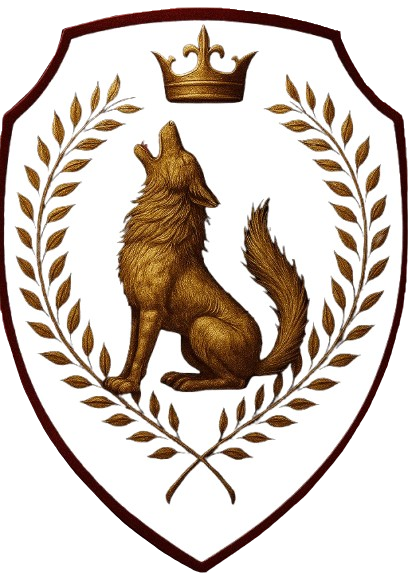
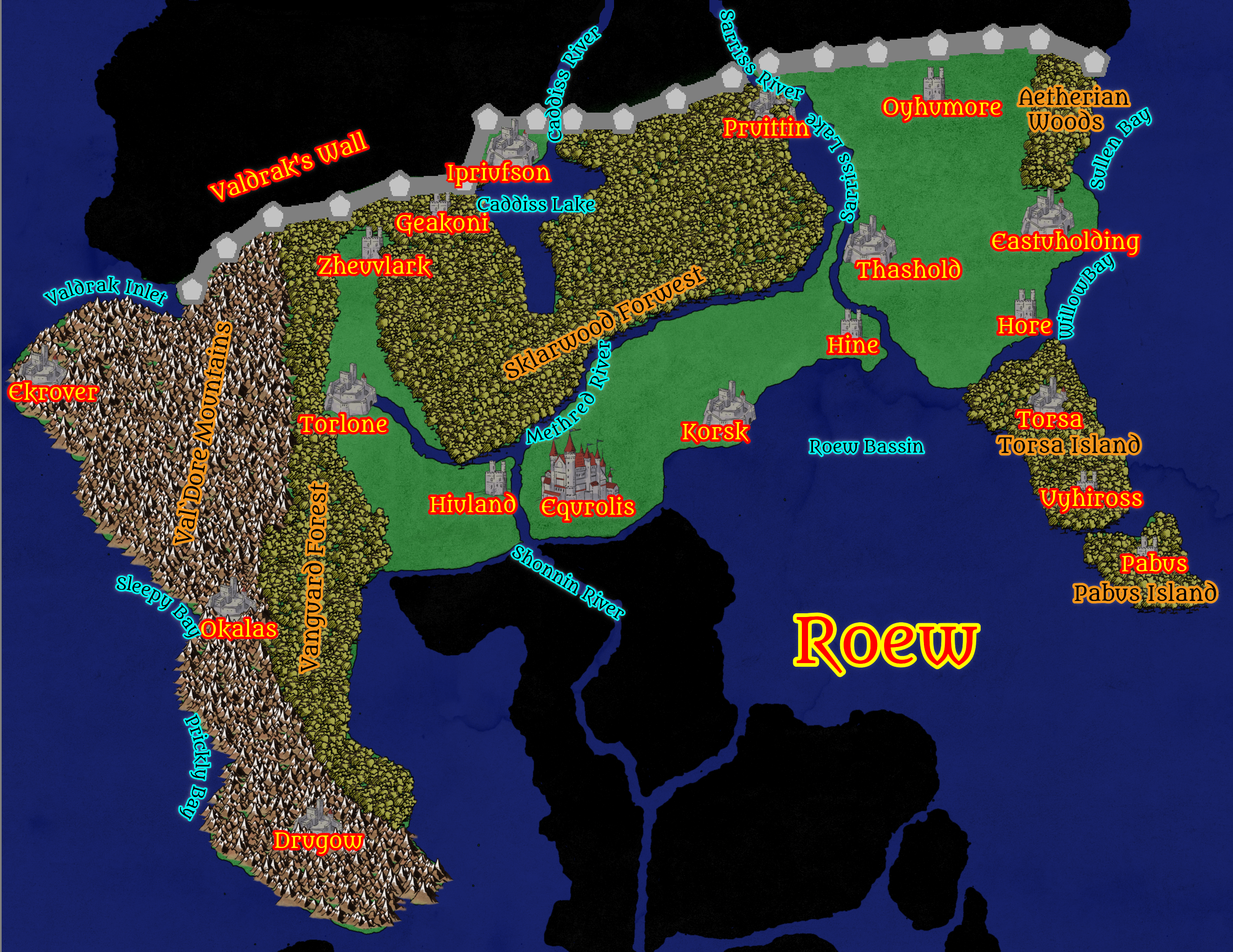
Roew is a rugged, mountainous kingdom nestled between 2 other territories, specificly, Bal'Lordorran and Aranor. Its lands are vast, spanning lush forests, craggy hills, and imposing mountain ranges. The kingdom's terrain makes it difficult to conquer, and it has a fierce, independent population of Wolven, known for their loyalty to their king and their warrior traditions.
Origins and Mythology:
The tale of Roew's founding is deeply entwined with the mythical figures of Rhu'mor and Rhu'mus, twin wolven born from the union of the celestial wolven goddess, Vanyr, and the mortal wolven-king, Ariasan. According to legend, Rhu'mor and Rhu'mus were abandoned by their people at birth, left to die in the wilderness of Roew. Yet, the divine forces of the land intervened, and the twins were nursed by a mighty she-wolf named Zerash, the great protector of the wilds.
Under Zerash's care, Rhu'mor and Larka grew strong, wise, and fierce. As they matured, they learned of their divine heritage and the ancient prophecy that foretold they would one day unite the scattered wolf clans of Roew and forge a kingdom strong enough to challenge the heavens themselves. They sought vengeance on the tyrant Orcus, a once-noble wolven who had usurped the throne of their ancestors. With the help of their loyal followers, the twins overthrew Orcus and restored the balance of power to the land.
The foundation of Roew was not just a political act; it was a divine calling. Rhu'mor, the first of the twins, became the first king of Roew, ruling with the blessing of Vanyr, the celestial wolf goddess. From that day, the land of Roew was bound by the blood of the twins and the divine pact that marked their reign. The Wolven are seen as both protectors and rulers of the forests and mountains that make up Roew.
Society & Culture:
The Wolven people of Roew live in tight-knit packs, each with their own leaders but united under a King or Queen, chosen by the Lunar Rite of the Wolf. This is a ritual held every decade, where the strongest and most honorable Wolven are tested in combat and wisdom. The winner is crowned ruler of Roew for the next ten years.
Hierarchy: The Wolven society operates through a complex system of clans or packs, each led by a Chieftain. Clans are often organized around a familial line and share a deep bond with nature and the wolves they revere. However, all serve the King or Queen, who acts as both a political and spiritual leader.
Religion: The Wolven worship Vanyr, the Wolf Goddess, through sacred rituals that honor the natural world. The priests, known as Wolfshamans, are seen as the direct conduits to the divine. They practice a blend of shamanism and druidic magic, drawing upon the powers of the forest and their animal kin. The culture of the Wolven is deeply rooted in ancient traditions, where honor, familial ties, and martial prowess are at the forefront of their values. They draw heavily from the ideals of a society that prioritizes strong civic duties, reverence for their ancestors, and a structured approach to leadership and law.
Social Structure & Class System
The culture of Roew is based on the values of strength, honor, and the preservation of tradition. Their society is divided into several classes. In the Wolven society of Roew, both nobility and commoners play essential roles in the kingdom's prosperity.
The Domsar (Noble Wolves): The highest class in Roew, the Domsar are the noble families who trace their lineage back to the founding of the kingdom. They are entrusted with governance, military leadership, and religious duties. The Domsar families are responsible for guiding the kingdom, as well as maintaining sacred connections to the divine, ensuring that the will of the gods is upheld.
The Equestrians (Wolf Soldiers and Traders): A class between the Domsar and Grak'war, the equestrians are wealthy merchants and military officers. These wolves often own horses and land, and while they don't hold political power like the patricians, they wield influence in trade, military campaigns, and local governance.
The Grak'war (Common Wolves): The Grak'war are the bulk of the population, made up of farmers, artisans, soldiers, and laborers. While they do not hold the same political power as the Domsar, they are the lifeblood of Roew, their work and sacrifices maintaining the kingdom's stability. They are often led by Warden Lords, who serve as local leaders and oversee the welfare of their communities.
Government and Leadership
The King or Queen: The High King or Queen of Roew holds supreme authority but is bound by tradition and law. They rule for a fixed term, usually ten years, after which they must undergo a selection process. They govern with the advice of the Senate and maintain the sacred connection to their goddess, Vanyr.
The Council of Fangs: Composed of 300 elder wolvens from the patrician families, the Council of Fangs has considerable influence in legislative matters, military decisions, and appointments to high offices. The Council Members, called Fangs, are expected to act in the kingdom's best interest, balancing personal ambition with the greater good of Roew.
The Tribunes: Elected by the common wolven, the tribunes represent the Grak'war and protect their interests. They have veto power over certain decisions made by the Council of Fangs, especially when those decisions threaten the welfare of the lower classes. Tribunes are often military leaders or successful warriors who have earned respect through their valor.
Religion and Rituals
The Worship of Vanyr: The Wolven revere Vanyr, the celestial wolf-goddess who is believed to have gifted them with their strength and connection to nature. The religious practices of the Wolven are heavily influenced by rituals and sacrifices. There are sacred altars and temples dedicated to Vanyr, where priests (called Wolfshamans) conduct ceremonies, offerings, and divinations.
The Wolven hold important public festivals, such as the Lupercalia (the festival of wolves), where they celebrate their connection to the wild and engage in contests of strength, endurance, and courage. Augury, the practice of reading omens from the behavior of animals, especially wolves, is a common method of divination.
Ancestor Worship: Wolven honor their deceased leaders and heroes through rites of passage and public commemorations. Statues and monuments of famous Wolven leaders are placed throughout the kingdom, and during the Lunar Rite of the Wolf, the spirits of past rulers are invoked for guidance.
Military Traditions
Warfare: The Wolven are fierce warriors, trained from a young age in martial arts and survival tactics. Their society values strength and cunning, with a strong focus on teamwork. Pack Warfare is integral to their culture, meaning that their battle tactics often revolve around swift, coordinated strikes and guerrilla warfare.
The military structure of the Wolven is deeply influenced by military formations. The legion is mirrored by the Zhun-Khal, an elite group of soldiers who serve as the backbone of Roew's defense.
The Zhun-Khal (Warrior Nobles): The Zhun-Khal are an elite class of warriors and military leaders who command great respect. They are often responsible for leading Roew's armies, ensuring the kingdom's borders are defended and expanding the kingdom's reach through conquest. Though not part of the Domsar, the Zhun-Khal are deeply involved in governance, often sitting on the Council of Fangs that advises the ruler.
Cohorts and Centuries: The military is organized into cohorts, groups of 480 wolves, with each cohort divided into centuries of 80 soldiers. Each century is led by a centurion, and these units work together to perform complex tactics in both defense and offense.
The Council of Fangs' Military Command: In times of war, the Council of Fangs may grant a Dictator role to a Wolven general, giving them absolute authority over the military for a limited time. The Dictator of Roew leads the Zhun-Khal in major campaigns.
Civic Life & Law
The Twelve Laws of Roew are a set of sacred and immutable codes that govern all Wolven in the Kingdom of Roew. These laws are more than mere rules; they are a reflection of the Wolven's values of honor, justice, and respect for both the individual and the community. Each law is designed to uphold the dignity of the Wolven people, ensuring fairness and balance while also establishing clear consequences for violations. These laws are enforced through public trials, tribunal decisions, and a system of punishments that emphasize restoration, honor, and sometimes vengeance.
The Twelve Laws of Roew are inscribed on ancient stone tablets, kept in a sacred hall known as the Hall of Judgment in Aiemaren. It is here that the highest tribunal, known as the Circle of Fangs, made up of the 12 senior most members of the Council of Fangs, convenes to preside over matters of the law, interpreting each case with wisdom and a strict adherence to tradition.
The Twelve Laws of Roew
- The Law of Honor: "Honor is the foundation of the Wolven soul. All actions, whether in battle or peace, must reflect one's honor."
Every Wolven is bound to uphold their personal honor and the honor of their pack. Dishonor, whether through cowardice, deceit, or betrayal, is considered the gravest of offenses. The Law of Honor demands that all Wolven act with integrity, never resorting to underhanded tactics or dishonorable deeds.
Punishment: Loss of status, public shaming, and potential exile. A Wolven who brings dishonor may be given a chance to redeem themselves by performing a significant act of valor or service to the kingdom. - The Law of Family and Blood: "Family is sacred. The bonds of blood are the heart of the Wolven spirit. No Wolven shall harm their kin, either by blood or pack."
The protection of family, both biological and social, is paramount. The Wolven see their pack as a family bound by deep loyalty. Any act of harm or betrayal against a family member is considered an affront to the entire community.
Punishment: The offender may be exiled from the pack or, in severe cases, executed. A trial by combat may be held to settle disputes between family members if dishonor has been brought upon the bloodline. - The Law of Justice: "No Wolven shall take the law into their own paws. All grievances shall be brought before the tribunal, where justice shall be meted out fairly."
The Wolven do not permit vigilante justice. Disputes, whether personal or communal, must be resolved by the Circle of Fangs or another authorized tribunal. Blood feuds are forbidden; all grievances must be heard in the light of justice.
Punishment: Any Wolven who enacts personal justice without the approval of the tribunal may be subject to trial and punishment, which could include imprisonment or death depending on the severity of the act. - The Law of Loyalty: "A Wolven's loyalty lies first with their pack, then with their kingdom. To betray this loyalty is to betray all that is sacred."
Loyalty to the pack and the kingdom is absolute. A Wolven must place the needs of their people and pack above personal gain. To act in betrayal, whether to a fellow Wolven or to the kingdom, is an unforgivable offense.
Punishment: Exile, or if the betrayal is particularly severe, death. In cases where a Wolven has betrayed their pack, they may be forced to undergo a public trial, where their fate is determined by their peers. - The Law of Duty: "Duty to the pack and to the kingdom is not a choice; it is an obligation. To abandon one's duty is to abandon one's honor."
Each Wolven has a role to play, whether it be as a soldier, healer, worker, or leader. All Wolven must fulfill their duties to their pack and their people. The Law of Duty demands that no Wolven shirk their responsibilities, and to do so is seen as a deep dishonor.
Punishment: The offender may face a public trial, with punishment ranging from forced service to the kingdom, public penance, or imprisonment, depending on the gravity of their neglect. - The Law of the Wild: "The Wild is sacred, and we, the children of the Wolf, must respect its laws. No Wolven shall desecrate the land or disturb the spirits of the forest."
The Wolven believe that their connection to the land is sacred. Destruction of nature or disruption of the natural balance is considered an offense against the spirits that guide them.
Punishment: Fines, restitution to the land, or exile. A Wolven found guilty of desecrating nature may also be forced to embark on a pilgrimage to seek redemption from the spirits, returning the harm done to the land. - The Law of Hospitality: "A Wolven must always extend hospitality to those who come in peace. To refuse aid to a traveler in need is a violation of our honor."
The Wolven are bound by a code of hospitality. Any traveler, regardless of race or origin, is entitled to shelter and protection if they come in peace. To deny aid is to breach the sacred bond between the Wolven and the world around them.
Punishment: The Wolven found guilty of violating hospitality may be publicly reprimanded, forced to provide aid, or required to compensate the harmed party. - The Law of Courage: "In the face of danger, a Wolven shall show courage, even when the odds are against them. Fear is no excuse for failure."
Wolven are taught that courage is the highest virtue. Whether in battle, diplomacy, or times of hardship, a Wolven must show bravery and strength of character.
Punishment: Cowardice in the face of danger, especially when it endangers others, is met with severe consequences. A Wolven may be stripped of rank or exiled if found guilty, and may also be publicly humiliated. - The Law of Fairness: "No Wolven shall show favoritism or injustice. All must be treated equally, and all disputes must be resolved in fairness."
Equality and fairness are essential tenets of the Wolven code. No Wolven shall be above the law, and every Wolven, regardless of status, must be treated equally in the eyes of justice.
Punishment: Those found guilty of favoritism or unjust treatment may be demoted in rank, fined, or stripped of their privileges. Reconciliation through restitution is often required. - The Law of Courageous Leadership: "A Wolven leader must always lead by example, showing courage, wisdom, and fairness. A leader who fails to uphold the laws is no leader at all."
Leadership is seen as a sacred responsibility. Those in positions of leadership, whether military, spiritual, or political, are expected to embody the values of the Wolven at all times. Failure to do so brings dishonor not only to the leader but to their entire pack.
Punishment: The loss of leadership position, exile, or death, depending on the severity of the offense. Leaders who violate this law are often given the opportunity to redeem themselves by undertaking a perilous task or quest in the name of the kingdom. - The Law of Family Defense: "To protect one's kin and pack is an unbreakable duty. No Wolven shall abandon their family in times of need."
The Wolven believe in the sacred duty to protect those they are bound to by blood or pack. Any Wolven who fails to defend their kin or pack members when they are in danger is seen as a coward and betrayer.
Punishment: The offender is typically exiled or forced to perform a great act of valor to restore their honor. In severe cases, if the failure results in death or irreversible harm, the punishment can be death. - The Law of Death and Burial: "A Wolven who dies in battle or at the hands of an enemy shall be honored. Their body shall be laid to rest in the sacred grounds of their pack, where they may rest in peace."
Death is treated with respect, especially for those who die in service of the kingdom or their pack. The Wolven believe in a sacred afterlife, where the souls of brave warriors are honored and given peace.
Punishment: A Wolven who disrespects the dead, whether through desecration of their body or failing to provide proper burial rites, is considered dishonorable. The punishment for such actions is usually death or exile.
These Twelve Laws serve as the foundation of Wolven society, ensuring that their culture remains centered on honor, respect, and balance. Each law is designed to maintain order and justice within the kingdom, while also respecting the rights and dignity of every Wolven. Public trials and the Circle of Fangs ensure that these laws are interpreted fairly, and punishment is administered in a manner that seeks to restore balance and uphold the integrity of Wolven society.
Valdrak's Wall
Valdrak's Wall, a monumental structure stretching across the border between Bal'Lordorron and Roew, is a symbol of both strength and division. Built over a century ago, this wall was erected in the wake of conflicts and tensions between the two kingdoms, particularly as Bal'Lordorron sought to control the volatile northern frontier while Roew maintained its belief in honor and territorial sovereignty.
The wall is not merely a physical boundary but a statement of power, protecting the southern regions of Bal'Lordorron from the perceived instability of the Wolven Kingdom. It stands as both a fortification and a reminder of the cultural and ideological divide between the two realms.
Construction and Architecture
- Material: The wall itself is made from dark stone, locally sourced from the rugged mountains near the border. These stones, naturally infused with magical properties, are impervious to the ravages of time and weather, giving the wall an almost unearthly durability. Runic carvings and mystical symbols are etched into the stones, imbuing the wall with defensive enchantments that ward off both magical and physical threats.
- Dimensions: Valdrak's Wall is 30 feet high in most places, with certain sections reaching up to 50 feet near key military fortifications. The width varies, but it is typically 15-20 feet thick, making it formidable enough to withstand both siege and storm.
- Design: The wall is not a straight line but rather follows the natural terrain, winding around hills, valleys, and forests. It is built on a series of watchtowers, bastions, and gates, allowing Bal'Lordorron's soldiers to monitor any movements on the border and to control access between the two kingdoms. The design is intimidating yet practical, offering a clear psychological barrier between the two realms.
Military and Strategic Role
- Border Defense: Valdrak's Wall serves primarily as a defensive barrier against potential raids from Roew. While Roew is not typically known for aggressive warfare, the Wall's existence ensures that Bal'Lordorron can fortify its defenses and control any conflicts that arise along the frontier. Forces stationed along the wall are on high alert, ready to respond to any challenge from Roew's Wolven or other forces.
- Control of Passage: The Wall is heavily guarded by Bal'Lordorron's Legions of the Sun, ensuring that only those with official permission are allowed to cross into Roew. Several gates exist, but they are heavily fortified and often closed unless a diplomatic mission or military convoy needs to pass through. The gates are staffed by elite guards, and passage is strictly monitored, making it difficult for Roew's people or any outsiders to enter without suspicion or scrutiny.
- Watchtowers: Every few miles along the Wall, high stone towers rise, allowing the Bal'Lordorron forces to survey the surrounding area. These towers are manned 24/7, and any sign of movement or breach is immediately reported to the central command. These positions also serve as relay points for messages, ensuring quick communication across the kingdom's vast borders.
Symbolism and Legacy
The Legacy of Valdrak: The Wall is named after Valdrak, a legendary Bal'Lordorron general who led the kingdom's forces during the most critical years of the kingdom's expansion into the northern reaches. Valdrak is credited with unifying the borderlands and establishing the permanent divide between Bal'Lordorron and Roew, marking the point at which Bal'Lordorron ceased its aggressive expansion into Roew territory. Valdrak's ambition and military genius are celebrated across Bal'Lordorron, with his name becoming synonymous with military strategy and defensive strength.
Psychological Barrier: Beyond its physical role as a defense structure, Valdrak's Wall has become a powerful symbol in the minds of both Bal'Lordorron and Roew. For Bal'Lordorron, it represents their dominance and control over the northern frontier. For Roew, the Wall symbolizes the oppression and division that they believe has been forced upon them by a neighboring kingdom that values strength and military might over peace and honor.
A Divisive Mark: The Wolven Kingdom of Roew sees the Wall as a blatant declaration of hostility. Though Roew has not openly challenged Bal'Lordorron in recent years, the Wall represents a historical disrespect for their sovereignty and autonomy. The Wolven feel that the Wall represents Bal'Lordorron's refusal to acknowledge the honor and traditions of Roew, and they consider it a blight on the land. However, the Coyle and Flind forces within Bal'Lordorron find it to be an essential barrier, a way to ensure that Roew's more peaceful nature does not become a weakness that Aranor could exploit.
The Wall's Influence on Trade and Diplomacy
Limited Trade: While Roew and Bal'Lordorron do engage in trade on occasion, the Wall severely limits the ease of this exchange. Roew's merchants are forced to navigate the gates under heavy scrutiny, and any goods that pass through are subject to tariffs and inspections. Bal'Lordorron's strict policies make such trade slow and cumbersome, adding another layer of political tension to an already strained relationship.
Diplomatic Stalemate: The existence of Valdrak's Wall has created a diplomatic stalemate. The gates open for official missions from Roew, but these visits are infrequent and often dictated by military necessity rather than peaceful diplomacy. The Wall stands as a constant reminder that Bal'Lordorron has the upper hand, and that any agreements between the two kingdoms are made under duress.
Valdrak's Wall is far more than a simple fortification. It is a monument to military dominance, historical legacy, and the ideological divide between Bal'Lordorron and Roew. For Bal'Lordorron, it is a physical embodiment of their strength and security; for Roew, it stands as a constant reminder of the division imposed upon them by an enemy kingdom that values power over honor. The wall's enduring presence will continue to shape the future of the relationship between these two kingdoms, standing as a silent sentinel to the tensions that simmer just below the surface.
Public Games and Festivals
: The Wolven love contests of strength, agility, and skill, and gladiatorial games. These events are often held in large public forums, where spectators gather to watch wolves compete in both individual and team-based challenges. These contests are not only for entertainment but also for the selection of new leaders and warriors.Population Breakdown:
Total Population: 2,500,000
- Wolven: 2,000,000 (80%)
- Kankorian: 375,000 (15%)
- Coyle: 125,000 (5%)
Cities:
- Equrolis (Capital): The capital city of Roew, where the central government and the Circle of Fangs (the Wolven leadership council) reside. It's the political, military, and administrative heart of the kingdom.
- Drugow: A major military city located along the kingdom's borders. Known for its fortifications, it serves as a primary defense against external threats and a rallying point for troops.
- Okalas: A city famous for its merchant trade, particularly in magical goods and rare artifacts. Okalas is known for its bustling markets and skilled artisans.
- Ekrover: A city dedicated to the spiritual well-being of Roew, home to ancient temples and the headquarters of the Wolven's druidic order. It serves as a sanctuary for those seeking peace and divine guidance.
- Zheuvlark: A small, quiet settlement nestled near the mountain foothills. Zheuvlark is known for its ancient ruins and is often a place of pilgrimage for those seeking knowledge of Roew's past.
- Torlone: A strategic stronghold situated on a major trade route. Torlone acts as both a military garrison and a vital trade city, ensuring Roew's economic prosperity and defense.
- Hiuland A sprawling agricultural city that serves as the breadbasket of Roew. It is known for its vast fields, orchards, and farming techniques.
- Korsk: A coastal city with strong naval influence. Korsk is Roew's center for shipbuilding and maritime trade, with the largest fleet in the kingdom.
- Geakoni: A city renowned for its research into the magical arts. Geakoni is home to the most advanced magical academies, attracting scholars and spellcasters from across the continent.
- Ipriufson: A highland city known for its spiritual significance, Ipriufson is where the Wolven gather to honor their ancestors and the Wolf-goddess Vanyr. It is also a place for the elite warriors of Roew to train.
- Pruittin: A bustling trade city that serves as a vital crossroads for goods coming in and out of Roew. Pruittin is known for its marketplaces and vibrant merchant guilds.
- Hine: A village located on the edge of Roew's wilderness, Hine is famous for its hunters and trackers who protect the borders and keep the kingdom safe from wild beasts and invaders.
- Oyhumore: A city known for its complex defenses and elite mercenary forces. Oyhumore is a key location for Roew's military training and tactics, often seen as the kingdom's military school.
- Thashold: A heavily fortified city, Thashold serves as the kingdom's first line of defense against invaders from the Coyle-controlled lands. It's known for its grand citadels and formidable walls.
- Eastuholding: Located in the eastern territories of Roew, Eastuholding is a key border city that acts as the kingdom's watchpoint, guarding against external forces or intrusions from the eastern wilderness.
- Hore: A small settlement renowned for its agricultural and alchemical practices. The residents of Hore are known for cultivating rare plants and herbs, used both for medicinal and magical purposes.
- Torsa: A coastal city famous for its beautiful beaches and rich cultural scene. Torsa is also a key port city, with trade flowing in and out of Roew from distant lands.
- Uyhiross: A city of ancient origin, Uyhiross holds great historical and magical significance. It is known for its underground ruins, ancient rituals, and its mystical sites where the Kankorian conduct spiritual practices.
- Pabus: A quiet town known for its unique architecture and cultural diversity. Pabus is home to various communities, including Wolven and Kankorian refugees, who have found a home here in peace.