Kingdom of Tarren
Geography
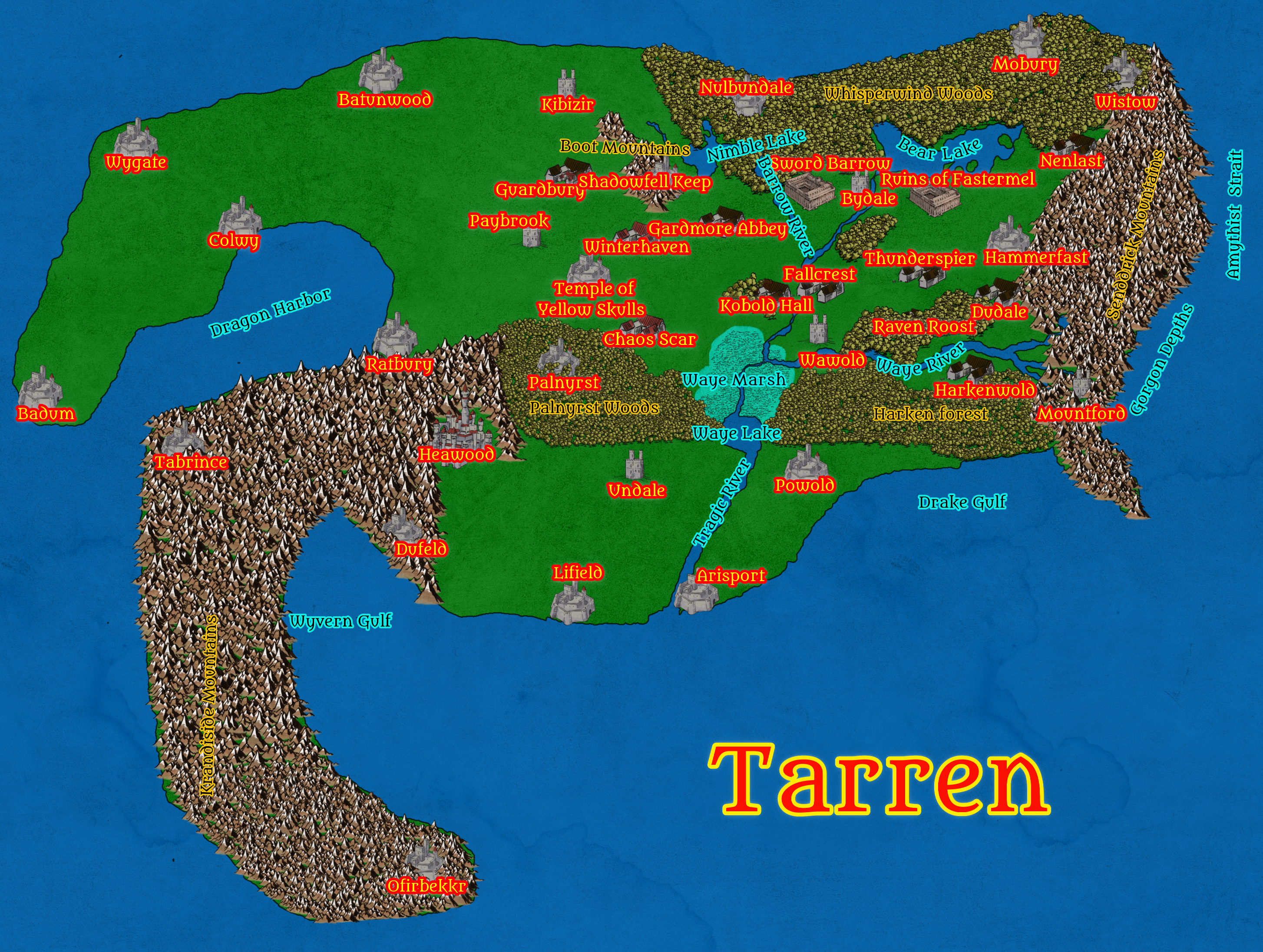
Tarren is a kingdom defined by its rugged terrain, fertile plains, and strategic waterways. The kingdom is split into several distinct regions that include towering mountains, deep forests, vast grassy plains, and dangerous swamps, each playing a role in its history, economy, and defense. Tarren is a large Island, providing access to maritime trade, while its rivers and lakes support the kingdom's agricultural and transportation networks.
- Mountains: The eastern and southwestern borders of Tarren are shaped by natural mountain ranges. These provide defensive barriers against invasion and serve as a rich source of minerals, ancient ruins, and hidden fortresses.
- Forests: The central and northern regions are heavily forested, offering resources such as timber and game, and making the forest cities ideal locations for defense and strategic governance.
- Grassy Plains: The fertile plains stretch across the center of Tarren, offering vast areas for agriculture and trade, supporting the kingdom's population and economy.
- Swamps: The southern-central swamps, including areas like Powdoll, are dangerous and difficult to navigate but are rich in resources and hold dark remnants of magical anomalies left by the Sundering.
History of Tarren
Tarren's history is marked by its rise from the aftermath of the Sundering, a catastrophic magical event that shattered the ancient kingdom of Tarren and Bal`Lordorron two thousand years ago. The Sundering was caused by the dark sorcerer-king Dorterran, whose quest for immortality unleashed a magical catastrophe that fractured the world and nearly destroyed both kingdoms.
After the Blooded Rebellion, which followed the Sundering and was fought for survival and control, Tarren began its slow process of rebuilding. The rebellion was sparked by the forces of Dorterran's followers, who sought to destabilize the kingdom. Tarren, with its resilient people, emerged from the chaos stronger and more united.
The kingdom's rebirth was guided by a line of High Monarchs who focused on military strength, economic recovery, and rebuilding the fractured land. Over the years, Tarren has become a kingdom marked by both its military might and its cultural resilience, though the shadow of Dorterran and the dark magic of the past still lingers in some regions.
Culture and Society
Tarren is a kingdom that values strength, resilience, and unity. Its people, though still haunted by the dark history of the Sundering, have built a society focused on rebuilding and securing a prosperous future.
Religion: The Pantheon of Rurga (Known to the Elves as Larini)
The priests of Rurga (Larini) preach that victory is possible through the guidance of Rurga (Larini) and the other deities, and the Sect promises that under Rurga (Larini)'s guidance, warriors will find victory. The priesthood does not make specific promises but implies that making generous sacrifices to the Pantheon will bring Rurga (Larini)'s favor. Followers are encouraged to combine their faith with traditional worship of local gods, believing that a well-rounded approach to divinity will lead to success.
Organization: The religion is a mix of old traditions revived and new practices, growing quickly as a movement centered on war and battlefield victories.
Symbols: In addition to the traditional symbols of the Pantheon, Rurga (Larini)'s followers use symbols of war such as the shield, sword, and battle banner.
Followers: Most of the followers are soldiers, warriors, and families of those who are fighting in the war, but the religion has spread to other groups as well.
Worship and Practices
- Holy Book: The Ta'Otara is the holy book of the Pantheon of Rurga (Larini). Unlike most religious texts, it is written in the first person, with each section narrated by one of the gods or key figures in the religion. The priests read aloud from the Ta'Otara in a ritualistic manner, often taking on the persona of the gods to convey their messages.
- Holy Practices: The worship of Rurga (Larini) often involves ritual combat, prayers for strength, and sacrifices to ensure divine favor in battle. The Scales of Truth and the leaf of the Black Walnut are commonly used in ceremonies and rituals. Warriors will often make offerings to Rurga (Larini) before heading into battle.
The Pantheon of Rurga (Larini)
Six gods. Six truths. Six paths to power, pain, and purpose.
They do not walk together.
They do not always agree.
But they are bound by war, by blood, and by the memory of what they once were, and what they may yet become.
- Rurga (Larini), the Flame of Truth: Rurga is the heart of the pantheon, the goddess of war and justice, and the embodiment of truth. Her voice is the winter wind, her wrath the storm that swallows the sun. She cannot be lied to, and she cannot be swayed. Warriors kneel before her not for mercy, but for clarity. She is the sword that cuts through deception, the shield that defends honor.
- Cirga, the Loyal Arrow (Known to the Elves as Solonor Thelandira): Cirga is the hunter, the bowman, the companion who never falters. He is brave and kind, but naïve, and his heart belongs to Rurga, though she does not return his love. He runs through forests and across battlefields, chasing justice with a smile and a blade. His arrows fly true, and his loyalty never wavers. Cirga is revered by those who still remember the old wars. He is the god of camaraderie, of the quiet strength found in friendship and shared purpose.
- Lista, the Cold Tide: Lista dwells in the deep, where light does not reach and warmth is a memory. She is beautiful, but not vain; passionate, but not loving. She offers victory, not comfort. Her counsel is sharp, her strategy flawless, but those who embrace her find themselves changed, colder, distant, feared. She is Rurga's daughter, once corrupted by Panath, now self-exiled beneath the sea. Her name is whispered by those who seek to win without losing themselves to rage.
- Kalba, the Wandering Whisper: Kalba was once a mighty wizard, a god of magic and mystery. Now he is a spirit, a voice without form, drifting across worlds in search of vengeance, or perhaps redemption. He claims betrayal by Panath, and speaks of dark gods who stole his body and power. His presence is strongest where spirits rise against tyranny. He is the god of ghosts, of possession, of the lost and the restless. His followers are few, but they listen closely, for Kalba speaks truths that others fear to hear.
- Kirgi, the Shadow Beneath: Kirgi is the rat god, the master of deception, betrayal, and thievery. He builds traps even in his own palace, and his followers walk carefully, lest they fall into his schemes. Once reviled, his worship now thrives, thanks to the cunning of Cardinal d'Fingal, who reformed Kirgism into a powerful and organized faith. Kirgi is ambitious. He has infiltrated the ranks of the Deevil Lords, sowing division and breeding new allies. He claims this is the greatest blow against evil, not through war, but through corruption. He is the whisper in the walls, the claw in the dark, the god who always has another plan.
- Panath, the Blade in the Smile(Known to the Elves as Kirith Druanna) Panath is the god of treachery, deceit, and assassination. He is charming, bitter, and endlessly sarcastic. He denies nothing, his role in Lista's fall, Kalba's ruin, and Rurga's heartbreak. Yet the pantheon still relies on him, for Panath is clever, and his enemies often fall before they know they are hunted. His worship is strongest in the cities, where thieves and assassins pray to him before every job. He offers no redemption, only results. He is the dagger behind the curtain, the lie that becomes truth, the god who laughs when others weep.
- Humans: 50% (1,250,000): Humans are the dominant race in Tarren, making up the majority of the population. The kingdom's strong military, agricultural development, and governance are driven largely by human influence. Humans are found throughout the kingdom, from the bustling cities like Haewood and Arisport to the agricultural plains and military fortifications.
- Halflings: 10% (250,000): Halflings are scattered throughout Tarren, particularly in the more rural areas like Paybrook and Wistow, where they are known for their agricultural skills and strong community bonds. They are respected for their trade acumen and resourcefulness. Many have integrated well into Tarren's society, with some even joining the kingdom's military or merchant guilds.
- Elves: 8% (200,000): Elves, particularly Wood Elves and Moon Elves, make up a significant minority in Tarren, especially in forested areas like Haewood and Batunwood. Elves are revered for their ancient knowledge of magic, nature, and history. Many elves serve as scholars, diplomats, and magical practitioners. While they maintain a separate cultural identity, they play an integral role in the kingdom's governance and magical studies.
- Dwarves: 5% (125,000) Dwarves are concentrated in mountainous regions, particularly in Kibizir and Hammerfast. Known for their craftsmanship, mining skills, and military expertise, dwarves are vital to Tarren's economy, particularly in metalworking, armor crafting, and construction. They also serve as strong allies in times of war, contributing to Tarren's defenses.
- Ratlings, Orcs, Goblins, and Trolls: 5% (125,000): This group includes both nomadic orc tribes and goblin communities that have settled in the swamps and forests of Tarren, as well as the occasional troll found in the more remote wilderness. While often mistrusted by the more "civilized" races, many of these creatures live in the more isolated regions like Nulbundale and Shadowfell Keep. Some tribes have allied with Tarren for mutual benefit, especially in times of external threat.
- Gnomes: 3% (75,000): Gnomes are primarily found in Bydale and Didale, where they contribute to Tarren's magical research, engineering, and craftsmanship. Highly intelligent and innovative, gnomes are essential to the development of Tarren's magical technology and scholarly pursuits. They have a well-established presence in the kingdom's academic institutions, especially in magical studies and research.
- Other Races: 4% (100,000): This includes smaller populations of Tieflings, Dragonborn, Half-Elves, and Other races who reside in Tarren. While these groups are less numerous, they have carved out roles for themselves within the kingdom's structure, particularly in more cosmopolitan cities like Haewood and Arisport.
- This breakdown reflects the diversity within Tarren, with Humans as the majority but Halflings, Elves, and Dwarves having notable populations that contribute to the kingdom's success. Smaller groups like Orcs, Goblins, and Trolls live in more isolated or border regions, sometimes in uneasy alliances or as part of a rural society, while Gnomes play a pivotal role in Tarren's academic and magical development.
- Haewood (Capital): The capital city, political and cultural center, housing the High Monarch, military leadership, and key institutions.
- Arisport: The main port city, bustling with commerce, maritime trade, and a significant merchant population.
- Wawold: A large agricultural and military town, vital for both logistics and the kingdom's food production.
- Badun: A key coastal city with strong ties to trade and defense.
- Bydale: A crossroads city between plains and forests, with a strong agricultural economy.
- Guardbury: A fortified city that plays a major role in defending the plains of Tarren.
- Paybrook: A central trade hub for rare goods and agricultural products.
- Ratbury: Known for its agricultural production and military importance.
- Colwy: Known for its magical academies and arcane significance.
- Batunwood: A city with a deep connection to magic, known for its scholars and practitioners.
- Kibizir: A town near the mountains, known for its artists and craftsmanship.
- Shadowfell Keep: A frontier stronghold city.
- Winterhaven: A plains settlement .
- Gardmore Abbey: A city with a focus on religious and military training, dedicated to Rurga (Known to the Elves as Larini).
- Wygate: A key trade city and port town.
- Temple of Yellow Skulls: A tample dedicated to Panath.
- Mobury: A forest city known for it's hunters and logging.
- Hammerfast: A dwarven stronghold that provides metalworks and crafts for the kingdom.
- Thunderspier: Known for its farmers
- Fallcrest: A trade center with a bustling river trade.
- Didale: A scholarly town focused on magic and research, home to many scholars and magical practitioners.
- Raven Roost: A spy and ranger base, known for its scouting and defense work in remote areas.
- Nulbundale: A forest city of elves
- Kobold Hall: A small but growing town located near asmall forest, once A kobold stronghold.
- Powold: A village known for its dark magical history.
- Wistow : An forest settlement that supports Tarren's food supply.
- Harkenwold: A small town.
- Mountford: A fortress city with a strong military presence.
- Tabrince: A mountain City near the western coast.
- Dufeld: A town situated in the mountains, famous for its large dwarven trade market.
- Ofirbekkr: A city with a strong dwarven influence, known for its mining operations.
- Undale: A small village, focused on agriculture and livestock.
- Lifield: A quiet city with a focus on cattle farming.
- Sword Barrow: A small settlement built around a large historical graveyard, a place of ancient battles.
- Chaos Scar: A remote village near the Chaos Scar, inhabited by those seeking to harness the strange magic of the area.
- Ruins of Fastermel: A ruined city turned into a point of interest for adventurers and scholars seeking lost artifacts.
- Nenlast: A small village.
The Ta'Otara: The holy book of the pantheon, written in the first person. Priests read aloud as if speaking with the voice of the gods, bringing divine presence into the hearts of the illiterate and the faithful. It is not just scripture, it is performance, invocation, and myth made living.
Social Structure
Tarren's society is highly structured, with the monarchy at the top, followed by a council of noble families, military leaders, and scholars. The nobility holds substantial power, but the common folk are valued for their hard work and contributions to rebuilding the kingdom.
Economy
Tarren's economy is based on agriculture, timber, mining, and trade. The plains are rich in farming land, while the mountains offer minerals and metals. Timber from the forests is a significant export, and the rivers provide easy transport for goods.
Military
Tarren's military has grown into one of the most formidable in the region, forged through the trauma of the Blooded Rebellion. The Legions of the Sun, Tarren's elite military corps, are stationed along the kingdom's borders, constantly on alert against external threats and magical disturbances.
Strengths: Tarren's military focuses on both heavy infantry and cavalry, with a strong emphasis on defensive tactics and securing the borders. The mountain regions and forests are ideal for guerrilla warfare, while the plains offer an open field for large-scale battles.
The Royal Army: While much of the army's leadership is centralized in the capital, Haewood, various military fortifications are scattered throughout Tarren, particularly in the mountainous and swampy regions, to keep threats from the south and east at bay.
Tarren is a kingdom of strength, unity, and resilience, having risen from the ravages of the Sundering and Blooded Rebellion. Its people, from the noble houses to the common folk, are bound by the memories of their past struggles and the hope of a prosperous future. With the Pantheon of Rurga (Known to the Elves as Larini) shaping the kingdom's spiritual and cultural identity, Tarren remains committed to its ideals of strength and honor, both in battle and in life. While its cities, like Haewood, Arisport, and Wawold, flourish, the kingdom's history and the shadow of Dorterran still loom over its people, ensuring that Tarren remains ever vigilant, both in terms of its military strength and its magical heritage.
Kingdom of Tarren Population Breakdown
Total Population: Approx. 2,500,000