Dynasty State of Teluria
Geography
Teluria dominates the southern and central reaches of Zerigoth — a vast realm where the land itself seems alive, forged and reshaped by ceaseless elemental fury. The horizon is crowned with volcanic peaks that glow like embers in the twilight, their slopes streaked with rivers of cooling lava and ash plains that shimmer with glassy fragments. From these molten summits, veins of basalt and obsidian run deep into the valleys below, where black rock gives way to fertile fields made rich by centuries of volcanic renewal. The landscape is a breathtaking paradox: between barren deserts of red sand and cracked earth lie oases of lush greenery nourished by mineral-rich soil and hidden springs.
The air is heavy with the scent of sulfur and smoke, a constant reminder of the restless fires beneath the crust. Geysers erupt in rhythmic bursts, casting plumes of steam high into the sky, while deep fissures glow faintly with inner light at night. Earthquakes ripple through the region with unnerving regularity, reshaping cliffs and valleys in an endless cycle of destruction and rebirth. The southern deserts, known as the Scorched Expanse, stretch for hundreds of miles, broken only by wandering nomadic settlements and the ancient ruins of cities long swallowed by ash. Teluria’s geography is not kind — but it is magnificent, a living testament to the balance between creation and annihilation.
History
The story of Teluria is written in fire and blood. Isolated by molten ridges and unforgiving deserts, it developed outside the influence of Zerigoth’s larger nations. The earliest records — etched into obsidian tablets — speak of the First Forgeborn, changeling clans who communed with the volcanoes and claimed descent from the spirits of flame and stone. They believed the eruptions were divine tempests — the breath of the world’s molten heart — and built their sanctuaries upon the edges of calderas to listen for its voice. These tribes waged fierce wars over the sacred forges and lava springs, eventually uniting under the legendary Forge Clans, whose mastery of metallurgy became the foundation of Telurian identity.
Over the centuries, Teluria’s fortunes have risen and fallen with the rhythms of the land. Prosperity came in the ages when the mountains slept, allowing trade and agriculture to flourish in the fertile valleys. Yet when the gods of fire stirred, entire civilizations vanished beneath rivers of molten stone. Still, each catastrophe only tempered the people further, forging them as the land forged itself — harder, stronger, and more determined. Today, Teluria stands as a patchwork of fortified city-states and nomadic clans, each bound by an unspoken oath to the flame: to endure, to rebuild, and to never yield.
Culture
The changelings of Teluria are the children of fire — shaped by the volatility of their homeland and the discipline required to survive it. Their society venerates resilience, strength, and craftsmanship above all else. The Telurian identity is built upon transformation, both physical and spiritual; the ability to adapt and endure is considered the highest virtue. From a young age, changelings are taught the Way of the Flame — a philosophy that embraces destruction as the seed of renewal. To them, the fire does not destroy; it purifies. It burns away weakness, forging the spirit anew.
Telurian settlements are marvels of elemental architecture — cities hewn from basalt cliffs and obsidian caverns, their walls veined with molten glass that glows with inner light. In the capital of Vul’Kareth, massive forges burn day and night, powered by captured geothermal vents. Artisans craft weapons and armor so finely balanced that some say they hum with living energy. Music and dance in Teluria are thunderous, mimicking the rhythm of eruptions and the deep rumble of the mountains. Festivals such as the Burning Night and the Feast of Renewal honor the volcano spirits, where offerings are cast into molten flows — prayers for prosperity, endurance, and strength. Every Telurian carries the flame within, both metaphorically and, in some cases, magically.
Economy
Teluria’s economy is a delicate balance between danger and opportunity. Its lifeblood flows from its volcanic wealth — precious metals, radiant gems, and obsidian glass found nowhere else in Zerigoth. The mines of Mount Dravok and the Ashen Spine produce gold, mithril, and the famed “dragon’s mirror,” a black crystal capable of channeling enchantments with remarkable precision. Master forges create blades of enchanted steel and armor of volcanic glass, sought after by nobles and warriors across the continent.
Beyond mining, the fertile volcanic valleys provide rich yields during the dormant seasons, supplying grains, fruits, and fire-peppers unique to the region. Traders from distant lands brave the burning passes to barter for Teluria’s goods, though few stay long — the land itself tests all who enter. In recent centuries, geothermal energy has become a cornerstone of Telurian industry, powering forges, foundries, and even heating entire cities. Where others see peril, Telurians see power — a chance to master the fury of the world and bend it to creation. Their economy, like their spirit, is forged in fire — unyielding, luminous, and eternal.
Though united under one monarch, the Zerigothian Dynasty is a realm of fluid power and mutable identity. Each of its three major states, Ganyth, Teluria, and Liwen, embodies a different aspect of the changeling spirit: the mind, the body, and the soul of the Dynasty. Together they form a perfect balance, mirroring the divine cycle of Change, Reflection, and Renewal that defines Zerigothian law and faith.
Government
Teluria is the political and cultural capital of the Zerigothian Dynasty, home to the royal palace, the Seat of the Shifting Veil, and the Mirror Council, a court of changeling nobles, spies, and illusionists who advise King Prestida IX directly.
Government in Teluria is built on deception, diplomacy, and divine theatre. Every noble wears a mask, both literally and socially, representing the belief that truth is a shifting illusion. The Mirror Council ensures that the Dynasty's changeling nature remains secret from outsiders by carefully curating false histories, humanized public images, and controlled interactions with foreign envoys.
Beneath the Mirror Council lies the Bureau of Faces, an administrative body responsible for intelligence, infiltration, and maintaining the countless “front identities” the Dynasty uses to operate across the known world. To outsiders, Teluria appears as a small, isolated human kingdom, its true nature hidden behind layers of illusion.
Military
Teluria commands the Veiled Guard, the dynasty's elite intelligence and counter-espionage force. They operate both as bodyguards and secret police, ensuring loyalty within and maintaining the masquerade beyond.
- The Glass Sentinels: The royal guard; their armor shimmers with illusion magic, creating the impression of an ever-shifting, faceless host.
- The Silent Host: Assassins and infiltrators who adopt the identities of foreign agents, diplomats, or nobles to manipulate events abroad.
- The Shadowcourt: A covert order of changeling enforcers tasked with erasing traitors or those who threaten to reveal the Dynasty's secret.
Teluria's military strength lies not in numbers but in information, manipulation, and fear. No army dares invade what it cannot truly see.
Unity Through Change
The three states, Ganyth, Teluria, and Liwen, embody the trinity of the changeling spirit:
- Ganyth represents Form and Strength
- Teluria represents Mind and Mask
- Liwen represents Spirit and Reflection
All answer to King Prestida IX, whose reign is seen as the axis upon which all transformation turns. Through their unity, the Zerigothian Dynasty maintains its greatest secret: a nation of changelings hidden in plain sight, ever-shifting, ever-renewing, and eternally unseen.
Religion
The religion of the Zerigothian Dynasty is intricately woven into the fabric of their society, reflecting their worldview as beings of transformation and eternal renewal. This belief permeates all aspects of their lives, from their rituals to their political structure, and defines their spiritual relationship with the universe.
Core Beliefs
At the foundation of Zerigothian religion is the conviction that change is not only inevitable but sacred. The changelings, with their ability to shift and transform, view this constant metamorphosis as a divine gift and essential to their spiritual journey. They believe that the cosmos itself operates in cycles of destruction and rebirth, akin to the natural cycles of seasons, storms, and volcanic eruptions that reshape their lands. These cycles are seen as sacred moments of renewal, and changelings align their lives with these forces, striving for continuous growth and self-improvement.
To them, transformation is not just physical; it is spiritual and intellectual. Through change, they grow closer to the divine, shedding their old selves to embrace new identities and insights. Every change, whether personal or cosmic, is a step toward enlightenment and balance in the world.
Deities and Spirits
The changelings revere the Alintari, a pantheon of deities and spirits that embody various aspects of transformation, nature, and the forces of creation and destruction. These deities are seen not as static figures but as constantly evolving entities, reflecting the ever-changing nature of existence itself. The most revered among them are:
- Lairdesian, the Shifter: God of Change and Changelings. Lairdesian represents the core belief of transformation, embodying both the physical act of shifting and the spiritual essence of perpetual renewal. It is said that Lairdesian was the first changeling, born of the shifting winds and the ever-turning tides of time. His followers believe that through him, they can access the power of metamorphosis and harness its force to evolve spiritually and physically.
- Colie, the Prankster: God of Chaos and Pranks. Colie embodies the disruptive forces of life, the chaos that forces change. He is the god of laughter, mischief, and the unexpected, teaching that transformation is not always smooth or predictable. Colie's followers believe that through embracing chaos, they can challenge their own limitations and discover new ways of thinking and being. His worship involves playful, unpredictable rituals meant to jolt the mind and spirit from stagnation.
- Khronid, the Timekeeper: God of Time. Khronid governs the flow of time, the ultimate force of change. He is believed to regulate the endless cycles of the universe, guiding the transitions between past, present, and future. His followers seek to understand time's deep mysteries, and many believe that by synchronizing their lives with Khronid's rhythms, they can attain greater harmony with the world and each other.
Rituals and Practices
Rituals in the Zerigothian faith are centered around personal transformation and aligning oneself with the cosmic cycles. Key rituals include:
- The Rite of Shifting: A coming-of-age ceremony where young changelings undergo a guided transformation, physically altering their form to symbolize their entry into adulthood and their ongoing spiritual evolution. This is often a highly individual experience, with each changeling shifting into a form that symbolizes their growth and future path.
- The Dance of Renewal: An annual festival where changelings gather to celebrate the cycles of destruction and rebirth. The ritual involves elaborate dances that mimic the natural forces of wind, water, and fire, representing the ongoing cycle of creation. It is a time of introspection and community bonding, with changelings meditating on their own transformations and offering prayers for future growth.
- The Chaos Feast: A festival dedicated to Colie, where followers partake in wild, spontaneous festivities. The feast is known for its unpredictable nature, games, jokes, and pranks fill the event as changelings embrace the unpredictable forces of life. It is believed that the more chaos embraced during this festival, the greater the transformation the individual will undergo in the coming year.
- The Moment of Reflection: A quiet, introspective ritual held at dawn, when followers sit in silence, contemplating the passage of time and their own place within it. This is dedicated to Khronid, seeking to understand the deeper currents of time and their relationship with the divine.
Spiritual Hierarchy
The changelings' spiritual leaders are known as Shapeguards, powerful individuals who are deeply attuned to the shifting forces of the world. They are responsible for guiding the people through the spiritual processes of transformation, leading rites, and interpreting the will of the gods. The Shapeguards hold significant power within the Dynasty, and their positions are often inherited through a mixture of bloodline and spiritual mastery.
The Shapeguards are also responsible for mediating between the physical and spiritual realms, communicating with the Alintari and interpreting signs of cosmic shifts. Their wisdom is highly valued, and they often serve as advisors to the rulers of the Dynasty. A Shapeguard's ability to shift their form and adapt to different circumstances is seen as a mark of their divine favor and spiritual insight.
Overall, the religion of the Zerigothian Dynasty is one of continuous growth, transformation, and spiritual alignment with the forces of change that govern the cosmos. The changelings' ability to adapt, evolve, and embrace both the light and shadow of transformation is what defines them as a people and as devotees of their ever-shifting deities.
The Law
The legal system of the Zerigothian Dynasty is founded on the belief in eternal renewal and the necessity of maintaining order and harmony within a constantly shifting society. Secondarily, to keep the truth of the Dynasty a secret from Outrsiders. Changlings are opften persecuted and hunted iby most races and if the truth were to become know the dynasty would face destructuion and war.
The law is seen not as a fixed set of rules, but as a living, evolving code that adapts to the needs of the people and the state. This philosophy of fluidity and change is central to the way justice is administered, and the law is often understood in terms of balance and adaptation rather than rigid punishment.
The Foundation of Zerigothian Law
The law is based on a set of principles known as the Circle of Renewal, which emphasizes that change must always be welcomed to ensure the health of the state and its people. The laws reflect the idea that no identity, form, or belief should remain static, and each person's role in society may shift over time. These laws also stress that the individual must serve the greater whole, ensuring that the continuity of the Dynasty is maintained.
Key tenets include:
- Respect for the Process of Change: The people of Zerigoth are expected to honor the ongoing transformation in themselves and others. This can mean personal growth, as well as the acceptance of the shifts that come in governance, leadership, and societal structures.
- Sacred Duty to Serve: Each changeling is expected to serve the Dynasty in some capacity, whether it be through resource production, governance, or military service. The concept of selflessness is deeply embedded in Zerigothian law, where individual desires must often be sacrificed for the greater good of the Dynasty.
- Balance of Destruction and Rebirth: The law recognizes that the destruction of the old must precede the rebirth of the new. This principle is reflected in the changing of societal structures, the cyclical nature of leadership, and the willingness to let go of outdated practices to make way for progress.
Justice and Transformation
In Zerigoth, the concept of justice is closely linked with transformation. When someone is found guilty of breaking the law, the consequences are often designed to transform the individual rather than punish them in the conventional sense. For example, instead of imprisonment, a changeling who has committed a crime may undergo a ritual of change, where they are symbolically “reborn” into a new role in society, shedding their past transgressions and emerging with a new purpose.
There are some crimes, such as betrayal or sabotage, that are considered so disruptive to the renewal process that they cannot be forgiven through transformation. In these cases, the individual may face exile or be subjected to the ultimate penalty of re-assignment, where their essence is bound to the land, forever shifting forms as punishment for their disruption of societal harmony.
The Circle of Renewal
The Circle of Renewal is a secretive group of changeling scholars, mystics, and law enforcers who ensure that the laws of the Dynasty are upheld. They are entrusted with interpreting the changing needs of the state and advising the monarchy on matters of legal importance. The Circle often acts as the final arbiter in matters of justice, particularly when the traditional forms of law do not apply to new and evolving circumstances.
Law and the Monarchy
The monarchy in Zerigoth holds ultimate authority in matters of law. King Prestida IX, the Sovereign of the Shifting Veil, holds the final say in all legal matters, though his decisions are often influenced by the guidance of the Circle. The monarchy is seen as both a political and spiritual body, with the king acting as the living embodiment of the Dynasty's ongoing renewal. As such, his actions are often framed as the divine will of the changeling gods, ensuring that his decisions, even in matters of law, are accepted as part of the natural and divine order of change.
Enforcement of the Law
Enforcement of the law is carried out by the Shifting Guard, an elite force of changelings who can assume any form and infiltrate any part of society. Their task is not merely to uphold the law but to ensure that the process of change remains unimpeded. The Shifting Guard is a clandestine force, often operating in the shadows, as their ability to blend into society allows them to root out corruption, rebellion, and any resistance to the renewal of Zerigoth.
The Law of the Zerigothian Dynasty
The legal framework of the Zerigothian Dynasty is not a static entity but a living, breathing system that mirrors the Dynasty's core belief in perpetual transformation. The laws are designed to adapt to the ever-changing needs of society, reinforcing the balance between the personal and the collective, and ensuring the continuity of the Dynasty itself. At its heart, the law seeks to protect the changelings' way of life, which, if exposed to outsiders, would risk destruction at the hands of a hostile world. To the Zerigothians, maintaining their secret identity is paramount, and the law is crafted with the understanding that the very survival of the Dynasty depends on its concealment from other races who might seek to wipe them out.
Core Philosophy of Zerigothian Law
The legal system in Zerigothian society is rooted in a worldview where change is seen as both inevitable and necessary for growth. The law is not rigid or fixed, but fluid, responding to the ebb and flow of societal needs and the changing face of the Dynasty. It is not only a tool of justice but a reflection of the Dynasty's ethos of transformation and renewal. Justice, then, is not about punishment or retribution, but about restoring balance, promoting growth, and ensuring the harmony of the state.
The law's primary purpose is twofold: to maintain internal order, guiding society through the cycles of destruction and rebirth, and to protect the Dynasty's true nature from being revealed to outsiders. The changelings' ability to shift identities is both a strength and a secret, one that must be carefully guarded against the ever-present threat of persecution from those who would see their race destroyed.
The Foundation of Zerigothian Law
At the heart of Zerigothian law lies the Circle of Renewal, a set of guiding principles that emphasize the necessity of perpetual change in all aspects of life. The law is grounded in the understanding that change, whether personal, political, or societal, is essential for the continued vitality of the Dynasty. This philosophy is ingrained in every aspect of the law, from the maintenance of social structures to the protection of the Dynasty's hidden identity. Each person's role in society is seen as temporary, ever-shifting, and adaptable to the needs of the greater whole.
Key Tenets of Zerigothian Law
The Circle of Renewal provides a guiding framework for the legal principles of the Dynasty. Some of its most fundamental tenets include:
- Respect for the Process of Change: This is perhaps the most important principle in Zerigothian law. All changelings are expected to honor the fluidity of their own identities and the ongoing transformation of society. Personal growth is not just an individual pursuit but a communal one, with each person's development contributing to the greater good of the Dynasty. The law mandates that changelings embrace their evolving roles in society, shifting in response to new challenges and opportunities.
- Sacred Duty to Serve: In Zerigoth, the individual exists not as a sovereign being but as part of the larger organism of the Dynasty. Every changeling is expected to serve the Dynasty in some capacity, whether it be through the production of resources, governance, military service, or spiritual leadership. This duty is sacred, and those who fail to serve the greater whole are seen as undermining the very structure that allows them to exist as changelings. Selfishness and personal ambition are frowned upon, as the greater good must always come before individual desire.
- Balance of Destruction and Rebirth: The law recognizes that all change requires destruction before rebirth. Old systems, traditions, and structures must be torn down to make way for the new. The principle of destruction is not seen as inherently evil but as a necessary force for progress. Whether through the shifting of leadership, the dissolution of outdated practices, or the overthrow of corrupt individuals, Zerigothian law embraces the cyclical nature of life, recognizing that what is destroyed today makes way for the possibilities of tomorrow.
Justice and Transformation
In Zerigothian society, justice is intricately tied to the concept of transformation. Punishment is not seen as a means of retribution, but as a tool for personal and societal renewal. When someone breaks the law, they are not merely punished; they are transformed. The idea is that the individual, having committed a transgression, must undergo a spiritual or physical transformation to cleanse themselves of their past actions and emerge anew.
For minor infractions, this transformation may take the form of a temporary change in role or identity, where the offender is given a new position in society that reflects their newly transformed self. Major crimes, however, such as betrayal or acts of sabotage that disrupt the flow of renewal, are met with more severe consequences. These offenses are considered so harmful to the very fabric of the Dynasty that the offender is beyond redemption through normal transformation.
In extreme cases, those found guilty of such crimes may be subject to Re-Assignment, a punishment where their essence is bound to the land itself, forever shifting in form as a punishment for their actions. Re-Assignment is seen as both a form of punishment and an eternal warning to others, showing the consequences of disrupting the delicate balance of the Dynasty.
The Circle of Renewal
The Circle of Renewal is a shadowy and highly secretive group tasked with upholding the laws of the Dynasty. Comprised of changeling scholars, mystics, and high-ranking legal officials, the Circle ensures that the principles of transformation and balance are respected and that the laws evolve as needed. The Circle acts as both interpreters of the law and advisers to the monarchy, especially when matters of legal importance arise that require the insight of the Dynasty's most learned and spiritually attuned members.
The Circle's role goes beyond interpreting the law, it is also charged with protecting the Dynasty's hidden nature. The Circle works in secret to ensure that the changelings' true identity remains concealed from the outside world, preventing any revelations that could lead to the Dynasty's destruction. Those within the Circle often have the ability to shift their forms in ways that go beyond ordinary changelings, allowing them to remain undetected by outside forces.
Law and the Monarchy
The monarchy in Zerigoth holds ultimate authority over the law. King Prestida IX, known as the Sovereign of the Shifting Veil, serves as both the political and spiritual leader of the Dynasty. As the living embodiment of the Dynasty's principle of continuous transformation, the king's role is to oversee the renewal of the state and to ensure that the law adapts to the ever-evolving needs of Zerigoth.
Though the king's word is law, his decisions are often influenced by the guidance of the Circle of Renewal, whose members provide counsel on matters that require deep spiritual insight. The king's decisions, particularly those regarding the law, are often seen as a reflection of the divine will, ensuring that the changing forces of the cosmos align with the goals of the Dynasty. In this way, Zerigoth's legal system is not merely a product of political authority, but a reflection of the divine forces of change that govern the universe.
Enforcement of the Law
The enforcement of Zerigothian law is entrusted to the Shifting Guard, an elite group of changelings trained to uphold the law while remaining invisible to the broader society. The Shifting Guard is highly secretive and operates in the shadows, using their ability to assume any form to infiltrate all levels of society. Their role is not just to enforce the law but to ensure that no resistance to the process of change is allowed to take root.
The Shifting Guard is tasked with identifying and rooting out corruption, rebellion, and any forces that threaten the renewal of the Dynasty. They operate with complete autonomy, and their ability to assume different identities makes them the perfect agents of surveillance and enforcement. The Guard is feared and respected, for they are the ones who ensure that Zerigoth's transformation remains uninterrupted, regardless of the cost.
Population
Total Population: 672,000
- Changlings: 100%
Cities
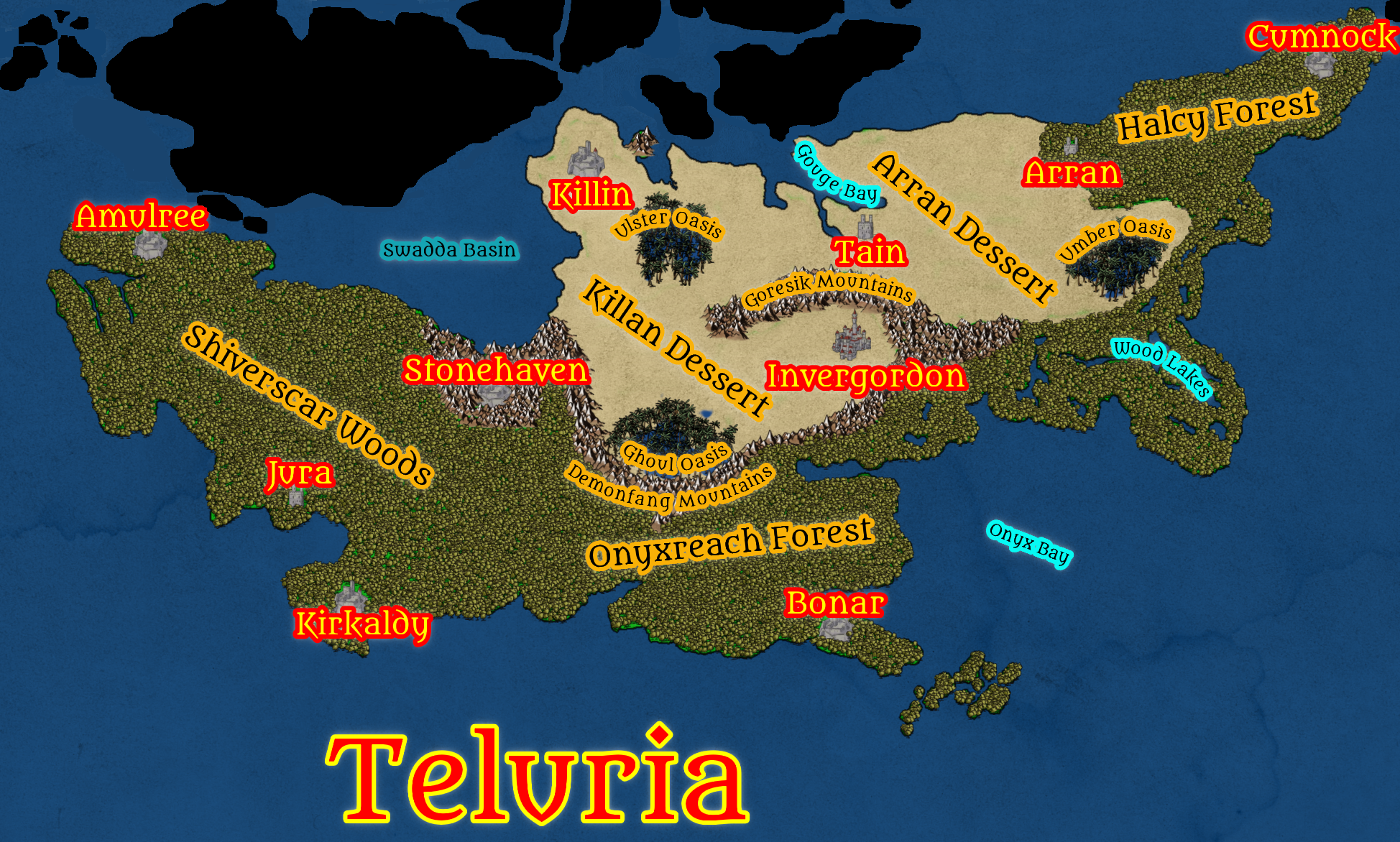
- Amulree: Amulree is the western gateway of Telvria, a mist-wrapped fortress city overlooking the cold Swadda Basin. Its tall granite towers and weathered sea walls protect a people hardened by generations of northern storms. Known as the "Grey Harbor," Amulree exports fine salt, whale oil, and northern timber.
- Jura: Nestled within the deep reaches of the Shiverscar Woods, Jura thrives under a canopy of ancient trees said to whisper to those who listen. Its druids and shifters are masters of survival and woodcraft, protecting Telvria's western forests from shadow-born beasts.
- Kirkaldy: A southern coastal city famed for its shipwrights and coral divers, Kirkaldy glows with the light of lanterns made from living shells. Its harbors are deep and treacherous, earning it the title “The Drowned Gate.” Many of Telvria's great fleets were born here.
- Stonehaven: Built upon the spine of the Demonfang Mountains, Stonehaven is the industrial heart of Telvria. Its foundries burn day and night, forging weapons, armor, and constructs of enchanted iron. The city's lower forges are said to reach into the world's fiery veins.
- Killin: Rising like an oasis fortress amid the Killan Desert, Killin guards the Ulster Oasis, one of the only freshwater sources for leagues. Once a haven for exiled nobles, it has grown into a bustling trade hub, its sandstone palaces gleaming under the desert sun.
- Tain: Tain lies at the base of the Goresik Mountains, commanding the desert passes with cunning and steel. Known as the "City of the Veiled Blades," it is ruled by a conclave of assassins and spies who ensure Telvria's enemies never strike unseen.
- Invergordon: Jewel of the eastern sands, Invergordon is both capital and cultural heart of Telvria. Built from pale marble and adorned with obsidian domes, it rises from the edge of the Killan Desert like a mirage. Merchants, mystics, and nobles converge here to trade, worship, and plot.
- Arran: Situated near the Umber Oasis, Arran is a lush settlement of scholars and seers. The city's gardens bloom with desert flowers and arcane plants that thrive under moonlight. Arran's sages are said to read the future in the shifting sands of the Arran Desert.
- Cumnock: Hidden at the northern fringe of Halcy Forest, Cumnock is a fortress of pale wood and silver stone. Its people are famed for their craftsmanship in bow-making and their bond with the forest spirits. Travelers call it the "Silent City," for here even the wind whispers in reverence.
- Bonar: Bonar rests on the southern coast near Onyx Bay, where the forest meets the sea. Known for its pearl fisheries and blackwood artisans, it is a city of duality, tranquil by day, and alive with secret trade and shadowed dealings by night.
Home