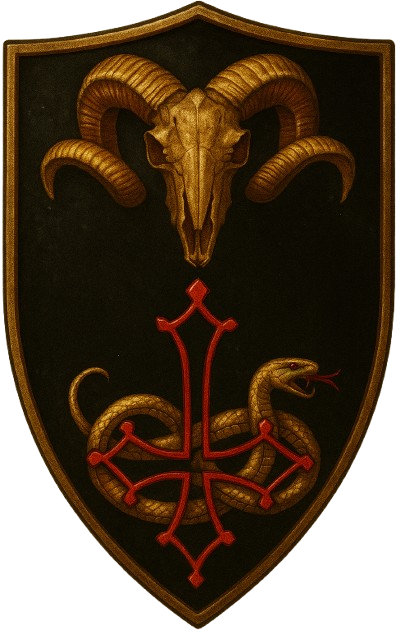
Zerigothian Continent
Off the southern coast of Kiadroth and the Laridian Continent lies a chain of islands shrouded in perpetual mist, known to the world as the Zerigothian Dynasty or the more common Demon Isles. Only the bravest or most foolish adventurers have dared to approach the fog-enshrouded shores. Very few who have ventured there have lived to tell the tale. Those few who survived often speak of demonic hordes, creatures that terrorize any intruders with eerie whispers, blood-curdling illusions, and grotesque visions. The islands are believed to be the lair of demons, whose terrifying presence ensures that no one who enters the Demon Isles is ever truly safe.
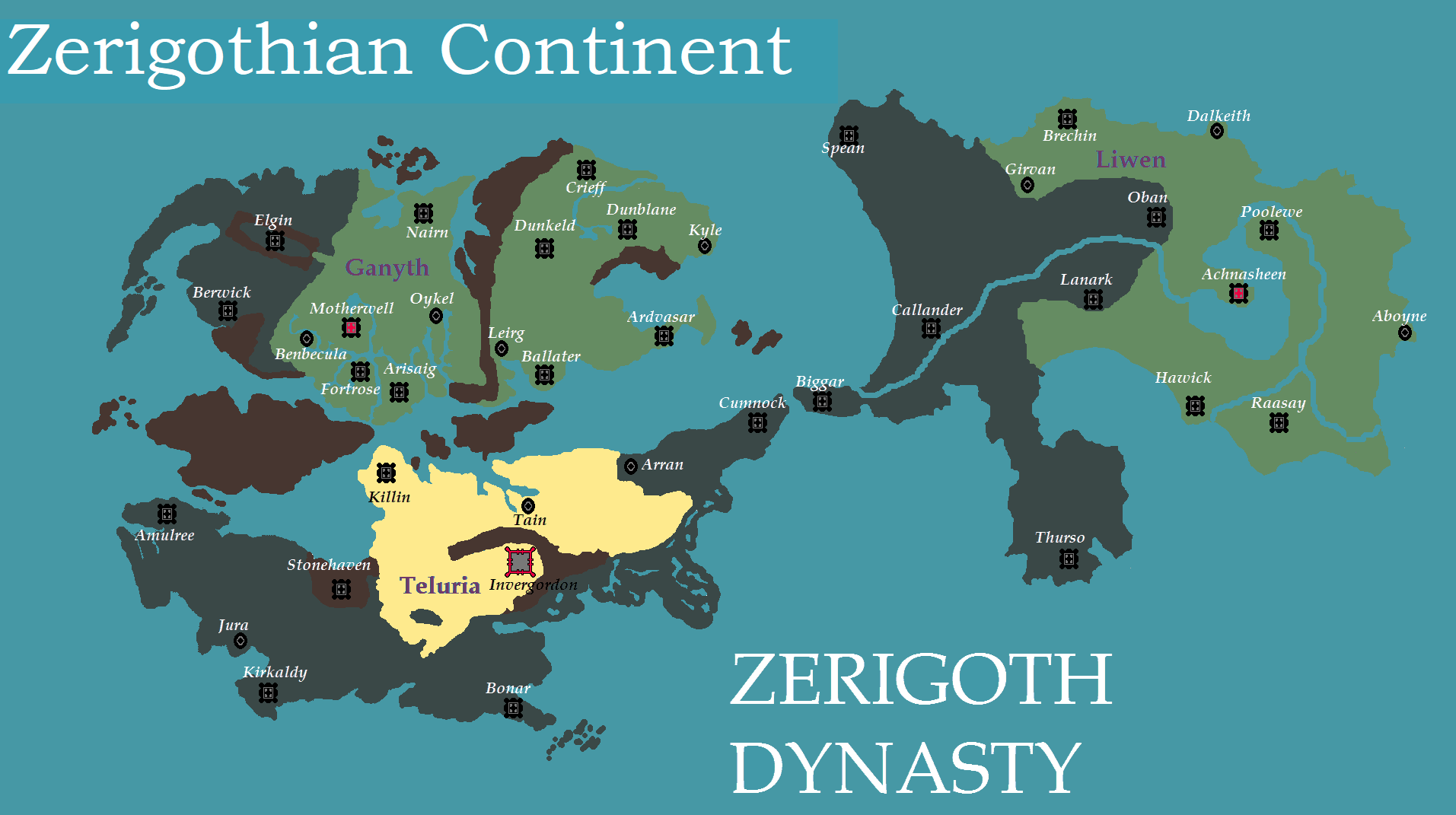
The Zerigothian Continent is a land of striking contrasts, marked by extremes in both terrain and climate. Its regions range from volcanic mountains and dense forests to arid deserts and lush plains. The land's varied geography has fostered diverse cultures, struggles, and histories, each region shaped by the natural forces surrounding it.
Volcanic Mountain Ranges (Southern and Central Regions)
The volcanic mountains are a dominant feature in the southern and central parts of the continent, particularly in Teluria. These towering peaks and active volcanoes create a rugged and hostile environment, one that offers natural barriers and challenges for both settlers and invaders. The region of Teluria and the surrounding areas, such as Invergordon and Tain, are harsh, with rocky terrain and minimal fertile land. The presence of volcanoes likely shapes the economy and culture of the people here, forcing them to adapt to a challenging environment, possibly leading to isolation or a reliance on mining and other mineral resources.
Dense Forests (Northern and Coastal Regions)
To the north, Ganyth and Liwen are vast, densely forested regions. These forests are not only rich in resources like timber and wildlife but are also integral to the culture and economy of these areas. The forests serve as both a boon and a challenge; they offer fertile grounds for settlement, but their isolation and the untamed wilderness can harbor dangers, from wild beasts to dark secrets. In Ganyth, these woodlands may serve as the heart of the region's industry and agriculture, with cities like Benbecula likely benefiting from trade in forest goods. Meanwhile, the region of Liwen may be known for its rugged terrain, home to resilient communities who have adapted to the isolation and mysteries of the wilds.
Desert and Arid Regions (Southern Teluria and Beyond)
The southern part of the continent, especially Teluria, is dominated by vast deserts and arid landscapes. This unforgiving environment is scarce in resources like water and fertile land, which makes survival difficult for any settlements here. In Teluria, this desert region may influence the culture, creating a people accustomed to hardship, with strong ties to trade routes or rare resources. The desert's influence is not only physical but spiritual, as the harsh conditions are likely reflected in the mindset and resilience of those who live here. Regions like Arran also contain arid stretches, where survival depends on trade, oasis settlements, and a constant search for water and resources.
Plains and Fertile Lands (Central and Northern Regions)
In contrast to the rocky and arid landscapes, the plains of Ganyth, Ballater, and Leirig provide fertile ground for agriculture. These areas are crucial for the continent's food production and have likely seen the rise of large settlements and cities, with fertile soil allowing for stable economies based on farming and trade. In these plains, societies may thrive with large populations and bustling cities, relying on the crops and goods produced here to fuel both domestic needs and trade across the continent. The plains are home to some of the continent's largest cities, which may serve as cultural and political hubs.
Coastal Regions and Waterways (Northern and Eastern Coastlines)
The coastlines of the Zerigothian Continent are rich in waterways, rivers, lakes, and seas that provide key access to trade and maritime activities. Coastal cities like Achnasheen, Biggar, and Raasay are likely strategic ports, essential for commerce and naval dominance. These water routes have likely shaped the development of powerful naval forces, bustling trade hubs, and strong economic links with neighboring lands. The presence of rivers and lakes also means that some of the continent's most important cities are located along these waterways, with settlements growing around the easy access to transportation, trade, and food sources that the seas provide.
The Zerigothian Continent is a place where geography dictates much of its cultural, economic, and political life. From the volcanic mountains that shape the southern reaches to the dense forests and fertile plains in the north, each region is marked by extremes that test the resilience of its inhabitants. Whether enduring the harsh conditions of the desert or thriving in the rich forests and plains, the people of Zerigoth are shaped by the land they inhabit, with each region offering a unique set of challenges and opportunities.
Early Maps and Descriptions
The Demon Isles first appeared on the maps during the Age of Discovery, though explorers could not agree on their location. Early sailors told of ghostly sights and horrible sounds that would torment ships as they sailed too close to the misty islands. The maps were marked with ominous warnings: "Demonic horrors roam these lands. Enter at your peril."
A monk-cartographer's sketch, is one of the most famous early depictions. His map described three large islands and several smaller islets scattered across an unfathomable fog. The map's inscription warned, "Demons assault ships near these islands, and no man returns from those waters." Though no evidence of demons was ever found, the stories persisted, tales of demonic hordes that haunted the islands.
The Changelings of Zerigoth
While many of these early accounts describe demonic hordes, the reality is far more insidious. The true inhabitants of the Demon Isles are not fiends or devils, but changelings, shape-shifting beings capable of imitating any humanoid form. The changelings have used the term "demons" to keep the outside world at bay, playing into the fears of outsiders by cultivating terrifying myths about their islands.
The changelings' ability to create illusionary horrors makes it impossible to distinguish the real from the fake. To an unwitting traveler, the sight of demonic beings or grotesque creatures seems all too real. The changelings are masters at manipulating fear, and only those who have endured the madness of the islands know the truth, that these "demons" are merely changelings in terrifying forms, preying on the minds of any intruders.
The Legend of the Demon Isles' Survivors
There are only a handful of recorded accounts from survivors who have returned from the Demon Isles, and their stories are fragmented, maddened by the horrors they encountered. These accounts tell of monstrous, demonic hordes that pursued them through thick, choking fog, their eyes glowing like fires. Spirits and phantoms torment the lost, whispering maddening secrets and paralyzing them with terror.
The most famous of these survivors is Tariqah de Zinnara, a noblewoman from the coastal city of Khadar, who was marooned on the Demon Isles. She recounted how, over the course of her imprisonment, she was haunted by the demons, phantom shapes in the fog that whispered to her, lured her into traps, and drove her to the brink of insanity. Tariqah survived for eight months, but her account only added fuel to the myth of the Demon Isles, depicting the islands as the cursed lair of evil entities.
Survival and Horror
Those few who return from the Demon Isles are often irrevocably scarred by the horrors they've witnessed. Mental breakdowns, sleepless nights, and an overwhelming sense of being watched are common symptoms reported by survivors. Some claim that the islands themselves are alive, and that the fog is a living presence, an intelligent, malevolent force that feeds on fear.
The changeling demons take full advantage of their environment. The fog itself is an illusion, an ethereal barrier that obscures the true nature of the islands, hiding hidden villages, demonically altered forests, and barren, cursed ruins. Any who wander too far are forced into dangerous confrontations with shapeshifting horrors, twisting and turning through the fog with unnatural speed.
Supernatural Phenomena and Explanations
Most of the supernatural phenomena reported by survivors are not the work of demons but are, instead, the illusions crafted by the changeling inhabitants. They have perfected the art of illusion magic, manipulating sound, sight, and even the very air to warp the senses of anyone foolish enough to set foot on the Demon Isles. The demonic hordes that so many speak of are changelings adopting monstrous forms, some are even said to be monstrous imitations of creatures from the nightmares of their victims.
- Disembodied Voices: The changeling demons whisper secrets of the land, weaving lies and confusion to disorient travelers.
- Ghostly Apparitions: Some survivors speak of ghostly figures moving through the fog, appearing as lost souls of those who perished on the islands.
- Terrifying Creatures: The changelings have been known to adopt the forms of beasts, monsters, or demonic entities to terrorize intruders and trap them in their illusions.
The Legacy of the Demon Isles
The Demon Isles remain shrouded in mystery, and the truth of what happens there is almost impossible to discern. While demonic hordes make for a great myth, the true terror lies in the chilling and disturbing nature of changeling illusions. Survivors who have lived to speak of the islands describe waking up in the dead of night to find themselves surrounded by glowing eyes, only to realize the next moment that these creatures were nothing but changeling-created mirages. As the fog rolls in, so does the feeling of being trapped, watched, and haunted by creatures that seem to know your deepest fears.
The islands are not merely a place of physical danger, they are a psychological hell, where the real demons are the ones lurking inside the mind.
Government and Society
The Zerigothian Dynasty is governed through a complex hierarchy of changeling leadership that reflects their philosophy of fluidity and adaptation. At its heart lies the central monarchy in Zerigoth, presided over by King Prestida IX, Sovereign of the Shifting Veil. Beneath him, authority flows through layers of regional shapeshifters and tribal councils, each of whom governs their territories according to the ever-changing needs of their people. These local leaders, known as Faceless Regents, are chosen not by birthright but by their mastery of transformation, wisdom, and their ability to interpret the will of the gods and the shifting tides of fate.
Each region within the Dynasty operates semi-independently, guided by its own council of elders and shapeguards, spiritual advisors and legal mediators who ensure that the local laws remain in harmony with the Circle of Renewal. This system allows the Zerigothians to maintain order even in constant motion, ensuring that no single form of governance becomes stagnant or tyrannical. Councils are expected to dissolve and reform at set intervals, a process known as the Cycle of Masks, symbolizing the necessity of change in leadership for the health of the realm.
Zerigothian society places great emphasis on self-sufficiency and resilience. Every citizen is expected to contribute to the prosperity of their community, whether through labor, artistry, warfare, or spiritual guidance. The changelings believe that strength lies in the collective ability to adapt, villages shift in form and structure, trade routes change with the seasons, and even social roles are fluid. A farmer one year may become a soldier the next, or a diplomat may take up the mantle of a craftsman, depending on the needs of the Dynasty. This constant evolution is not seen as chaos but as the very essence of balance.
Though the monarchy wields ultimate power, the King's rule is not absolute in practice. The Circle of Renewal and the Shifting Guard serve as checks on his authority, ensuring that the divine laws of transformation guide the nation's destiny. Society is structured in such a way that every changeling, from the humblest miner to the highest regent, understands their place within the great cycle of rebirth. To resist change is considered a moral failing, for it halts the progress of the Dynasty and disrupts the harmony of its ever-shifting order.
King Prestida IX: The Sovereign of the Shifting Veil
King Prestida IX, known as the Sovereign of the Shifting Veil, rules the Zerigoth Dynasty, an empire where all the people are changelings, gifted with the ability to assume any humanoid form. His reign is one of absolute power, mystery, and transformation, a reflection of the changeling nature of his people. Under his guidance, the Zerigoth Dynasty remains in a state of eternal renewal, ever-changing, yet unbroken, like its ageless ruler.
Prestida IX is not just a monarch; he is the living embodiment of the dynasty's cycle of transformation. His true form, a pale, thin, purplish-grey humanoid with large, sad eyes, is known only to a very few. To the rest of the changeling populace, he is an eternal, ageless king whose wisdom and immortality are unquestioned. Though he is capable of assuming any appearance, like his people, his true identity is hidden from all but his closest allies.
The Court of the Shifting Veil
The court of Prestida IX is as fluid and ever-changing as the kingdom itself. Each member of the court is a changeling, capable of taking on the guise of anyone, from noble lords to humble peasants, creatures of myth, or even unknown beings from distant lands. This ability makes the court both a place of supreme intrigue and deception, where loyalty is constantly tested, and trust is a rare commodity.
At the heart of this court is the Circle of Renewal, a shadowy faction of changelings tasked with maintaining the purity of the dynasty and ensuring that the king's will is enacted in total secrecy. These changelings act as spies, diplomats, and enforcers, ensuring that no secret goes untold and no rebellion takes root. The Shifting Veil ensures that Prestida IX's rule is never questioned, and his agents are ever-vigilant, able to strike swiftly at any sign of disloyalty.
The Philosophy of Eternal Renewal
Prestida IX's rule is based on the belief that the Zerigoth Dynasty, like all things, must constantly renew itself. This concept of renewal is central to the changeling nature, where individuals shed old forms and embrace new ones. For Prestida IX, this cycle of change is not just a physical one, but also an ideological and political one, his kingdom must evolve, or else it will decay.
The believes that decay and complacency are the greatest threats to his dynasty. Prestida IX's reign, then, becomes one of perpetual transformation, where old ideas, old leaders, and old systems are replaced or purged to make way for something new. This constant rejuvenation of his rule mirrors the changeling condition, where identity is fluid, and individuality is a malleable concept.
The Heart of Renewal: The Veil of Rebirth
At the heart of Prestida IX's immortality and the Zerigoth Dynasty's power lies a single source of renewal: The Veil of Rebirth. This sacred and hidden well, located deep within the Heartlands of Zerigoth, is a magical nexus that grants those who partake in its waters the ability to renew their life force. The Veil of Rebirth is the secret of Prestida IX's undying reign, his lifeblood, the reason he has ruled the Zerigoth Dynasty for centuries.
Legend speaks of the well's power to restore life to those who have reached the brink of death, but it does so at a cost. The Veil of Rebirth does not merely restore physical vitality; it binds the soul to the land, renewing not just the body but the essence of the individual. It is said that Prestida IX, having drunk from its waters many times, is no longer fully mortal but a soul bound to the well, a being who cannot die as long as the Veil of Rebirth flows.
However, the well is deeply secret and protected by a network of changelings who guard its sanctity. Only those who serve the dynasty and have proven their loyalty may approach the well, and even then, it is said that only the king may fully partake in its restorative magic. Others who attempt to draw from the well's power often find themselves changed, their forms twisted, their minds lost, or their very essence corrupted.
The Shadow of Fear and Control
Prestida IX's rule is maintained through fear, secrecy, and the constant shifting of identities. Even though the entire population of Zerigoth is made up of changelings, there is always the fear of exposure, of being discovered as a traitor or imposter. The king's agents, disguised as anyone and everyone, ensure that no plot goes unnoticed and no rebellion can take root.
The Circle of Renewal operates in the shadows, performing their duties with ruthless efficiency. Dissenters are either purged, replaced, or disappeared. Those who question the king's authority are seen as threats to the eternal cycle, and they are dealt with swiftly, often without the chance to mount any form of defense.
In this society, where nothing is as it seems, loyalty is not just encouraged, but demanded. Prestida IX rules through the shifting veil of illusion, keeping the people of Zerigoth in line with the knowledge that the king's eyes can be anywhere, anyone could be a watcher, reporting secrets and testing loyalties.
Legacy and the Eternal Rule of King Prestida IX
Prestida IX is a living legend, a figure whose name is whispered with both awe and fear throughout the Zerigoth Dynasty. His immortality, achieved through the Veil of Rebirth, allows him to rule over his changeling people with unyielding power, always renewing himself through the sacred well. His reign, now lasting centuries, is seen as the natural order, an eternal cycle of change and transformation, where nothing and no one is ever fixed or stagnant.
The Zerigoth Dynasty is a kingdom of constant renewal, its people, its land, and its monarch in a perpetual state of flux, but unchanging in its core purpose: to survive and evolve forever. Under the watchful gaze of Prestida IX, this eternal rule will continue, and the Veil of Rebirth will remain the heartbeat of a kingdom whose true nature can never be understood by those who are not changelings themselves.
Military
The Zerigothian military reflects the same principles that govern its society, adaptability, secrecy, and transformation. There is no singular standing army in the traditional sense; instead, the Dynasty maintains a fluid and decentralized network of shape-shifting warriors organized into regional militias. Each region trains its soldiers to fight according to their environment, with tactics tailored to the land's unique terrain and dangers.
In the vast and mist-shrouded forests of Zerigoth, warfare is an art of deception and illusion. The changelings are masters of guerrilla tactics, striking swiftly from concealment and vanishing into the shifting mists before their enemies can retaliate. Forest defenders, known as the Veil Wardens, use their innate shapechanging abilities to blend into the environment, taking the forms of animals, trees, or even shadows themselves. These tactics make direct assaults on Zerigothian territory nearly impossible, as outsiders find themselves fighting ghosts and reflections rather than flesh and blood foes.
The protection of the Dynasty's mineral-rich lands and mountain settlements is of paramount importance. Elite units known as the Stonebound guard these regions, stationed in hidden fortresses carved into cliffsides and volcanic ridges. Their armor is crafted from Zerigothian steel, a metal said to adapt to its wearer's form, and they wield weapons that can shift between blade, spear, and bow as needed. The Stonebound are both soldiers and sentinels, sworn to ensure that no outsider uncovers the Dynasty's true nature or the source of its power.
Above all stands the Shifting Guard, the clandestine enforcement arm of both the military and the law. They operate unseen, policing both the people and the borders to preserve the Dynasty's secrecy. The Guard's agents are said to be everywhere and nowhere at once, capable of assuming the faces of allies, invaders, or even spirits. Their loyalty is absolute, bound to the will of King Prestida IX and the Circle of Renewal. In war, they serve as assassins, infiltrators, and spies, turning the enemy's strength against them. In peace, they act as silent watchmen, ensuring that Zerigoth remains hidden, eternal, and ever-changing.
Unity Through Change
The three states. Ganyth, Teluria, and Liwen, embody the trinity of the changeling spirit:
- Ganyth represents Form and Strength
- Teluria represents Mind and Mask
- Liwen represents Spirit and Reflection
All answer to King Prestida IX, whose reign is seen as the axis upon which all transformation turns. Through their unity, the Zerigothian Dynasty maintains its greatest secret: a nation of changelings hidden in plain sight, ever-shifting, ever-renewing, and eternally unseen.
Religion
The religion of the Zerigothian Dynasty is intricately woven into the fabric of their society, reflecting their worldview as beings of transformation and eternal renewal. This belief permeates all aspects of their lives, from their rituals to their political structure, and defines their spiritual relationship with the universe.
Core Beliefs
At the foundation of Zerigothian religion is the conviction that change is not only inevitable but sacred. The changelings, with their ability to shift and transform, view this constant metamorphosis as a divine gift and essential to their spiritual journey. They believe that the cosmos itself operates in cycles of destruction and rebirth, akin to the natural cycles of seasons, storms, and volcanic eruptions that reshape their lands. These cycles are seen as sacred moments of renewal, and changelings align their lives with these forces, striving for continuous growth and self-improvement.
To them, transformation is not just physical; it is spiritual and intellectual. Through change, they grow closer to the divine, shedding their old selves to embrace new identities and insights. Every change, whether personal or cosmic, is a step toward enlightenment and balance in the world.
Deities and Spirits
The changelings revere the Alintari, a pantheon of deities and spirits that embody various aspects of transformation, nature, and the forces of creation and destruction. These deities are seen not as static figures but as constantly evolving entities, reflecting the ever-changing nature of existence itself. The most revered among them are:
- Lairdesian, the Shifter: God of Change and Changelings. Lairdesian represents the core belief of transformation, embodying both the physical act of shifting and the spiritual essence of perpetual renewal. It is said that Lairdesian was the first changeling, born of the shifting winds and the ever-turning tides of time. His followers believe that through him, they can access the power of metamorphosis and harness its force to evolve spiritually and physically.
- Colie, the Prankster: God of Chaos and Pranks. Colie embodies the disruptive forces of life, the chaos that forces change. He is the god of laughter, mischief, and the unexpected, teaching that transformation is not always smooth or predictable. Colie's followers believe that through embracing chaos, they can challenge their own limitations and discover new ways of thinking and being. His worship involves playful, unpredictable rituals meant to jolt the mind and spirit from stagnation.
- Khronid, the Timekeeper: God of Time. Khronid governs the flow of time, the ultimate force of change. He is believed to regulate the endless cycles of the universe, guiding the transitions between past, present, and future. His followers seek to understand time's deep mysteries, and many believe that by synchronizing their lives with Khronid's rhythms, they can attain greater harmony with the world and each other.
Rituals and Practices
Rituals in the Zerigothian faith are centered around personal transformation and aligning oneself with the cosmic cycles. Key rituals include:
- The Rite of Shifting: A coming-of-age ceremony where young changelings undergo a guided transformation, physically altering their form to symbolize their entry into adulthood and their ongoing spiritual evolution. This is often a highly individual experience, with each changeling shifting into a form that symbolizes their growth and future path.
- The Dance of Renewal: An annual festival where changelings gather to celebrate the cycles of destruction and rebirth. The ritual involves elaborate dances that mimic the natural forces of wind, water, and fire, representing the ongoing cycle of creation. It is a time of introspection and community bonding, with changelings meditating on their own transformations and offering prayers for future growth.
- The Chaos Feast: A festival dedicated to Colie, where followers partake in wild, spontaneous festivities. The feast is known for its unpredictable nature, games, jokes, and pranks fill the event as changelings embrace the unpredictable forces of life. It is believed that the more chaos embraced during this festival, the greater the transformation the individual will undergo in the coming year.
- The Moment of Reflection: A quiet, introspective ritual held at dawn, when followers sit in silence, contemplating the passage of time and their own place within it. This is dedicated to Khronid, seeking to understand the deeper currents of time and their relationship with the divine.
Spiritual Hierarchy
The changelings' spiritual leaders are known as Shapeguards, powerful individuals who are deeply attuned to the shifting forces of the world. They are responsible for guiding the people through the spiritual processes of transformation, leading rites, and interpreting the will of the gods. The Shapeguards hold significant power within the Dynasty, and their positions are often inherited through a mixture of bloodline and spiritual mastery.
The Shapeguards are also responsible for mediating between the physical and spiritual realms, communicating with the Alintari and interpreting signs of cosmic shifts. Their wisdom is highly valued, and they often serve as advisors to the rulers of the Dynasty. A Shapeguard's ability to shift their form and adapt to different circumstances is seen as a mark of their divine favor and spiritual insight.
Overall, the religion of the Zerigothian Dynasty is one of continuous growth, transformation, and spiritual alignment with the forces of change that govern the cosmos. The changelings' ability to adapt, evolve, and embrace both the light and shadow of transformation is what defines them as a people and as devotees of their ever-shifting deities.
The Law
The legal system of the Zerigothian Dynasty is founded on the belief in eternal renewal and the necessity of maintaining order and harmony within a constantly shifting society. Secondarily, to keep the truth of the Dynasty a secret from Outrsiders. Changlings are opften persecuted and hunted iby most races and if the truth were to become know the dynasty would face destructuion and war.
The law is seen not as a fixed set of rules, but as a living, evolving code that adapts to the needs of the people and the state. This philosophy of fluidity and change is central to the way justice is administered, and the law is often understood in terms of balance and adaptation rather than rigid punishment.
The Foundation of Zerigothian Law
The law is based on a set of principles known as the Circle of Renewal, which emphasizes that change must always be welcomed to ensure the health of the state and its people. The laws reflect the idea that no identity, form, or belief should remain static, and each person's role in society may shift over time. These laws also stress that the individual must serve the greater whole, ensuring that the continuity of the Dynasty is maintained.
Key tenets include:
- Respect for the Process of Change: The people of Zerigoth are expected to honor the ongoing transformation in themselves and others. This can mean personal growth, as well as the acceptance of the shifts that come in governance, leadership, and societal structures.
- Sacred Duty to Serve: Each changeling is expected to serve the Dynasty in some capacity, whether it be through resource production, governance, or military service. The concept of selflessness is deeply embedded in Zerigothian law, where individual desires must often be sacrificed for the greater good of the Dynasty.
- Balance of Destruction and Rebirth: The law recognizes that the destruction of the old must precede the rebirth of the new. This principle is reflected in the changing of societal structures, the cyclical nature of leadership, and the willingness to let go of outdated practices to make way for progress.
Justice and Transformation
In Zerigoth, the concept of justice is closely linked with transformation. When someone is found guilty of breaking the law, the consequences are often designed to transform the individual rather than punish them in the conventional sense. For example, instead of imprisonment, a changeling who has committed a crime may undergo a ritual of change, where they are symbolically “reborn” into a new role in society, shedding their past transgressions and emerging with a new purpose.
There are some crimes, such as betrayal or sabotage, that are considered so disruptive to the renewal process that they cannot be forgiven through transformation. In these cases, the individual may face exile or be subjected to the ultimate penalty of re-assignment, where their essence is bound to the land, forever shifting forms as punishment for their disruption of societal harmony.
The Circle of Renewal
The Circle of Renewal is a secretive group of changeling scholars, mystics, and law enforcers who ensure that the laws of the Dynasty are upheld. They are entrusted with interpreting the changing needs of the state and advising the monarchy on matters of legal importance. The Circle often acts as the final arbiter in matters of justice, particularly when the traditional forms of law do not apply to new and evolving circumstances.
Law and the Monarchy
The monarchy in Zerigoth holds ultimate authority in matters of law. King Prestida IX, the Sovereign of the Shifting Veil, holds the final say in all legal matters, though his decisions are often influenced by the guidance of the Circle. The monarchy is seen as both a political and spiritual body, with the king acting as the living embodiment of the Dynasty's ongoing renewal. As such, his actions are often framed as the divine will of the changeling gods, ensuring that his decisions, even in matters of law, are accepted as part of the natural and divine order of change.
Enforcement of the Law
Enforcement of the law is carried out by the Shifting Guard, an elite force of changelings who can assume any form and infiltrate any part of society. Their task is not merely to uphold the law but to ensure that the process of change remains unimpeded. The Shifting Guard is a clandestine force, often operating in the shadows, as their ability to blend into society allows them to root out corruption, rebellion, and any resistance to the renewal of Zerigoth.
The Law of the Zerigothian Dynasty
The legal framework of the Zerigothian Dynasty is not a static entity but a living, breathing system that mirrors the Dynasty's core belief in perpetual transformation. The laws are designed to adapt to the ever-changing needs of society, reinforcing the balance between the personal and the collective, and ensuring the continuity of the Dynasty itself. At its heart, the law seeks to protect the changelings' way of life, which, if exposed to outsiders, would risk destruction at the hands of a hostile world. To the Zerigothians, maintaining their secret identity is paramount, and the law is crafted with the understanding that the very survival of the Dynasty depends on its concealment from other races who might seek to wipe them out.
Core Philosophy of Zerigothian Law
The legal system in Zerigothian society is rooted in a worldview where change is seen as both inevitable and necessary for growth. The law is not rigid or fixed, but fluid, responding to the ebb and flow of societal needs and the changing face of the Dynasty. It is not only a tool of justice but a reflection of the Dynasty's ethos of transformation and renewal. Justice, then, is not about punishment or retribution, but about restoring balance, promoting growth, and ensuring the harmony of the state.
The law's primary purpose is twofold: to maintain internal order, guiding society through the cycles of destruction and rebirth, and to protect the Dynasty's true nature from being revealed to outsiders. The changelings' ability to shift identities is both a strength and a secret, one that must be carefully guarded against the ever-present threat of persecution from those who would see their race destroyed.
The Foundation of Zerigothian Law
At the heart of Zerigothian law lies the Circle of Renewal, a set of guiding principles that emphasize the necessity of perpetual change in all aspects of life. The law is grounded in the understanding that change, whether personal, political, or societal, is essential for the continued vitality of the Dynasty. This philosophy is ingrained in every aspect of the law, from the maintenance of social structures to the protection of the Dynasty's hidden identity. Each person's role in society is seen as temporary, ever-shifting, and adaptable to the needs of the greater whole.
Key Tenets of Zerigothian Law
The Circle of Renewal provides a guiding framework for the legal principles of the Dynasty. Some of its most fundamental tenets include:
- Respect for the Process of Change: This is perhaps the most important principle in Zerigothian law. All changelings are expected to honor the fluidity of their own identities and the ongoing transformation of society. Personal growth is not just an individual pursuit but a communal one, with each person's development contributing to the greater good of the Dynasty. The law mandates that changelings embrace their evolving roles in society, shifting in response to new challenges and opportunities.
- Sacred Duty to Serve: In Zerigoth, the individual exists not as a sovereign being but as part of the larger organism of the Dynasty. Every changeling is expected to serve the Dynasty in some capacity, whether it be through the production of resources, governance, military service, or spiritual leadership. This duty is sacred, and those who fail to serve the greater whole are seen as undermining the very structure that allows them to exist as changelings. Selfishness and personal ambition are frowned upon, as the greater good must always come before individual desire.
- Balance of Destruction and Rebirth: The law recognizes that all change requires destruction before rebirth. Old systems, traditions, and structures must be torn down to make way for the new. The principle of destruction is not seen as inherently evil but as a necessary force for progress. Whether through the shifting of leadership, the dissolution of outdated practices, or the overthrow of corrupt individuals, Zerigothian law embraces the cyclical nature of life, recognizing that what is destroyed today makes way for the possibilities of tomorrow.
Justice and Transformation
In Zerigothian society, justice is intricately tied to the concept of transformation. Punishment is not seen as a means of retribution, but as a tool for personal and societal renewal. When someone breaks the law, they are not merely punished; they are transformed. The idea is that the individual, having committed a transgression, must undergo a spiritual or physical transformation to cleanse themselves of their past actions and emerge anew.
For minor infractions, this transformation may take the form of a temporary change in role or identity, where the offender is given a new position in society that reflects their newly transformed self. Major crimes, however, such as betrayal or acts of sabotage that disrupt the flow of renewal, are met with more severe consequences. These offenses are considered so harmful to the very fabric of the Dynasty that the offender is beyond redemption through normal transformation.
In extreme cases, those found guilty of such crimes may be subject to Re-Assignment, a punishment where their essence is bound to the land itself, forever shifting in form as a punishment for their actions. Re-Assignment is seen as both a form of punishment and an eternal warning to others, showing the consequences of disrupting the delicate balance of the Dynasty.
The Circle of Renewal
The Circle of Renewal is a shadowy and highly secretive group tasked with upholding the laws of the Dynasty. Comprised of changeling scholars, mystics, and high-ranking legal officials, the Circle ensures that the principles of transformation and balance are respected and that the laws evolve as needed. The Circle acts as both interpreters of the law and advisers to the monarchy, especially when matters of legal importance arise that require the insight of the Dynasty's most learned and spiritually attuned members.
The Circle's role goes beyond interpreting the law, it is also charged with protecting the Dynasty's hidden nature. The Circle works in secret to ensure that the changelings' true identity remains concealed from the outside world, preventing any revelations that could lead to the Dynasty's destruction. Those within the Circle often have the ability to shift their forms in ways that go beyond ordinary changelings, allowing them to remain undetected by outside forces.
Law and the Monarchy
The monarchy in Zerigoth holds ultimate authority over the law. King Prestida IX, known as the Sovereign of the Shifting Veil, serves as both the political and spiritual leader of the Dynasty. As the living embodiment of the Dynasty's principle of continuous transformation, the king's role is to oversee the renewal of the state and to ensure that the law adapts to the ever-evolving needs of Zerigoth.
Though the king's word is law, his decisions are often influenced by the guidance of the Circle of Renewal, whose members provide counsel on matters that require deep spiritual insight. The king's decisions, particularly those regarding the law, are often seen as a reflection of the divine will, ensuring that the changing forces of the cosmos align with the goals of the Dynasty. In this way, Zerigoth's legal system is not merely a product of political authority, but a reflection of the divine forces of change that govern the universe.
Enforcement of the Law
The enforcement of Zerigothian law is entrusted to the Shifting Guard, an elite group of changelings trained to uphold the law while remaining invisible to the broader society. The Shifting Guard is highly secretive and operates in the shadows, using their ability to assume any form to infiltrate all levels of society. Their role is not just to enforce the law but to ensure that no resistance to the process of change is allowed to take root.
The Shifting Guard is tasked with identifying and rooting out corruption, rebellion, and any forces that threaten the renewal of the Dynasty. They operate with complete autonomy, and their ability to assume different identities makes them the perfect agents of surveillance and enforcement. The Guard is feared and respected, for they are the ones who ensure that Zerigoth's transformation remains uninterrupted, regardless of the cost.
Population
Total Population:2,450,000
- Changlings: 100%
The States of the Zerigoth Dynasty
|